30,000 People Studied. This Is How You Should Train.
In a Nutshell
Higher weekly training volume (10–30 sets per muscle) drives greater hypertrophy, and training near failure (0–3 reps in reserve) in the 5–30 rep range maximizes growth. Frequency itself isn’t magic for size, but splitting volume across 2–4 sessions per muscle allows higher total sets and better-quality work. For strength, train heavy (80–90 % 1RM) 2–4 times weekly with 2–5 hard sets per lift early in the session; for power, pair those heavy sessions with 30–70 % 1RM explosive work at low volume (2–5 sets of 2–4 reps) and maximal intent to move.
These notes were generated by AI and may contain inaccuracies.
Fifty participants already constitutes a large study. Thirty thousand allows us to make very strong claims about the best ways to train and how to avoid it. If your coach frequently violates these basics, you should be very skeptical and ask questions. This comprehensive review is enormous, so good luck trying to argue about it. A training study involving 50 participants is actually a very large study of muscle growth in the scientific field. Many of these studies include only 12 to 20 participants. Today's study is what is called a comprehensive review, which means that it did not take individual review studies, but rather took the systematic reviews themselves and combined them into one giant analysis. 137 systematic reviews in total, with a total of 30,000 individual participants from all the studies included in it. The PMID reference number for this study is 41843416. If you want to delve deeper, visit PubMed and read the full study.
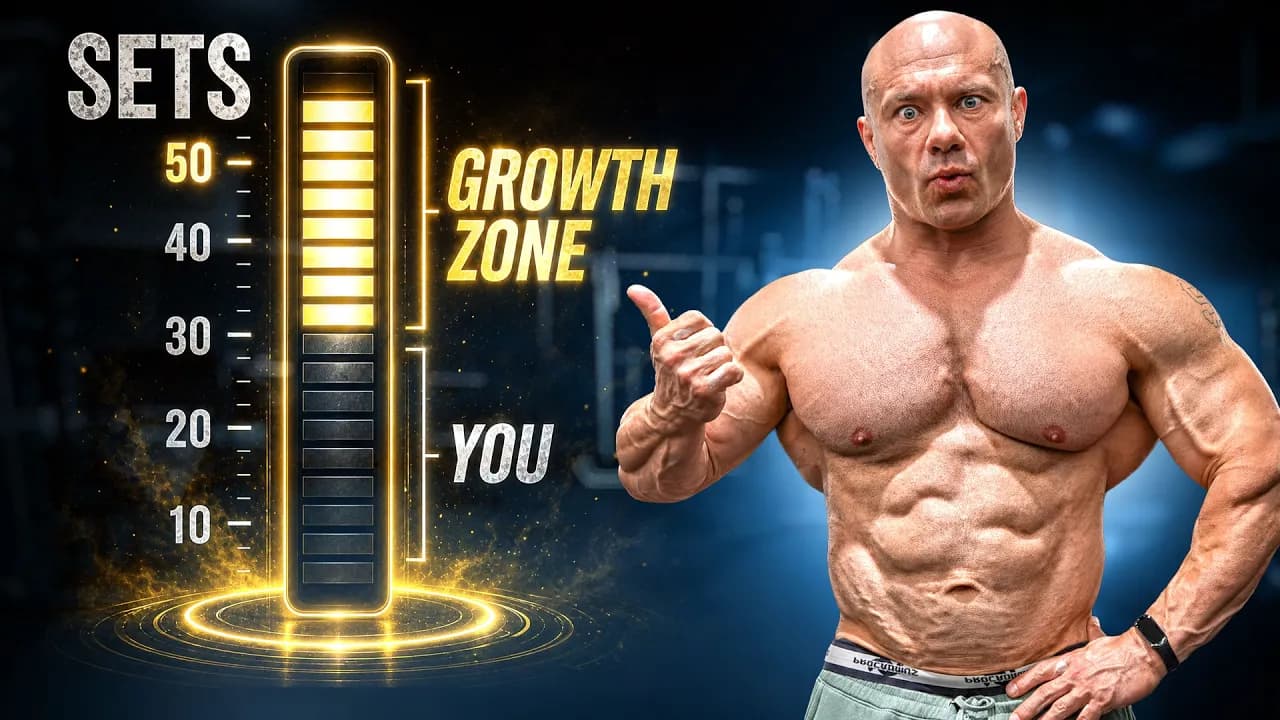
The first takeaway from this massive review is that higher weekly training volumes, i.e., the number of sets you perform per muscle, cause greater growth. Almost all studies agree that performing more than 10 sets per week for each muscle will make you bigger in almost every case compared to performing fewer than 10 sets. The bottom line here is that the more effort you put in, the more you grow, provided you are able to heal. If you look at all the studies they used, there is evidence that getting more than 30 sets per week per muscle gives you greater and more reliable growth. If the program you are considering claims that the best results in the world occur when you perform eight sets per muscle per week or less, then either the person who wrote the program has a real problem with recovery or you should be very skeptical that this is even remotely close to the truth. If you want to get bigger, increasing your training volume is a reliable way to achieve that, as long as you take care of recovery through plenty of good food, stress management, and excellent sleep.
If you go from 5 to 10 sets, your muscles will grow much bigger. If you go from 10 to 20 sets, you will grow more, but not as much as if you went from 5 to 10. If you go from 20 sets per week to 30 sets, you will definitely grow more in most cases, but only slightly. If you exceed 30, 35, or 40 repetitions, you will get very diminishing returns. The returns are still positive, but they are decreasing. If you feel energetic throughout your entire system, increasing your workout volume will help you build bigger muscles. Don't forget to use "priority" as a tool in your exercise. If you want to maximize your chest muscles, perhaps reducing your triceps and back workouts a little is the way to give your body more room to recover, allowing you to get your chest workouts to 20, 25, or 30 sets, which will stimulate their growth to the maximum possible size.
The second benefit is that training near muscle failure yields better gains than training far from it. If you're exercising and stopping five or more reps before muscle failure, such as six or seven reps, you'll get much better gains if you push yourself harder. On the other hand, this review found that reaching muscle failure did not yield better gains than stopping before muscle failure by one or two repetitions in normal situations in your program, and in the average weeks of your training program. Start by letting about three reps go before failure in most programs, and aim to add 2.5 to 5 pounds or more reps per week to most sets until you reach muscle failure and then reduce the load.
The third benefit surprises many people. Almost equal growth is observed from the five difficult and near-failure repetition groups, the 15 repetition groups, and even the 30 repetition groups. As long as you get close to muscle failure in each set, you can get very good gains, and even some of your best gains, in roughly any range of 5 to 30 repetitions per set. On the other hand, if you do less than five repetitions per set, such as trying to hypertrophy by doing double sets, or more than 30 repetitions, such as trying to bulk up by putting your maximum weight on for 50 repetitions and doing 48 of them, it is unlikely to maximize growth, although it may cause some. The difference in overall growth as something you expect to look forward to in your program between performing sets of eight repetitions and sets of 16 repetitions will be small and depend on the conditions, if there is any difference at all. If you're doing sets of eight repetitions and you feel some discomfort in your triceps or elbows, or you're feeling tense or haven't slept well, is it literally okay to double your repetitions by drastically reducing the weight and doing sets of 16, 20, or even 29 repetitions? Yes, certainly. As much as you like. Every time you hear people say, "Man, groups of 15 or 20 repetitions are too much." This may be true in certain circumstances for some exercises and movements, but as a general rule, any number between five and 30 repetitions causes roughly the same amount of growth, at least over the course of months of training.
Repeating training does not lead to further gains unless you also increase the training volume or significantly improve the quality of your training. If you do, for example, 10 sets over two workouts versus the same 10 sets over three workouts during the week, such as Monday and Thursday versus Monday, Wednesday and Friday, you will get similar gains in most cases because you did roughly the same number of sets. If you train with a very high frequency, but your training volume in a single session is low, don't expect magical gains. You will find someone who does, say, seven sets of chest exercises on Monday, and seven sets of chest exercises on Thursday. And someone else will come along and say, "Scott, do you remember that popular trend from back in the day? By trend, I mean a training priority that people followed, but they were imitating it because they repeated it so often. Do you do a full-body workout every day? Full body every day? Full body every day, right? This is science. Full body every day." If you do two chest sets every day versus seven chest sets two days a week, you'll get roughly the same gains. There are no magic gains from high frequency training, but there is one very important detail. With increased frequency, you are often able to lift heavier weights on average because you do not feel the fatigue caused by the first few sets. You will likely be able to perform a greater number of repetitions in each set. Because you can't cram so many sets into one workout that you become so tired you're not lifting a weight of any value, you can almost always do more weekly sets at a higher frequency. But in itself, hesitation is not magical.
Exceeding 15 sets per muscle in a single session makes the last set unstimulating because you are exhausted and too tired, so increasing the frequency is the best option. Because 20 sets are superior to 10 sets per week in terms of training volume, two sessions are superior to one session per week in most cases. If you say that the volume of training is the only thing that matters and the frequency doesn't matter, you are mostly right. But if you do more than one session per week, and often more than two sessions for smaller muscle groups, you can double the size and quality of the session to such an extent that the higher frequency ends up building more muscle than the lower frequency. But hesitation itself is not the reason. If you simply divide the size and intensity and keep all the data the same but repeat it more often, you probably won't get better gains. The secret lies in the extra size and improved quality. This is really good news, because anything between two and four times a week for each muscle can be very effective, and the rest depends on your preferences, schedule, and your body's own response.
The duration of repetitions, the order of exercises, and the details of advanced periodicity are barely noticeable in scientific research. Most of these studies were conducted on relatively beginners. Most of this research only covers a period ranging from a few weeks to a few months of training. Therefore, we must take these results very cautiously. However, there is much wisdom to be gleaned from here. First and foremost, repetitions that take between 2 and 9 seconds, such as performing slow versus fast movements in the stretching phase, have almost the same raw effect on overall muscle hypertrophy. One very important point: if you expect that a new detail in the routine, such as training for three days and a day of rest, or five days and a day of rest, or any other magical division, will make you extremely bulky while the previous division did nothing, you will be very disappointed. The basics still cover almost everything the training needs. If you're overthinking things, like whether to do flyes or presses to develop your chest, you're probably overthinking. Most exercises performed with proper technique are truly great, and the details of choosing or ordering the exercises probably don't matter much. What matters most in these minute details are the responses and preferences of individuals. The subtle differences in the training split that affect variables such as volume, load, and effort will make a difference because they affect volume, load, and effort, not because there is a magic sequence that works extremely well. Don't think that this is a free pass to do anything. Never go against the basics, and then many training split systems will work very well. But there are many partitioning systems that go against the basics, and these will certainly make a negative difference and will not achieve much growth through them.
Training twice a week for strength is better than training once a week. Why? Because your nervous system gets more practice, actual practice in performing the lifting and becomes better at doing it. It's like wanting to become good at singing, but only singing once a week. Singing twice a week will make you much better at singing. It's a greater opportunity for your nervous system to exercise, and your nervous system loves large volume and high frequency. He thrives thanks to this kind of thing. If you can only recover from a very heavy workout once a week, don't despair. You can perform the same lifts on another day later in the week, but with a lighter weight, without reaching muscle failure, and with a much smaller volume, such as three sets of five repetitions at 50% of your maximum weight, and you will get great nervous system gains that will actually make you stronger the next time you perform that lift. Thus, if you have a heavy session in one part of the week and a light session in another part, this actually makes you stronger compared to just having one heavy session if that's all you can recover from. This frequency still applies even if you only train with a heavy weight once a week. Achieving three or four weekly sessions of the same lift, some difficult and heavy and some light and easy, enhances gains more if you want the best results in a particular lift. So, for example, if you are really serious about increasing your bench press weight over the medium term, i.e., several months, and it really matters to you to reach the highest possible weight, don't just train it once a week. I recommend doing something like two heavy sessions on Monday and Wednesday, then on Friday a light recovery session using great technique just as if you were training with heavy weights. This amount of repetition will put you in your strongest form.
Exercises performed earlier in the session achieve the best strength gains compared to later exercises in the same session. The explanation here is that you become stronger by lifting heavy weights, and you can lift your heaviest weights early in the session because you are not as tired then, which is a major limiting factor to how strong you can get. Therefore, doing the opposite would be ridiculous. Don't put deadlifts at the end of your day after five other back or leg exercises if you want to maximize your performance in them. Reserve subsequent exercises for hypertrophy exercises, lighter technique exercises, or complementary exercises to work on another part of your body or a muscle that is otherwise hindering your progress. In strength training, they are called auxiliary exercises. Dave Tate said: You really only have two basic exercises you can do in each session where you can train really hard and with really heavy weights. I think Dave used an example like heavy squats, then heavy "good morning" exercises, heavy deadlifts, and then heavy leg presses. The third exercise, whatever you think it does for you, will not be a great strength booster. If it's for muscle hypertrophy, then that's great. If it's for light recovery exercises and technical work, that's great too. But if you want to train with heavy weights in three consecutive exercises, I have news for you, my friend. In the third exercise, you will be very tired and what feels heavy is not actually heavy enough to give you the best gains in strength. Therefore, Smart Strength Programming means choosing approximately two movements per session, practicing them intensely, and then choosing two more movements later in the session for hypertrophy, assistance, technical work, recovery, flexibility, or whatever else you need.
Training above 80% of your maximum weight per repetition is significantly better for strength than training below 80% of your maximum weight per repetition. The key point here is that 80 to 90% of your maximum single repetition is where you make the best gains in your heavy strength training sessions during the week. You can do light exercises to focus on technical performance, but there is no better alternative than strenuous sets of three to six repetitions. You could try to increase your strength without doing so in the 80 to 90% range, but this is probably not realistic. Lifting weights exceeding 90% often severely restricts exercise volume and increases stress and the risk of injury. Don't rely on this range too often, but committing to a good training regimen in the 80-90% range, and the usual five repetitions, will give you a great deal of strength.
Just two heavy sets in one session can significantly boost strength for many people. So, if you do five sets of squats, and the first two or four sets are strenuous sets of three to six repetitions in the 80-90% range, you will gain a lot of strength, even if the third, fourth and fifth sets are eight to ten repetitions. Here's something else. You don't have to do too many sets of three to six repetitions to gain strength. Even just two sets of three to six repetitions in a single session are very helpful. I would say that precision lies in this. Between two to five heavy sets per session for each movement. Like the squat and push-up, perform two to five heavy sets of each; this is best for most recommendations for each exercise. With less than that, you could have done more and gained more power. Moreover, you will most likely feel extremely exhausted and will not gain much from it.
The key to developing capability is the ultimate intention to move. Each time you train for strength effectively, you should push or pull the weight as hard as you can in each repetition. Especially when doing light exercises for technical performance, I see many people pushing the weight too quickly when it is heavy. But when they get to the light technical performance exercises later in the week, they become lazy about performing them. You need to move quickly, then you will get maximum power because power is force multiplied by speed. If you train with heavy weights, the element of strength is taken very well into account, and the speed does not change, so you become noticeably more capable. If you are training with lighter weights, you need that high speed to be motivating because the power is very low. You can perform any strength training exercise, such as squat jumps and weightlifting derivatives, until you are exhausted. If you are lax in speed and do not perform the concentrated movement at your maximum speed, you will get almost no increase in power, and sometimes no increase at all. This is extremely important. There are two types of athletes. Athletes understand the importance of weight training and make sure to move the bar as fast as humans can. These people improve and become stronger. Real athletes see weight training as a major distraction from what they really want to do, which is practice and train for their sport. These people perform the repetitions carelessly, and do not get nearly as much strength benefits, and often do not get any at all. You don't have to pull the bar off your chest directly in a chest press exercise, for example, but at least you should speed up the movement of the bar. You can start slowly at the bottom and then push the bar as fast as possible, because high speed is the key to power.
Low to moderate training volumes are better than high volumes. Sessions of two to five sets, with two to five repetitions in each set, are the way you will gain the most strength. If you perform 10 sets of weightlifting jumps in one session, it will most likely only lead to exhausting your body. You will feel increasingly tired, and fatigue destroys strength long before it affects muscle strength and long before it affects muscle mass. So yes, you will become bigger and possibly stronger, but you will not have the same explosive power. Strength training has a very limited range in terms of training volume. It falls into that low to moderate range, just a few sets per session. Anything more than that when you start to feel extremely tired is not good, and there is actually a way to learn how to do that. In every strength training set, you should feel like you are moving at an extremely high speed. You should feel that your performance is outstanding. If at some point, such as during the sixth set of strength exercises, you feel like you are moving slowly, then you are no longer training for strength. You are recording that you are training for strength, but in reality, you are just training a poor version of strength and muscle hypertrophy training. This is extremely important. Because strength training is very sensitive to fatigue, you can combine it with low-volume strength training to definitely become stronger and more explosive at the same time. But if physical strength is really important to you at the moment, you cannot combine it with muscle-building exercises; Because bulking exercises require high repetitions and training volume, which will lead to fatigue. Therefore, your strength training will become so tiring that it will no longer be effective, even if you continue to do it and perform the required movements. This is why, in modern cycle division, we use periods of time during the year, extending for a few months, in which we focus on increasing muscle size, then periods in which we focus on increasing strength, and others in which we double explosive power, where hypertrophy exercises and high training volume are completely absent. This means that it is best to hypertrophy your muscles first, then strengthen them, and then take your massive, strong muscles and teach them how to move quickly in a low-stress environment, simply put.
Loads that are between 30% and 70% of the maximum weight you can lift in one repetition are considered best. Why? Strength is about moving that weight quickly, or moving your body very quickly. If the weight isn't moving quickly, you're not training for strength. What you need to do is train for strength in the 80 to 90% range, and this will enhance your explosive power because it greatly increases your overall strength, as long as you are
As long as you are making the maximum effort possible to move that weight as quickly as possible, even if it is moving slowly. At the same time, whether it is later in the same session, earlier, or in another session, you will want to train with weights ranging from 30 to 70% of the maximum weight you lift in one repetition within strength movements. This will maximize your explosive power.
The key point is that a 30 to 70% range is a very wide range. Most studies show that the closer you get to 30% of your maximum weight in a single repetition, the greater your actual ability to increase strength, provided you also train to increase overall strength in other sessions.
Training volumes should be low. Your repetitions should range from two to five sets, and primarily two to four sets with two to four repetitions and a weight that is 30 to 50% of the maximum weight you lift in one repetition is probably the best range for strength. In addition, in other sessions or in the same session, you can train with a similar number of sets and repetitions, but with a weight between 80 and 90% to increase overall strength. This is how you will maximize your explosive power.
There are many amazing ways to train. Dozens and tens and tens. So never feel too restricted. But the big takeaway here is that some things are already very well understood. So don't deviate from the basics we've talked about here and reverse them, unless you have very compelling reasons to do so. If your coach frequently violates these basics, you can be very skeptical and should ask questions.
If you want to learn more details about training, especially if you want professional-level insights, our other YouTube channel, which is growing rapidly, "RP University", regularly offers a free and comprehensive university-level curriculum on all things related to the science and practice of training, diet, and recovery, to help you or your clients achieve the best possible physical condition, fitness, and health.
Keep Renaissance Periodization in your library
Save the videos and channels worth coming back to, and find them again in one place.