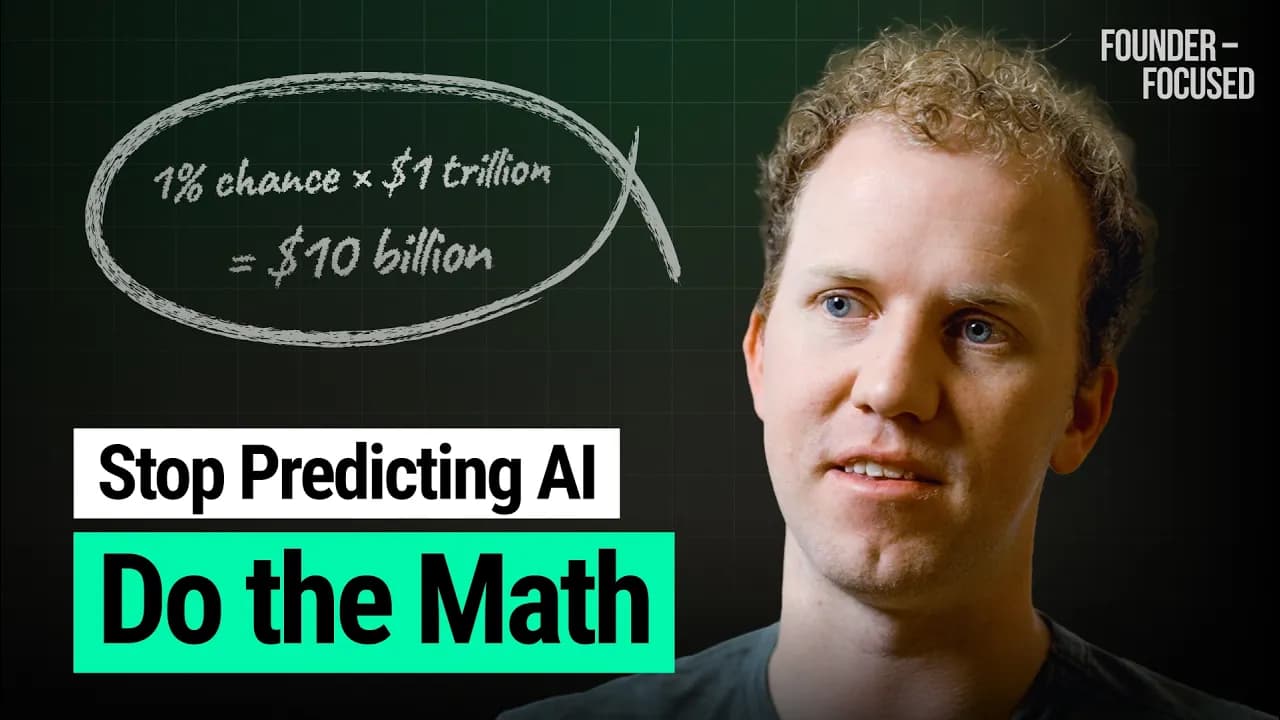
Adam Foroughi, Applovin CEO: Surviving a 92% Drawdown, Ads as ML 1.0 & the $50B Game Ad Market
In a Nutshell
AppLovin survived a 92% stock drawdown by aggressively buying back $6B in shares while the business generated growing cash flow, turning the multiple from 50x to under 4x EBITDA into a massive recovery. The company's edge stems from running advertising as machine learning 1.0—deep learning models that predict user behavior in mobile games and translate those predictions directly into revenue at 84% EBITDA margins. AppLovin now operates in a $50B mobile gaming ad market, competing with Meta and Google through focused execution rather than scale, while positioning discovery advertising as distinct from the bottom-of-funnel transactions that large language models will disrupt.
These notes were generated by AI and may contain inaccuracies.
Adam Foroughi is the founder of AppLovin, a company that operates an advertising platform embedded inside 100,000 mobile games. The platform quietly outperforms Facebook ads for e-commerce brands. AppLovin went public as the most valuable company among over 1,000 IPOs. The company is projected to generate approximately $6 billion in cash in the current year.
AppLovin is an advertising company focused on helping mobile game developers monetize their platforms. The mobile gaming market has grown substantially, with over one billion people playing mobile casual games daily. These users are adults and heads of households.
The company disclosed $11 billion in annual ad spend on its platform nearly two years ago. With 60% year-over-year growth, this translates to approximately $20 billion today. Including other ad companies in the ecosystem, the total mobile gaming advertising market is estimated at $50 billion annually.
The company initially focused on creating intent to drive users from one game experience to another. Deep learning models have now enabled the platform to create shopper behavior experiences, allowing access to larger economies and greater economic impact.
Advertising represents ML 1.0, being the first implementation of technologies now driving AI. Large language models have greater economic value in society than advertising, but advertising remains a profitable implementation of deep learning models. Recommendation systems differ structurally from large language models but follow similar trajectories. Research in both domains can cross-pollinate. Researchers in large language models often began their careers working on advertising systems.
A key advantage of advertising businesses is that when a model predicts a future outcome, such as an advertisement click, the value of that prediction can be translated immediately into revenue.
Ad quality has improved significantly since 2005, when ads were considered complete garbage and spam. Facebook demonstrated that combining available data with good technology could make ads relevant. Most shopping recommendations today come from Instagram, where ads have become content-like. Users engage heavily with relevant mini-game ads within games due to improved recommendation technology.
Two distinct advertising categories exist: bottom-of-funnel advertising where consumers know what they want to buy, and discovery advertising where intent is created. Large language models will compete primarily with Google's search business for bottom-of-funnel transactions. The discovery model, which AppLovin operates, creates new economic expansion by showing consumers products they did not know existed.
The phenomenon of seeing ads for products mentioned in conversations is typically not due to microphone access. Users often perform trackable actions like searches or website visits that they do not consciously connect to subsequent ads. AppLovin does not track precise location data, as the data transfer requirements would be substantial.
Social networks can leverage relationship data to show relevant ads. If one user searches for something, connected users might see related content. This is considered acceptable targeting. The economic value created by relevant ads contributes significantly to GDP growth, with better targeting technologies driving faster economic expansion.
The company is based in Los Angeles, started in Silicon Valley with offices in Palo Alto. Engineering offices are located in Palo Alto, Beijing, and Singapore. The company avoided significant venture funding in early stages, which contributed to quiet development.
AppLovin went public in April 2021 with approximately $28 billion market cap at a co-IPO. The market cap reached a peak of $40 billion. By 2022, despite generating $1 billion in EBITDA, the market cap dropped to $3.8 billion from an initial $600 million EBITDA valuation. The stock declined every day during 2022.
The market's reaction created a disconnect between business performance and stock price. With a finance background, the approach was to recognize that market price reflects investor quality. Private market investors and ex-cofounders planned to sell at IPO during a period when many companies went public simultaneously. Blue-chip investors did not conduct sufficient research on the company, resulting in no demand and high supply.
The multiple compressed from approximately 50 times EBITDA to under 4 times. Rather than continuing investor relations efforts, the strategy shifted to aggressive stock buybacks using generated cash. Approximately $6 billion of stock was repurchased, retiring 20-25% of outstanding shares. At peak valuation, this $6 billion buyback was worth over $50 billion.
The 92% stock decline created significant personal pressure, including family members calling to check on mental health. The CEO maintained perspective that the stock remained above previous levels, but recognized team members faced similar pressures without equivalent ownership or gravitas.
The cultural approach was to adopt an "us against the world" mentality. A performance stock plan was implemented across key employees, acknowledging the difficulty while promising significant upside upon recovery.
The company transitioned from regression models to deep learning models. The advertising algorithm drives performance, with better algorithm performance directly improving advertiser returns. The business model is performance-based, selling revenue to advertisers who scale based on results. The deep learning model launched in April 2023, with market recognition occurring by September 2023 when the stock recovered from $80 to $150 in a single week following investor meetings.
Public market investors follow similar patterns to private market investors, often arriving late to trends. Sophisticated investors identify trends early, distinguishing exceptional from average investors in both private and public markets. The stock moved from $9 to $750 per share in 2.5 years, creating extreme outcomes on both the downside ($3.8 billion market cap) and upside ($250 billion market cap).
Apple and EU privacy regulations have restricted precise user targeting. When users opt out of precise targeting, they are grouped together and served less relevant advertisements. Users subsequently complained about receiving spam rather than relevant ads. Clear privacy regulations allow technology adaptation, and consumers generally want relevant ads, especially when watching 30-second ads to earn game rewards.
The company previously acquired game studios as a data acquisition strategy. When building the first deep learning model, training data was needed, but game studios typically resist sharing user data with third parties. After acquiring studios to seed training data and building a successful model, third-party data became available and the studios were divested.
While some consumers may use agents for routine purchases like supplement subscriptions, discovery platforms serve different purposes. The typical shopper is not deeply engaged with cutting-edge technology adoption. Discovery shopping involves window shopping, comparison, transaction experience, and package tracking. The dopamine response from the shopping process outweighs potential cost savings from agent optimization for many consumers.
Meta and Google generate most revenue from advertising with superior engineering resources and decades of experience. AppLovin's competitive approach is maintaining constant vigilance rather than assuming victory. The company operates lean with subject matter experts focused specifically on mobile gaming translated to transactional behavior. This focus enables faster movement than larger competitors.
The company achieves 84% EBITDA margins, considered the highest in the market. The business model involves advertisers purchasing consumers through the platform. When consumers transact, advertisers cover the cost immediately. For example, a lipstick sale at $20 generates payment to AppLovin at less than the selling price minus cost of goods sold. The performance model scales efficiently because the company powers advertiser-consumer connections without being the advertiser itself. The lean, algorithmically-focused, automation-driven approach minimizes operational leakage.
Because these technologies are really complex and if you can innovate and you have differentiated data, you can build an advantage. By that token Anthropic shouldn't be running away with the large language model space but the power of a model that then reaches a point of scale and gets adopted by a large scale community becomes something that is a moat that is hard for other people to overcome.
The team in China provides a significant edge. Chinese people are very humble, they're very, very hardworking, they're very sharp. When you can work with them, whether out of China or United States or any other part of the world, you're working with some of the brightest minds in the world.
When starting the business, one goal was to work with great people and figure things out. When sitting in a room with some of the people on the team, knowing you're probably the dumbest person in that room gets excited to show up.
The session concludes with audience appreciation for Adam Foroughi.
Keep All-In Podcast in your library
Save the videos and channels worth coming back to, and find them again in one place.