AI Is Killing the Career Ladder. A Stanford Economist Explains What Comes Next | Bharat Chandar
In a Nutshell
AI is causing 16% slower employment growth for young workers in exposed jobs like software development and customer service, acting as "canaries in the coal mine" for structural labor market shifts, while experienced workers with tacit knowledge remain resilient. Firms under-invest in training youth due to mobility risks, but AI as a personalized learning tool can accelerate skill acquisition in strategic thinking and social skills, enabling a flexible "career lattice" over rigid ladders. Young people should build extensively with AI, focus on human strengths like values and guidance, and embrace profession-switching to thrive amid rapid AI advances.
These notes were generated by AI and may contain inaccuracies.
Jobs more exposed to AI show young workers experiencing 16% slower employment growth, a significant effect. Structural changes from AI capabilities impacting the labor market are not temporary. Unlocking AI for helping people learn could make switching professions easier, leading to a career lattice that benefits workers over a rigid career ladder with higher risk from technological change.
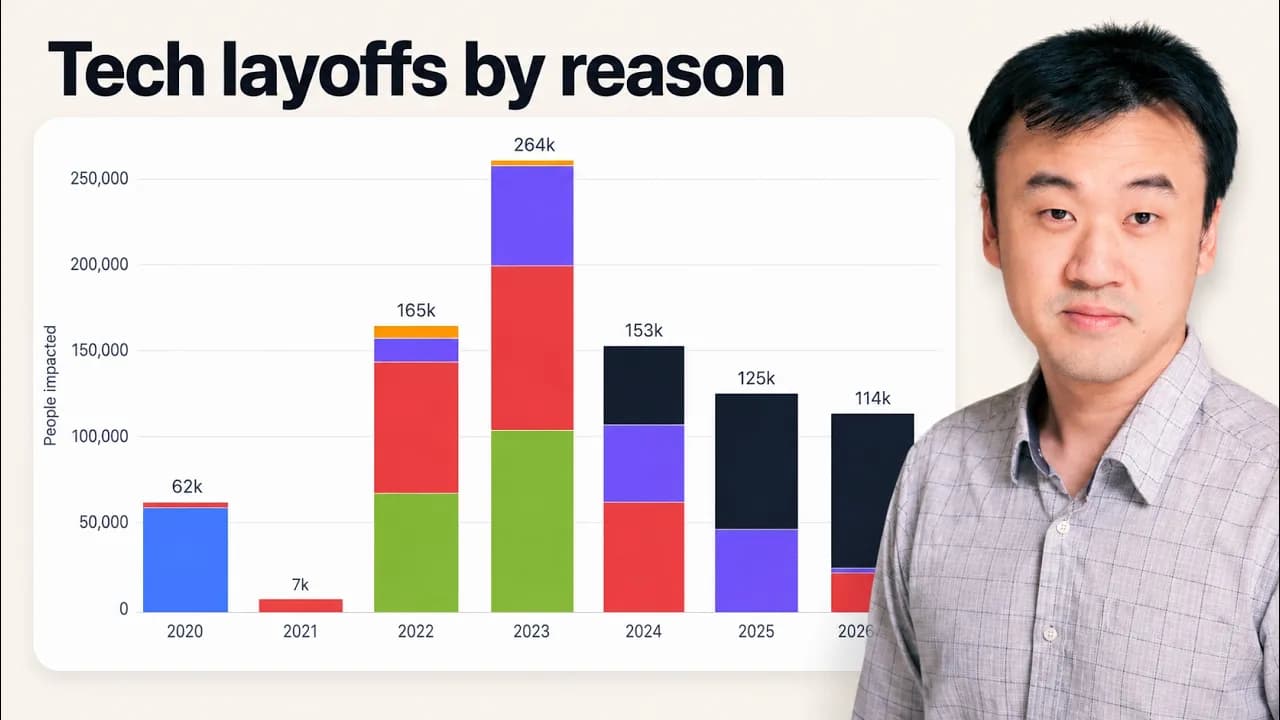
Barat Chandra (corrected from Barat Chandra), economist at the Stanford Digital Economy Lab, studies AI's impact on work. Over the past year and a half, AI's labor market effects became a central question in labor economics. Using AI tools shifted his research agenda due to their societal importance.
Released study with collaborators Eric Bolson and Ryu Chen using ADP payroll data tracking millions of US workers. Compared jobs more vs. less exposed to AI. Overall, no major employment differences. For young workers, divergence: AI-exposed jobs (e.g., software development, customer service, administrative roles) show employment declines; less-exposed jobs continue growth. Experienced workers see on-trend growth. Young workers in AI-exposed jobs have 16% slower employment growth.
Title reflects young workers as early indicators of AI's transformative impacts. Uncertain if driven by AI or temporary; tested alternatives like interest rates (AI-exposed jobs less affected, e.g., transportation, construction more interest-rate sensitive), tech overhiring (results hold excluding tech/computer jobs). If structural AI change, it's long-run. Need ongoing tracking; no clean AI vs. no-AI experiment, more research needed.
Young workers focus on implementation using book knowledge from school. Lack tacit knowledge (hyper-local context, strategic thinking, social interaction built on-job). AI overlaps more with young workers' tasks. Experienced workers advantaged in tacit areas vs. AI and young workers.
Firms want young hires for future middle management but incentives misalign: workers can leave for other companies. Private firm incentives < societal optimum, leading to under-hiring/under-training young people.
AI as learning tool could speed tacit knowledge acquisition, requiring education system changes (universities, lower levels).
- Physical tasks (absent robotics advances)
- Strategic thinking/guiding work
- Social interaction
Strategic thinking increasingly vital: future work may involve guiding AI agents on implementation. Key skill like managerial work.
Build/use AI tools extensively to adapt to disruptions/technological changes.
Industrial Revolution: Skilled workers (e.g., Luddites, skilled textile workers) most at risk, lost work to inventions. Similar to AI hitting knowledge workers in educated roles.
20th Century (electricity, IT revolution): Middle/low-skill work exposed; highest-educated benefited.
AI's distinguishing factor: rapid capabilities improvement (far more capable than 3 years ago). Question if AI advances fast enough to take new work created.
AI can augment (expand task scope, e.g., startup founder with lean team handling more functions via AI) or automate (shrink tasks). Augmentation via education historically expands capabilities; AI as learning tool could do same.
Potential for biggest learning change in 100+ years via AI personalized learning.
Uses AI for math (modeling, proofs): easier to check/verify than create from scratch, augments work. Avoids AI for writing: writing aids thinking/understanding; less value if not done personally.
Humans excel in values (right/wrong), preferences (what to build for happiness), reflection on desires. Guidance on implementation characteristically human short-to-medium term; AI better for execution.
If AI lowers barriers to top-field performance, labor market inequality could decrease (less gap between high/low performers). Trade-off with learning investments.
Conversely, if AI boosts benefits of strategic thinking/social skills, increases returns to school effort.
Use AI tools extensively, build with them, develop strategic thinking. Identify AI weaknesses, human value-add areas.
Interventions promote critical thinking over offloading (e.g., Khan Academy AI mode guides thinking to answer without giving it directly).
Unlocking AI learning could ease profession switches as demand shifts, enabling career lattice over risky career ladder.
Ken Ono, mathematician, University of Virginia professor on leave, founding mathematician at Axiom Math, works in AI for math. First time struggled to stump ChatGPT; shifted view: wrong question is 'how to stay ahead of AI'.
Current education systems suboptimal. Kindergarten/first-grade wonder/energy (e.g., knowing primes, adding) should be preserved for creativity/productivity like Ramanujan. Potential resides in all; who owns your identity? You do.
Keep EO in your library
Save the videos and channels worth coming back to, and find them again in one place.