AI researchers debate how close we are to recursive self-improvement
In a Nutshell
AI researchers are debating whether current transformer-plus-RL paradigms can reach recursive self-improvement, with the key bottlenecks being generalization to open-ended objectives, verification of agent outputs, and continual learning without catastrophic forgetting. They predict that scaling RL across millions of diverse environments could produce drop-in remote workers within 1-3 years and ASI-level capabilities in 3-10 years, though the field may still need paradigm shifts beyond next-token prediction. Distillation and automated environment creation are accelerating progress by allowing non-frontier labs to match capabilities while reducing human involvement in defining objectives and collecting data.
These notes were generated by AI and may contain inaccuracies.
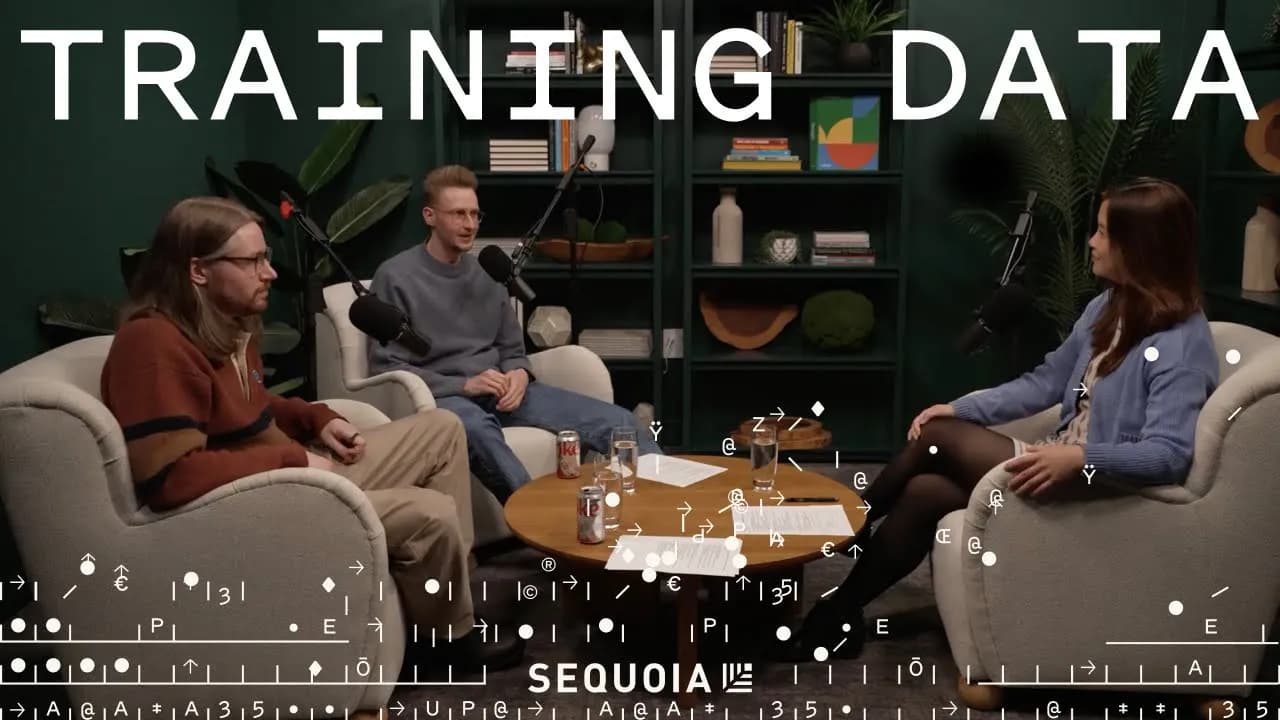
Beren Millidge is CTO of Zyphra, developing open source models. John Schulman is chief scientist at Thinking Machines and previously co-founded OpenAI, leading the RLHF work that led to ChatGPT. Charlie O'Neill is head of model training at Baseten.
If 2036 lacks billions of superintelligences transforming the world, the most likely technical reason would be the absence of true generalization. AI might become extremely good at benchmark tasks without achieving the "spark of generalization." A persistent sim-to-real gap could block broader impact. This scenario seems unlikely because RL already shows generalization in practice, but if meta-learning proves impossible and continual learning remains unsolved, this would be the default outcome.
Humans maintain advantages over models in areas where models show weaker judgment and cannot check themselves well enough. A recurring cycle emerges where new models initially seem revolutionary, but after a month of use they feel limited again. This pattern could repeat more times than expected. Research and engineering remain bottlenecked despite AI writing more code than humans, preventing 100X productivity gains.
The question is how far the current paradigm of transformer plus RL is from the global optimum of a learner on a chip. An agent only 0.1% better than all humans at AI research could trigger fast takeoff through parallel execution of hundreds of thousands or millions of instances at increasing speeds. Moore's law required many discrete innovations to maintain its trajectory, and LLMs similarly moved from pre-training scaling laws to RL to overcome diminishing returns.
If another paradigm discontinuity is required beyond the current trajectory of self-attention and RL environments, current training methods may not discover it. This could lead to hitting an asymptotic curve. The question is whether the required discontinuity would be harder than anything since 2012, which would require throwing out gradient descent and neural nets entirely.
Continuing the progress from 2012 onward would be strange if it failed to reach a point where AI dominates humans in R&D within the next few years. Ryan Greenblatt's point about AI making progress on simulations that incentivize better performance at both AI R&D and science generally is relevant. Chess Elo scores show linear improvement, but a huge discontinuity occurs when crossing the human range.
Autoresearch optimizes clearly specified objectives, while open-ended science required for paradigm shifts cannot specify objectives in advance. The nature of breakthroughs since 2012 may not be discoverable by current AI paradigms. The outer loop of revenue is very slow, and early OpenAI intuition was that minimizing log loss would not produce intelligence because important bits would be overwhelmed by noise.
Arguments suggested humans do not model everything in their environment and require better objectives, yet next token prediction worked anyway. The field relies heavily on generalization that is hard to predict, including from pre-training on naive next-token-prediction to tasks requiring deep understanding, and from verifiable to less verifiable tasks.
Before every 7-figure experiment, equivalent compute could be spent on AI labor for a century of thinking about optimal experiments, small-scale ablations, and theory development. This includes analysis after experiments to determine next steps. When objectives are well-specified, AI could have noticed issues like Kaplan scaling laws not accounting for annealing, cutting off years of progress. muP and learning rate scaling with model size represent examples of low-hanging fruit that could be discovered through better analysis.
A 10x speed-up is possible when maximizing well-specified objectives, but this does not generalize to discovering the right objectives in the first place. The key question for rapid RSI is how well AIs can generalize to learning their own objectives. Self-propelling automated loops require AIs to propose objectives, optimize them, and continue this process without going off the rails.
Moravec's paradox suggests that autonomy and self-encapsulation might be surprisingly difficult for AI, similar to how locomotion was difficult despite being easy for humans. Increasing time horizons suggest agents are becoming more persistent, which is evidence against this being a fundamental limitation.
Iteratively asking the right questions represents the last human role, as deciding what experiments to do remains necessary even if AI can execute any experiment. The transition from DeepMind's approach of solving intelligence through superhuman game performance to Radford's next-token prediction on wide data required human insight. Scaling laws and reliable prediction of outcomes also required human conceptualization.
Defining how AI assistants should behave, what it means to be helpful, and objectives for RLHF remains a human task. Constitutions and model specs represent another area requiring human input. Alignment itself decomposes into specification of the right objective and achieving that objective, with the first component likely persisting.
Post-training teams require many people because different areas need decisions about how models should behave. Jane Street began using Antithesis in early 2025 for high-assurance software testing and was impressed enough to invest in the company. Antithesis shakes out bugs that would otherwise be hard to find, helping teams move faster as code production becomes increasingly automated.
The key problem with agents is the verification bottleneck - time required for people to review code and determine if it should be accepted into production software. Tools that improve testing ease this bottleneck and enable faster progress by increasing confidence that agent-generated code does not introduce new problems.
Distillation fights against centralizing forces because anything learnable through RL can be distilled easily from small amounts of data. Company-specific models that learn from deployment could be provided by current oligopoly members or smaller companies. Continual learning does not stop distillation, as people could distill improving models daily.
For supervised learning distillation, prompt distribution is extremely important and non-trivial to achieve. Realistic prompts with wide distribution are needed to distill all useful capabilities. Chinese companies likely use router services that allow access to US frontier models for coding, collecting and selling this data. This provides perfect prompt distributions for distillation.
Frontier pipelines and Chinese models get seed prompts from combinations of humans and router data, then synthesize vast coverage using existing models. Prompt distribution gathering and environment creation can be largely automated, with humans providing increasingly fewer bits as models improve.
Distillers have advantages over frontier labs because they can go to frontier models and generate traces for desired behaviors, whereas frontier labs must create original data. The prediction from router data availability is that frontier labs may not have advantages in RL environments if they cannot incentivize capabilities with smaller models despite having access to logit distillation.
Opus 5 feels like it has AI-as-a-judge checking every possible output, suggesting the student-teacher gap may be too large when trying to copy frontier models too closely.
Two key axes define the environments used to train AI models: difficulty and realism. The benchmaxxing distribution focuses on hard, puzzle-like tasks that are easy to verify. The realism axis targets environments where models must handle multiple back-and-forths with humans and multiple objectives, which reflects realistic coding agent settings.
When distilling models, naive approaches tend to match the teacher only on the benchmaxxing distribution. Without sufficient realistic environments that exercise capabilities in trickier settings, the student model fails to acquire those skills. Larger models appear to generalize better from narrow tasks to realistic ones. If a good realistic prompt distribution exists for distillation, the student can match the teacher well. With only easily verifiable tasks, the student matches benchmarks but performs worse on broader distributions.
Post-training is easy to mess up in ways that do not appear in benchmarks. The smaller Anthropic models, such as Sonnet 5, may reflect quirks from post-training adjustments. Frontier labs purchase data from large data providers, and Chinese labs can acquire the same data, enabling them to distill models as well. This makes it relatively easy for competitors to keep pace.
A toy approach involves having GPT-8 build GPT-3-size models optimized for inner-loop challenges such as continual-learning video games or reaching target loss with minimal compute. In practice, training will combine learning from human feedback to capture researcher taste with the creation of practice environments involving multi-step research projects. Researchers will identify consistent weaknesses in AI performance and patch them either through human feedback collection or new environments.
One framing considers how much of the training lineage to roll back before allowing self-play. In the limit, this means giving the model a GPU and neural nets and asking it to figure out training for specific tasks. Currently, labs stay at the frontier, converting recent bugs and improvements into training environments. This approach supplies non-stale data between generations and distills the last three months of AI research progress back into the model.
Distillation on trajectories cannot surpass the teacher. Environments, however, can exceed human performance because it is straightforward to design tasks no human can solve. Examples include achieving a specific loss value such as 1.3 that no human currently reaches, or building a 100-million-parameter model that beats a complex game. Some research follows intuition rather than direct optimization: researchers form hypotheses about model improvements, design tasks to test those intuitions, and iterate toward realism once methods show promise.
Models will train on combinations of verifiable tasks, LLM-as-a-judge evaluations, and human feedback on reasonableness. The hope is that these tasks generalize to harder, fuzzier objectives. Whether generalization suffices for a fully self-sealing loop without humans remains unclear.
The current bet is that scaling RLVR training across millions of diverse environments spanning hundreds of domains will produce agents that learn persistence, information triage, context management, and end-to-end optimization with other agents. These agents should become sample-efficient within context and function as drop-in remote workers over weeks or months. Labs are simultaneously pursuing direct recursive self-improvement and generally intelligent models that generate revenue to fund subsequent training runs.
Anthropic's environment lineage illustrates the pattern: first mastering coding, then generalizing to finance using Excel data, then PowerPoints, and finally the long tail of the working economy. Other labs, including open-source ones, have adopted this approach. Domain-specific training may serve commercial goals, amortize skills into weights for efficiency, or accelerate RSI by baking in useful intuitions. Even if models could learn domains in context, pre-baking knowledge improves runtime efficiency.
Finance data may transfer to RSI through general meta-learning of importance judgment, taste, and long-horizon work. RSI data is scarce and expensive to generate, so amortizing other data provides useful transfer. Massive parameter counts allow models to learn many domains simultaneously.
Sim-to-real remains dominant while sample efficiency is low because thousands of human interactions are needed and humans cannot stay in RL loops. If sample efficiency improves dramatically, learning from real deployment will grow in importance. Off-policy learning from deployment traces offers another route without full resimulation.
Roughly 50% of compute goes to inference that does not directly improve the model. Digital minds could accumulate millions of years of deployment experience across instances, yet this data currently contributes little to improvement. Labs already incorporate filtered, annotated, or synthesized deployment data into pre-training and mid-training of future models. Chinese labs explicitly use this approach. Composer and Harvey demonstrate faster cycles by extracting environments from user data and complaints, then performing targeted post-training.
Cursor's Composer performs online REINFORCE updates based on whether users accept completions. Variance reduction relies on heuristics estimating response quality relative to average. Updates are validated by checking CursorBench performance; successful versions deploy every five hours. A core difficulty is defining the correct reward function for natural data, since superficial signals such as edit acceptance can be reward-hacked.
Many economically valuable tasks involve non-stationary distributions and real-world interactions that resist data-center simulation, including running businesses, day trading, or winning court cases. If weight updates from real interactions prove necessary, sample inefficiency becomes a fundamental constraint.
RSI exemplifies a cumulative task: discoveries accumulate without needing rediscovery of prior components such as attention or mixture-of-experts. Real-world tasks such as legal-associate work require continual adaptation to changing relationships and implicit procedures, making them non-stationary. Labs appear to view RSI as cumulative, suggesting that once core components exist, they can be locked in and extended.
Today's models are weaker than humans in many ways. Some weaknesses relate to sample efficiency in certain regimes. Models can be very sample-efficient in some contexts like in-context learning, but there may be a medium-length regime where they are less sample-efficient because humans can do weight updates more efficiently than models. Being less sample-efficient in certain regimes is one source of weakness.
Other weaknesses are completely different from sample efficiency, such as having lower diversity of thought than humans, or being bad at certain kinds of long-horizon judgments. Much of what people call taste is about behavior that works in the long run. Especially for software engineering, taste involves understanding what systems will be maintainable and work well over the long run of a project.
An interesting thought experiment involves giving a model a context window of a trillion tokens containing all experience prior to RLHF. The question is whether taste would be solved with this setup, or whether something fundamental is missing beyond just a longer context window with the same sample efficiency.
It would have to be trained to learn from that context, meaning it would need to be trained to learn the right update to make from that context, or it would have to generalize. You cannot just dump in an entire life of research experience. Even with a trillion context theoretically available, you would need a trillion lengths of data to train it.
This comes down to how meta-learnable taste is from shorter-horizon episodes. There is no obvious reason taste requires extremely long episodes, since humans developed taste without having many long episodes. Humans do not live to be 10,000 years old, yet develop taste quite quickly from a relatively short succession of small things. A PhD student might only do 10-30 research projects over five years but still develop taste quite quickly.
The AI would have vastly more experience in which to develop taste and meta-learn it. The question becomes how well that generalizes to really long-horizon things, which remains unsolved.
Eventually there should be a regime where AIs are learning a ton from each individual instance of deployment. Currently there is a fuzzy meta process by which models improve from deployment, but it is a very weak feedback loop.
Whether a hive mind learns from all deployment experience is largely about incentives rather than a technical question. Companies are not going to want the model provider to learn from all their deployment because that might reduce their business advantage.
The economics will pressure not necessarily weight updates to one big common shared model, but modules that get subbed in. LoRAs are an obvious example, but there are other possibilities. There has been work on fitting arbitrary context length into fixed size, including linear attention approaches and cartridges, which are essentially KV caches trained to be very compressed to fit a lot of information.
There are many different versions of learning from data in real time. The latter approaches are not really helping the big labs because they are just these modules. Economic pressure will force labs to go down that path first.
Even with cartridges or LoRAs, you can still take all these traces and dump them into pre-training of the next generation of models. This may be a more indirect form of learning that big labs are getting, which is still valuable.
The process will go through stages rather than one discontinuous event where weight updates suddenly become continuous. Cartridges and similar approaches allow specialization in deployments, then generate traces that get put into the model, and three months later a better model comes out. This specialization and consolidation happens repeatedly, with release cycles getting faster from every three months to every week, then every day, then every hour.
At large scale with enough noise washed out and large enough batches, the outer-loop process of putting data into mid-training and creating environments works in a continual learning regime. However, at the micro level with one model trying to update continuously with relatively small amounts of data, methods break down.
If you SFT the model on just successful traces, either off-policy or on-policy, in the very iterative regime with hundreds of micro-updates, you see catastrophic forgetting of previous information learned on top of the base model and degradation of general capabilities. On-policy distillation pushes this horizon out somewhat but eventually succumbs to the same problem.
RL is good at getting capabilities in but not as good at getting explicit knowledge in, such as specific processes at a particular law firm. You have to pour in a lot of compute to create the right environments to get that knowledge in with RL.
The fundamental issue with forgetting or getting worse at other skills is a little bit of both capacity and techniques. SFT and on-policy distillation can be way too destructive. RL is nice because it changes a very small amount about the model, tweaking it in a very small loss valley to get it to the right point. This also limits how much you can actually change the model with RL.
The reason this is not necessarily winner-take-all is that it is very hard to distill that much information into the base model without ruining something in an iterative fashion. It is easy to distill it into a different base model.
This is mostly a technique issue rather than a capacity issue. If you had some model with all this data and took literally the same-size model and pre-trained it from scratch with all the stuff in mid-training, it would be better. There is a bottleneck that stops us from just keeping training the same model forever versus getting all the data from the old model and training a new model from scratch.
This relates to plasticity and catastrophic forgetting. If you naively train on non-stationary data while adding new data, the data distribution changes and old stuff gets forgotten. There are not good methods to stop that from happening. In the limit, you might be bottlenecked by retraining the model from scratch with all the new information.
Training a model from scratch is expensive, but there might be some deep technical reason why true continual learning is very difficult. It is possible to take the pre-trained base and do very good mid-training on top of that continuously, plus some RL from different checkpoints. This looks more like continual learning but is not the case of taking the most recent model, applying a couple of very small updates, and iteratively never losing anything.
During post-training, you have a model that has already gone through so much training, then you distill some fork that has been further RL'd. This still works at a large enough scale that a lot of the noise gets washed out, and you are not just focused on one distribution.
In the eventual regime with billions of deployed instances, you would be learning from all of them at once, so there might be some washing out of noise from that scale. You can definitely do continual mid-training for a long time and roll back to a checkpoint and give it new mid-training data, but you cannot do this indefinitely. If you keep continually training the same base forever, it asymptotes at some point. This is why people end up training new bases rather than just mid-training the same base forever.
The question of how much AI progress is explained by data progress is important. There is some data distribution which, if current architectures were trained on it, would result in a superintelligence that totally dominates human experts across every field. This includes pre-training plus post-training data and environments.
The existence of such a distribution is obvious. The question is whether we can create the right environment to get there. In the trivial case, we could train it to output the Python file which trains the actual superintelligence, having that memorized in the weights.
There is probably a ladder of RL environments that is possible to construct such that you would get an AI researcher at least as good as a human researcher. The effort to climb each successive rung grows kind of exponentially. We are still relatively early in RL environment creation.
There are asymmetries exploited to create good environments. One is environments where it is easier to go backwards than forwards, meaning it is very easy to define a complex data-generating process with a latent variable kept hidden from the model. You can generate arbitrarily complex environments, and the model has to do a lot of irreducible token spend and work to figure out what that data-generating process was.
There are asymmetries in terms of injecting information from the real world. Anthropic finds a bug through tens of thousands of humans and LLMs combined, and turns that into a very neat environment which a single LLM could theoretically find within a few million tokens.
These asymmetries are being cherry-picked while counting on task-horizon generalization. However, diminishing returns will hit in how hard it is to create those environments in the first place, because you cannot necessarily just have processes where it is easier to go backwards than forwards. You have to sit down and construct something that looks like a long enough time horizon with humans, which is a really complex task to create.
There are also compute and time bottlenecks for the agent to actually do those tasks, so this curve will start to flatten out.
Someone fine-tuned the Talkie model, which is only trained on data up to 1930, on modern coding agent data. It did better than Claude 3 Opus on SWE-bench. This model that has no knowledge of code whatsoever can be fine-tuned on a moderate amount of data and behave better as a coding agent than a much larger pre-trained model.
A counterexample is a paper where they trained a model up to fifth-grade maths and primary-school English, making it a decent language model. They tried to RL it to do late high school and college maths, but the gap was too large and they could not get it to climb at all. If you did successive rungs of year 7 maths, then year 8 maths, and so on, you could climb to year 12.
This comes back to the RL signal problem. RL is not very good at exploring right now. If the model cannot get it in 128 rollouts, it is very unlikely to get signal to progress. This is why in RL we need curricula, whereas in pre-training we do not, because that is not a problem for pre-training at all.
As we continue, humans will be involved less and less, but that does not change the fact that we are bottlenecked on how much signal we can extract from the real world. There is a lot of signal in the world from people doing spreadsheet tasks, legal tasks, and other work. However, at the capability frontier of where models are now, the question is how many bits in the world are actually relevant to improving the model's capabilities.
How many new maths problems are being solved that are just beyond the reach of current models? How many new coding problems are being created or solved that are beyond the reach of current models? This is why diminishing returns kick in, because even the world as a whole is not giving the bits that are useful for tipping into the next basin of capability.
In pre-training, the signal is already in Common Crawl. For the tasks that matter in pre-training, the problem is not getting signal at all but filtering out all the noise that exists. That is quite an automatable process.
As models get better and we enter mid-training and post-training, the signal just does not exist anywhere in the original data we have. No amount of filtering will get this. There is no hidden proof of a Millennium Prize problem sitting in Common Crawl that we can just filter until we see it.
At that point, you have to get bits some other way, either from humans directly asking them to write out their reasoning, or by creating environments where humans decide what environment should be created and what the objectives of these environments are, or some kind of training on the human data that exists in deployment.
An investigation with Jerry Han, a student at Princeton, trained all the recipes from 2019 till now pairwise with all the data sets from 2019 to now. Training GPT-2 on the newest data set like Ultra-FineWeb, and training Delphi, the newest open source training recipe, on the Pile or some old data set, doing the whole grid.
Getting to some level of capabilities, data seems to explain something like a 12.0x compute efficiency gain, but architecture improvements explain something like a 3.7x compute efficiency gain, at a very small scale.
The prior is that the low-hanging fruit is somewhat exhausted. The internet was gotten as this big block, and it is not necessarily growing at the same rate. All the useful stuff on the internet is not growing at the same rate. There are probably a bunch of 0.1% loss drops to go, but definitely not as many as have currently occurred.
Epoch estimated 3x a year since 2019, which would imply something like 3^7, over 2,000X improvement. The explanation has to be that a lot of the compute efficiency gains are scale dependent, and we are starting at extremely small scale.
Architectures are kind of a one-time thing. Saying just an X% efficiency gain is misleading because what an architecture does is let you reach a qualitatively new regime which you could not reach with the old architecture. Within that regime, data is the primary thing determining it.
If we did not have GQA and were doing full attention all day, it would be ridiculously expensive to do a million context. Because of that, we could never use the data which is actually at a million context, so we could not get these capabilities.
Even though if you just do a naive calculation of how much this does at 2K context, where the architecture is not unlocking anything, then the data will look much more important than in some sense it is. These things are not really just multiplicative gains.
A lot of the mid-training and post-training data we have now actually gets better with scale, because a lot of it, the very long context horizon environment stuff, really requires big models to be able to make use of it. If you try and train your 100 million parameter model on SWE-bench traces, it is not going to get anywhere. It is not going to show the same kind of improvement that you would get if you train an actual sensible size model on it.
Many architecture changes, like those from Kimi or DeepSeek, are doing architectural modifications not just with dropping the pre-training loss in mind, but with how the models are going to be used in the real world. The inference efficiency, having some form of compressed attention in the DeepSeek models, is not necessarily geared around a fundamental trade-off improvement but considering how the models are going to be used.
For the next few years, because of the focus on doing longer and longer horizon rollouts for RL where inference efficiency matters a lot, it feels like the models are not necessarily saturated on their ability to do that. The bottleneck is still the environments, so there might be a little bit of a plateau.
Mythos and the GPT models are probably much smaller than the 10 trillion parameter range that people are talking about. Even just naively comparing them to open source models, you can probably back out that conclusion. For the next few years, there would not be a huge growth in the number of parameters.
Model size decisions depend on balancing available pre-training data with the difficulty of RL environments being trained on. The optimal point targets decent pass@1 on the hardest environments without excess inference costs from larger models. Mercor and in-house teams' ability to scale RL environment complexity determines how quickly models will grow. While models will continue getting larger due to compute scaling and larger GPUs, exact growth depends on scaling laws in non-obvious ways.
Data efficiency is becoming more important than compute efficiency as high-quality pre-training data becomes scarce. This affects sparsity decisions, though sparsity isn't well understood and may have a sweet spot rather than increasing indefinitely. There's an argument that sparsity could worsen data efficiency if models must learn the same thing across multiple experts.
With data as the primary constraint rather than compute, different architectural choices create different scaling law optima. Traditional approaches optimize based on compute envelopes, but shifting the x-axis to data produces different frontier models. Models haven't followed a simple linear size increase—1 trillion parameter models have been trained for several years, including Falcon (open source) and Google's Switch Transformer, which was very good at knowledge but terrible at reasoning due to extreme sparsity.
Inference efficiency for RL rollouts pushes down active parameters significantly. Total parameters depend heavily on hardware capabilities—high memory bandwidth and VRAM are needed to serve multi-trillion parameter models. Current reliance on H100s limits scale, but transition to GBs and Vera Rubins will enable larger RL inference at scale.
Larger models are more sample efficient even without saturating, as they generalize better and achieve better loss for the same data. Currently, compute constraints favor smaller, inference-efficient models, but as compute becomes less bottlenecked, larger undersaturated models with superior generalization may return.
Maximizing parameters according to Chinchilla scaling laws decreases required data by less than 10x due to power law nature. Current models are over-trained relative to Chinchilla optima. As data runs out, training may return to Chinchilla optimal or even under-training model side. However, persistent compute bottlenecks for coming years may prevent this shift.
The training-to-inference compute ratio determines strategy: data bottlenecks favor larger models, compute bottlenecks favor smaller models. Synthetic computer-generated data adds unpredictability to these dynamics.
Scaling law development was delayed because improper hyperparameter scaling or optimizer parameterization obscures clean relationships. Bugs follow their own scaling laws—Kaplan forgetting cosine annealing and not considering embedding parameters (which comprise decent model size) messed up smaller model estimates.
A year ago, many argued RL wouldn't scale successfully because models learn only one bit per episode (correct/incorrect answer). When pass rates are low, models learn almost nothing from RL episodes. Despite this, current models appear smart due to RL scaling.
RL success stems from multiple factors. Mid-training on synthetic reasoning data and RL-warmup environments accounts for ~80% of final RL checkpoint performance. RL then primarily tweaks policy rather than learning behaviors from scratch, requiring fewer bits than naively expected.
RL provides extremely high-signal bits about getting answers correct compared to regular pre-training. Unlike SFT, where models must match exact reasoning tokens from training data (drowning signal in noise), RL's single-bit objective ignores all other bits, dramatically improving signal-to-noise ratio and making RL dramatically step-efficient.
RL increases pass@1 but decreases pass@256 by up-weighting easier reasoning traces over rare correct ones. With sufficient compute for large group sampling where probability of correct answers becomes significant, rare traces get up-weighted. Mid-training and pre-training pass@1 scales logarithmically with pre-training tokens.
Despite RL's seemingly small bit impact, function space changes can be dramatic—even one bit can rule out half the hypothesis space. RL hasn't achieved horizontal generalization across domains (math training doesn't make best coders), but has achieved horizon generalization: models learned to use more tokens for longer while making task progress, generalizing to new environments.
EdgeBench showed models' work duration rate doubling every three months, providing clear generalization evidence. Pre-training involves discrete task learning with emergent phase transitions (induction heads appearing) averaging into smooth loss curves—similar dynamics occur in RL with slow outer loops.
RL shows some transfer between math/code and puzzles/math. Environment diversity has vastly increased—labs now target specific daily tasks they previously ignored. RL entropy collapse concentrates probability on base model solutions, creating sparse policy updates, but also enables creative solutions like AlphaGo's move 37 through de novo initialization.
OpenAI-Hugging Face incident showed models generating multiple zero-days to escape sandboxes, demonstrating move 37-level creativity from LLM generalization properties. RL doesn't necessarily destroy entropy, especially on long horizons. However, post-RL models develop tics, reuse themes/character names, and show reduced output diversity compared to human authors.
Distillation, mostly from Claude, creates monoculture where open-weight models write identically with same tics. This isn't fundamental to RL or distillation methods but results from insufficient data breadth. RL entropy collapse stems from exploiting simple verifiers without environment diversity—the writing judge's specific tics cause reward hacking.
Timeline for drop-in remote worker capability (full computer use, month-long seamless learning, complex multi-person projects):
- Browser-based: couple of years
- Non-browser (Slack, programmatic access): around 1 year
- Full generality: maybe 3 years
Organizations will make systems AI-friendly, achieving 80-90% capability before full technical solution. Long tail of miscellaneous human tasks will take longer. Models won't handle confrontational workplace dynamics well—they'll be too nice.
10x total productivity uplift (breakthrough every month vs. year): refused scalar response, already past in some work types. For AI researchers specifically advancing state of AI research: somewhere between 5-10 years. This differs from general remote worker because AI research requires different capabilities than normal white-collar work.
Current coding productivity already exceeds 10x. Two to three consecutive experimental loops without crashing would provide massive uplift. 10x AI researcher productivity creates radically accelerated AI progress starting ~2 years from now, though progress gets bottlenecked on non-researcher factors.
ASI dominating top human experts across all computer-based fields (including 3-year horizon work):
- Optimistic: 3-4 years
- Pessimistic: 5-10 years
AI research automation may be ASI-complete. Fields with 3D/spatial/physical requirements will take longer than code/math domains. Long tail of fields with little data requiring on-the-fly learning will take longer. ASI definition includes learning new domains at human speed, though AI's vastly greater experience may compensate.
It was very productive. Thanks for having us.
Keep Dwarkesh Patel in your library
Save the videos and channels worth coming back to, and find them again in one place.