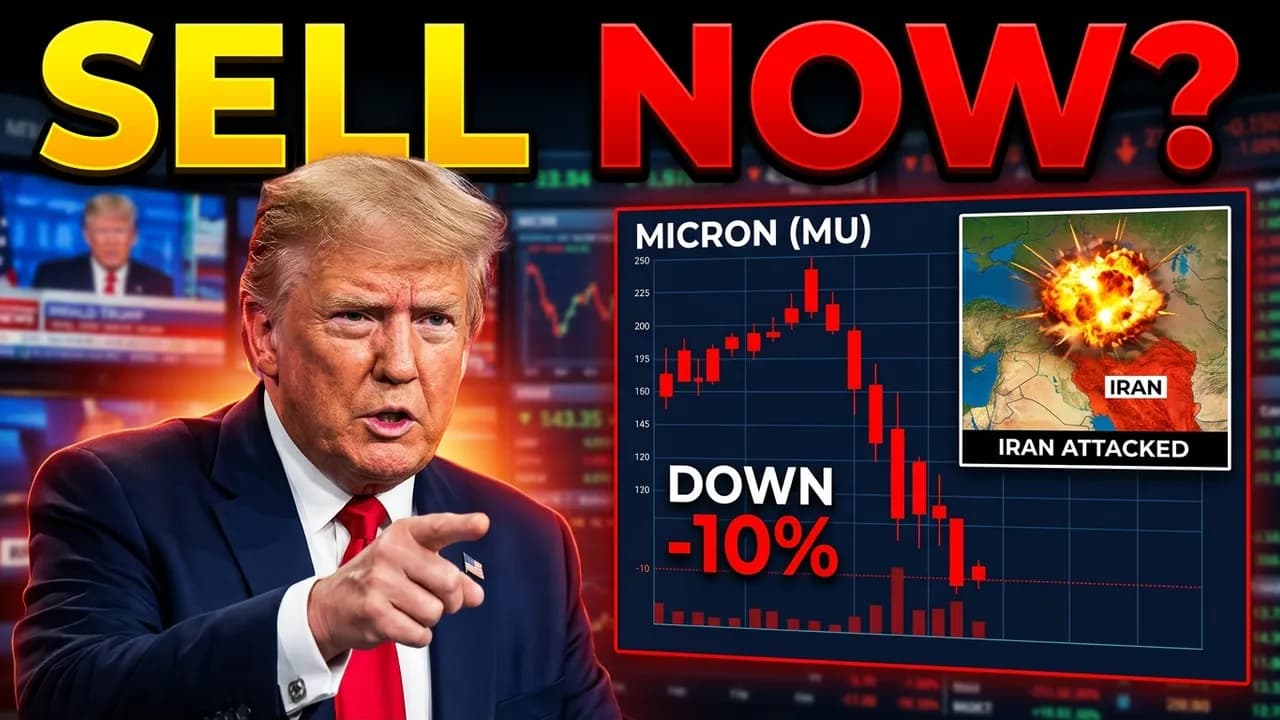
ALERT: Over $400 Billion Has Been Wiped Out From US Markets
In a Nutshell
Markets dipped after Iran threatened to close the Bab el-Mandeb Strait and South Korea raised rates, wiping $400 billion from US indices, with semis and memory-chip stocks hit hardest. The Nasdaq is still holding its 700–740 range, so the speaker sees no reason to panic unless support breaks. Key takeaways: avoid leverage, take profits at first sign of resistance, and stay disciplined when volatility spikes.
These notes were generated by AI and may contain inaccuracies.
Happy Thursday. Markets were up a little bit over $5,000 on the day. Every trade taken was caught in the live trading session with the LPP team. If part of the LPP team, rewatch today's live session. If not part of the team and want to watch the live session, message on Instagram via the third link in the description.
Focused on mistakes made yesterday. Started the morning $3,000 in the hole after a series of bad trades, then spent all day recovering to finish $3,000 in the green. It felt exhausting. Today, within the first hour, was up over $4,000 by focusing on position size, confirmation, and not being greedy by taking profits at any indication of resistance. Especially when there's a lot of uncertainty in the market, when in doubt, never be afraid to cash out.
The Nasdaq market is down 1% on the day. There is no break of pattern. The Nasdaq is still consolidating within its range of support at 700 and resistance right around 740. Until that support is actually broken, there is no true reason to panic. Markets are still holding up.
$400 billion has been wiped from the US market after Iran threatened to close the Bab el-Mandeb Strait. Tensions in the Middle East are escalating.
Semiconductors are getting beat even harder due to unfortunate news from the South Korean market. The South Korean Central Bank raised interest rates for the first time in over 3 years. The South Korean KOSPI index fell another 7%. There has been significant volatility within the South Korean market, largely due to its influence in the semiconductor and memory chip space. As that was announced, markets began to fall, especially semiconductors and memory chip stocks in the US markets.
Koreans are committing suicide to the KOSPI correction due to leverage, overexposure, and way too much expectation. A debt counseling hotline has been launched that expands the scale of support centers.
The Fed released jobless claim reports every Thursday, 1 hour before markets open. Expectation was 216,000, actual 208,000. Results were better than expected, but this is being clouded by news in the Middle East and South Korea.
Micron has sold off 30% from its all-time highs. There is rotation out of memory chip and semiconductor stocks and more into the Mag 7. Microsoft and Meta have been doing very well in recent weeks. Meta is up 25-30%. Micron is down 25-30%.
UNH reported earnings and killed it. Initially gapped up about 8.5%. Since then, it has given back some gains but is still up 5%. After UNH crashed and sold off to lows of 320, the dip was bought and invested in long term. It has nearly doubled. There was negative sentiment after the CEO killing in New York and an investigation opened about potential Medicare fraud. UNH is a very strong company. Even after the huge recovery, there is still 10% upside based on fair value analysts. It is at a fair P/E ratio of 33 times earnings. The company produces $449 billion in revenue and a net income of $12 billion.
TSM reported better than expected earnings but is still down due to South Korean market conditions and Middle East tensions. At one point it was down 4-5%. Currently it is only down 2%. Semiconductors are still a little weak.
Don't overleverage. If markets are down and you want to buy the dip, there is nothing wrong with buying the dip. Make sure you can tolerate the time it might take for markets to recover. Don't use leverage, especially with high-performing stocks. There is nothing wrong with wanting to be invested, but do not overleverage thinking they have to recover. Market sentiment for semiconductors and memory chip stocks is somewhat weak. Expect them to recover, but you can never predict the future. When in doubt, never be afraid to cash out. Please don't use leverage.
Netflix is set to report earnings after the bell. Questions can be left in the comments. To rewatch today's live trading session with the LPP team, message via Instagram through the third link in the description. The goal is to get a taste of what the LPP team experiences before joining. Let's make sure to end the year on a green day.
Keep Ricky Gutierrez in your library
Save the videos and channels worth coming back to, and find them again in one place.