Alex Hormozi Answers Your Questions
In a Nutshell
Alex Hormozi warns against overcorrecting when winning—use sandpaper for refinement rather than jackhammers for major change. He stresses that no billion-dollar coaching business exists because the model inherently struggles to scale, unlike software or finance. For stagnant businesses, dramatic restructuring may be needed, but winners should avoid constant reinvention that creates team and customer whiplash.
These notes were generated by AI and may contain inaccuracies.
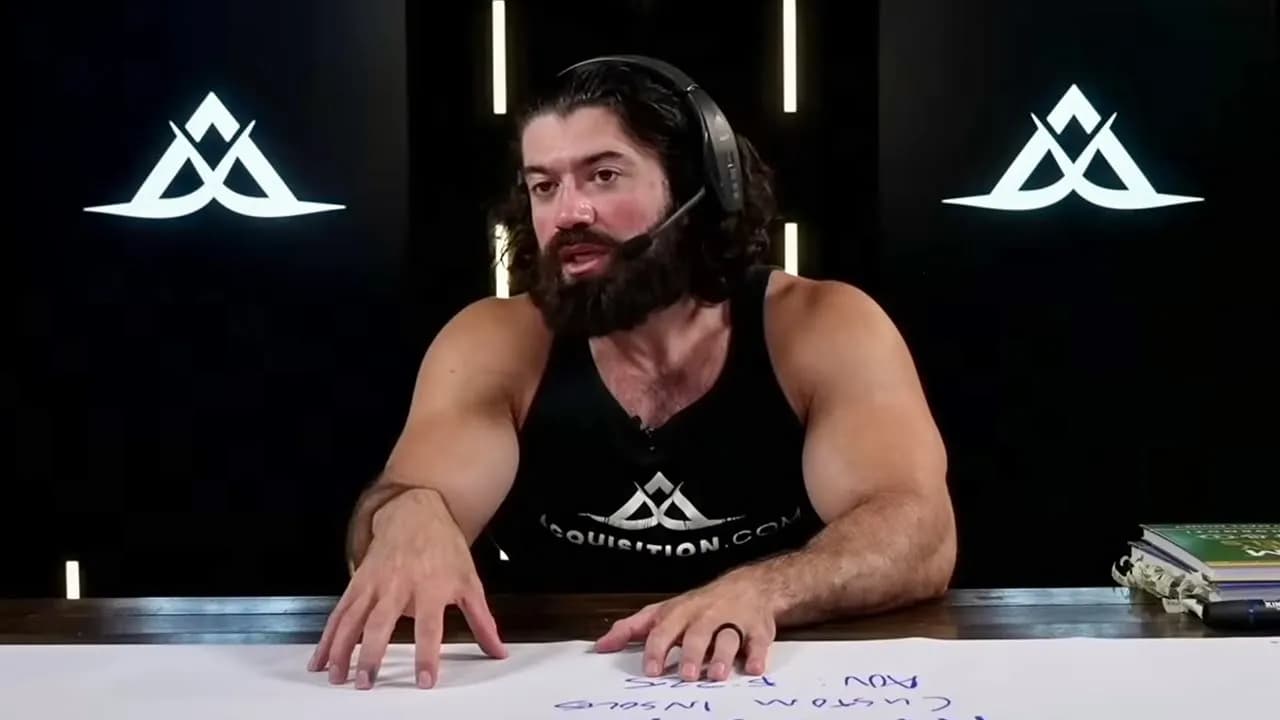
Alex Hormozi begins a 30-day experiment testing two major initiatives. The first involves live clipping - moving from live video directly to clipped content in minutes rather than using the traditional ingestion, finding moments, editing, post-production, QA, and posting process. The second initiative stems from Ila's question about what he enjoys most, leading him to realize he values hotlines and Q&As because they directly help individuals even if the content doesn't perform as general content.
Hormozi identifies his tendency to overcorrect when uncomfortable with business situations, wanting to kill a mosquito with a cannon. This weakness is described as a cousin to lack of focus. He distinguishes between two scenarios: times when complete disassembly is necessary versus times when only minor tweaks are appropriate.
He notes there's no billion-dollar coaching business despite many wanting one, unlike billion-dollar insurance companies, banks, or software companies. This suggests inherent scaling difficulties in certain business models. When no one has achieved the desired outcome in a business model, it may require blowing up the existing structure.
Entrepreneurs often reach local maximums - small peaks on larger mountain ranges of potential. They must be willing to lose status to themselves, as self-worth is often tied to revenue, profit, or cash flow. The key is stepping back to assess resources, skills, and money to determine the best deployment for highest return.
If stagnant with no version of the business significantly larger or accomplishing desired goals, consider dramatically changing the business. This is contrasted with the opposite scenario where radical change isn't warranted when doing well.
Hormozi sold a company to a group unwilling to take risks proportional to business requirements. Yesterday morning, he proposed radical changes to company leaders but recognized his tendency to burn everything down and start over isn't appropriate when winning.
When winning with things trending up and to the right, use sandpaper and chisel for fine details rather than jackhammers or chainsaws. The challenge is avoiding constant reinvention that causes team, self, and customer whiplash, as most people lack context for understanding the reasoning behind changes.
Alex Becker shut down a large information business to start Hyros, which became more valuable. Sam from Consulting.com shut down a $3 million/year business making $3 million working one day a week, allowing school to take off. Both examples show the importance of sacrificing short-term lifestyle for larger goals.
The key insight is matching the tool to the situation: jackhammers for major change, sandpaper for refinement. The warning is against chopping trees with sandpaper or jackhammering the Mona Lisa's final details.
If winning, change very little. If losing, consider changing a lot. Losing can mean different things depending on individual goals.
Cra runs a house plant soil business doing $6-7 million revenue at 5% profit, targeting $30 million at 20% profit. The business has split focus between direct consumer and retail, with 55% gross margins on direct-to-consumer sales. They have 100 retail stores acquired by accident representing 7% of revenue, with no previous B2B effort. The founder, age 26, lost $700k over four years and wants to avoid jinxing the first profitable year.
Hormozi questions whether any soil business achieves 20% margins, noting Cra's direct-to-consumer model lacks margin despite premium pricing. The repurchase rate question remains unanswered in the transcript segment.
Keep Alex Hormozi in your library
Save the videos and channels worth coming back to, and find them again in one place.