Amazfit Bip Max - Best Budget Watch? (Scientific Review)
In a Nutshell
The Amazfit Bip Max delivers strong heart-rate accuracy across running (0.99 correlation) and outdoor cycling (0.97), with overall HR scoring 95.8/100 and sleep-stage agreement around 80/100—making it one of the best-performing sub-$100 wearables tested. GPS tracking is merely average (65/100), and weight-lifting HR is weak, but the device still offers solid data quality, a square form factor, and fully free basic features via the Zepp app. For anyone seeking an affordable sports-smartwatch without subscriptions, the Bip Max is currently the strongest budget option.
These notes were generated by AI and may contain inaccuracies.
These new sub $100 wearables are pretty crazy. The Amazfit Bip Max is performing really well in testing. There are a few limitations, but for just $100, the device seems to be doing really well in a lot of categories. The reviewer is Rob, a post-doctoral scientist specializing in biological data analysis, focusing on data analysis of the health tracking features of the new Amazfit Bip Max. For $100, the device offers a pretty good screen, a nice form factor, and pretty good performance.
The heart rate tracking performance during indoor cycling was tested with the reference device being an ECG chest strap on the horizontal axis and the Amazfit Bip Max on the vertical axis. Each point represents a single heart rate measurement. Most points are quite close to the blue line with perfect agreement, though there is one moment of deviation. The correlation is 0.91, which isn't quite as high as hoped, but still pretty okay. One specific moment showed the device missing the first interval detection.
Unfortunately, only a single session was available for indoor cycling due to a problem with one of the reference measurements. Two total sessions were started, but one had to be excluded.
When comparing the correlation value to the competition, indoor cycling is the one cardio exercise where the device didn't perform amazingly. The Amazfit Bip Max is rather low in the overview, close to the Ultra 2 from Amazfit. Better performance would be expected roughly in the area close to the T-Rex 3 Pro, Active Max, Cheetah 2 Pro, and Active 3 Premium. With more testing, the device might end up higher given that it isn't very heavy.
For running, the device performed very well with most points close to or on the blue line and a really high correlation of 0.99. Among individual runs, one run had some issues with slightly too low heart rate for a while. Otherwise, the other sessions were pretty good with minor deviations and one almost perfect session.
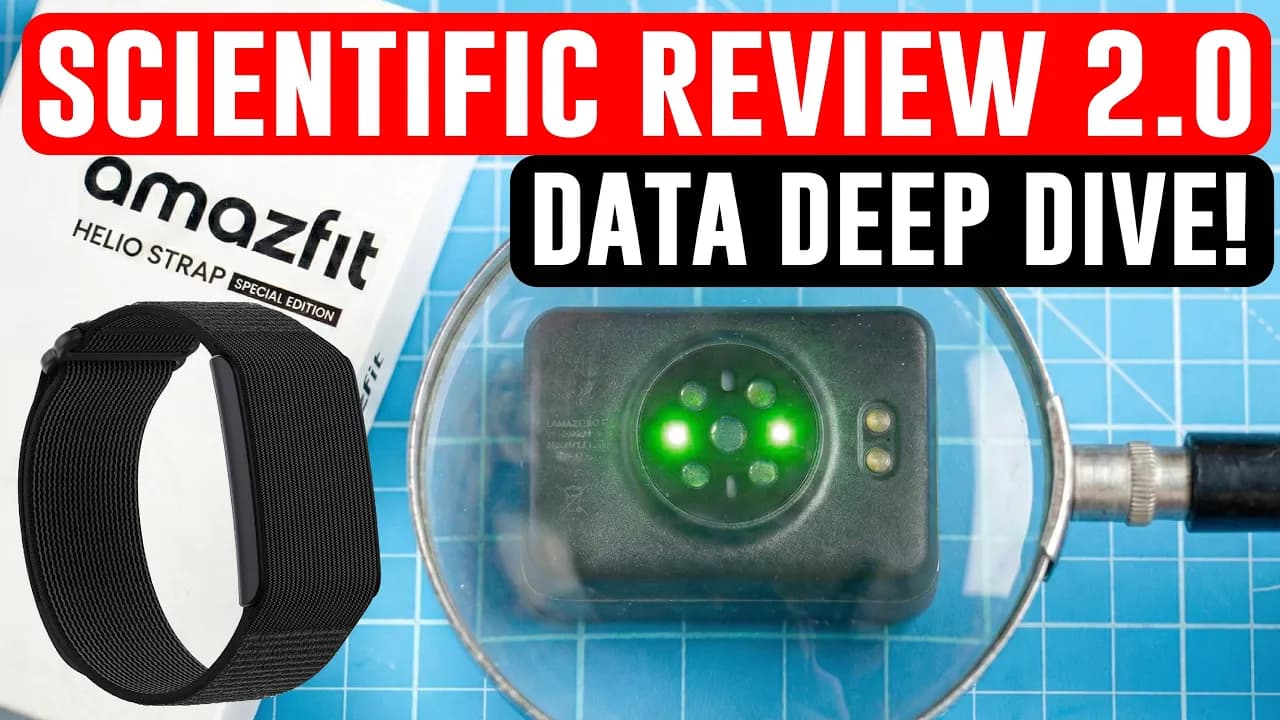
When compared to the competition, the Amazfit Bip Max is doing really well among some of the best performers. It is close to the Amazfit Helio strap with the same sensor worn on the bicep. The Amazfit Helio strap on the wrist also did pretty well and is really close in performance. Even compared to Garmin devices known for more sports, the Amazfit Bip Max did really well.
Outdoor cycling tends to be harder due to more tension on the wrist and bumpiness, but the device performed well with a correlation of 0.97. There are minor moments of deviation, but this is likely good enough. Individual bike rides show some missed details in peaks, with the Amazfit Bip Max slightly lower than the reference, but overall looking really good.
The Amazfit Bip Max is close to the Amazfit Helio strap on the bicep and not far from the Amazfit Helio strap on the wrist, which has the same sensor. All these devices are around $99 and doing really well as budget options. An Apple Watch or Pixel Watch 4 might provide better performance, but whether it's worth the extra money is uncertain.
The device isn't doing so well for weightlifting, often detecting too low heart rate and not able to detect all peaks. For weightlifting, this is likely not the top choice, though most devices aren't good enough during weightlifting.
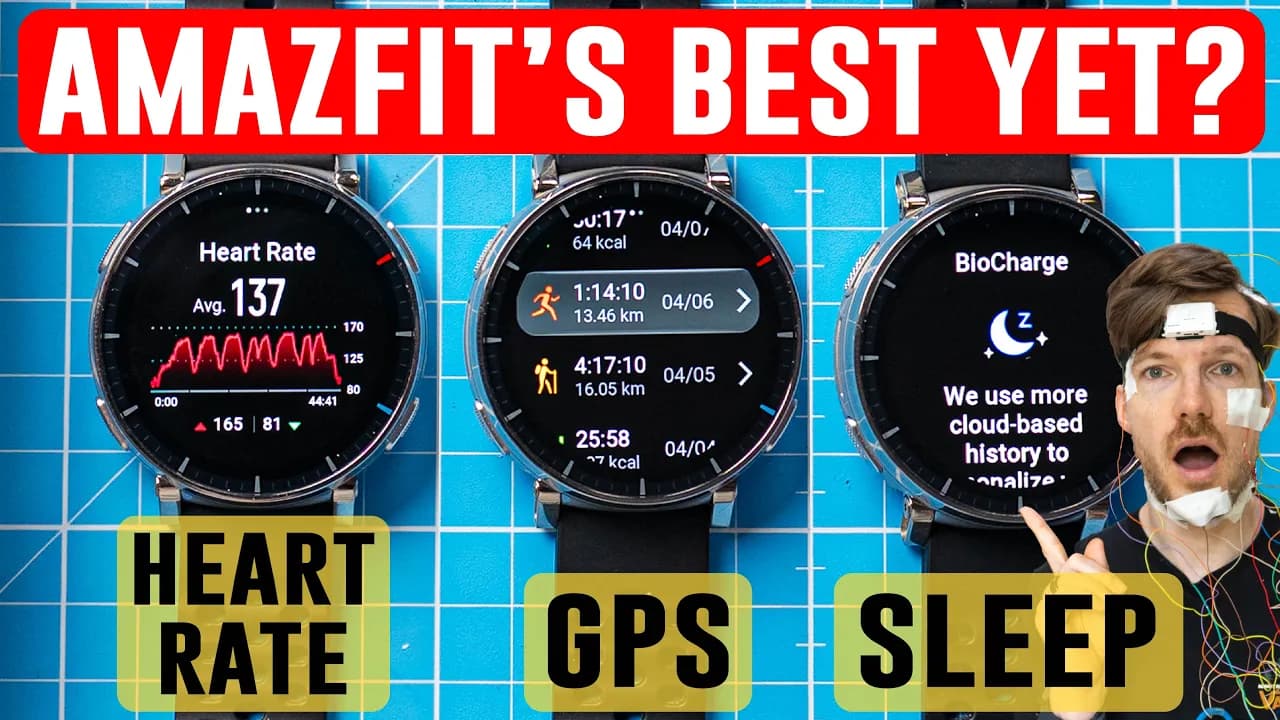
The overall heart rate score is 95.8, putting it into the category of great heart rate tracking. This makes it a really amazing heart rate tracker for the price. Minor issues were only seen during spinning, with more testing planned in the future.
The sleep stage tracking performance was tested against the ZMAX EEG headband, which measures brain waves. Only two nights of data were available due to issues with the reference device, making this an initial test. More data will be available in testing of the Amazfit Helio Strap versus the Fitbit Air.
The sleep stage tracking performance shows about 92% of what was deep sleep according to the reference was also deep sleep according to the Bip Max. Light sleep agreement is at 65% with extra deep sleep and REM sleep being detected. REM sleep agreement is at 84%. Overall performance is really good, especially compared to the older algorithm.
In example nights, all deep sleep detected by the reference is also detected by the Amazfit Bip Max, but some extra deep sleep is detected. For REM sleep, most of the REM sleep detected by the reference was also detected, with some extra REM sleep detected.
The Amazfit Bip Max is doing really well, quite close in performance to the Amazfit Cheetah 2 Pro which should have the same sleep stage tracking. The truth might be somewhere in the middle. The Amazfit Active 3 Premium might have used the same algorithm. With limited testing of only two nights, the results have an asterisk. The Cheetah 2 Pro had about a week's worth of data (6-7 days).
The best devices are among the top right performers. If these results hold true, Amazfit could make it into the top six brands for sleep stage tracking. Common brands that do really well include Oura Ring with the Oura Ring 5, Whoop Strap, Google and Fitbit with their devices and Pixel watches, Apple Watch, and Eight Sleep Pod.
The Eight Sleep Pod is the favorite sleep improvement device, super expensive and not a wearable. It goes around the mattress and can actively cool and heat each side of the bed independently. It provides good sleep stage tracking and is among the top five brands. The main reason for use is the cooling functionalities, which help during summer sleep issues.
With the big asterisk for only two nights of data, the sleep stage rating is great with a score of 80. The performance predicts a little bit too much deep sleep and REM sleep, affecting light sleep agreement, but overall shows some of the best performance out there.
GPS tracking performance was tested during both cycling and running by cycling and running the exact same route several times. If signals overlap nicely, GPS tracking is very good; big deviation indicates poor performance.
Four cycling trips to work and four trips back from work were tested. For cycling to work, the signal wasn't acquired instantly, taking time on two occasions. Some deviation was observed, with more deviation than desired, but the final part looked pretty solid.
For cycling back from work, signals were acquired very fast, almost instantly. Some deviation occurred with a sudden shift in location that wasn't real. Other deviations were observed but overall not bad.
Two runs were tested in a circle in Park Belvadier. The major issues occurred where a large wall tends to interfere with the GPS tracking signal, introducing quite some noise. The device is sensitive to interference. On the left side without interference, signal quality is quite good with signals close together. On the right side with the wall, more deviation occurs.
The GPS tracking score is 65 out of 100, categorized as okay GPS tracking. For the price, this is quite okay but not quite top-of-the-line as with the Cheetah models.
The device has a square design and feels more massive than many other devices. It's not a small device and is somewhat bulky compared to the Fitbit Air. It's also not thin, requiring big enough wrists.
For the price, the performance data is looking really good despite limited testing days. This could be recommended to quite a few people as a good first model for tracking rides, runs, and sleep. It has all the functionalities needed as a smartwatch with good data quality. More testing is planned, possibly including colleague Raphael.
The Zepp app looks quite okay but is quite cluttered without the best overview. Some redesign could help. The app copies points from the older Whoop app and works quite okay but is a bit sluggish with not optimal design. Starting a workout can take a while and stopping a workout sometimes doesn't feel the smoothest.
All basic functionalities are free with no subscriptions. The device can be recommended to many people who don't want to spend a lot of money but still want a sports and smart watch. Spending more money on an Amazfit device or another device will get better performance from the watch itself, but whether that's worth it depends on individual needs.
The editor Alex is already really happy with his Amazfit device which is even cheaper than the Bip Max.
Keep The Quantified Scientist in your library
Save the videos and channels worth coming back to, and find them again in one place.