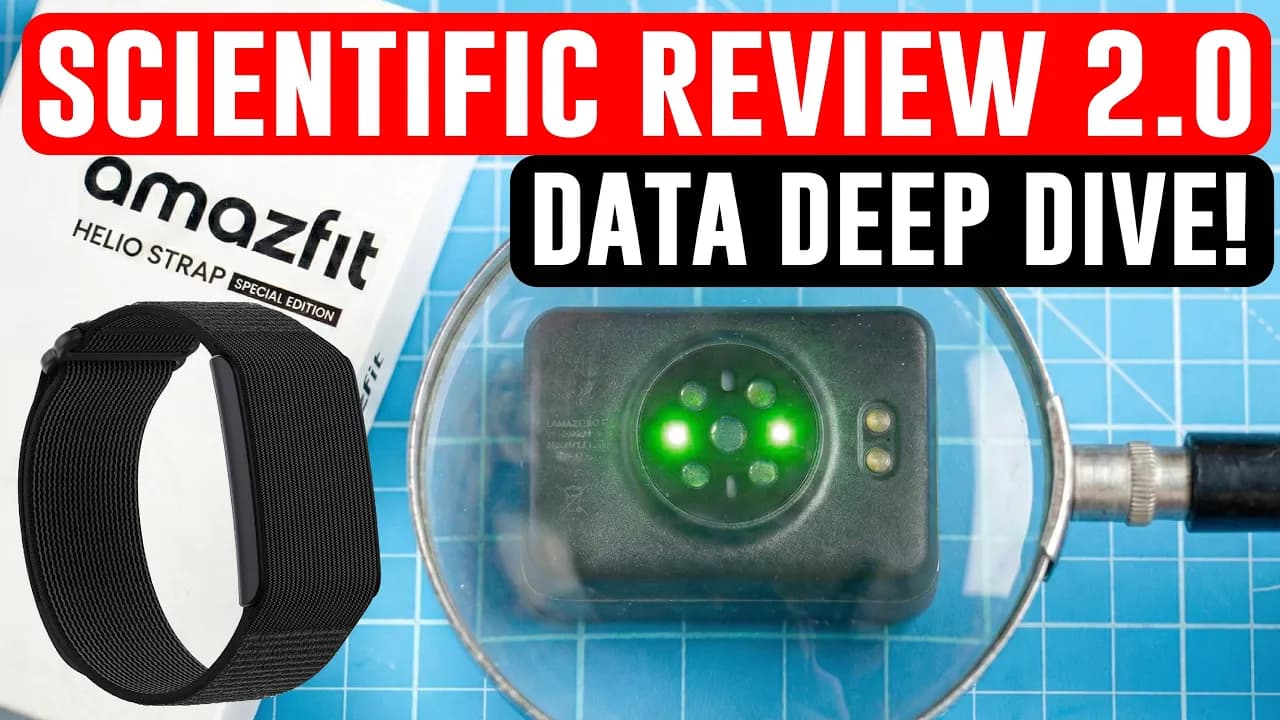
Amazfit Helio Strap Accessory Upgrade! (Scientific Review)
In a Nutshell
The Amazfit Helio Strap with the biceps sleeve delivers top-tier heart rate tracking across cycling, running, and weightlifting, achieving 0.98–1.00 correlation with a Polar H10 ECG reference. The sleeve is significantly more comfortable than the official band, protects sensors from sunlight, and costs just $20 versus the $99 strap. Sleep tracking remains average, making Whoop the better all-day choice if budget allows, while the Helio setup excels for budget-conscious users focused on workout accuracy.
These notes were generated by AI and may contain inaccuracies.
Lately, the Amazfit Helio strap has been used more frequently due to two accessories. The main accessory is a sleeve that can be worn on the biceps. There is also the official biceps band and unofficial versions that were used previously because the official biceps bands were difficult to obtain. The official biceps band often becomes uncomfortable during running or weightlifting because it can be quite tight and sometimes causes skin irritations when running due to rubbing back and forth on the skin.
The sleeve is softer and more comfortable to wear. The Amazfit pod slides into a small pouch on the inside of the sleeve, with the sensors remaining accessible. The medium size (M) is being used, and a small size (S) is also available. The sleeve has led to using the Amazfit Helio strap for most workouts again. Different colors are available for the Amazfit Helio strap, including a purple one that becomes visible when placed in the biceps band.
During exercise, the sleeve is preferred, while during day-to-day use, a biceps band is used similar to how the Whoop strap is worn. The biceps band of the Whoop strap is more comfortable and does not rub against the skin as much. The sleeve provides better protection from sunlight because both sides of the sensor have covering, which prevents extra light from getting into the sensor and potentially improves the heart rate signal.
Testing over the last 2 months shows heart rate tracking performance during different exercises. For indoor cycling (spinning), the correlation with the Polar H10 ECG chest strap reference is rounded to 1.00, indicating nearly perfect agreement. Individual sessions show almost perfect agreement, including during interval training. The Amazfit Helio Sleeve ranks among the top performers when compared to competition, very close to Apple Watches, Apple AirPods Pro 3, and previous testing of the Amazfit Helio Strap on the biceps.
The Amazfit Helio Strap tends to perform better on the biceps than on the wrist. Previous testing with the special edition strap on the biceps was already more comfortable than the default biceps band. These results represent some of the best performances observed.
For running, the correlation is 0.99, which is still excellent. Individual running sessions show very good agreement, with only occasional 1-2 BPM underestimation. A marathon session showed nearly perfect agreement with some moments of slightly too high heart rate detection, but 99% accuracy overall. The Amazfit Helio strap ranks among the best performers alongside Apple Watches, previous Amazfit Helio strap testing, and Pixel Watches.
The Runna app provides personalized running plans and live guidance during runs. When wearing Meta smart sunglasses, a red light indicates when pace is lower than planned. A 2-week free trial is available through an affiliate link.
For outdoor cycling, the correlation is 0.98, representing some of the best performance observed. Most points align closely with the reference, though occasional slightly too low heart rate detection occurs. Some sessions show minor deviations, and a few instances where heart rate increases took time to detect. The Amazfit Helio strap in the sleeve ranks among top performers, close to previous biceps testing.
For cycling, biceps band placement is recommended over wrist placement. Top performers include Apple AirPods Pro 3, Pixel Watches, and Apple Watches. Most devices tend to perform well across different exercises for heart rate tracking.
Weightlifting presents challenges because wrist-worn devices struggle with tension affecting blood flow detection. The Amazfit Helio strap in the sleeve achieves 0.98 correlation for weightlifting, with some points showing slightly too low heart rate detection. This performance is very minor compared to competition. Individual training sessions show accurate detection of heart rate peaks in most cases, though some peaks are not fully detected. The comfort-to-price-to-performance ratio is considered excellent.
When compared to competition, the Amazfit Helio strap in the sleeve performs very close to previous biceps testing. The standard band, special strap, and sleeve testing all show basically the same performance. Apple Watches may perform slightly better but drop heart rate more often when they detect poor signal quality, whereas the Amazfit Helio strap continues attempting detection.
Currently, the Amazfit Helio strap is only used for workout tracking, not sleep, so only the sleeve is being used. For day-to-day use including exercise, sleep, and normal activities, combining with the biceps band is recommended. The pod can be easily removed and placed into different accessories. Four new colors are available including green and reddish options. The sleeve can dry from sweat when not in use, providing a dry biceps band for day and night use.
Sleep state tracking performance is neither the best nor the worst. Amazfit devices were tested against the ZMax EEG device, which serves as a silver standard reference. The Amazfit Helio strap performs in the middle range of devices tested. Amazfit devices tend to struggle with REM sleep prediction. All Amazfit devices tested fall in the middle performance range.
For sleep stage tracking focus, five brands are recommended: Google Pixel watches or Fitbit devices, Apple Watches, Whoop strap, Oura ring, and Eight Sleep Pod.
The Whoop strap is a main competitor with similar form factor, wearable on wrist or biceps. The Whoop strap serves as the personal day-to-day main tracker due to solid overall tracking, good sleep tracking, solid heart rate tracking (though not quite as good as Amazfit Helio strap), and one of the best health tracking apps. The Whoop strap includes Health Span metrics using sleep, sleep consistency, strain, strength training time, and heart rate zone time to provide biological age versus chronological age comparison.
Whoop strap provides better visualization and recovery metrics that reasonably match personal experience. Morning metrics include heart rate variability, resting heart rate, and respiratory rate. The Amazfit app provides similar metrics but feels more cluttered and less polished, with occasional crashes during workouts. The Amazfit app appears to be imitating the Whoop strap to some degree.
The Eight Sleep Pod provides excellent sleep stage tracking as a non-wearable device that goes around the mattress and independently cools and heats each side of the bed. This has been essential for comfortable sleep during summer. The Eight Sleep Pod is expensive and recommended only if affordable.
The Amazfit Helio strap with the sleeve is one of the most budget-friendly options for good heart rate tracking during different exercises in a comfortable way. At $99 for the strap plus approximately $20 for the sleeve, the performance is excellent. Sleep stage tracking is not great and the app could use stability improvements. If budget allows, the Whoop strap is preferred as an overall tracker, though it requires a subscription. The choice ultimately depends on individual budget constraints and needs.
Keep The Quantified Scientist in your library
Save the videos and channels worth coming back to, and find them again in one place.