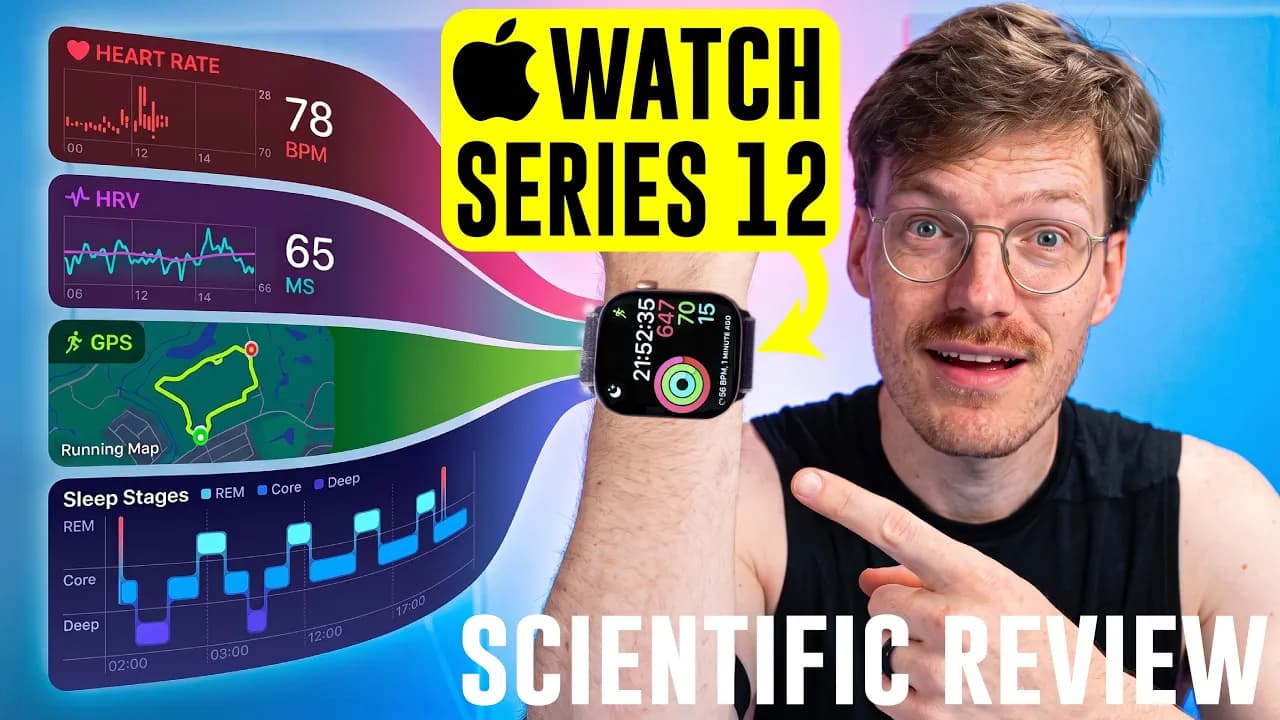
Apple Watch Series 12 - First Scientific Test!
In a Nutshell
The Apple Watch Series 12 delivers near-perfect heart rate accuracy during indoor cycling (R=1.0) and strong performance in running (R=0.98) and weightlifting (R=0.97) versus a Polar H10 chest strap. Step counting shows a median error of just 5 steps per 1,000, while GPS tracking is acceptable but inconsistent around obstacles. Overall, the Series 12 outperforms most competitors in exercise tracking and appears optimized for all-day continuous monitoring rather than peak performance.
These notes were generated by AI and may contain inaccuracies.
Apple claims the Series 12 has the most accurate heart rate sensor of any wearable. Testing methodology involved comparing the Apple Watch Series 12 against an ECG chest strap (Polar H10) similar to how Apple tested it. Additional testing included manual step counting, GPS accuracy assessment, and weightlifting exercises - the exercise type that has traditionally caused Apple Watches the most difficulty. The tester is a post-doctoral scientist specializing in biological data analysis.
Indoor cycling was tested as one of the easier exercises for devices to track. The reference device (Polar H10) is displayed along the horizontal axis with the Apple Watch Series 12 heart rate on the vertical axis. The correlation R value is rounded to 1.0, indicating essentially perfect correlation. A single indoor cycling session was tested with the reference shown in blue-green and Series 12 in red. The Series 12 tracked all intervals correctly with no complaints about performance.
Running showed a correlation of 0.98, slightly lower than indoor cycling. Traditionally, Apple Watches have struggled with running on this tester. Minor deviations appear in the higher heart rate range, specifically at the beginning of the run. Despite these small deviations, overall performance remains good for running.
Weightlifting is identified as the hardest exercise for Apple Watches and all devices tested. The correlation achieved was 0.97. Unlike many devices that detect too low values in higher heart rate ranges due to wrist tension, the Series 12 does not appear to have this issue. Traditional Apple Watch problems include dropouts at peak heart rate values, where Apple has historically prioritized quality over quantity by dropping unreliable readings.
The Series 12 performed better than expected with many peaks at least mostly detected, though not fully detected. Testing was divided into two sections: chest and triceps exercises. Bench press was performed on the left side and dips on the right side. This represents a very initial test but compares favorably to competition.
Comparing the three exercises (spinning, running, weightlifting) with correlation against the reference device on the vertical axis:
- Indoor cycling: performed better than 92% of devices tested
- Running: performed better than 23% of devices tested despite minor deviation
- Weightlifting: performed better than 85% of devices tested
The Series 12 results are compared to long-term testing of the Apple Watch Series 11, showing similar correlation results. The Series 11 had better running performance, suggesting Apple may still be tweaking algorithms for the new sensor. The previous sensor had more time for optimization, but overall performance remains very good.
Step counting testing involved only true positive testing - verifying that steps taken were counted. Manual counting was performed by pressing a button for each step taken across roughly 5,000 steps in sequences of approximately 1,000 steps each. Data was recorded on a cardboard board and transferred to Excel for analysis.
Results showed:
- Maximum difference of 14 steps over 1,000 steps
- Differences across five segments: 0, 3, 5, 5 steps
- Median step difference of approximately 5 out of 1,000 steps
Testing included alternating carrying the counter in right and left hands, with the Apple Watch always worn on the right (dominant) wrist as set in the app. Two games were carried during the last two segments. Step counting performance is described as really good.
GPS testing involved running in a rectangle shape multiple times, with good GPS tracking indicated by overlapping signals. The Series 12 performance is described as somewhere in between - not great but not terrible. The first part of the run showed bigger deviation, then appeared to lock in and improve on the left side. The right side showed more deviation due to a bigger wall interfering with GPS signal.
Satellite view revealed the GPS path going through bushes on corners. Performance is not ideal but good enough. The tracking appears smooth around corners with some initial signal acquisition weirdness. More updates and longer-term testing may show improvement.
The Series 12 shows pretty good heart rate tracking as expected. Potential for further improvement exists as Apple becomes more familiar with the new sensor and adapts algorithms. Running may see particular improvement. The impression is that Apple is focusing on power efficiency for continuous heart rate tracking throughout the day rather than just exercise periods, while maintaining all-day battery life.
Long-term testing will examine continuous heart rate accuracy during non-exercise activities like working or walking. Battery life comparisons will include the Ultra 3 or Ultra 4 for those needing longer battery life. The tester notes issues with data export due to large amounts of data in Apple Health preventing loading into computer systems.
Keep The Quantified Scientist in your library
Save the videos and channels worth coming back to, and find them again in one place.