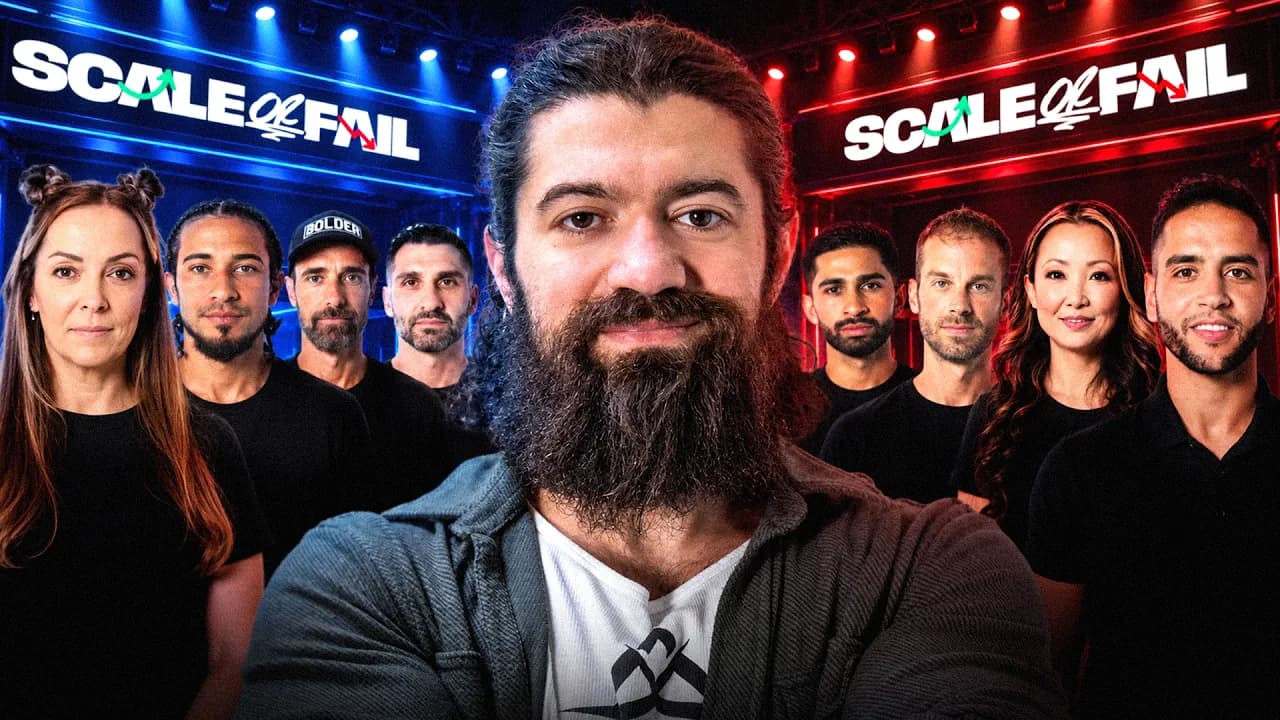
Building a $6,000,000/yr Business for a Stranger in 36 Minutes | Scale or Fail - Episode 3
In a Nutshell
Alex Hormozi shows how Tina Sue's autism treatment business can scale from $770K to multi-million revenue by replacing 3-4 hour unstructured sessions with a 45-minute structured webinar, implementing a $2,500 self-service vs $3,000 one-on-one pricing tier, and using AI to handle DM responses. Key changes include moving to weekly webinars instead of launches, pricing the $150/month membership at $750-800 or eliminating it, and reducing DM time from 30 hours to 3-5 hours weekly. The core constraint is Tina's resistance to systematizing sales and delivery processes that would let her help more families rather than fewer.
These notes were generated by AI and may contain inaccuracies.
Alex Hormozi introduces Tina Sue, a competitor in a challenge to win $100,000 and a golden ticket for a year of guidance from his team behind a $250 million per year portfolio. The winner will move on to the finale for the grand prize. Tina explains her mission to help parents of children with autism, ADHD, and speech delay, with a vision to change mainstream views on autism treatment through examples of healing children.
Tina Sue reports her business generated $770,000 in revenue over the last 12 months with $555,000 in profit, achieving a 72% profit margin. Her core product is called Hi Mama, a group program helping children with speech delay transition from non-verbal to speaking their first words while reducing autism symptoms. The offer is priced at $2,500 for the year, consisting of a 3-month intensive followed by 9 months of aftercare.
After completing the Hi Mama program, Tina sells customers an all-access pass that grants access to every cohort and the 3-month intensive for continued progression. Tina identifies her primary constraint as doing everything herself including all Instagram conversations, marketing, and delivery. She handles customer service alongside her team and reports having no time for low-hanging fruit tasks. She states she does not conduct sales calls.
Tina explains her motivation stems from healing her own son who had autism, ADHD, and epilepsy. After conventional medicine and seven ADHD medications failed, she pursued holistic approaches including dietary and environmental changes. Within two years, all symptoms went into remission. She previously built another business to $20 million while caring for her infant son, working between 8:00 p.m. and 2:00 a.m. She paused that business to focus entirely on this mission.
Alex asks whether Tina's current business model can scale, and she acknowledges it likely cannot reach the scale she wants without modifications. Alex notes that Tina appears to associate charging more, implementing upsells, or standardizing sales processes with negative connotations. He emphasizes that structuring these elements will enable helping more families rather than fewer.
Alex outlines a back-to-front methodology: fix the offer first, then the conversion process, then traffic generation. He identifies that Tina currently runs unstructured 3-4 hour Monday sessions instead of a formal webinar pitch. Tina admits resistance to creating webinars because she doesn't want participants to feel "sold to."
Alex reframes Tina's concern by explaining that people only feel sold to when the selling is done poorly, and good selling feels good. He notes that Tina's 3-4 hour sessions cover points that could be addressed in 45 minutes. The structured webinar should include a big promise at the start explaining why viewers should stay, followed by Tina's origin story showing the old way versus the new way, then addressing the three biggest concerns parents have about the approach.
Each concern follows a pattern: what they think (their belief), why that's wrong, what's right, and proof (statistics, stories, or other evidence). Alex explains this approach will increase conversion rates from the current 9% by making the presentation more visually stimulating with slides and structured content. Tina is currently selling to a warm audience through existing relationships, but scaling requires selling to cold audiences who don't already know her.
Currently, 10% of customers take the all-access pass upsell. Alex recommends changing to a 6-month recurring model instead of annual, with the 3-month intensive followed by 3-month aftercare. He advises selling the upsell at the halfway point, two-thirds point, and end of the intensive rather than only at the end, which could increase conversion from one-third to two-thirds or more. Tina currently sells most to people in aftercare near the 12-month mark.
Alex recommends implementing a $2,500 checkout price for self-service and a $3,000 one-on-one price for those requiring direct consultation, creating a $500 premium for personalized attention. He suggests categorizing all DM conversations into FAQ buckets and addressing the most common questions (ranked by frequency) during the webinar FAQ section rather than handling them individually afterward.
Alex recommends offering a three-day "no sweat" guarantee to address concerns about spousal buy-in, noting this is legally required anyway. He advises completing onboarding the day after purchase to reduce refund likelihood by delivering value immediately. Tina currently offers bonuses for purchases made during live events.
Tina has a $150/month membership for one-on-one coaching with her team. Alex states this is significantly underpriced and should be either five times more expensive ($750-800/month) or eliminated entirely. He emphasizes that pricing affects buying behavior, and the current structure makes the one-to-many offer appear less valuable compared to the one-on-one option.
Alex suggests implementing AI to create an agent that searches Telegram conversations for similar past responses and suggests answers to the team. This would create a dashboard where team members can review, edit, or approve suggested responses rather than searching through Telegram directly, dramatically increasing delivery team leverage.
Alex recommends running the structured webinar weekly rather than only during launches. He suggests inviting all parents who have expressed interest via DM to attend live sessions, creating a consistent pipeline rather than batch processing during launch periods.
The shift from 3-4 hour marathon sessions to a structured webinar format allows for consistent delivery without repeating the same conversation 100 times. The weekly webinar operates as organic traffic while launches remain paid. The waitlist serves launches specifically because they require more razzle-dazzle presentation.
The structured webinar maintains the same core content whether used for launches or organic traffic. Live participants can be brought on for proof points during launches, though this is optional. Bi-annual renewals eliminate the need for upsell timing adjustments that would otherwise matter between 6-month versus 12-month payment plans.
Pricing is structured to reduce direct DM requests by offering a cheaper price point with bonuses for immediate purchases. One-on-one purchases exclude the bonus and cost more. During calls, exceptions can be made by stating "I'm not supposed to do this but I'll give you the bonus" when asked. This creates psychological permission for the upsell while maintaining the core offer structure.
Vibe code delivery increases team leverage. The pitch includes a "no sweat" guarantee and FAQs to address spouse concerns. The offer now includes automatic renewal at the correct point with structured conversion processes.
With 200+ unposted testimonials available, the focus shifts to posting existing content rather than creating new material. Q&A sessions generate 30-50 actual questions per week across live calls, creating 30-50 potential posts weekly when captured and edited.
The same questions repeat across cohorts, but the audience perceives them as new. This mirrors Dave Ramsey's approach where fundamental advice about spending less and saving more remains relevant regardless of repetition.
Q&A content gets edited into bite-sized posts using AI editors or offshore editors for the repeatable cutting process. Questions from Telegram with high engagement receive green screen answers where the question appears behind the speaker who reacts to it, similar to reaction videos. An AI voice can read questions before responses.
Hooks should avoid starting with "A lot of people have been asking me this question" as this creates a weak opening.
All platforms funnel to Instagram as the single conversion point. YouTube Shorts descriptions direct viewers to DM on Instagram. TikTok bios state "DM me on Instagram." This consolidation pushes traffic toward the webinar.
Content volume increases to 3-4-5 posts daily per platform through Q&A captures and green screens, reaching 20-30 posts daily per platform. Winning content becomes ads targeting the launch or waitlist. Organic posting continues initially, with potential evolution toward weekly webinar ads.
A 3-second delay on video banners improves traffic quality. The hook plays first, followed by the CTA button appearing after the delay, remaining visible thereafter.
The goal is removing the business owner from DMs entirely. One team member can direct people to the webinar. AI automation handles initial responses on Instagram. A fractional version of the owner through team delegation outperforms full-percentage responses from non-experts.
Making more money enables helping more families, including those who cannot afford paid services. The business requires profit to grow. Helping more people through free content while offering paid options for deeper assistance represents the middle ground between "starving artist" and "soulless corporation."
The structured webinar reduced DM time from 30 hours weekly to 3-5 hours weekly, representing a 90% reduction. Team members now handle initial questions and direct people to the webinar. The business has 7 employees excluding coaches, 12 including coaches, positioning between the 5-9 and 10-19 employee scaling phases.
Product decisions include eliminating lower payment plans (12-month and 8-month options) and one-on-one services or pricing them significantly higher. Sales materials now include the webinar structure. Niche-down messaging through short videos feeds into ad campaigns. Customer service playbooks enable team members to review past responses and make suggestions for approval.
The mechanics of the scaling plan are straightforward given affiliate marketing background. The critical uncertainty centers on emotional capacity to stop answering every individual DM in favor of local costs creating global benefits. Steve Jobs, Elon Musk, and Bezos cannot respond to every customer service request because they chose to help more people at scale.
The 12-month goal is 500 new clients plus certification programs. The decision to scale requires committing to execute the plan without deviation. The assessment gives benefit of the doubt based on execution capability while acknowledging the emotional challenge of prioritizing global impact over individual DM responses.
Keep Alex Hormozi in your library
Save the videos and channels worth coming back to, and find them again in one place.