Building the First Data Centers in Space
In a Nutshell
StarCloud is building data centers in space to bypass terrestrial energy constraints, using cheap solar power and plummeting launch costs. The company launched the first H100 GPU in orbit on StarCloud 1 for $2M (vs. $75-100M quoted), solved radiation and thermal challenges through testing and immersion cooling, and filed for an 88,000-satellite constellation delivering 20 gigawatts of compute. They've raised $170M and are now developing space-optimized chips with Nvidia while winning DoD contracts.
These notes were generated by AI and may contain inaccuracies.
First thing every space company should do is book the first available launch they can before they built the thing that they're going to launch, before they built the thing, before they probably even know what they're going to launch. Booking a launch is such a good forcing function for a space company. The company was founded January 1st 2024. January 2nd they booked the first available SpaceX ride share launch and decided something is going to be on that rocket.
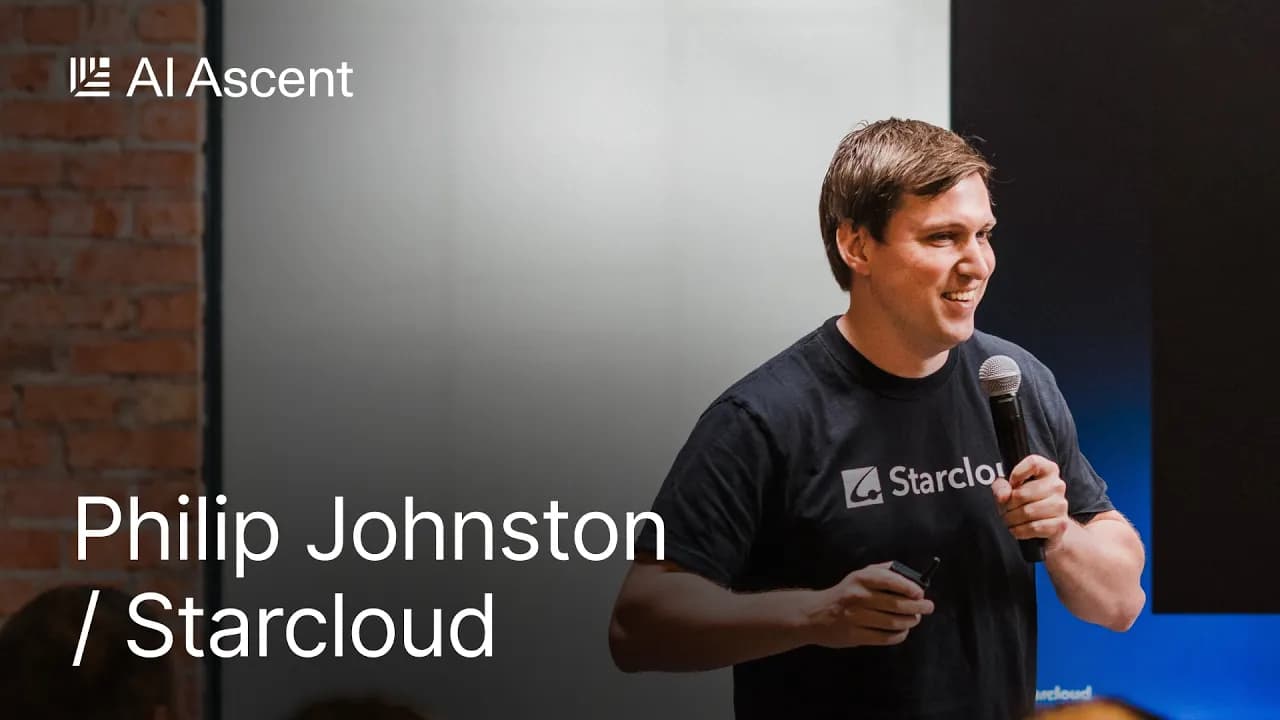
Welcome to another episode of the Light Cone. Philip Johnston is the co-founder and CEO of StarCloud. StarCloud is building data centers in space to address the energy bottleneck that AI is creating here on Earth. Earlier this year, they raised $170 million led by Benchmark and became the fastest growing unicorn in YC history just 17 months after demo day.
The company is running up on constraints on where new energy projects can be built terrestrially. By building them in space, they get access to almost unlimited low-cost energy in the form of solar. The cost of launch is actually very rapidly trending down with new launch vehicles coming online, including the Falcon 9 program and Starship on the horizon.
Philip had been working with McKinsey for a few years working with the space agencies of different governments and could see that the launch cost was very rapidly trending down. In early 2023, he decided randomly on a weekend to take a trip down to Starbase Texas where they're building the Starship launch program even before the first launch. Not many people were paying attention back then. He could see that they were building enormous capacity with two Starship gigafactories designed to produce something like three Starships per day.
Because Starship is reusable, on a three or four year time frame, that could lead to having thousands of times the capacity to get things to space. The thinking was: if the launch cost was 10 times lower than it is today, and the launch capacity was maybe a thousand times more than we have today, what would make sense that currently doesn't make sense?
Started thinking about concepts from sci-fi like space-based solar where you have these huge solar panels in space and beam that power down. Reached out to folks known in the space industry and started ideating on what would make sense if the launch cost was much lower than it is today.
Tons of ideas occurred during this process. They looked at manufacturing in space, asteroid mining, Astroforge from YC, and space hotels. Basically anything which could make sense if the launch cost was a lot lower than it is today.
Data centers makes a lot of sense to be the first thing you do because you don't need to re-enter a product. With things like asteroid mining or manufacturing in space or space hotels, they require this very expensive re-entry process.
Initially they started doing space-based solar with huge solar panels beaming power down, a concept from the 60s, even Asimov in the 40s was writing about it. The problem with space-based solar is you actually lose 95% of the energy in transmission from space to Earth.
For the first two months of the company, that was literally what they were doing. They were called Lumin Orbit because of luminosity in orbit. They were thinking once they get that power down, what are they going to be using it for? Even back in 2023, most new energy projects were being built for data centers.
They initially ran the numbers to know what's the launch cost break even that makes sense for space-based solar and came to a number of like $50 a kilo. Then they reran the calculations and figured out what the launch cost break even would need to be to make data centers in space break even, coming to a much closer to reality number of $500 a kilo.
StarCloud 1 launched in November of 2025. They set this launch date 18 months in the future and initially started with something quite unimpressive like flying some Nvidia Jetson chips that have been flown in space before, trying to do some new workloads on there. ADI came on and said they need to do something way cooler than that.
They ended up putting five GPUs on there: three from Nvidia, two from ARM. The most interesting one was an Nvidia H100. They had to put it through thermal cycling and didn't have time to book the vacuum chamber. They needed to know if heating up this phase change material and cooling it down was going to crack anything.
At 5:00 a.m. the day they had to ship it down, working through the night, Ezra was dunking this thing in an ice bath to cool it down. Then they pulled it out the ice bath and used hair dryers to heat it up and melt all the wax, then dunking it back in the ice bath.
It is a miracle that it works. This is the kind of thing you can do as a startup because they actually had a quote from one of the primes on what it would cost to do StarCloud 1 and they said $75 million to $100 million, and they did the whole of StarCloud 1 including the launch for $2 million.
They got the most incredible separation video. Half the time as it deploys it will be behind the shadow of the earth and you don't see anything. The other half of the time it will deploy not into the silhouette of the Earth. This was played by Jensen as he walked on stage at the GTC conference this year on a five story tall screen behind him playing the StarCloud 1 separation video.
The whole team went down to Florida. There was only 12 in the team at the time of StarCloud 1 launch. They had a hundred friends and family investors. Some of the team brought their family and kids down. It was a really nice day.
The rocket lifted off at around midnight and then at 1:00 a.m. they closed the bleachers and everyone had to get on a bus and leave. Philip was sitting in the back of a cab watching the live feed on SpaceX.com when it started deploying. It took about 12 hours to make first contact, which is not bad since it usually takes at least 24 hours to get first contact.
Then there was a two-week commissioning period. They had software issues where the whole satellite kept restarting every 2 hours. One of 20 different failure triggers was triggering and they didn't know which one it was. They could only get a ground station pass every hour and a half maybe longer. They had to manually turn off each one, turn back on everything else and wait for a ground station pass to know which one it was. That took 3 days just to figure out that software issue.
Two weeks after that they started commissioning and turning on all the different payloads. They trained the first model, ran the first version of Gemini, did the first fine tuning of a model in orbit, did the first high power inference on satellite imagery.
StarCloud 1 travels around 17,000 mph and it's about an hour and a half to do one circumnavigation. From StarCloud 3 onwards, they'll have 88,000 satellites and they'll all fly in what they call mid-inclination orbit, so it doesn't go over the poles. This one doesn't even fly in the right orbit but at least it enables them to test the hardware. The next one will fly over the poles, which gives 24-hour always in the sun.
In order to do that, you need to put thrusters on the satellite to move it into that orbit. In the end, they will be deployed in that orbit, but you need thrusters anyway to maintain the orbit because you have drag from the upper atmosphere there.
The core problems to solve are: how to get rid of heat in a vacuum, how to handle radiation that can flip bits in processors, how to send all the data back and forth to Earth, how to get the solar panels to become really big and expand, and cooling since space is cold but there's no air to circulate it back.
The two biggest ones that are outstanding and most of the engineering team is split basically 50/50 down these two lines are: number one, how do you get rid of this heat in a vacuum, and number two, how do we make the chips work in a higher radiation environment.
The interconnect has been solved by signing a contract with SpaceX for the next 20 satellites to have a Starlink laser terminal that gives very high bandwidth, low latency connectivity.
For thermal management, they are building a very large low-cost and low-mass deployable radiator. Radiators in space are not new physics, it's more of a manufacturing and engineering challenge. The international space station has had a radiator which dissipates lots of heat already using a very similar mechanism with a liquid cooled loop.
The challenge is making it cheap and light. Their radiator is at least 10 times less mass per watt of dissipation than the ISS radiator and 500 times less cost per watt of dissipation than the ISS radiator.
For radiation, they've done several rounds of testing at the Brookhaven National Lab particle accelerator for heavy ions and at the cyclotron for high velocity protons down in Knoxville. They expose it over a 24-hour period to the same radiation dose that you would have in a 5-year mission. That telemetry and data then informs their choice on both shielding and software to mitigate bit flips.
They are the only people in the world now that know where both an H100, a B200, and H200 will fail if you blast it with high velocity protons and heavy ions.
They do both shielding around the electronics and component selection. For example, all of the SSDs, all of the power delivery system, all of the power converters, they test 10 components and whichever the best one is, they pick. They're trying not to use space rad-hard components, trying to use off-the-shelf like automotive style components because it's way cheaper.
They're in LEO, not GEO.
For a very long time, people's reactions were that this is the dumbest thing they've ever heard. They tried to apply to YC once and got rejected. They tried to raise $2 million at 10 posts on a SAFE and it took 3 months and they got rejected from at least 100 VCs. Even after YC, when they went out to raise after demo day, they got rejected from at least 20 VCs before they got to the first check.
People had a hard time visualizing a world with low-cost launch. It just sounds too sci-fi. To make this work, there's a convergence of two factors: the launch cost coming down, and it becoming way harder to build stuff terrestrially. Maybe two years ago that wasn't quite as obvious as it is today. Now people are seeing that they just banned building new data centers in New York and they're going to ban it in seven other states.
The reason for confidence is having such a strong engineering team. Having the world's best space engineers saying this is possible, with full confidence in two co-founders, one from SpaceX and the other was building satellites for NASA.
The advice for all space companies is that the first thing every space company should do is book the first available launch they can before they built the thing that they're going to launch, before they built the thing, before they probably even know what they're going to launch. Booking a launch is such a good forcing function for a space company.
They founded the company January 1st 2024. January 2nd, they booked the first available SpaceX ride share launch. It was cheap, like $300,000. It was 18 months out and then it got pushed to 21 months out.
What they initially planned to launch was very unimpressive. It was going to put a Jetson chip which has been flown on many satellites before and use it for edge processing. They actually had a co-founder change quite early on and when they got Addy from SpaceX, Addy was like that's lame, let's put an H100 on there.
The amount of people who said it was physically impossible to run a chip that's that power dense in orbit. People just thought it was literally impossible to run data center grade GPUs on orbit.
There are two things: the thermal side of things since they're very power dense and produce a lot of heat, and they had never been tested in the radiation environment of space.
For the thermal solution, they submerged the entire thing in this phase change material so everything on StarCloud 1 is submerged in this immersion cooling for all of the components, all of the power delivery, memory, everything is submerged. It's not a particularly scalable solution since you have quite a low duty cycle and have to wait for it to melt and then it solidifies every so often, but it enables proving that you can run the H100 in space.
The next one is a direct chip liquid cooling architecture that can run continuously. To get to a data center that's commercial scale where you can actually make money on it and make it profitable, it's going to require many steps.
The first step was booking whatever the first launch lowest MVP available. The second step is producing something which is a product they can sell to customers, that's StarCloud 2, a 10 kilowatt spacecraft that they can sell compute to government and military satellites.
The third step is the product that they're going to be able to sell to hyperscale data centers, that's StarCloud 3. It's a 200 kilowatt, 3 ton spacecraft, about 6 meters long. With that they can fit 50 of them per Starship, so about 10 megawatts of new compute capacity per Starship.
They've just filed with the FCC for a constellation of 88,000 of those. That means on the order of 20 gigawatts of new compute capacity. They can fit up to 10 terawatts in the dawn sun synchronous orbit, so that's like 20 times the entire US power grid.
The largest data center deployment on Earth is about a gigawatt. The timetable is very dependent on the launch cost. Estimates for Starship if you believe Elon it will be end of this year, but let's say end of next year, early 2028 for Starship deploying and ramping up the launch cadence. They're actually phasing out Falcon 9 so they're going to be moving over commercial customers to Starship.
There are also a whole bunch of other launch vehicles coming online: Stoke Space has the Nova rocket, Rocket Lab has Neutron, Blue Origin has New Glenn. End of 2028 is when they're starting to ramp up for the terrestrial business competing with terrestrial data centers.
Initially it's government and military. They've just won four contracts with various DoD and government entities. Initially also it's people who want that compute for other purposes in space.
Right now many satellites are very constrained with the amount of data they can downlink. Using optical terminals, they'll have three optical terminals on their second satellite. They can ship enormous amounts of raw satellite imagery and SAR data, synthetic aperture radar data to them. They then process that on orbit and can just downlink very quickly the insight from that, and the insight might be the coordinates of a vessel or something like that.
The transcript cuts off mid-sentence while discussing partnership with Nvidia around chip design and potential changes needed to the design as they reach scale.
StarCloud is working very closely with Nvidia on the Reuben Space chip, also called Reuben One, which is specifically designed for the space environment. The company heavily modified the H100 GPU to work in space by stripping out components like AC to DC converters, cold plates, and other elements, then stiffened the board and made it radiation tolerant. This modification process has generated valuable data on how high-power GPUs operate in space, making StarCloud the only entity with such operational information.
The team is collaborating with Nvidia on designing this new space chip, focusing on simple modifications that make chips significantly more effective in space environments.
StarCloud's solar panels generate DC power directly, eliminating the need for AC to DC conversion. The company uses DC to DC converters instead, which are much more efficient than AC to DC converters. This approach avoids significant power losses that occur during AC to DC conversion, making solar panels more efficient overall.
This technology could unlock GPU data centers powered by solar energy in various environments, including space, underwater, and on Earth.
StarCloud 2 will include a Bitcoin mining ASIC, scheduled to launch next year. The crypto community has shown significant enthusiasm for this development. The company will also fly additional H100s and Blackwell chips on this mission.
StarCloud is partnering with AWS to launch their Outpost hardware, which provides on-premises server blades that run local instances of cloud services. This will be particularly useful for military customers.
When StarCloud first attempted to raise $2 million at a $10 million post-money valuation at the end of 2023, it took three months to secure funding, with approximately 100 VCs declining the opportunity. Deep tech and hard tech in space were not considered attractive investment areas at that time.
After YC, the company faced continued difficulty raising funds, getting rejected by at least 20 VCs before receiving their first check on demo day. The investment landscape has shifted dramatically over the past six months, with increased appetite for deep tech investments.
The shift in investor sentiment appears linked to the recognition that software no longer provides strong competitive moats. The public market reaction to Claude code's release, which caused SAS stocks to decline, directly influenced demo day sentiment, with investors suddenly prioritizing hard tech investments.
Benchmark made StarCloud their first space investment, led by partner Chathan. The investment decision was based on recognizing a strong technical team working on something that could be transformative if successful.
The major funding round was more challenging than it appeared externally. Several VCs with existing SpaceX positions became conflicted when SpaceX publicly announced they were pursuing similar initiatives mid-round. Despite these obstacles, the round eventually came together more quickly toward the end.
Chathan conducted extensive due diligence, spending significant time with the engineering team and reviewing team backgrounds. The team consists of the world's top space engineers, with half coming from SpaceX and the other half from hyperscalers. The investor's confidence stemmed from the team's capability to solve complex technical challenges rather than relying on external validation that the approach was feasible.
Co-founders Addy and Ezra were recruited through different channels. Ezra was contacted after a visit to Starbase, Texas, with the initial concept being space-based solar power. Addy was introduced through mutual connections and had already been considering similar ideas, having registered stellaccloud.com.
The hiring approach has been deliberately slow and selective. After YC, despite raising $11 million at a $40 million valuation, it took six months to make the first hire, securing a top-tier space engineer. Even after raising larger rounds, the company maintains only 20 engineers plus one commercial hire from the Space Force who worked on Golden Dome.
Philip has been advocating for space data centers on Twitter for three years, consistently posting about why data centers in space would make sense. The validation has been surreal as major industry players including Google and SpaceX have embraced the concept, recognizing that a significant percentage of future data centers will likely be located in space.
Philip's background includes five years as a software engineer with undergraduate and master's degrees in math and physics, followed by McKinsey work on the commercial product side. During McKinsey, he worked on projects with national space agencies on satellite missions, where he first noticed rapidly declining launch costs.
Lacking a space engineering background, Philip recognized the need to recruit world-class space engineers. Following YC advice, he prioritized assembling an exceptional space engineering team before finalizing the specific business idea.
Ezra and Philip grew up in the same area in the UK. Philip contacted approximately 10 space engineers, with 2 agreeing to join. The pitch to potential co-founders was straightforward: develop ideas that would be commercially viable if launch costs were 10x lower than current levels, with Philip handling commercial aspects while co-founders focused on satellite technology.
During the YC batch, StarCloud was viewed as viable only if it could achieve lower per-unit compute costs than ground-based alternatives. However, this requirement may no longer be necessary for success due to growing political opposition to AI data centers in democratic countries, with examples including New York's blocking of data center construction.
Building data centers in space offers significant regulatory advantages compared to terrestrial locations. The regulatory environment for space-based infrastructure is considerably more favorable than the increasingly restrictive ground-based data center approvals.
Water consumption concerns for data centers are primarily a function of power usage rather than an inherent requirement. Data centers can be cooled without daily consumptive water use by allocating additional power to cooling systems. Major data center companies are now proposing closed-loop systems that consume minimal water.
A large data center consuming hundreds of megawatts would use approximately the same amount of water as a McDonald's restaurant, making water consumption concerns largely unfounded.
Most new power projects for data centers are being built with natural gas generators due to insufficient grid capacity. Data centers do not compete with existing grid resources when new power generation is constructed specifically for them.
Evidence suggests that adding data centers can increase grid capacity over time and potentially lead to lower electricity prices. The combination of AI demand, data center requirements, and national security implications positions space-based compute as strategically important for maintaining technological leadership.
The space industry is in its early stages with enormous growth potential, particularly given the substantial launch capacity expected to come online over the next five years. Technical talent on the founding team should be the primary focus, following YC's core advice, with everything else developing from that foundation.
Keep Y Combinator in your library
Save the videos and channels worth coming back to, and find them again in one place.