Buy the Dip Now or Wait for Lower Prices?
In a Nutshell
Markets have pulled back sharply, hitting semiconductor stocks like Micron and SanDisk especially hard, yet these remain at low forward PEs with multi-year sold-out backlogs. Beginners should start tiny—one share only—to learn drawdowns and risk tolerance without emotional or financial damage, while avoiding leverage and overleveraging entirely. The core rule: control position size and conviction, not market direction or news.
These notes were generated by AI and may contain inaccuracies.
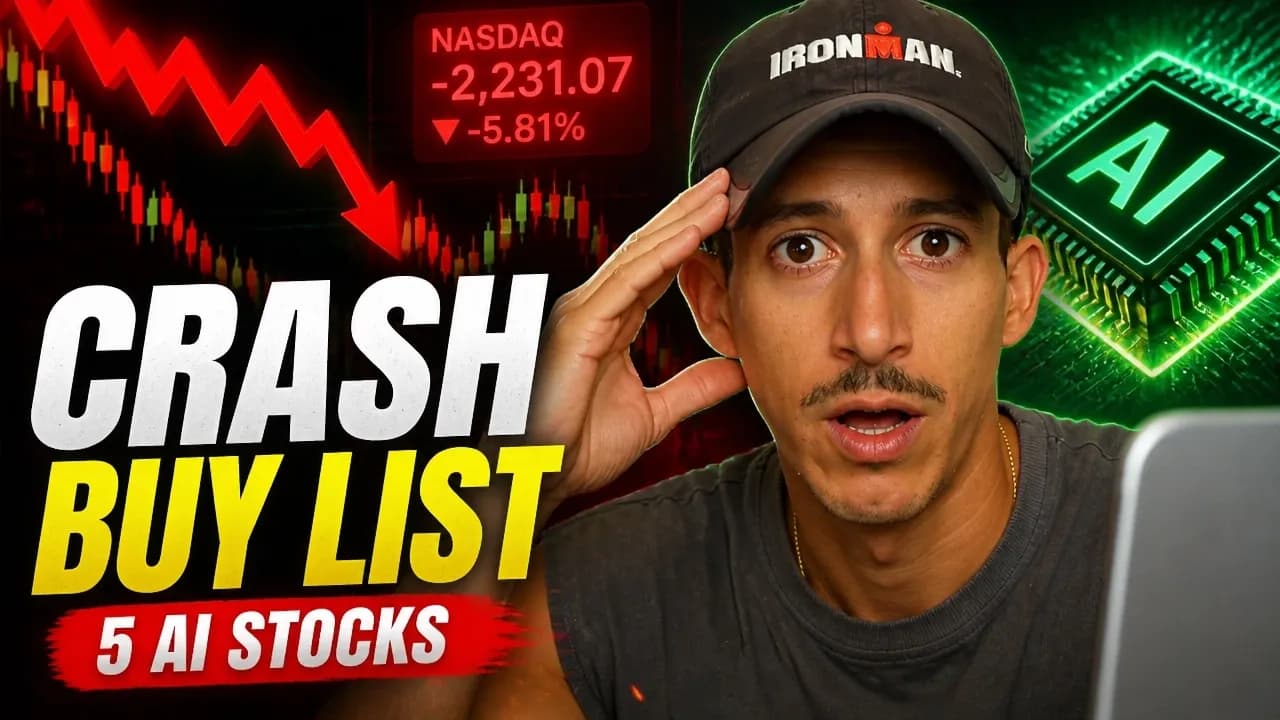
Markets have pulled back 7% from all-time highs, prompting widespread concern and second-guessing about whether to buy the dip or wait for potentially lower prices. The current situation involves escalating tensions in the Middle East, with the ceasefire ending and renewed attacks on Iran since July 7th. Oil prices are rising again after inflation data showed improvement in June during the ceasefire period. This raises questions about whether July inflation will come in higher due to elevated oil prices.
The primary market discussion centers on semiconductors and memory chip stocks, including Micron and SanDisk, which were among the best-performing stocks of 2026. Micron is currently down 30% and SanDisk is down over 40% from recent highs. Despite the pullback from an insane rally, these stocks remain trading at very low PE ratios. The forward PE ratio for Micron is described as incredibly low. Some analysts have pointed out that these companies have historically been cyclical, experiencing periods of huge demand catalysts followed by sharp declines, though current conditions show companies sold out for the next two to three years with infrastructure being built that wasn't previously constructed.
The broader NASDAQ market, tracked by QQQ, is down approximately 7% from all-time highs. However, individual semiconductor stocks have taken significantly larger hits over the past two to three weeks. Looking at the daily chart, there is potential for a larger gap down if the NASDAQ sells off to end-of-March levels, which would represent a 20% retracement from current levels. The NASDAQ functions as an incubator where individual stocks fall even harder when the broader market declines, with overhyped and overvalued stocks potentially correcting even more severely.
For someone just getting started as a complete beginner, the focus should be on gaining experience rather than making significant profits. A common saying notes that some of the best investors are skilled at doing nothing for extended periods. The recommendation is to keep it simple by selecting one or two companies to invest in, focusing on those believed to be fundamentally good deals with long-term conviction. This approach applies particularly to AI and memory chip space investments, which have been trendy, though these stocks have experienced significant hype and price momentum that could lead to harder corrections.
A recent article highlighted that over a million traders in South Korean markets were overleveraged and subsequently liquidated, representing approximately 3.4% of the adult population. The key mistake identified was becoming overleveraged at overbought levels during uncertain times. The critical principle is that while market direction and external factors like Federal Reserve policy, Trump statements, Middle East developments, and inflation trends remain outside individual control, investors can control what they invest in and how much they invest. The first investment should not be expected to generate millionaire status or $100,000 returns.
The accessibility of trading platforms has lowered barriers to entry, allowing anyone to buy and sell stocks, which isn't always beneficial as it can turn intended investments into trades. The suggestion is to start with just one share of a chosen company to gain experience without devastating losses. For example, if buying Micron at $8.30-$8.40 and it drops another 10%, the loss on one share would be approximately $0.83, which most people can tolerate. This allows for mathematical exercises: calculating what a 10% move would mean on a $10,000 investment ($1,000 gain or loss) or a 20% move ($2,000 gain or loss).
Starting with minimal positions enables learning about drawdowns and emotional responses without significant financial risk. The process involves experiencing market movements firsthand, doing the math on potential gains and losses at different position sizes, and understanding personal risk tolerance. This approach prevents the investment from turning into active trading unless that was the original intention. Most investors seek passive, long-term growth rather than the stresses of active trading, which requires significant time dedication and stress tolerance, especially on red days or with oversized positions.
For impulsive investors, using a financial advisor can create a beneficial barrier where trades require contacting someone else to execute, adding an additional step that may discourage impulsive decisions while still allowing personal investment choices. The key message emphasizes that investors have nothing but time and should prove to themselves that investing can be profitable through simple, small steps rather than overcomplicating the process.
Overleveraging carries dual risks: if markets decline further, investors may become discouraged and abandon investing entirely; if markets recover and generate large profits through luck rather than skill, investors remain vulnerable to giving back gains on subsequent bad trades without proper risk management understanding. The current drawdown in semiconductor stocks may make entry points attractive, but the choice of stocks or ETFs should align with individual conviction, not limited to semiconductors.
Several trading applications are mentioned as free and US-regulated options, with links provided in the video description. For those with full-time jobs or businesses as their primary focus, active trading may not be suitable due to time requirements and stress levels. Investing Pro software is referenced for fundamental analysis capabilities, also linked in the description. The overall message emphasizes that when in doubt, cashing out is acceptable, and beginners should avoid leverage entirely.
Keep Ricky Gutierrez in your library
Save the videos and channels worth coming back to, and find them again in one place.