Can This New Battery Design Save Electric Vehicles In The U.S.?
In a Nutshell
GM's Wallace Battery Cell Innovation Center in Michigan drives its EV push with $900M+ investments in LMR (lithium manganese-rich) batteries, enabling 400+ mile range in trucks like the Hummer EV at lower costs by favoring cheap manganese over cobalt/nickel. Amid Biden's 2021 snub favoring GM over Tesla and recent $7.1B losses from slumping sales, GM scales production at Factory Zero and gigafactories for 13 EV models, targeting full North American battery independence from mines to vehicles. LMR chemistry and advanced R&D position GM to compete in affordable, high-range EVs despite market challenges.
These notes were generated by AI and may contain inaccuracies.
In August 2021, President Joe Biden held an electric vehicle summit at the White House without inviting Elon Musk or anyone from Tesla. Biden credited GM with leading the electric vehicle revolution: "You electrified the entire automobile industry. I'm serious. You led and it matters." These moves led Musk to publicly embrace Donald Trump. Tesla reshaped the auto industry and turned electric cars into a reality. GM and other American automakers were EV laggards.
The Wallace Battery Cell Innovation Center is on GM's campus in Warren, Michigan, outside Detroit. Scientists and engineers there aim to show GM takes electric vehicles seriously.
"This is Godzilla."
Andy, a battery engineer at General Motors, delivers their message.
"My name is Andy. I'm a battery engineer at General Motors."
Andy had a soul-searching moment a few years ago due to his kids and wanting a better planet. He emailed GM's CEO about relating the mission statement more to the environment. The CEO forwarded it to communications. A year later, Andy learned about the zero-zero-zero vision: zero crashes, zero emissions, and zero congestion.
GM has quietly built an electrification powerhouse, investing close to $900 million in the Wallace Battery Cell Innovation Center and the adjacent Battery Cell Development Center for full-scale prototype cells at rate. The new Battery Cell Development Center (gray walls, under construction in 2023) will build 100x more cells per week than the current facility. GM has investments in gigafactories in Ohio and Tennessee, producing about 300,000 cells per day—far more than prototypes.
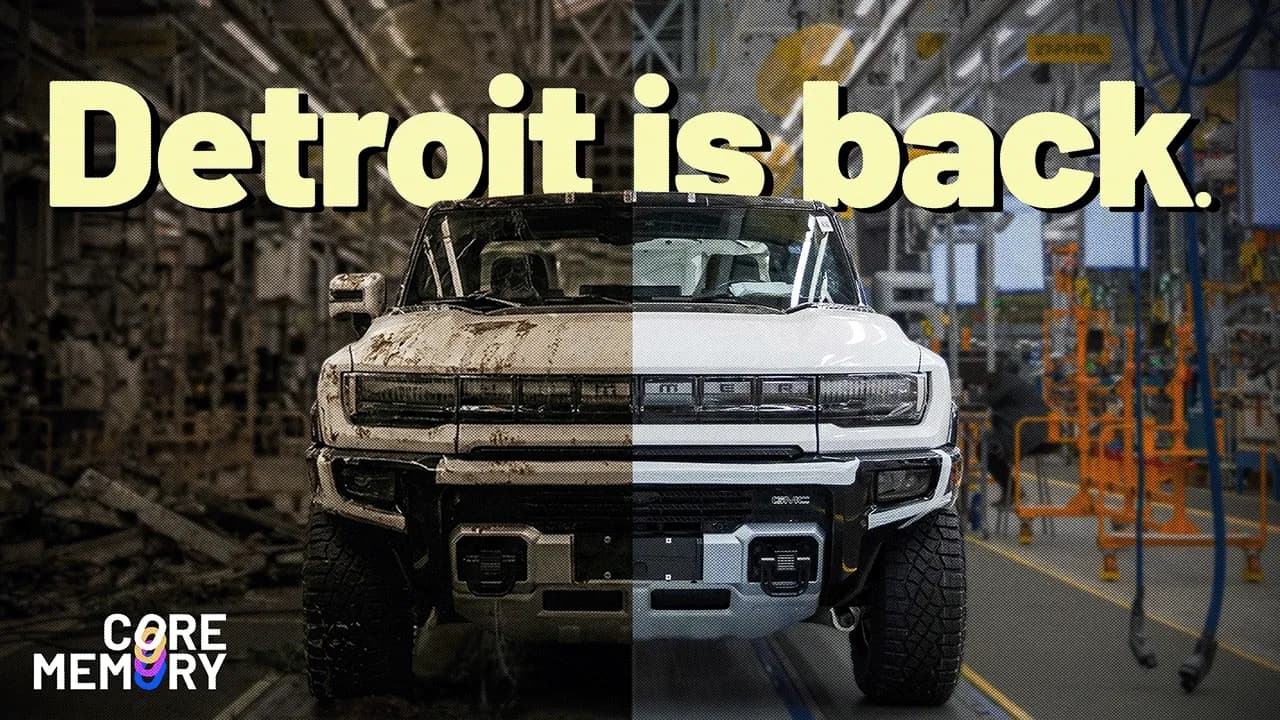
GM has 13 EV models from small cars to trucks. The Hummer EV is massive with 500 miles of range.
In R&D labs, blue test chambers test battery packs under temperatures above and below Earth's surface extremes, from desert dry to rainforest wet. Examples include the Corvette battery pack in a hot, humid chamber simulating Miami's hottest week.
"This looks like a very nice torture chamber."
Cell technology evolution table:
- EV1 (late '90s): lead acid batteries, <100 miles electric range.
- Late '90s/early 2000s: nickel metal hydride in hybrids like Prius.
- First-gen lithium ion in Chevrolet Volt (2008): 38 miles electric range.
- Current LMR cell (lithium manganese rich): >400 miles range in trucks; battery costs dropped by factor of 10 ($/kWh).
Mega shaker room (largest of three: medium, large, mega) required separate foundation to avoid shaking the building; used for full-size prototypes like small satellites. Enables building full-size prototype battery cells, which most can't do.
GM does fundamental research from elemental level to battery packs and vehicles. Partners with LG and Samsung but does much in-house. Focus: LMR (lithium manganese rich) batteries for affordable EVs.
"We announced in May the lithium manganese rich chemistry which is a gamechanger chemistry for electric trucks because we can use it in a way that gets range of over 400 miles meaning we can get really excellent range at an affordable price for those customers."
Battery particles evolved from homogeneous to structured (e.g., cobalt-rich shell, nickel-rich core). Costs: cobalt most expensive, then nickel, manganese least. Trend: reduce cobalt, increase nickel for higher energy density, lower cost. LMR: reduce nickel, increase manganese.
In precipitation reactor lab with Ashley, they synthesize cathode material to achieve targeted performance.
Labs involve nanoscale work (5 nanometers, 50-100 nanometers), high temperatures (124°C), electron beam, chemical vapor deposition, machine learning, AI, in-house modeling algorithms, surface area testing.
Factory Zero on Detroit's edge builds Hummer EV truck/SUV, Silverado EV, GMC truck, Cadillac Escalade EV.
Production process:
- Cells into mini stacks, then soft stacks.
- Robot compresses stacks, intensive electrical test.
- Welding: copper (golden), aluminum.
- Automated guided vehicles (AGCs) load modules (two at a time, barcode scanned), tighten down.
"This is Godzilla."
Largest robot by Fanuc loads/unloads packs; start and end of pack main line.
GM recorded $7.1 billion loss from underperforming battery factories and EV assembly lines. Sales slumped partly due to Trump cutting EV rebates. Americans less enthusiastic about EVs than hoped. GM committed long-term. Goal: North American battery manufacturing independence from mines to vehicles for resilience.
"We want to have North American battery manufacturing independence. We want to be resilient to the point that we can chart our own destiny from the mines and the materials, processing those materials, putting them into the cells, and then into vehicles."
Keep Core Memory in your library
Save the videos and channels worth coming back to, and find them again in one place.