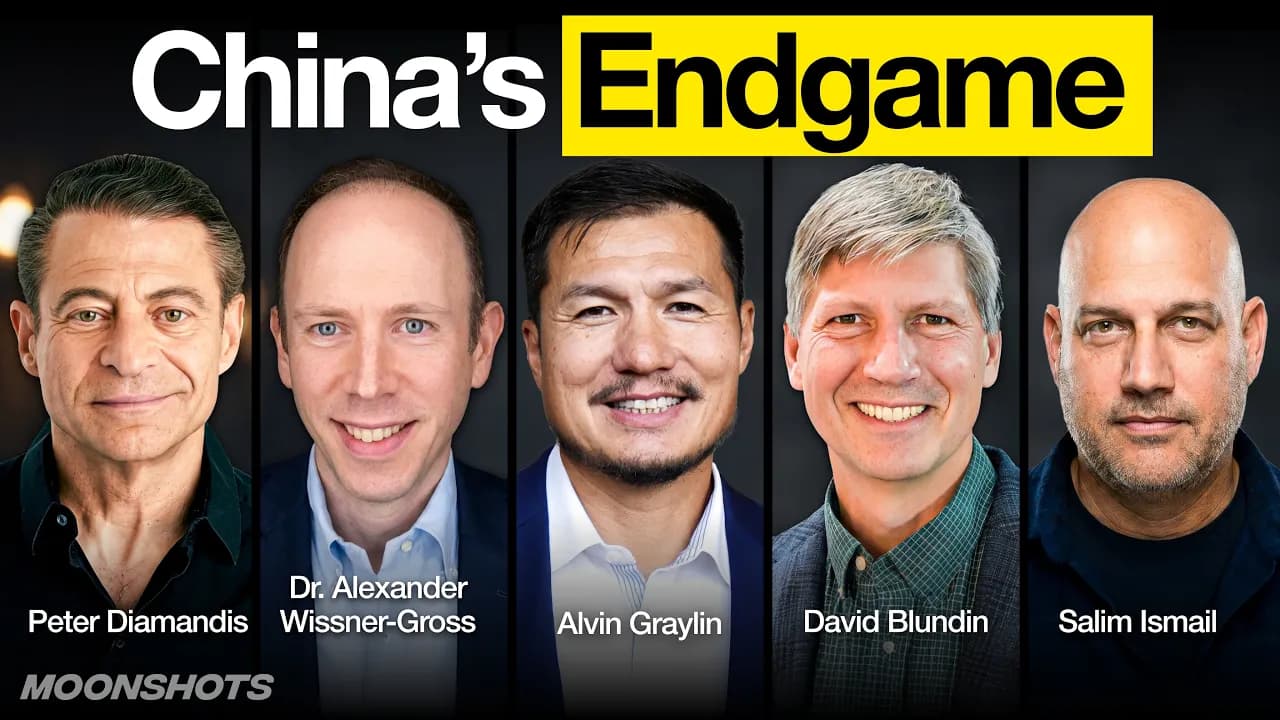
China Is About To Pop The AI Bubble
In a Nutshell
The video argues the US AI buildout is a trillion-dollar bubble propped up by hype, with hyperscalers spending 3% of GDP annually while failing to generate measurable ROI or disclose AI revenues. It claims China's cheaper, near-open-source models (7-12x lower cost, comparable quality) are already winning global adoption as countries reject US export restrictions. Early warning signs include flat hyperscaler stock prices, declining AI token prices, tight credit spreads that historically preceded crises, and a market rewarding chip sellers while punishing the companies actually spending on infrastructure.
These notes were generated by AI and may contain inaccuracies.
The entire US stock market, including 401ks, index funds, and retirement values, rests on a story that may be ending. The current AI buildout is much bigger than the TMT buildout of 1999-2000, even as a percent of the economy. The prevailing narrative holds that American companies will generate trillions in perpetual profits because the world will be forced to use American technology.
The relevant tech centers are America, China, and Israel. Some argue this American dominance story is ending due to lies, spending, and competition.
On June 12th, Commerce Secretary Howard Lutnik sent a letter to a San Francisco company. By the end of that night, Anthropic was ordered to cut off two of its most powerful AI models from every foreign national in the world, including France, Germany, Japan, and even Anthropic's own non-American employees.
Four days after the letter, France fired Palantir. The French prime minister stated they cannot depend on partners who can turn off the tap. Germany had already walked away. Spain told its companies to stop signing deals. Britain followed the same path. The world discovered it has a choice that is 7 to 12 times cheaper.
America is spending $1 trillion per year on AI, representing 3% of the US economy. China is spending a fraction of that amount while giving technology away virtually for free.
Ed Zitron argued that large language models are not the future. Big tech is investing because they have run out of hypergrowth ideas and lack a next iPhone or new Google search. They have put over a trillion dollars, with trillions more to come, into what he called a dead-end industry.
Alex Karp, CEO of Palantir, stated that nobody really trusts AI. He questioned ownership of data, caching locations, prompt security, and compensation structures. Karp argued that if AI were truly as valuable as marketed, companies would not charge per token but would instead take 30% of the revenue generated from billion-dollar business ideas.
AI companies charge per token usage. A token is essentially a word. Users pay for every word the AI reads and writes, regardless of whether the answer is good or bad. Karp noted that enterprises are livid about paying for tokens that create no value, describing it as a wealth tax that punishes billionaires without helping the poor.
Models hallucinate by confidently making things up. No one, including the builders, can predict when or why this happens, and no one has completely fixed it. Both Anthropic CEO Dario Amodei and Sam Altman have said they cannot wait to see what users build, because they themselves do not know what can be built with current models.
Corporations spending $50 million on AI face board questions about ROI that cannot be answered. Corporate America is paying subscription fees for technology whose outcomes cannot be measured.
When companies use these models, their data, processes, and trade secrets flow through them. The AI company learns from the business and can become a competitor. Anthropic launched Claude Design while maintaining a relationship with Figma; Figma's CEO publicly expressed shock at watching a vendor potentially train their own replacement.
The most technical players are moving toward owning their GPUs, data, and models to control their alpha. This means downloading models and running them on internal infrastructure where no one can access or learn from the data.
Two days before the interview, Palantir announced a partnership with Nvidia to sell open models in sovereign environments. The interview functioned as a product launch for this new service.
Ground News is an app that displays the same story from hundreds of outlets simultaneously, labeling left-leaning, right-leaning, and center sources. South Korea's national AI and chip investment announcement was covered by 159 sources with varying headlines and framing depending on political orientation.
Traditional software has near-zero marginal cost: build once, sell repeatedly with costs remaining flat. AI broke this model because every query costs money in electricity and chip wear. More customers means more cost dollar-for-dollar. OpenAI burned $20.9 billion in 2025 according to Financial Times and The Information reporting.
AI company margins are getting worse rather than better. Every new model costs more to run than the previous one. OpenAI is potentially pushing its IPO to 2027 after failing to achieve a trillion-dollar valuation.
Oracle is building 7.1 gigawatts of capacity for one customer. The annual report disclosed the risk that they might not get paid. OpenAI is estimated to require $75 billion in annual compute revenue to support the full Stargate project.
Nvidia sells chips to smaller cloud companies called NeoClouds that borrow billions to purchase the chips. Nvidia then rents the GPUs back. Companies mentioned include CoreWeave, Nebius, Crusoe, Cipher Mining, and Tomorrow.io. This arrangement only occurs in an industry lacking diverse, real demand.
Microsoft, Google, Meta, and Amazon do not disclose their actual AI revenues. Their other businesses continue growing, but AI operations lose money. Public companies share good news; the absence of AI revenue disclosure indicates the news is not positive.
The assumption that American companies will capture all future AI profits rests on the premise that the world has no other option. China spent $102 billion this year and plans $123 billion next year, representing 0.6% of its economy compared to America's 3%.
A developer gave the same coding task to Claude Opus and the Chinese GLM model. Both completed the task in approximately 5.5 minutes. Claude Opus charged $2.33; GLM charged 31 cents, representing a 7-12x price difference.
The best American model scores 60 on the Artificial Analysis Intelligence Index. GLM, the best Chinese open model, scores 51. Chinese models including DeepSeek, Qwen, Kimi, and MiniMax occupy much of the middle of global rankings.
China uses distillation: training models by studying answers from existing frontier models rather than training from scratch. This allows China to compress US research results into smaller, cheaper models and open-source them for free.
Meituan, China's food delivery company equivalent to DoorDash, built LongCat, which competes with Google's Gemini and beats older versions of Anthropic's flagship models on real-world agentic tasks.
For equivalent work, American models charge 18.5 cents per task while Chinese models charge 4 cents, representing a 76% discount at comparable quality levels.
During the dot-com bubble, the NASDAQ peaked in March 2000. Companies laying fiber optic cables continued spending billions into 2001, a full year after the market collapse. The market changed when investors stopped believing the story, not when spending stopped.
Goldman Sachs analysts indicated the first hyperscaler to pull back capex will be rewarded by markets. Other signs include financing falling through for xAI or Anthropic, and the debt market refusing to issue data center debt. Google raised $85 billion in equity, signaling debt market constraints.
Bond investors care only whether they will receive interest payments. When scared, they demand higher rates. Credit spreads measure the difference between the risk-free rate (US government bonds) and corporate bond rates. Tight spreads indicate lenders feel safe; widening spreads indicate rising fear.
When investors feel like there's some market risk, the premium explodes. The spread increases. That is one of the early signs that we could start to see that this is going to fall apart.
In 2008, spreads hit almost 22%. Lenders started to charge very high prices. Credit shut off completely and companies that ran on borrowed money just collapsed. There was also a jump in spreads in 2020.
Today, the spreads are very tight at 2.6%. That is close to the lowest and the calmest readings in recorded history. This means that either bond investors see no problem and everything discussed is completely wrong, or bond investors are wrong and they can be wrong.
In early 2007, the housing crisis was already underway. Bear Stearns was months away from blowing up and spreads were only 2.5%. They were super calm right where they are today. The fear gauge didn't predict 2008 because spreads don't really measure what is true. They measure what lenders believe.
In 2007, lenders believed the housing market was safe, which we now know obviously that it wasn't. When someone on the news says "Hey, don't worry. AI is totally safe. It's doing great. Credit markets, the spreads are not so worried," remember that the credit market wasn't worried in '07 either. Credit markets can be wrong and they have been wrong before.
Spreads have been wrong before. The timing isn't going to be immediate, but at some point a hyperscaler is going to pull back capex. When that happens, this is an industry of followers. The tech industry doesn't have ideas. They just copy each other. Everyone copied Satya Nadella when he put ChatGPT in Bing. Whoever breaks capex first, they'll follow them too.
Michael Burry, the investor who predicted the 2008 financial crisis, posted analysis showing that chip stocks are trading at the top of their 15-year valuation range. This is basically the same peak that they hit right before the 2024 correction. The market is basically pricing chips like the trillion dollars has already been made.
One chart tracks three groups of AI stocks since last year. The gray and white lines going up to 200% represent the AI winners—the companies selling the chips and the equipment. The orange line way at the bottom that's barely above zero represents the hyperscalers—companies like Microsoft, Google, Amazon, and Meta.
This means the market is telling us that the companies that are doing the spending, the trillions of dollars, they're getting almost no credit for it. Their stock values aren't really going up. Wall Street instead is rewarding the companies that are getting that money and it's ignoring the companies spending to build it. That's basically the market admitting it doesn't believe the spenders will make it back.
A third chart shows the Silicon Data LLM token expenditure index. This shows the price that people pay for AI tokens. This index is the price of AI itself, and it is down almost 20% from its high in May.
The question is why the price of AI would be going down during the biggest AI buildout in history. Bloomberg says either it's because demand is going to cheaper models or buyers are just not willing to pay more. The middle explanation shows demand is shifting towards cheaper models, and that is the China theory that's showing up in this data.
Michael Burry has been early before, and when people say early in the market, that's a polite way of saying he's been wrong. He's made market crash predictions over the years quite a lot that didn't really come true. Even this index has dips that have recovered.
Bloomberg says that the signal for all of this is ambiguous. We can't really learn anything from this data. It can mean anything. The real answer to how long it will take for the AI bubble to pop, if ever, is that no one knows. But those are some of the early signs to look for based on the data from the past.
Keep Andrei Jikh in your library
Save the videos and channels worth coming back to, and find them again in one place.