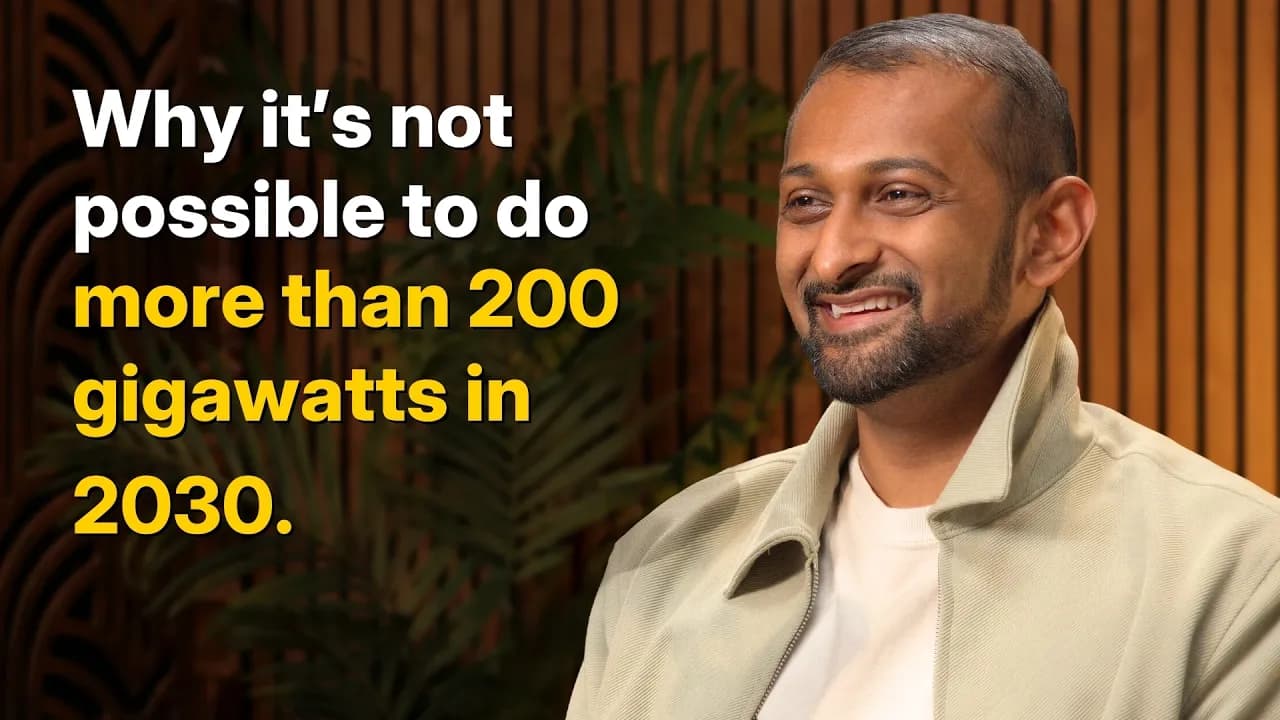
Dylan Patel – Two labs will soon control most of the world's workforce
In a Nutshell
Two frontier labs—OpenAI and Anthropic—are absorbing 40-50% of new compute deployed each year and will control most usable global AI compute within two years as their gigawatt-scale clusters triple annually while total world compute merely doubles. Their revenue per megawatt has already surged from negative margins to $30-50M, enabling self-funded expansion toward 100 combined gigawatts by 2028, while supply-chain bottlenecks (EUV mirrors, turbines, power) and regulatory constraints on model releases create the only real limits to their dominance. This concentration means virtually all AI labor and most of the world’s high-value cognitive work will soon reside inside two organizations, fundamentally restructuring power, capital allocation, and economic returns worldwide.
These notes were generated by AI and may contain inaccuracies.
The conversation opens with Dylan Patel of SemiAnalysis discussing how the world economy increasingly depends on lab economics and compute markets. Most GDP growth in America last year came from AI infrastructure.
About a third of compute coming online this year is for the labs (OpenAI and Anthropic), though it may be built by others and rented to them. Compute numbers are ballooning from over a trillion dollars in CapEx this year to more than $2 trillion by 2028. The labs are taking an increasing percentage of this, moving from spending tens of billions annually to hundreds of billions, with forecasts of spending trillions by the end of the decade.
This requires reshaping the labs' economics. Until recently, these were companies that mostly lost money. Anthropic started turning a profit in Q2, and OpenAI is believed to potentially turn a profit in Q3 with the rise of Codex and 5.6. A year ago, all their money was venture-funded losses. Even at the beginning of this year, it remained venture-funded losses. They've now turned the corner and are starting to profit, though new capital continues coming in to accelerate growth. More of their business is being funded from their own revenue rather than capital injections.
Over the last year and a half, their margins have skyrocketed. The base cost of compute tends to be around $10-15 million per megawatt. Previously, serving models like GPT-4 on Nvidia Hopper GPUs generated negative gross margin for OpenAI. Now, when OpenAI serves GPT-5.6 or Anthropic serves Opus 5 or Fable 5, their revenue generation has passed well beyond the incremental $10-15 million per megawatt. In Anthropic's case, revenue has gone as high as $50 million per megawatt.
This enables them to reinvest: if they spend $10 on inference capacity, they generate $50 of revenue, then turn around and incrementally spend that profit on training.
OpenAI started at 2 gigawatts and Anthropic at less than 2 gigawatts at the beginning of this year. By the end of this year, both are above 5 gigawatts—they've 3-4x'd compute as a whole. When looking at incremental compute added, that's about 30% of compute added this year. Next year, Anthropic and OpenAI are taking 40-50% of compute. This centralization is accelerating, not slowing.
Next year, SpaceX is a big new entrant building significant compute, which they're likely to lease to Anthropic and OpenAI since those labs can pay the highest price. OpenAI and Anthropic are also starting to build their own compute—OpenAI with their own chips, Anthropic with TPUs purchased from Google and deployed with Fluidstack.
By the end of next year, half of incremental compute will go to Anthropic and OpenAI. Since compute is growing so fast, incremental compute will be basically most of compute. Within a year and a half or two years, most of the world's compute will be owned by two labs or serving their demand. World compute in gigawatts may double every year, but frontier lab compute triples every single year.
The trend shows compute going from 2 gigawatts at the beginning of this year to close to 6 at the end of this year. Projecting forward: 18 gigawatts by end of 2027, 54 gigawatts by end of 2028.
Incremental compute this year adds 30 gigawatts, next year 50 gigawatts, and the year after roughly 70 gigawatts. A new watt deployed this year is significantly more efficient than watts deployed two years ago. A huge percentage of the world's compute was deployed this year. Even though it didn't double the number of watts, the new deployments are GB300s, TPUv7s, and Trainium3s, which are 3-5x more performance per watt than prior-generation chips.
If Anthropic and OpenAI take 45% of compute next year, by December 2027 they've taken half of the world's incremental new compute. This half is at higher performance than everything before it, creating another multiplier. By end of 2028, if the trend continues, they control most usable flops in the world.
To make a gigawatt of Vera Rubins, you need 55,000 N3 wafers, 6,000 N5 wafers, and 170,000 DRAM wafers. An LLM analysis of the wafer fab equipment model shows $3-4 billion in tooling costs to produce a gigawatt of compute every year. Adding cleanrooms and shell, $6 billion of fab CapEx produces a gigawatt every single year. A gigawatt produces $100 billion of revenue. Over five years, the first gigawatt generates five years of profits, the second generates four years, and so on. $6 billion of CapEx generates over a trillion dollars of end AI revenue.
There are OpEx and other CapEx costs (data centers, power, installation), plus payments to OpenAI for R&D. Taking away half for middlemen still leaves a 100x discrepancy between fab CapEx and end revenue generated. This creates a situation where $1 can turn into $100. The bottleneck is mirrors for ASML machines—labs could make a trillion dollars but are constrained by mirrors. People are already doing arbitrages, buying turbines and reselling them because turbines are bottlenecking data centers.
The supply chain doesn't react immediately to the whip signal. Carl Zeiss previously didn't think they needed to make enough mirrors for 100 EUV tools a year; now they do. However, it should be even more given the economics. If every company in the stack got private equity investment with AGI-pilled leadership maximizing production, physical constraints would still exist. The supply chain is currently expanding toward 100 ASML tools for 2030.
The labs will generate hundreds of billions in revenue next year, but CapEx next year is around $2 trillion. The wafer fabrication equipment supply chain does about $200 billion. The data center market supply chain does more. The accelerator supply chain does more. The energy supply chain does a number. Summed up, it's well north of $2 trillion in CapEx. The labs haven't yet reached the point where their cash flows can fund this. They'll never get to that point because CapEx should stay higher than returns—you reinvest.
If current trends continue, it's north of 50 gigawatts per lab by end of 2028—100 gigawatts combined. These gigawatts drive many-fold more throughput by 2028 than now, because hardware has gotten better. Not only have flops per watt increased, but hardware works better with AI workloads.
World compute by 2028 is difficult to project given that labs have taken 70-80% of incremental compute. The price of compute would need to skyrocket for labs to buy 70-80% of compute. It's unclear if Google, Meta, or Amazon would sell that much. When Amazon serves Bedrock Anthropic models, it counts as Anthropic compute because it's effectively revenue for Anthropic even with revenue share arrangements.
Anyone can make money at $10-15 million per megawatt today. You can get a GB300 rack, download Kimi weights, use vLLM or SGLang, set it up, and put it on OpenRouter. Codex and Fable can help. It's not trivial but not rocket science. You'll generate more revenue than you pay for compute. This has already caused compute pricing to inflect upward.
To reach 100 gigawatts in 2028, labs must outpay for compute. Anyone can make money at $10-15 million per megawatt. Compute may need to reach $25 million, $40 million, or $50 million a megawatt. Labs are already generating way more revenue per megawatt than everyone else. If they stay ahead, this continues. Recursive self-improvement—where labs have internal models not released externally that help make next models better—would amplify this.
Labs will continue gobbling up more compute, but can't do it at current pricing. They need to pay $25, $30, or $50 million a megawatt to get 70% of world compute in 2028 and reach 100 gigawatts. There's already been a huge slowdown for AI labs. Regulation they advocate for slows labs more than open-source Chinese models. OpenAI not releasing Astra, stopping training for two weeks, Anthropic not releasing Model 2 (widely believed to be next version of Mythos)—they're not releasing their best models, so revenue per megawatt stalls or declines because other models become competitive again.
If regulatory impact prevents releasing best models, revenue per megawatt doesn't climb as fast. Their ability to buy incremental compute at higher prices diminishes, and they may not reach 100 gigawatts. In a world where safety doesn't matter, they can generate $100 million per megawatt or more and pay $50 million a megawatt. No one else has reason to do anything with their compute besides sell to the highest bidder.
If AI models were as good as a fully automated software engineer, a gigawatt sustaining a million white-collar workers would generate $100 billion. With full AGI, it would be many hundreds of billions of dollars per gigawatt. Most value capture isn't happening at the labs—it's going to users. Jane Street generates way more value from tokens than Anthropic generates in profit. Meta, once rumored to be 10% of Anthropic's business, generates way more efficiencies from models than Anthropic captures.
The market may come into equilibrium where compute price equals what Anthropic and OpenAI can generate, with small markup. Currently there's a 4x or more difference between what compute sells for and what Anthropic can make. If Anthropic's ability to monetize a gigawatt doubles or triples, it would be weird if the gap continued increasing.
Anthropic and OpenAI have ballooned in value capture. Elon demonstrated he can sell compute for $25-40 million a megawatt to Anthropic and Google, recouping CapEx in a year. Most compute will still transact at sub-$20 billion a gigawatt even at end of next year because all of it has to be financed. Meta, Microsoft, Amazon, and SpaceX can build compute without finding a customer first. Most compute is contracted before it's built. Elon took advantage of having compute already built and selling it at premium prices.
Meta and SpaceX are the only plausible #3 because they're hoarding compute. They use their balance sheets to build compute without an end customer monetizing at huge scale. They have actual balance sheets to access credit markets. You build a gigawatt, make a good margin, and now have optionality: use internally or sell to Anthropic/OpenAI at crazy margins. SpaceX and Meta are saying they'll build compute and rent it for $25, $50, or more—not $13 million per megawatt.
Grok Bot was used to generate candidate lists for interviews. Initial outputs were poor quality, but after providing feedback on missing criteria, it produced an improved list of candidates. This workflow was saved as a routine that automatically checks inbound email and X DMs weekly for promising interview candidates. The service is accessible at x.ai/bot.
Revenue per gigawatt projections for Anthropic and OpenAI by end of 2027 are estimated at $50+ million per megawatt, potentially reaching $70-80 million per megawatt blended across the company. This depends on model quality and regulatory ability to release best models. Current model training occurred in February, with concerns that labs may not be allowed to release their best models externally.
Incremental compute is valuable enough that Anthropic might pay $40 million per megawatt for SpaceX compute. Value capture creates a bullwhip effect where price increases propagate through the supply chain over time rather than immediately. TSMC raises prices slowly while memory companies (SK Hynix, Micron, Samsung) and substrate companies raise prices quickly. Elon Musk raised xAI compute prices from $15 to $25+ per unit.
Current progress rate suggests GPT-4o to Mythos 2-size capability leap by end of 2027. However, Mythos 2 is not released, and even Mythos has been restricted from use for optimizing inference performance. Revenue per gigawatt could reach $100 million per megawatt by end of next year if current progress continues.
OpenAI stated they are not training models for two weeks. Astra is not widely deployed internally. Models are restricted from internal use despite capability improvements. Regulation methods include not releasing models, New York banning data centers, Texas implementing moratoriums, and Ohio requiring property tax payments within certain radii around data centers.
By end of next year, labs may have close to 20 gigawatts total compute. The question arises whether labs should shift from 60% to 70% of compute allocated to training when each gigawatt generates $100 billion in revenue. Investor pressure may push against increased training allocation in favor of revenue-generating inference.
Labs are expected to allocate less compute to inference over time, contrary to consensus that most compute will go to inference. Current revenue per megawatt is $30-40 million with 40% allocated to inference. As revenue per megawatt increases to $60-70 million, the decision becomes whether to maintain 40% inference allocation for profits or redirect compute toward AGI development.
OpenAI's Ultrafast mode is allocated to both internal and external use because internal value from super-fast AI exceeds external token sales value. The calculation favors dedicating more compute internally for AI research progress rather than generating $100 million per megawatt through external inference.
Anthropic has been increasing compute allocation toward R&D over the last three months. Monthly compute additions have increased while revenue growth has plateaued from $25 billion ARR monthly additions. Marginal megawatts are being directed toward R&D rather than inference, indicating factual increase in compute toward research activities.
Global AI compute projections: 30 gigawatts this year, 50 gigawatts next year, 70 gigawatts in 2028, 90-100 gigawatts in 2029, with potential for 100+ gigawatts annually thereafter. At 100+ gigawatts per year, this represents absurd GDP growth rates. The slope of compute growth can continue upward, though predictions beyond four years become highly uncertain.
US share of world compute deployment increased from 45-50% in 2022 to 70% currently. China dropped from 30-35% to sub-10% of watts deployed for data center AI compute. China's domestic production remains small, with limited Nvidia purchases often ending up in Malaysia or other locations. By 2028, China projected to have 30 gigawatts or less of AI compute.
China's compute development timeline: 2026 relies on smuggled chips and TSMC chips originally made for non-Huawei companies; 2027 sees initial fab development; 2028 marks significant fab deployment from SMIC and CXMT producing millions of units annually. This enables 5-10 gigawatts of domestically produced chips in 2028, though these chips are inferior to Nvidia, Google, and OpenAI chips available in 2028.
China could add 50 incremental gigawatts in 2029, potentially through both domestic production and foreign chip purchases. However, if most are domestic chips, the 50 gigawatts may be equivalent to only 20 gigawatts of American chips in quality. Leading US labs in 2028 may have more compute than all of China weighted by quality through 2029-2030.
Export controls have created significant compute gaps between US and China. By the time automated coding and automated researcher capabilities emerge, China will be far behind on compute stock. Chinese financial systems are less willing to invest in startups compared to American systems, though Chinese semiconductor subsidies exceed the rest of the world's semiconductor industries combined.
Leading Chinese labs have 100-200 megawatts total compute at most, with ByteDance Seed as an outlier having significantly more. Kimi is not running a gigawatt or close to it. Anthropic will have more than 5 gigawatts by end of year. Current compute difference doesn't significantly impact model capabilities.
Lab compute budget breakdown: 50% research, 10% development, 40% inference. Research involves generating ideas, testing architectures, data mixes, hyperparameters, and attention techniques. When Anthropic trains Mythos, pre-training uses sub-200 megawatts for approximately two months, with RL requiring even less compute.
Current training limitations include difficulty coordinating multiple clusters, co-locating resources, multi-site training challenges, and RL complexity. Even with multiple gigawatts available, maximum single-site usage may be 200 megawatts. As automated coding and automated researcher capabilities advance, research versus training percentages become fuzzier, with more compute directed toward training models including continual learning.
At 100 gigawatts annual build rate and current prices, this represents $5 trillion CapEx yearly. Including power plants (30-year assets) and data centers (15-20 year assets), total CapEx increases to $7-10 trillion. Critical IT (servers, networking, fiber, transceivers, optical communications) costs $40-50 billion, but this excludes data center buildings and power plants built ahead of time.
Hyperscalers (Google, Microsoft, Amazon, Meta) funded initial growth but now spend everything on CapEx plus raise debt. By 2028, hyperscalers will raise hundreds of billions in debt while supply chains do the same. Funding sources include semiconductor companies (Nvidia, Broadcom, memory companies), traditional infrastructure investors shifting from bridges to data centers, and economy-wide investors choosing hyperscaler debt over homes, credit, or government debt.
High AI investment returns create rate of return problems for non-AI investments. Data center construction at 10x depreciated cost creates $1 to $2 or $10 returns. This raises interest rates economy-wide as AI investments compete with government, corporate, and consumer borrowing. The result makes borrowing more expensive for everyone else in the economy.
The US will be fine because data centers built in America can be taxed, though corporate income currently represents less than 10% of federal revenues while 80%-plus comes from payroll taxes and income taxes, which will shrink with increased automation.
20% of tax revenue currently goes toward servicing debt. A 1% rise in interest rates would increase this from 20% to 25% over a five-year period. A 5 percentage point rise would push debt servicing costs above 40% of tax revenue. When accounting for $2 trillion in annual government borrowing, this could exceed 60% of tax revenue going toward interest payments.
Countries with high debt levels, low tax revenue, and frequently serviced debt like Pakistan and Nigeria face severe challenges in the new interest-rate regime. This crowding-out effect limits the scale of data center construction.
Industries and companies that rely heavily on debt include consumer packaged goods companies, telecom companies, and banks. When interest rates rise in the market - the spread between the federal rate and what corporations pay - it creates challenges in accessing capital.
Amazon would happily pay 8% on debt for compute infrastructure because the returns are enormous, compared to the current 5-6% rates. A 250 basis point increase would cause broader economic effects, including banks losing money as their credit spreads reprice faster than their assets.
Rising interest rates increase discount rates, causing discounted cash flows of equities to crater. While the S&P 500 may remain stable, individual stocks - especially stable cash-flow stocks like Johnson & Johnson or railway companies - would see significant value drops as investors reject paying high multiples at 8-10% discount rates.
Economist Basil Halperin predicts a second Volcker shock where interest rates rise more than 5% (around 8% real interest rate), potentially causing 40 developing countries, mostly in Latin America, to default.
Before singularity, interest rates could rise 2-3%. In the 2030s, when the world economy doubles every year, interest rates should approach the growth rate - at least tens of percent, possibly hundreds. This would cause every non-AI-producing country to default and all non-AI stocks to become worth zero.
The opportunity cost of government borrowing for pensions becomes extremely high when that capital could fund robot factories that build robot factories. This fundamental increase in opportunity cost drives all discussed economic effects.
In an AI-pilled market, everything should trade at 2-3x earnings. Memory stocks like Micron, Hynix, or Kioxia trading at 2-3x earnings would be justified if AI causes this drastic economic change, but this would also mean the broader stock market crashes.
The limiter on AGI development is not research engineers but how much the rest of the world allows it through regulation, interest rate increases, and restrictions on data center construction. Labs are already designing their own chips and contracting their own data centers.
Regulatory constraints include governments preventing model releases, limiting internal use of advanced models, and restricting deployment. This creates downward pressure preventing straight takeoff even if models are capable.
By 2030, governments might require six-month delays before releasing new models publicly. During these delays, labs could conduct recursive self-improvement internally while the public receives models years behind current capabilities.
If governments slow AI progress by one year through compute restrictions, they prevent a full year of deployment. However, they would also need to restrict labs' internal model usage, as seen when Anthropic temporarily stopped giving Mythos to foreign employees.
With compute at frontier labs growing 4-5x annually and compute requirements decreasing 3x annually, effective AI population size increases 10x year over year. By end of decade, individual labs could have more AI labor equivalence than Earth's human population.
Most "people" in terms of work output would concentrate within two labs consuming increasing amounts of global compute. If AIs are misaligned, most of the world's minds would be misaligned. Even without misalignment, very few companies would have disproportionate influence.
AI training has huge economies of scale - training efforts get amortized across billions of users. Companies slightly ahead can charge higher markups due to compute scarcity. Models learning from deployment get more real-world data when deployed more widely.
Capitalism worked through decentralized decision-making and power, but AI flips this dynamic. Private ownership may no longer be most efficient, leading to super-centralized AI economies. The question becomes how to prevent super-concentration without slowing AI progress or having governments regulate extensively.
Anthropic captures value through revenue per megawatt increasing from $20 million to $100 million, but Jane Street captures $300-500 million per megawatt from the same compute. The broader economy may profit more from AI companies than the labs themselves capture.
The logic behind reallocating inference capacity to AI R&D centers on the fact that returns to labor inside AI labs are substantially higher than returns available outside these organizations. This represents a strategic decision where internal deployment of compute resources generates superior value compared to external allocation.
Power concentrates because organizations prefer not to send tokens outside their control when those tokens hold greater value internally. This dynamic creates a natural tendency toward vertical integration, where AI labs retain their computational resources for their own development rather than leasing capacity to external parties.
The question arises whether AI labs should allocate compute to external entities like Jane Street, which generates $200 million per megawatt through efficient market-making activities. If Jane Street is willing to pay $100 million for access to that compute, the critical consideration is whether the AI lab can generate hundreds of millions of dollars per megawatt by deploying that same compute internally for its own development purposes.
"If the end monetization that Jane Street has per megawatt is $200 million, so they're willing to pay Anthropic $100 million… Well, what if Anthropic can just generate hundreds of millions of dollars per megawatt by using that compute internally?"
This calculation demonstrates why AI labs increasingly choose to retain their computational resources rather than lease them to high-value external customers.
The discussion concludes with a reference to meeting again when RSI (recursive self-improvement) is officially initiated, marking the end of the conversation segment.
Keep Dwarkesh Patel in your library
Save the videos and channels worth coming back to, and find them again in one place.