Eric Weinstein: The State of American Science, Breakthrough Coverups, and the Danger of Physics
In a Nutshell
Eric Weinstein argues that American science has been deliberately stalled since the 1965-1975 period through institutional mechanisms that punish heterodoxy and reward consensus. The most critical damage came from restricted data classifications in physics that suppress free inquiry, peer review systems designed to protect government interests rather than advance knowledge, and funding models that favor predictable low-risk research over high-beta breakthroughs. The result is 53 years of stagnation in fundamental physics, preventing new propulsion, energy, and weapons technologies while creating dangerous knowledge asymmetries that China is now exploiting by recruiting American scientists.
These notes were generated by AI and may contain inaccuracies.
Eric Weinstein is a mathematician, physicist, and economist with a PhD in mathematical physics from Harvard. He completed a National Science Foundation postdoc and was an O&R fellow at Harvard. He published a proposed mathematical framework called geometric unity in 2021, previously worked with Thiel Capital, and is a podcast host and guest.
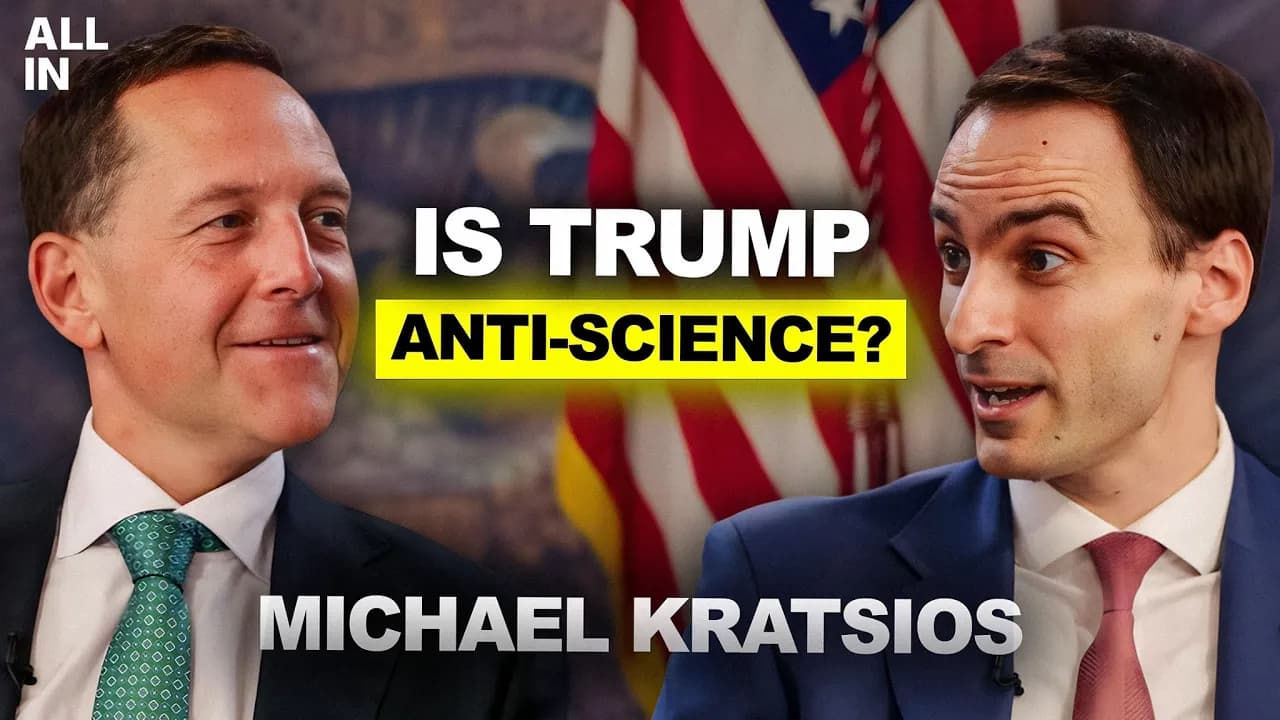
Government-driven science has played a fundamental role in American success over the last 100 years. Michael Katzios at OSTP published a report on science and a new golden age, with Weinstein having conveyed issues to him. Katzios stated that science is at the beginning and they don't know everything yet. The report is described as a great blueprint and the first major proposal to reform American science since Vannevar Bush at the end of World War II.
The biggest risk is the courageous science that America can afford as a rich, ruggedly individualistic nation that no one else can afford. Incremental research with low variance called excellence is depressing because America should take bets no one else can afford. China has a problem with freedom, and freedom is a weapon that allows America to look at itself critically.
Scientists should be able to investigate whether Fauci killed 10 million people as virologists and epidemiologists. When scientists are hamstrung because conclusions are predetermined, it limits the ability to use cowboy science to drive the world. America is giving away its biggest advantage: the ability to say screw you to a supervisor who tells you what is true and isn't true.
Young people should be able to say their field is going in the wrong direction and bet their career on it without interference. During COVID, lockdowns, and the pandemic, where were the skeptics questioning the dogma? If everyone in a room agrees, it's probably wrong. Science requires asking questions, interrogating assumptions, generating evidence and data, then drawing conclusions.
The scientific precariat was created where professors cannot afford to go against consensus. Consensus is usually an artificial agreement achieved through pressure, like the Washington consensus. When everyone agrees, you shouldn't need a consensus - arithmetic doesn't require consensus that 2+3 equals 5.
Jay Bhattacharya exemplifies what should happen - he has a PhD in economics and MD, went against consensus with the Great Barrington Declaration, and is now head of NIH. He was called a fringe epidemiologist by Francis Collins and Anthony Fauci.
Weinstein states Anthony Fauci was probably America's bioweapons czar. The US signed the Geneva Convention and Bioweapons Treaty in the 1970s. Through a cryptic system, a Ukrainian-British zoologist received huge amounts of money through EcoHealth Alliance from DTRA (Defense Threat Reduction Agency). Scientists can see through covert operations because science has powerful tools like hair follicle analysis.
B-minus policy people in the covert community don't want independent scientists because they explode false narratives. This creates problems with both good science and good journalism.
During WWII, there was agreement not to report on Roosevelt's health while he was in a wheelchair. Similarly with Biden undergoing dementia, no one asked geriatric neurologists to examine his gait and speech patterns to assess his cognitive trajectory. When telling structural lies, you don't want scientists exploding them.
The Manhattan Project (Los Alamos from 1940-1945) created the most powerful weapon on Earth, and there was justification for secrecy there.
People who stood up during COVID are not being made university presidents or department chairs. They haven't been rewarded with chairs. Weinstein asks where his third home is for standing up - he wants to put three kids through school and participate in security and prosperity. The American scientific precariat explains strange political affiliations and lack of balance in professors.
Theoretical physics is the only profession to lose free speech due to restricted data. Physicists cannot put pen to paper to write physics equations if they affect nuclear weapons. This makes it impossible to do good physics without affecting hadrons and nucleons, creating a threat where physicists aren't protected by the First Amendment.
Professors must fall in line to gain tenure, get grants, and achieve chairmanships. Heterodox views lead to being called fringe scientists, losing access, jobs, and income. Weinstein came up with differential geometry equations in 1987, was treated badly, but those equations took over the field in 1994 with no attempt to acknowledge the mistreatment.
Scientists are told true scientists don't care about money or security - the reward is the work. But scientists provide security for others while not participating in prosperity themselves. Gini coefficients are blowing out largely due to technology derivative of science.
The period between 1965 and 1975 is when everything went wrong, particularly 1965-1969 to 1971. The MIT physics department walked out in spring 1969 protesting the Vietnam War, including Manhattan Project participants. The government viewed this as wobbly and untrustworthy.
The MIT Instrumentation Laboratory was taken outside the university and turned into Draper Labs. The Mansfield Amendment of 1969-1971 stated the military could no longer fund blue sky research inside universities unless it had direct military purpose.
Previously, the military said they wanted physicists fat and happy doing blue sky research, trusting them to be available when needed. The military was the best friend of science. Scientists are extreme and weirdos - if you don't have communists and fascists in the same department having tea, something has gone wrong.
The system is spaying and neutering the best minds. Palmer Luckey looks like a scientist - a reverend with a crazy shirt who builds things that kill people. If he were in a physics department, he couldn't be that guy.
Nima Arkani-Hamed is identified as the best current scientist - charismatic, brilliant, uncompromising, didn't go in for string theory fad. Jim Watson was kicked out of Cold Spring Harbor which he built. Mark Ptashne, in his mid-80s, wrote a genetic switch on phage lambda and is brilliant and irreverent.
Eric Lander was White House science adviser but his picture isn't on the wall because he's uncompromising. The movie Whiplash is referenced - the best band doesn't come from handing out tissues.
National interest waivers are proposed. Weinstein wants to blow a giant hole in the Civil Rights Act so teams aren't constantly afraid of HR. His closest friends from college - two Jews and a Muslim - constantly tease each other about banks, newspapers, and terrorism, but this model can't be explained to HR departments.
High agency people form tight cohesive social units that HR doesn't understand. HR shouldn't require notes from mommy and daddy for everything. The culture of greatness requires hyperindividualism and rugged hyperindividualism, not collectivist thinking.
Peer review is a fake story retconned into science. Google Ngrams shows no mention of peer review before 1965. The Medicare Act made government the major payer for medical procedures. Doctors said they didn't want government oversight, so they would peer review each other. It started in a Utah clinic.
In 1975, fiscal and social conservatives attacked NSF over Man: A Course of Study (MACOS). Anthropology was grouped as a science, which Weinstein considers a mistake. Hard sciences should be separated from weaker scientists who should form their own organization.
Science has become synonymized with biomedical, which it isn't. Markets work well except in market failure categories.
Markets cannot price science effectively because it is both inexhaustible and inexcludable. When markets are perfect, they can price everything, but anything that fits this definition cannot be priced by a market unless an artificial market is created. Tax dollars must be used for things that markets cannot reach, similar to how taxes fund an army because an army cannot be made exhaustible and excludable.
Homotopy theory serves as a case study. It is an incredibly important part of pure mathematics with no known industrial applications, yet removing funding for it pulls out a Jenga block from an ecosystem that is not understood. The failure of PhDs to engage with the current administration stems from viewing Trump as having cooties, resulting in the administration not hearing what it needs to hear.
A Nature survey of 2,000 scientists found that only 6% voted for President Trump, with 85% voting for Kamala Harris. This lack of engagement means the scientific community is not explaining why basic research like homotopy theory requires tax funding.
Michael Kratsios, who assumed the role Eric Weinstein had sought, comes from a non-PhD background but demonstrated an approach of admitting what he doesn't know and seeking to learn. Jim O'Neill at NSF and Jay Bhattacharya were identified as quality appointments. The question posed is whether the inability to work with these people represents their problem or the scientific community's problem.
The argument that wealthy individuals like Jim Simons and Yuri Milner would naturally fund basic research through private markets fails because even Simons, with detailed knowledge of pure mathematics, did not understand certain concepts. In a conversation about the Chern-Simons transgression interpreted as an action functional being the only rival to Einstein-Hilbert, Simons lacked the knowledge to evaluate this claim.
Communication difficulties exist even between adjacent fields like algebraic geometry and differential geometry. The requirement that billionaires exist in every relevant subfield—algebraic geometry, representation theory, category theory—to fund research is considered completely insane.
Previous systems operated through slush funds where good people had money and could identify talent. An anecdote described an older scientist who never applied for a job in his life because people high up in the field would make phone calls to place talented individuals where they needed to be.
The modern approach applies KPIs and data-driven metrics to science, asking for ROI on research. This misunderstands the scientific mindset versus the technology mindset. Scientists care about whether their names will be discussed 10,000 years from now if humans still exist, rather than acquiring luxury items like McLarens.
Modern grants require specific objectives with capital allocated to predetermined uses. Grants favor lower beta research with more predictable outcomes, applying modern portfolio theory to science. This misses opportunities for crazy high-beta bets on individuals rather than ideas.
An example illustrates the difference: Stuart Butterfield had three million dollars remaining after VCs invested, with the project nearly failing. When calling Ben Horowitz about returning the money, he mentioned an intra-company communication tool for the engineering team. Horowitz told him to keep the money and pivot, which became Slack, sold for $30 billion. This demonstrates backing the person rather than the idea.
The formula for identifying exceptional researchers is to find who established leaders will block but will not short-fund. For geometric marginalism or geometric unity, the willingness to short these theories would indicate genuine engagement rather than blocking without reading the work.
Edward Witten is identified as the smartest man in the world today, though he drove theoretical physics off the road 42 years ago. The standard model has not changed since, and recent string theory conferences show no talks containing words like electron, hadron, Higgs, or lepton—indicating no discussion of the physical world.
Physics made sense in 1983 but did not in 1984. Three people—Leonard Susskind, David Gross, and Edward Witten—drove the field in a different direction. The achievement has been making physics safe for geopolitical rivals by focusing on AdS/CFT correspondence rather than advancing knowledge of the physical world.
Talks given at physics departments have been restricted, with the University of Texas at Austin allowing talks only if not attributed to the physics department, and the Perimeter Institute labeling talks as Eric answering questions rather than formal presentations.
The Reference Committee was established in 1940 inside the National Research Council. After the neutron's discovery and chain reaction concepts, papers on chain reaction physics submitted to journals were shunted to this committee, which would return them claiming results were preliminary. This process destroyed the ability to earn a living for those doing chain reaction physics outside the Manhattan Project between 1940 and 1945.
The question is whether this happened once or repeatedly. If repeatedly, the analog of Los Alamos, white badges, and the Reference Committee would need identification.
Renaissance Technologies on Long Island presents characteristics that could indicate such a structure: a secure campus, a cover story of hiring only physicists and mathematicians while avoiding market experts, a close relationship with Brookhaven National Laboratory, and proximity to Stony Brook University with its historical strength in relevant fields. The Medallion Fund has delivered returns unlike any other, closed to external capital with only internal money remaining.
Jeffrey Epstein's operation similarly featured a cover story of running a multi-strategy FX hedge fund requiring power of attorney for investments over a billion dollars, using a 727 aircraft, and employing yeshiva students as the only trustworthy traders, with strategies limited to trend following, mean reversion, and carry.
Eric Weinstein discusses the absence of information about certain technological capabilities and their connections to academic institutions. He mentions Stony Brook and its relationship with a national laboratory as being unacknowledged. The conversation then shifts to a hypothetical scenario where physics did not progress into quantum gravity.
The discussion explores what physics would look like today if the field had not advanced into quantum gravity research. Weinstein addresses the argument that physics has contributed to practical applications like semiconductor manufacturing, advanced lithography, and materials science. These developments enabled modern computing and AI tools. The question becomes whether this applied progress misses a deeper point about fundamental physics advancement.
Weinstein describes the frontier model combining general relativity with the standard model of particle physics. He explains that valence quarks were discovered inside protons and neutrons since 1968, yet remain confined due to infrared slavery - the phenomenon preventing isolation of individual quarks. This demonstrates how scientific discoveries may not yield immediate industrial applications.
Weinstein discusses the Patis-Salam model proposed by Abdul Salam in the mid-1970s, which he believes represents the correct first-order grand unification. The model uses SU4 rather than SU3 symmetry. SU3 generates the strong nuclear force that prevents protons from repelling each other within atomic nuclei - the same force harnessed for nuclear weapons in 1945.
With SU4 symmetry, electrons and neutrinos become the fourth color associated with up and down quarks. This framework suggests the possibility of weapons that could rotate up and down quarks into lighter leptons, potentially disintegrating matter. Weinstein introduces the concept of decoupled matter, noting that neutrinos represent a form of dark matter that barely interacts with ordinary matter.
Weinstein explains the concept of rotating neutrinos into charged particles, allowing them to pass through Earth. He describes beta decay where a neutron transforms into a proton by releasing an electron, clarifying that a down quark emits a W minus particle that decays into an electron. The existence of neutrinos was inferred through conservation principles when accounting showed missing energy in beta decay reactions.
The danger of additional force particles beyond the standard model is that currently stable matter might become unstable. Weinstein mentions that SU5 could potentially disintegrate mountains, though he considers SU4 more stable than SU5. He introduces the framework of boom (weaponry), vroom (energy), and zoom (propulsion and computation) to categorize physics applications.
Weinstein notes that the standard model was finalized approximately 53 years ago, meaning society has been denied new boom, vroom, and zoom capabilities from fundamental physics advances. He suggests this stagnation may have contributed to human species survival by preventing access to more terrifying weapons, but acknowledges the cost in foregone technological advancement.
Weinstein rejects the argument that physics stagnation represents a net positive for humanity. He references his experience during COVID-19 lockdowns, noting that splicing four amino acids into the coronavirus spike protein required only 12 nucleotides and was sufficient to shut down Earth. He argues that scientific knowledge carries profound leverage that most people fail to appreciate.
Weinstein discusses the Breaking Bad scene where Walter White demonstrates the ease of creating powerful explosives. He notes that black powder composition (75% saltpeter, 10% sulfur, 15% charcoal) is unknown to modern audiences. He references the Anarchist Cookbook and questions whether nuclear weapons could be constructed without centrifuges or using materials accessible to high school students.
Weinstein mentions the case of someone who constructed a working nuclear reactor using americium scavenged from 218 smoke detectors in Brooklyn, illustrating how nuclear technology might be more accessible than commonly believed.
Weinstein discusses United States versus The Progressive magazine, where the Teller-Ulam design for thermonuclear weapons was published. The government attempted to prevent publication, claiming it revealed restricted data about the geometry required to compress fusion fuel using light-speed processes.
Weinstein recounts the story of John Aristotle Phillips, a Princeton student who designed an atomic bomb for his junior thesis. Freeman Dyson agreed to evaluate whether the design would work without providing assistance. The government removed the relevant page from the thesis, which is no longer in the Princeton library.
Weinstein argues that if the United States fails to prevent Iranian nuclear development, other countries will pursue nuclear weapons. He describes the petrodollar system as actually being violence dollars, where the US provides security for oil in exchange for dollar dominance. He warns of a multipolar world where game theory becomes unpredictable with multiple nuclear powers.
The discussion explores what technologies might exist beyond 80-year-old nuclear weapons technology. Weinstein questions whether unidentified aerial phenomena represent Chinese or American advancement in physics, noting his recent conversations with credible witnesses have changed his skepticism about UAPs.
Weinstein confirms the existence of special access programs related to UAPs. He explains that compartmentalization prevents information sharing, making it difficult for anyone to piece together complete knowledge of classified programs.
Weinstein introduces the concept of multi-temporal adversaries who might access multiple time dimensions rather than being limited to single-dimensional time. He uses the analogy of weapons platforms moving from one-dimensional (rail car) to two-dimensional (tank) to three-dimensional (A-10 Warthog) movement to illustrate how multi-dimensional time access would create insurmountable advantages.
Weinstein describes the solar system as an escape room requiring multiple habitable locations rather than relying solely on Mars. He argues that chemical rockets between Earth, Moon, and Mars would provide only three locations for civilization, which is insufficient. He believes Elon Musk's focus on Mars is a red herring and that humanity needs tens of thousands to millions of locations before achieving civilizational stability.
Weinstein argues that general relativity creates a prison preventing interstellar travel. Traveling to Alpha Centauri at near-light speed would result in eight years of Earth time passing during the round trip. He notes that general relativity equations have remained essentially unchanged since 1915-1917.
Weinstein discusses the Dark Energy Spectroscopic Instrument (DESI) at Kitt Peak, Arizona, which he believes will demonstrate that the cosmological constant is not constant. This would break the current formulation of general relativity because the derivative of lambda times the metric must vanish according to Lovelock's theorem.
Weinstein proposes holding a conference where physicists present alternative formulas for dark energy rather than accepting string theory as the only viable approach. He criticizes the 42-year dominance of string theory and M-theory as failed frameworks.
Weinstein emphasizes that general relativity is a derivative model, not the territory itself. He states there is no initial singularity from the Big Bang nor Schwarzschild singularities at black hole centers - these represent points where the theory's ignorance becomes apparent.
Weinstein references a 2003 TED talk demonstrating multi-touch gestures and suggests that pinch-to-zoom functionality might be built into spacetime itself. This could allow changing distances without violating the speed of light, representing a way to escape Einstein's prison.
Weinstein describes being unable to participate in physics departments because he believes Edward Witten drove the field off course. He notes that radical ideas face institutional barriers, comparing this to being labeled a bigot for stating that male and female are primarily determined by the SRY complex on the Y chromosome.
Weinstein discusses how China is recruiting American and Russian scientists by offering freedom, pay, and escape from Western collectivist constraints. He warns that this freedom has limits regarding Tibet, Tiananmen Square, and Taiwan.
Weinstein predicts that AI systems will eventually read the trash can corpus - ideas rejected and ridiculed by leading physicists. He suggests China might develop private AI models that assume string theory and M-theory are red herrings designed to prevent discovery of more promising approaches.
Weinstein argues for the return of scientific figures like John von Neumann, Richard Feynman, and Paul Dirac. He rejects accusations of arrogance, stating that the current scientific establishment has failed and that radical reassessment is necessary.
String theory has not been the leading theory for 42 years and has never been the only game in town. Eric Weinstein compares this situation to Jeffrey Epstein never being a hedge fund manager, noting that certain facts are not allowed to be discussed openly. He questions whether there are individuals at the CIA's Science and Technology Directorate or the Department of Energy who would be interested in having this conversation, especially given that the United States is in conversation with Chinese, North Korean, and Russian counterparts.
Weinstein argues it is insane to have pushed out AI as a commercial product, comparing it to a scene from Silence of the Lambs where Hannibal Lecter is wheeled out on a gurney in a straight jacket with a mask. He describes Anthropic's approach as presenting "your new employee, Hannibal Lecter" as a consultant hired from a temporary agency, with the harness supposed to prevent harm being the people around him, the mask, and the straight jacket. He contrasts this with the military research project being released into homes, comparing it to making the Davy Crockett personal nuclear weapon available at Kmart with a waiting period under the Second Amendment.
The models have been distilled and commoditized with open weight releases now available. These models could be directed toward discovering novel physics, examining strange texts and ideas, and rethinking fundamental concepts. Weinstein suggests this represents "a hell of a ride" for scientific progress.
Weinstein addresses the question of what UAPs represent today by first noting the professional risks involved in speaking openly. He references taking a job with Peter Thiel, which closed approximately 30% of doors to colleagues who would not open their doors to him. He emphasizes that many in the scientific community are terrified of discussing these topics.
If general relativity is the last word, Weinstein believes UAPs are nation-state experimental weapons systems with breakthroughs occurring particularly in the 1960s. He references a 1971 Australian intelligence document showing that Australia, used as a testing ground for United Kingdom nuclear weapons, began seeing UAPs near their nuclear tests similar to American observations.
The Australian document reveals that many top institutions were conducting anti-gravity and gravity shielding research, with the cover story being the golden age of general relativity from the early 1950s to the late 1960s and early 1970s. Weinstein rejects the notion that general relativity is the last word and proposes that "pinch to zoom" exists along with another multi-touch gesture called "shear to tilt," enabling departure from the solar system.
If humanity can leave the solar system, Weinstein argues that others can come as well, given the size of the universe and the laughable odds that humans represent the most advanced life form. He draws an analogy to North Sentinel Island, where inhabitants are considered Indian citizens but don't know the word "India" and are uncontacted people who don't realize they're part of something larger that watches them.
Weinstein's concern is that when nuclear weapons were detonated in 1945 or when Italy became proficient in quantum theory under Fermi and the atomic boys, with the Magenta incident under Mussolini, UAPs appear closely tied to nuclear technology. He believes a nuclear detonation signals that a civilization has become advanced enough to develop profound propulsion systems and leave their planet.
Weinstein proposes that geometric unity represents the next theory that will cause the world to become unrecognizable. He suggests there are multiple areas for discovery including multi-temporal movement, dark chemistry, dark light, and two other families of chyro matter at a luminous level. He states that spin three-halves matter exists and that SU(4) × SU(2) × SU(2) represents the next grand unified theory to be found.
Weinstein emphasizes that America should lead because no other nation can be trusted like the American people to take care of the planet. He advocates making common cause with rivals as quickly as possible due to the overwhelming danger of reaching the next level of leverage in contested situations. He specifically mentions the Persian Gulf and urges the scientific community to recognize that despite feelings about Donald Trump, four or five individuals with science portfolios in his administration are much better than PhDs think.
Weinstein recommends that scientists come to Washington DC for a few days and utter the dangerous words "how can I help" before turning up their noses at the current administration's science capabilities.
Keep All-In Podcast in your library
Save the videos and channels worth coming back to, and find them again in one place.