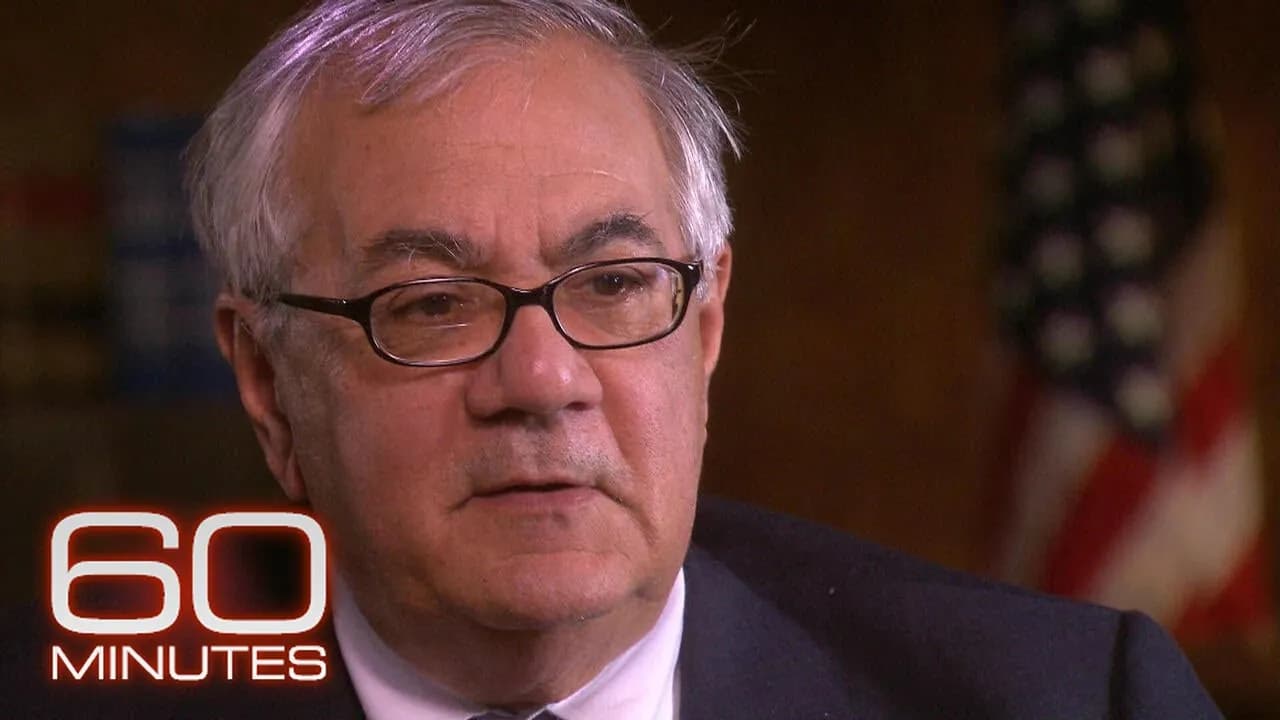
Former Federal Reserve chairman Alan Greenspan | 60 Minutes Archive
In a Nutshell
Greenspan defended his Fed tenure and low interest-rate policy, admitting he underestimated the scale of subprime lending abuses and rejecting proposals to regulate them more aggressively. He claimed he could not have prevented the housing bubble or its fallout, insisted Bernanke was handling the crisis correctly, and pushed back against critics who blamed his decisions for the credit crunch. The interview also revealed his unusually close ties to the Clinton White House, his support for Bush-era tax cuts despite later regret, and his post-retirement forecast of further home-price declines and reemerging inflation.
These notes were generated by AI and may contain inaccuracies.
Alan Greenspan served as Federal Reserve chairman for 18 years and may be remembered as one of the best in American history. His tenure featured unprecedented economic growth, budget surpluses, and a booming stock market. He was praised for guiding the economy through the shock of 9/11. Greenspan wrote the memoir The Age of Turbulence, which was released as he faced criticism for the housing and lending crisis. Critics argued he established a pattern of bailing out Wall Street investors.
In his first major interview, Greenspan defended himself against criticism that he should have stopped shady practices in subprime lending. He admitted he missed its significance. When asked why he did not speak out despite having a powerful platform, Greenspan stated he was aware practices were occurring but had no notion of how significant they had become until very late in 2005 and 2006.
Former Fed governor Ed Gramlich proposed that the Fed examine subprime lending practices, but Greenspan rejected the idea. He believed the Fed would not be capable of doing what was suggested and that it was very difficult for banking regulators to deal with such practices. He maintained there was nothing particularly to look into because regulators already knew some practices were occurring.
Greenspan insisted there was nothing he could have done to prevent plummeting home prices, with a million families losing homes. Some economists argued he created the housing bubble and credit crunch by keeping interest rates too low for too long. He noted that rates were raised at every meeting from June 2004 until he left office, following 13 rate cuts during the earlier period.
He defended keeping rates modestly low as necessary to unfreeze the American banking system. Some Fed governors who worked with him later stated they believed interest rates were too low for too long, but Greenspan maintained they were mistaken.
Investors called on Greenspan's successor Ben Bernanke to act as Greenspan would have by throwing more cash and liquidity into the system faster and more dramatically. Greenspan was not certain he would have acted differently. He explained that during his tenure, inflation was easing, allowing earlier action without fear of stoking inflationary pressures, whereas the current environment was different.
He stated he doubted he would have acted any faster and believed Bernanke was doing an excellent job. When told that Ford and Chrysler CEOs were begging the Fed to lower rates, Greenspan suggested they focus on selling and creating better cars for customers.
Greenspan retired in 2006 at age 79. When asked about investing in real estate, he declined to answer. He also declined to comment on the stock market despite the public's interest. When asked about his book advance of reportedly $8 million and in what currency he would like to be paid, he stated that as an economist he could not care less because currency could be converted in exchange markets. He emphasized that the key question is in what currency to hold assets and confirmed he diversifies even in terms of currency, though he would not specify which currencies.
Greenspan's book is personal and chatty, described by him as a psychoanalysis of himself. He wrote 80% of it in the bathtub. The book discusses his romance with NBC newswoman Andrea Mitchell, who is 21 years younger. On their first date in 1984, they had dinner and he invited her back to his apartment to show her an essay he had written on the Sherman Antitrust Act of 1890. They dated for 13 years before he proposed, using what she described as Fed speak that she initially could not interpret as a proposal. For their honeymoon, he took her to an international monetary conference.
Greenspan was described as a geek from childhood in depression-era New York City, where he collected railroad timetables, learned Morse code, and memorized baseball statistics. He initially dreamed of being a professional baseball player because he could hit a curveball when younger. He still fills out scorecards at games. When professional baseball did not work out, he pursued becoming a professional musician and was a good enough saxophonist in high school to be hired by the Henry Jerome Orchestra, traveling the country playing bebop jazz at age 17.
While other band members drank and smoked between sets, he read books about the British stock market and ended up doing their income taxes. He eventually became an economist with his own forecasting firm in New York in the 1950s. He became friends with philosopher Ayn Rand, author of Atlas Shrugged, which she gave him while it was still warm off the press. Rand advocated unfettered, unregulated capitalism. She nicknamed him The Undertaker because she thought he radiated gloom, and she thought he was too much of a social climber. He acknowledged being guilty of social climbing, arguing that everyone seeks approval of others.
Greenspan revealed personal feelings about six presidents he knew. He described Richard Nixon as so profane it would have made Tony Soprano blush and wrote that Nixon was anti-Semitic, anti-Italian, anti-Greek, and anti-Slovak. He said there were two Nixons. Of Gerald Ford, he called him an extraordinary human being who was not the smartest but was the most normal and had a strong ethical base, often asking what was the right thing to do for the economy.
Of Ronald Reagan, Greenspan said he had an odd form of intelligence used to improve the country's self-image. He described a terrible relationship with the first President George Bush, who publicly pressured him that interest rates should be lower, which Greenspan said was improper and crossed a line given the Federal Reserve's statutory independence. Bush later blamed Greenspan for losing the 1992 election to Bill Clinton.
Clinton was the only Democrat he served under and was described as the smartest of all presidents he knew. He called Clinton an extraordinarily effective president and noted their relationship was described by Clinton as the odd couple. He described Hillary Clinton as very smart and unquestionably capable of handling the presidency, though he questioned if she was the best person for the job and stated his tendency would be to vote Republican.
Greenspan visited the White House as often as once a month during the Clinton years, more frequently than predecessors. He described himself as functioning as an economic consultant. When questioned whether this compromised the Federal Reserve's appearance of independence, he stated that the Federal Reserve is not a foreign enemy and that he hoped he was influencing policy.
Greenspan described engaging in syntax destruction when answering congressional questions about interest rates, making responses sound like answers without actually answering. He confirmed he worked on making his statements impenetrable. This often resulted in two newspapers publishing opposing headlines from the same hearing, which he considered success. He became known as Saint Alan and Easy Al during the Clinton years for his rate-cutting policies.
Greenspan's most criticized move was supporting tax reductions at the start of George W. Bush's term. Though his testimony was careful, it was read as an endorsement of massive tax cuts. He had previously advocated using surpluses to shore up Social Security and Medicare but came to favor tax cuts because he believed without one the surplus would become too large. He stated he never explicitly said he was in favor of the Bush tax cut and that the administration interpreted his words that way. He denied succumbing to White House pressure and said he would not change a word of his testimony even knowing the outcome.
The surplus evaporated and deficits returned. Greenspan proposed trimming back tax cuts when this occurred, but the administration maintained policies developed during the campaign when a large surplus was projected. He expressed surprise and disappointment in Dick Cheney, who was less focused on restraining spending than desired, and disagreed with Cheney's statement that deficits do not matter.
After leaving government, Greenspan established Greenspan Associates, an economic forecasting firm. He predicted that current market fear would subside and that the credit crunch would pass, describing it as a human behavior phenomenon. He stated that home prices would fall further and that effects were already appearing in the job market for housing-related sectors including real estate, appliances, and furniture. He believed underlying economic strength would prevent a spiral into deeper problems.
Over the long run, he identified the reemergence of inflation as the main problem. His book outlook was described as gloomy regarding rising interest rates and inflation. In February, he predicted a one-in-three chance of recession that year, rattling markets and raising questions about propriety of his public comments as a former chairman.
He argued his responsibility was to comment on global things rather than monetary policy and that he could not pursue his profession without making such forecasts. He noted there was a one-year restriction on lobbying the Fed but no restriction on speaking, and he would not impose one on himself.
Greenspan relaxes by reading government reports and data. He expressed love for details such as the protein content of hard red winter wheat and price differentials between Kansas City and Chicago, describing this as romantic to him.
Keep 60 Minutes in your library
Save the videos and channels worth coming back to, and find them again in one place.