From Pivot Hell To $1.4 Billion Unicorn
These notes were generated by AI and may contain inaccuracies.
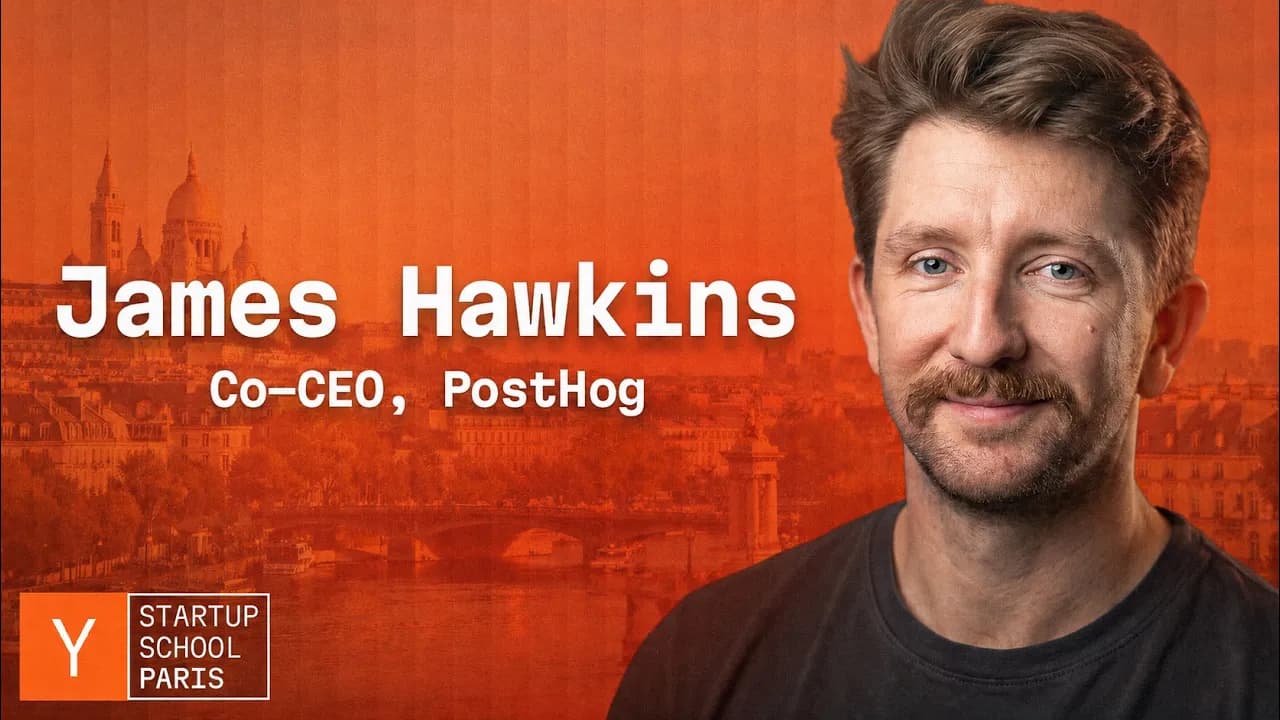
James Hawkins, CEO and founder of PostHog from YC Winter20 batch, raised $75 million Series Z at $1.4 billion valuation, making PostHog the latest YC unicorn. Discussion covers PostHog's start, best YC pivots of the last decade, and using attention and humor to compete.
James explains PostHog helps users debug products, ship features faster with feature flags, and keeps customer and product data in one stack.
PostHog has ~160 people, ~300,000 customers (many free, several thousand paid), 16-17 products in production or development. Pushing hard on more products, expanding across customer data, automating with AI. Started year at 70 people, scaling to ~200 by year-end.
First working product after multiple pivots: self-hosted product analytics. Frustrated setting up analytics repeatedly during pivots. Strong competition existed, but products were for product managers forcing engineers to implement. Founders wanted SQL access, data in own infrastructure to avoid ad-blocker losses. Talked to customers who self-built junky analytics stacks; productized as open source on Hacker News. Last 4 weeks of YC batch to launch. Iterated to cloud-based with multi-product.
Forged in the fires of pivot hell—pain from repeated analytics setups during pivots.
Co-founder quit previous job (aiming for Facebook). James grabbed him to start together, solving personal professional problems, initially bootstrapping from coffee shops (problem: buying coffee rounds). Worked ~6 months, one idea every 5-6 weeks.
First Idea: Sales Territory Management
James, ex-VP of Sales, built product to waste less time on non-closing deals using stats to reroute territories. Complicated to build, poor go-to-market. Got 15 Series B/C/D sales leaders interested; built MVP in weeks, sent links—14 didn't click, 1 clicked but no account. Lesson: poor signal from salespeople (friendly but no action); hadn't read The Mom Test. Realized better to target engineers/support (say-do alignment) to reduce variables like poor explanation.
Entered YC with product for developers taking surveys on technical debt via pull requests. Through pivots, went full gas on each idea: in-person customer visits (from England to SF), charged for products to test real interest. Felt confident pivoting when effort matched past enterprise sales but no buys.
Maintained momentum with shamelessness, short weekly goals (e.g., 10 meetings, 3 features), held accountable. Felt existential vs. "proper careers," but tracked regular real progress.
Higher excitement for open source product analytics vs. prior ideas. YC office hours: auto-capture all user data (no manual events), self-host. Reframed as open source product analytics—vibe fit Hacker News. Felt confident it'd land.
Bad to wait for exciting idea; built many to find it. Doing gives stronger signal.
Easier interviews; Hacker News launch mediocre by 2023 standards but best dev tool post of year per demo day slide. Pull basis post-launch: feature requests poured in.
Raised post-demo day on 1-month-old product amid March 2020 COVID chaos. Initial buzz from HN launch turned to angels at $5K checks after VCs pulled out. Met 160 firms (hardest round vs. later ~30 total). Stress: pregnant wife, co-founder left fearing visa issues.
Sucked at pitching: vanilla plans (revenue, features), too early for open source. Got opinionated: all-in on open source community, no big sales/enterprise. Got term sheets, closed seed, Series A month later.
Investors agnostic on plan if passionate and executable. Better different than right.
Easier: spoke to 1 investor (Petrichor—Chelendra main, Anav involved). Preemptive offer after prior round. Initially unsure on spend, but got bullish on AI after vacation reading (OpenAI motives: brains physical, build AGI).
Reflected: AI won't flatten, path to product autonomy. Shifted from CRM/support to deeper products (e.g., desktop app shipping pull requests from customer data: session recordings, analytics, error tracking, LLM traces—fixes issues while asleep).
Instead of push requests like "build me this feature," the flow is now pull-based: features are built based on what's happening, and teams can review, close, edit, or merge them to speed up development. PostHog raised funding for comfort and confidence, largely psychological, to fully embrace the product strategy and increase the size of their swing.
This allows fully exploring the implications of PostHog's original idea: understand what's happening in your product and what users are up to, enabling downstream actions.
Customer understanding is like seeing a painting: one data type is like seeing only blue, lacking nuance. Example: data shows users not using a feature, suggesting an email about a new one, but conflicting support data shows they're pissed off—bad time to email. Humans look across tools; PostHog builds something to do this automatically.
Building a Better Product Manager
They set out to build a product manager—a physical thing that exists but better. Human product managers have product-market fit; companies buy them. Previously, strategy was building all customer data products with PMF for convenience. Now, expand to team members: sales, support, engineering all have PMF, so build better versions now that it's possible.
Work feels much more leveraged and entertaining. Early days focused on getting attention in a noisy world—sending emails and LinkedIn messages with little impact, though sparks lead to fires. Now, it's like unlocking rocket launchers in a computer game: go nuclear on ideas.
They can build this because it requires 15-16 products plus AI, needing time. Similar to Intercom's Pin but across 16 products, going much deeper. Starting from scratch would be impossible, like SpaceX starting with satellite launches, not Mars transport. PostHog has done the homework to take the bigger swing.
Original reason: build trust, especially for free open-source users investing time and data. Software is more competitive, especially with AI. Marketing goal: highlight differences and build trust via transparency—fully explain who they are and what they're doing, beyond a one-pager landing page.
Addressed critiques from Hacker News launches: unclear business model, sustainability suspicions. From day zero, explained future paid product without having one.
Content Strategy: Experts and Humanization
Experts writing is compelling. To get on Hacker News (top for audience), write as expert on their own business: learnings and doings. Early post: "What it's like moving to San Francisco"—viral, built trust by humanizing (e.g., photos climbing Twin Peaks at night).
Today, every product page shows literal engineers building it; click bios for personal details like pet cats. Humanization stands out: shows people are home for neat interactions.
Moving to SF post: nothing remarkable, but got on Hacker News because it showed humanity. Developers relate; signaled "this is going somewhere."
Building in public connects via humanity, humor, merriment, amusement, chaos.
Billboards everywhere in SF shock newcomers with tech ads; PostHog did something unique.
First Billboard: Session Replay as Tomato Sauce
Ad for session replay: promotes "sweet taste of understanding," compares to tomato sauce. Designed to be different—brands get more interesting on billboards to stand out.
Companies come out of shell on billboards; PostHog, already weird online, goes bizarre. Not for conversions (unlikely while driving); purely for awareness. Funny content spreads 1000x more than useful posts.
Crank weirdness/funniness: competes not with B2B software, but radio/podcasts/phone distractions—MrBeast-level bar.
Incubation Process
Small group (3-4 people), high trust, direct feedback. Aim for genuinely funny/sarcastic that they'd laugh at themselves. Heavy criticism culture (Hacker News trolls, Slack marketing channel: "joke not funny, trying too hard").
Make fun of adverts: 1950s Americana style for AI software (e.g., "tastes better than spaghetti"). Stereotypical billboard origin: funnier, better thought out vs. modern bland/big words.
Warm, stupid feeling (frilly frock). CEO in ads: average middle-aged guy (people don't realize); edgier than hedgehogs (too professional/kooky). Signals care, thoughtfulness in details like typography—translates to product quality.
Website same: shows savviness, gets technology/audience.
Since 2021, website is sales team—every customer visits pre-buy, especially self-serve audience. No big sales team needed (early: tiny, 2 people). Justify massive effort: low cost, high energy to stand out.
Everyone does 80/20 polish quickly and stops; PostHog goes insanely far past normal for remarkability—people talk. Users came via recommendations; reasons: all tools in one, low pricing, dev brand, technical support.
Crank dials: 3 products → 300; weird brand → weirder to polarize. Monitor mentions: "best thing ever" or "atrocious"—polarizes in favor of audience.
Multi-Dimensional Experience
Document/price 15-16 products + extras: developer jobs board (filters: laptop type, % developers); popular handbook (pay, layoffs, everything); 100k+ subscriber newsletter.
Traditional pages insufficient for multi-dimensional company. Spits on funnel idea: give great cheese to savor vs. push through.
Expected: double traffic, half conversion—took it. Developers find "get started" buttons (3 on page). Marginal users impressed enough to convert.
Result: conversion 10% worse initially, now traffic much higher + significantly higher conversion despite complexity.
Unhinged Merch Shop
Deep cut: signed photo of founders James and Tim—sold out (sold one). Yacht rock aesthetic; supposed to represent Tim's alignment. Offsites with voting.
I was thinking about it on the way here and I think the reason that feels funny is you go like this represents Tim and I being aligned and close together, but this is what aligned would be—we're close but something else.
Thank you so much for spending time with us today and talking us through all this. Many folks follow the videos looking for ways to break through. Your point about having to be remarkable is obvious but overlooked so much today. Thank you for sharing ways to stand out and be remarkable. Congratulations again on the latest round raised. We're happy for you and excited here at YC.
Yeah, thank you. It was monumentally important to us to go through the program. If you're listening, go apply to YC.
All right, thanks for joining us today.
Keep Y Combinator in your library
Save the videos and channels worth coming back to, and find them again in one place.