How I Built a $1B AI Company by Knowing Real PMF From Fake | Serval, Jake Stauch
In a Nutshell
Jake Stauch learned from Neuroplus that rabid early fans can create false PMF signals if the market is tiny and customers share odd traits that don't scale. At Serval he stayed deeply skeptical for a full year, embedded in customer workflows, until repeated deals showed conversations shifting from “interesting” to “how much and how fast.” The key lesson is to ruthlessly test for genuine, scalable demand before building further, because strong market pull makes everything else fall into place.
These notes were generated by AI and may contain inaccuracies.
We had rabid fans of our product that loved what we were doing. And that gave me this delusion that we had found product market fit or we were just around the corner from really unlocking massive growth. It shouldn't be one good customer conversation, three good customer conversations. You have to have enough where you really feel like you understand the problem deeply. You should be really ruthless around your judgment on whether you found product market fit. And it has to be in a genuine interest in them and in making their lives better that drives that relationship forward and gives you the insights you need to build a better product.
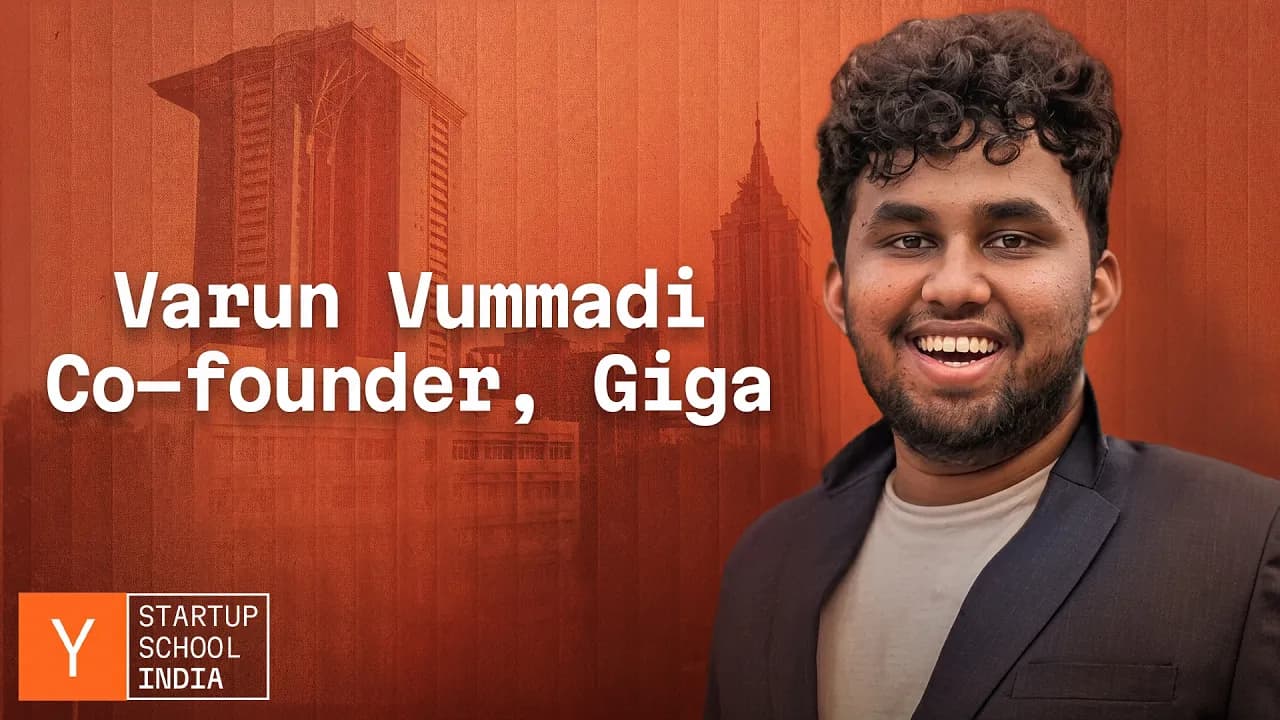
I'm Jake. I'm the co-founder and CEO of Serval. Serval is an AI native platform for IT teams. We help automate help desk requests, onboarding, offboarding, just in time access requests. Basically, the long tail of things that IT has to do. And we just recently announced our $75 million series B led by Sequoia at a billion dollar valuation. From founding to a term sheet valuing us at a billion dollars was 18 months.
I don't know that I would describe myself as a genius, but yeah, I did get a good SAT score in high school. I think the way I would think it affected me is it just gave me a lot of confidence. I think that that confidence is really helpful just knowing that I can figure things out. I can learn things. I can be competitive. I don't have anything to prove. I'm just trying to learn.
I was working in a neuroscience lab at Duke. But as a kid, I think I was just really curious. I really like to learn. I really got interested in topics very quickly, dove in, learned a lot, and then got bored and moved on to the next topic and not really sticking with anything all the way through because I was just kind of hopping between interests. And so I always wanted to start a company. My mom was an entrepreneur and I always envisioned myself. I tried to start a business when I was a teenager and I think that was ultimately the goal. And even when I was in college, I joined a bunch of entrepreneurship groups. I ended up moving into an entrepreneurship group. So even though I was studying neuroscience, I was very interested in startups and starting companies.
I dropped out of college to start my first company, a company testing advertising with brain scans. At the time, just like I'll take a few months off and then I'll just come back to school if this doesn't take off. And then that first semester off became a second semester off became a third semester off and then eventually became clear that I was never going back. And things went well enough.
Something happened during that process where one of our customers said, "Hey, can I take that headset home? Can I put that on my son and see when he's paying attention to his homework and when he's not? He has ADHD and I just want to help him give get feedback." And that story really stuck with me and we decided to build kind of a pet project of hey, maybe we could build a video game for kids with ADHD. And we ended up pivoting the company to build out a consumer product for kids with ADHD, building new hardware, a new headset, and that became Neuroplus. Ran that company for about seven years.
We had fans, we had rabid fans of our product that loved what we were doing. And that gave me this delusion that we had found product market fit or we were just around the corner from really unlocking massive growth. But so at the time when I got Forbes 730, I didn't think of the company as falling apart. In retrospect, obviously we were not anywhere near product market fit. So maybe we did have some product market fit, but it was with a market that was so small that it was pretty irrelevant and inconsequential. We're just a little bit away from unlocking some massive growth. But during that time, it's ticking up. It feels good. It feels like it's working. We just done a successful Kickstarter campaign. A lot of people are buying our product. There's always one more thing that I felt like was going to unlock the next stage of growth. And we could probably keep it going in some form for a very long time, but it was not going to be the company that I imagined and I envisioned. So, probably took a year or two after winding down Neuroplus for me to really be able to look back and realize that we were never that close.
It shouldn't be one good customer conversation, three good customer conversations. You have to have enough where you really feel like you understand the problem deeply and you understand how your solution is really going to solve it for a big enough part of the market. I think for first-time founders, you should be really ruthless around your judgment on whether you found product market fit. And so, obviously, you're always starting with early adopters and you're always having to like grow into the larger mass market. But I think you have to be honest with yourself about, you know, are you starting with early adopters and you actually are going to be able to get to the rest of the market or is your entire market just a kind of a crazy early adopter set and that could be a hard thing to figure out.
I think some of the signals that we had early on was that there were things that were very unique and different about our customers that didn't look like the rest of the market. And I think that that is one signal that maybe you're not playing in as big of a market as you think is if your early customers all have something in common that seems very strange and you don't see a natural gradient towards the rest of the market from jumping from those customers to the rest. It feels like it's working especially if you have a lot of optimism which all founders do especially early founders early career founders. It's hard to look at great customer feedback and have the skepticism and the cynicism to say I don't think this is working. We should do something else. And you understand how your solution is really going to solve it for a big enough part of the market.
And then that experience of building hardware and software platforms is what led me to Vicata before leaving to start Serval. I think the thing that sticks with me the most is this idea of you have really strong market pull and product market fit. The rest kind of falls into place. I was lucky to have a friend an early adviser to Neuroplus that I had gone to college with. He had joined Vicata as an early employee running marketing and he initially called my wife and said hey we need people this is crazy. And I remember his words were you know how everything at a startup is really hard and nothing works. And eventually flew out on site, walked into the office, felt the energy and realized this is where I have to be. I have to see what this feels like, what this looks like if I'm going to be a successful entrepreneur in the future. It's only in retrospect when I joined Vicata and I saw real product market fit that you see how different it is.
So, when I was on first call with a customer, a sales rep was demoing the product and I didn't think the sales rep did a very good job and they messed up a lot. They kind of fumbled their way through the demo. They got a couple things wrong. And the customer was a little bit confused and I just thought, "Oh man, this is not going well." And then at the end of the call, the customer says, "Okay, sounds good. Could you send me a quote? I think we'll probably buy 30 cameras or so in the next month."
The biggest question mark for us was not whether or not this was the right approach. I think it's intuitive and obvious that if you could do it, if the technology existed, that would just be the right approach. And you don't have to be perfect at every other aspect of the business if you get that part right. And so it's always been important for us from the very beginning is focus on the product experience. Focus on making sure you're building something customers want and really customers love and then the other things kind of fall in line. So if you don't have product market fit, you can't fix the rest of the organization. It means that there's an answer to the problem in the back of the book is kind of how I liken it is so hard and you have to work through problems but you know that there's an answer to all the problems that you're trying to solve. That's what I deal with. And if you could solve that, that would be meaningful. And that was really how Serval was born.
It was a year into Serval before I really believed that we were anywhere close to product market fit because I was so skeptical of every conversation I had. We are an AI platform for employee support. So when employees go and ask questions like they need access to an application, they need a password reset, they need to request time off or just get the Wi-Fi information, Serval automates the answers to those questions. We felt like we were on the right direction, but every time we kind of turned the conversation into, you know, what it would take for them to buy, there's just such a long list of things that the platform did not do that were really required of it.
And here's where it's really tricky because, similar to my experiences at Neuroplus, you can delude yourself into thinking you're just one feature away from product market fit all the time. And you can delude yourself into thinking like, I just got to keep building, keep building, keep building, and then one day I'll find it. And that's almost never the case. Now in our case we had a theory that the product that we wanted to build had to be a platform. It had to combine the full ITSM this AI native workflow builder access management help desk automation that it was actually the full platform that was what was going to be successful in the market and we wouldn't really have a product to test until we built the platform. And so that's how we kind of kept the conviction during that one-year period where we're just building and we're not getting any kind of market traction is that well the product is not built yet and we have to just build it and then we'll know.
Eventually we close our first deal and then we close our second and we close our third and our fourth and then that just kind of creates this cascade and all these customers that are providing feedback and the product's getting better and we're iterating faster and then the product gets better and we close more deals and every conversation ends up becoming not oh this is really interesting keep me posted but how much does it cost how do we try this out what's your POC process and so the tenor of the conversation changed almost overnight over a few week period in April or May of 2025 where it went from this is really neat keep us posted to how much does it cost how do we get started because in our early conversations we would get nuggets that were interesting of customer interest in what we were trying to build and we just didn't let that kind of like push or pull us.
So, you become very neutral to the customer feedback. Whereas, I think in the early part of my career, every customer conversation, you know, you just you're a pendulum. And so, you have a good call and you're on the moon. They're so excited. Like, people love this idea. You have a bad call, you're just in the dumps. And in this company, when we were doing customer discovery, we just kind of took a lot of calls. We did not let any single conversation influence us too much. So I try to be on customer calls five or six hours every single day because it's not just an IT help desk automation platform. It is a broad enterprise automation platform for the organization.
So I think a lot of folks approach these customer conversations as these point in time interviews, these kind of discreet moments where I'm going to do a customer interview, I'm going to do a customer conversation and I approach it much more as a relationship that is built and fostered over time. I want to be embedded with customers. So, I don't think about customer interviews or customer conversations. Like, I'm just talking to customers all the time. I'm in their Slack channels. I talk to them every single day. That builds just an intuition for our customers that is much more powerful than these kind of point in time, hey, I've got a list of questions I want you to answer. You know, customer interviews are valuable, but I think what's more valuable is actually understanding the customer, understanding their problems, their pains, their perspective, how they use your product. And you can't build that understanding quickly. You can't build it through formal interviews. You can only build it by truly being embedded in their day-to-day and building relationships with them over time. It has to be a genuine interest in them and in making their lives better that drives that relationship forward and gives you the insights you need to build a better product.
I think when you're building an AI product today, one of the most challenging things to always be thinking about is what's going to happen with the models and how are these capabilities going to change over time. And in the early days, to be honest, it didn't. You know, the workflow builder did not allow you to just describe any arbitrary automation and have that build out automatically without intervention. It took iteration. It took prompting. It took a lot of behind-the-scenes animations to make that all work and be seamless. And I think the bet that we took was that between our efforts and improving the product and doing a lot of clever things under the hood and the improvements in the underlying models that we would be able to build a product that delivered on this vision of make automation.
I'm very bullish that the software companies of the future are going to be much broader in scope, but I also think there are going to be more of them because people do want more out of these platforms. And so I don't necessarily think there's going to be a consolidation. But I do think that we're going to expect a lot more out of all these tools. Are you building for how the models work and behave today or are you building for a future where they're a little bit better or are you building for a future where they're a lot better and they work very differently? And figuring out what is the right call is really hard. And on the one hand, you want to kind of be skating ahead a little bit and knowing, hey, like we did where it's like the models are not good enough for what we want to do yet, but they will be very soon. In the same way, you can delude yourself into thinking, oh, this doesn't work today, but all we need is the models to get better and then all of a sudden we'll have a company. I think that's a bad idea. But I think it is smart to embrace challenges that are almost possible and you could with a small leap of faith believe that they're going to be possible in the near future.
Keep EO in your library
Save the videos and channels worth coming back to, and find them again in one place.