How I'd Go From $0 to $100,000 (If I Had to Start Over)
In a Nutshell
To reach $100k, first eliminate high-interest debt, then use the CEO system: cut unnecessary costs, increase earnings, and automate monthly investing of the remainder. Build a 6–12 month cash emergency fund, then put the rest into low-cost index funds or target-date funds while raising your investment rate 1% every December. Avoid get-rich-quick schemes, toxic frugality, regret, and endless tinkering—set up the system once and let compounding do the work.
These notes were generated by AI and may contain inaccuracies.
$100,000 is the point where everything changes. It's where your money starts working harder than you do, where compound interest actually starts outpacing your paycheck, and where you stop stressing over every financial decision. A lot of people never reach this milestone. The exact playbook to get from zero to $100,000 uses real math, a dead simple framework, and identifies four traps that steal this money from people before they even realize what happened.
According to payments research from 2025, roughly half of Americans earning $100,000 or more a year report living paycheck to paycheck. These are people earning good money and still feeling financially stuck. When you have more money, the world hands you more ways to spend it: a bigger house, a nicer car, private school for all the kids. It feels reasonable in the moment, and before you know it, that raise is gone.
This is the lifestyle gap: your income increases, but your expenses go up basically in the same ratio as your increase in pay, and you never outpace your lifestyle inflation with your pay. The advice is not to stop spending entirely. There is a difference between spending intentionally on the things you actually love and just letting your money fall out of your pockets because you didn't have a plan.
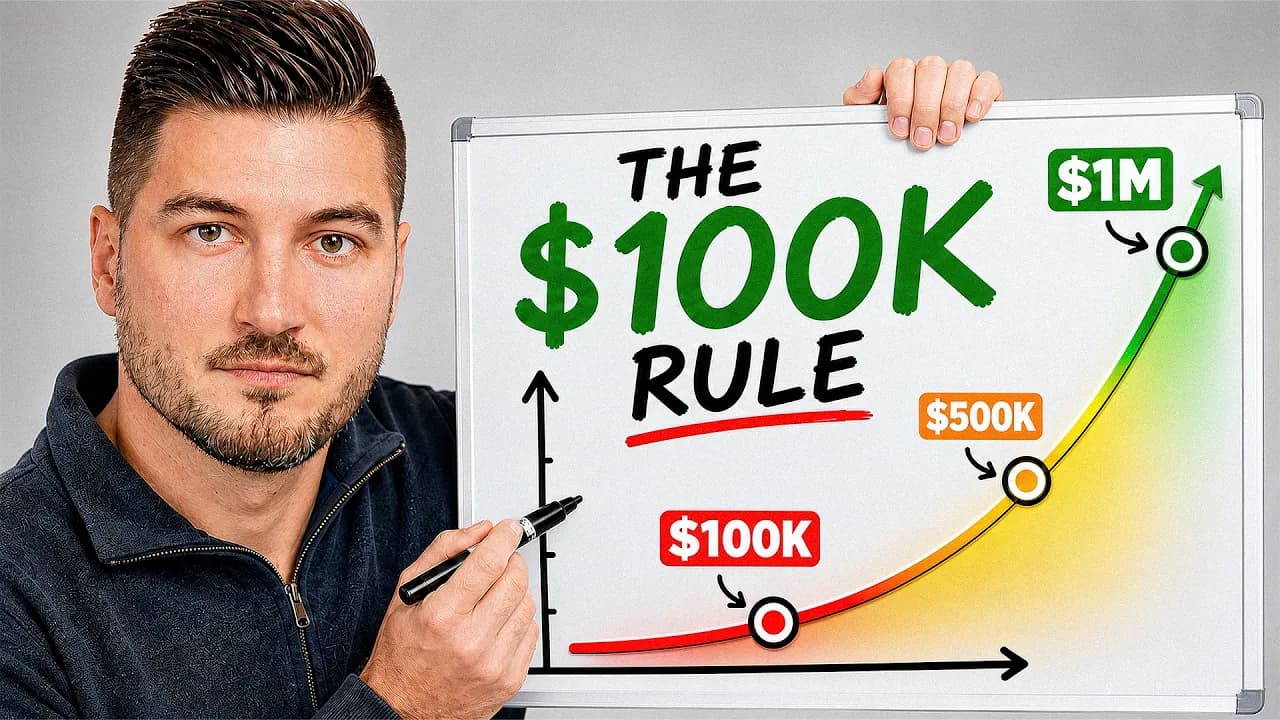
The first $100,000 is the hardest. After that, the math actually starts working for you instead of against you. Your compound interest starts building faster than your contributions, and you stop making financial decisions out of fear. $100K is the tipping point where compound interest starts to accelerate wealth building.
Investing $600 a month at a 7% annual return (a conservative assumption; typically closer to 9 or 10%) produces just over $102,000 after 10 years. Only $72,000 of that came from personal contributions; the other $30,000 came from compound interest. By the time you hit $1 million, roughly 70% of that amount comes from compound interest, not from contributions.
The speaker has been investing in the stock market since age 18 and is 38 at the time of recording. The best-performing positions are from a Roth IRA started in the early 20s, invested in the market for about 17-20 years. The advantage of watching now is that no time machine is needed; starting right now allows the system to do the lifting.
Before moving further, high-interest debt must be removed. Most people have never sat down to calculate the exact month and year their debt will be paid off. Many do not know how much debt they owe right now or the interest rates off the top of their head.
Compound interest works for you at 7% a year. Credit card debt works against you at 27%. That 20% gap is a math problem you cannot invest your way out of. Once high-interest debt is gone, the monthly payment previously going to the credit card company can be redirected toward investments and wealth building. This is the only part of the plan where speed matters. After this, the process slows down to build a system.
After debt is handled, the CEO system is implemented. C stands for cut costs, E stands for earn more, and O stands for optimize.
Cut Costs
Cut costs means getting honest about what actually matters. There are probably two or three things you genuinely love spending money on and a dozen things that are just there out of habit. Cut the habits. Cut out the subscriptions you don't need, the impulse purchases, and DoorDash. Spend on what you love.
Earn More
Earning more is still part of the equation. Financial literacy matters; you can make millions and still end up broke without it. The focus is on building the skill of earning more through a raise, a new job, or a side business that fits your life and skill set. These are the real levers that can meaningfully change your trajectory.
Optimize
Optimize is where the magic happens. Set up an automation flow with buckets. When your paycheck hits your account, put it into savings buckets (travel fund, emergency fund, taxes fund) and invest the difference automatically. Set up automation for the Monday following payday. Once monthly income and expenses are understood, the leftover amount (for example, $500) is automatically put into savings or investments. The system does the work; you just live your life.
A free 7-day money roadmap is available via QR code on screen.
Every December, increase your investment percentage by 1%. If currently investing 10% of take-home pay, bump it to 11% next year, then 12% the following December. One percent is so small it is not noticeable in the overall budget. Over time, that 1% compounds alongside income. If a raise occurs, 1% of a bigger number automatically goes to work. Some brokerages allow scheduling these increases in advance. If not, set a recurring calendar reminder for December 15th once per year. This single habit can be worth hundreds of thousands of dollars over an investing lifetime and requires almost zero willpower.
Brokerage recommendations and specials are available via QR code or links.
Warren Buffett noted that Berkshire Hathaway is structured so that it will never run out of money; at the time of recording, it holds almost $400 billion in cash or cash equivalents. A financial moat protects the castle and consists of 3 to 6 months of living expenses in an accessible liquid account earning a little interest but not invested in the market. The speaker's personal rule is 12 months to avoid being forced to sell investments at a bad time due to medical bills, major car repairs, or layoffs.
When calculating the moat, start with actual fixed costs (rent or mortgage, utilities, car payment, groceries, life insurance), then add 15% for unexpected expenses. This money should not be in the market. Investing is for money that would not be needed for years. Cash in SGOV or a high-yield savings account (accessible via QR code) keeps up with at least core CPI, even if groceries and fast food have inflated 50%.
Once the emergency fund is solid, debt is gone, and automation is running, the majority of net worth is invested in index funds. Index funds are baskets of stocks that automatically diversify across hundreds or thousands of companies. Over a 20-year period ending in 2024, 94% of actively managed domestic funds underperformed their benchmark. In 2025 alone, 79% of active large-cap managers failed to beat the S&P 500. Index funds are low-cost and available through recommended brokerages.
Target date funds are another great option. A Roth IRA can be entirely in a target date fund for 2055. Pick the year planned for retirement; the fund automatically becomes more conservative as that date approaches. It manages itself.
Fees matter significantly. A 30-year-old investing $50,000 and contributing $1,000 a month sees a difference of over $423,000 over 35 years between a 0.2% management fee and a 1% fee. That difference goes to the fund manager or financial advisor, not the investor. Low fees matter more than almost anything else in the portfolio.
Even doing everything right, four traps can still destroy progress toward $100,000.
The Get-Rich-Quick Trap
Meme stocks, Airbnb rental schemes, and hustle culture content telling people to sleep 4 hours a night and grind 7 days a week are not how real wealth is built. Real wealth is built slowly through boring systems that actually work. Pick a business or start a side hustle and let it compound over time.
Toxic Frugality
Walking 8 miles to work to avoid a $3 subway fare is an example of toxic frugality (unless the person genuinely enjoys walking). Both skills must be built: how to save well and how to spend well. Deprivation is not a plan.
"I Missed Out" or "I Missed My Chance" Syndrome
Thoughts like "I should have started when I was 20" are common, but time remains. The world does not stop because investing did not begin 20 years ago. The best time to start was 10 or 20 years ago; the second best time is right now. Do not let regret prevent the next right move.
The Optimization Spiral
Switching savings accounts every 6 months to chase an extra tenth of a percent in interest or spending 3 months researching the perfect fund allocation before investing a single dollar are examples of the optimization spiral. Focus on the big picture. Set up the system first; once it is running, leave it alone and go live life.
The speaker began investing at age 18 with mistakes including buying Nike stock because of soccer cleats and Apple stock because of an iPod, then selling when prices rose slightly. Since college, the majority of net worth has been in index funds and ETFs. Every single trade is shared at whiteboardfinanceuniversity.com. The community of 450 people knows more about the speaker's finances than his own parents or possibly wife.
The site offers full courses and live streams. A free 7-day money roadmap is available via QR code. WhiteBoardFinanceUniversity is also accessible via QR code or description links. The core message is to set up the system, live your life, and focus on the long term. Getting rich overnight is not possible. It took 18 months to make the first dollar from WhiteBoardFinance after giving out free information for a year and a half. Things take time; instant gratification does not work. The 7-day money roadmap is free; WhiteBoardFinanceUniversity is essentially free. The closing encouragement is to set up the system, live life, focus on the long term, like, subscribe, hit the bell, and share.
Keep Marko - WhiteBoard Finance in your library
Save the videos and channels worth coming back to, and find them again in one place.