How to Build a Strong Core & Abs
In a Nutshell
Core strength training must distinguish **abs** (rectus abdominis, obliques, TVA for aesthetics) from broader **core** (including pelvic floor, diaphragm, glutes, back for stability and performance), prioritizing **contraction intensity** over high reps via progressive overload like other muscles (2-4x/week, 10-20 sets/muscle, load > endurance). Use **Three I's framework**: Investigate (e.g., Sahrmann test, Biering-Sørensen hold >200s), Interpret (tailor to look/feel/perform goals: 50/50 big lifts/isolation for aesthetics; 75% isolation for back pain), Intervene with anti-movements (Pallof press, planks), flexion (crunches), rotation, and compounds (deadlifts, carries). **5-step progression**: isometric control → anti-movement/eccentric fatigue → loaded anti → concentric fatigue → heavy concentric; big dynamic exercises maximize force safely, debunking daily high-rep myths.
These notes were generated by AI and may contain inaccuracies.
Andy Galpin, executive director of the Human Performance Center at Parker University, discusses developing a strong core and great-looking abs. Warm-up questions: sit-up vs. deadlift for core/abs—which is better? Machine vs. free weight exercise—do free weights activate core more? How often to train core—every day since small muscles recover quickly?
Many common training approaches for abs and core do not align with current scientific evidence. Everyone wants a strong core and great-looking abs, but fewer achieve visible abs than have a million dollars in the bank. Solution: understand difference between core and abs, and specific outcomes desired.
Episode covers: what is the core, how abs work, training based on goals. Spoiler: not everyone means the same by strong core/great abs. Variables: exercises, order, frequency, load, rep range.
Presenting sponsor: Momentous—highest quality supplements, third-party tested, many NSF certified for sport. New Fiber Plus prebiotic addresses fiber deficiency (95% of Americans fail to hit recommended daily amount). Fiber supports gut health, nutrient absorption, energy stability, recovery, inflammation control. Andy mixes cinnamon flavor in water nightly to supplement whole food diet. Try at livemus.com/galpin, code galpin for up to 35% off first order.
People do endless sit-ups, crunches, planks without results. Origins in 1960s-70s: Joe Weider, Arnold Schwarzenegger promoted high reps/sets, many days/week (as in Arnold's Encyclopedia of Bodybuilding). Not all bodybuilders followed, but Arnold's influence carried to mainstream.
1980s: Pilates, Jane Fonda, 8-minute ab workouts focused on burn—the more burn, the stronger. 1990s-2000s: Stuart McGill and others shifted to low back pain perspective—train core to minimize injury/pain. First bifurcation: aesthetics (look great) vs. functionality (no back pain).
Fitness pros, PTs, strength coaches differ because of outcome goals: aesthetics vs. functionality. Perspective determines recommendations.
Abs generally mean aesthetics (how they look): rectus abdominis (six-pack, middle), obliques (sides), transverse abdominis (TVA).
Core = abs + more for performance/outcomes: pelvic floor, diaphragm, rib cage, back (spinal erectors, deep spine muscles, QL, lateral trunk), hip stabilizers, glutes, even upper back/shoulder girdle. Core is everything except limbs (forearms, knees, toes).
Training principles differ across core muscles (e.g., upper trap vs. diaphragm vs. rectus abdominis). Training abs not just for looks—weak core increases low back pain risk. Sport performance: weak core leads to force transmission inefficiencies (e.g., rotational athletes like baseball/golf/javelin throwers lose distance if core can't handle hip/foot force).
Look: aesthetics, hypertrophy, bigger/defined abs.
Feel: pain reduction, no weakness/imbalance (often low back pain).
Perform: functional improvements (hit golf ball/baseball harder, better balance on skateboard/surfboard).
If wanting all three, combine elements from each.
Crunch/sit-up activates rectus abdominis. PT/low back specialist: hates them—spinal flexion under load causes/aggravates pain. Bodybuilder: loves them for rectus abdominis hypertrophy (not TVA/obliques). Both correct depending on goal/risk tolerance.
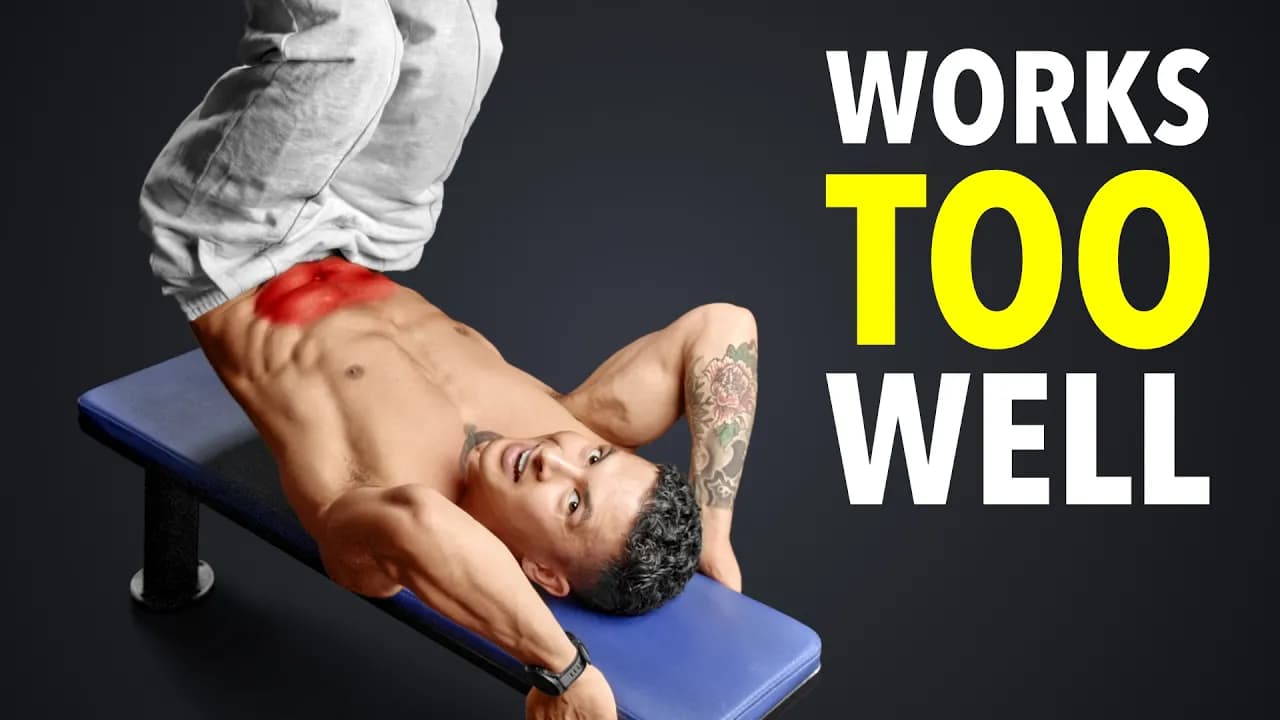
Abs: rectus abdominis (RA, six-pack—not one muscle, series of segments with connective tissue; starts below sternum, attaches to rib cage/hip bone; pulls rib cage down. Hip flexor pain from sit-ups often due to improper form using pelvis/hip flexors like iliopsoas instead of RA).
Obliques (internal/external): sides (palms on bottom ribs, fingertips on hips); give V-shape/taper; enable rotation (not TVA).
Transverse abdominis (TVA): like weight belt/corset from ribs to hips, front to back; pulls belly inward (e.g., yoga/jiu-jitsu stomach control). Not for transverse rotation—common misunderstanding leads to undertraining.
Core functions: stabilize rib cage (RA), rotate (obliques), pull in (TVA). These are muscle groups with many individual muscles (TVA has ~28).
- Flexion: sit-up, body folding forward.
- Lateral flexion: side bend.
- Extension: backward (back to hamstrings).
- Rotation: side to side.
Shift ~25 years ago (e.g., Stuart McGill): core primary role is stability, not movement (unlike biceps/triceps for elbow flex/extend). Little need to bring rib cage to thighs.
Hand-on-table analogy: flat hand/fingers firm on table—pull middle finger up, snaps back hard. Fingers barely touching—barely moves. Unstable base (palm/core) reduces appendage (finger/arm/leg) force/power transmission.
Stiff core (not rigid): strong/stiff when needed, pliable for movement. Added anti-movements: anti-flexion, anti-rotation, anti-extension, anti-lateral flexion.
Aesthetics: more movement-based. Feel/perform: more anti-movement.
Core differs: mostly avoids movement, consistently activated at 2-3% of maximum voluntary
Core muscles produce high force during standing contractions. Unlike triceps or biceps, core is active at all times, even if not much. During basic activities like lifting a backpack or grabbing a gallon of water, core muscles reach 30-40-50% force output immediately. Most other muscles wouldn't reach that high that quickly. Core reaches nearly 100% during a sneeze. Vigorous sneezing causes huge cramps due to full contraction. Vomiting produces the most intense core contraction from top to bottom. Core can go from slightly on to high activation quickly, unlike other muscles.
Core muscles are almost never off; most muscles do turn off. Research from 1996-1997 by Paul Hodges and Carolyn Richardson introduced feedforward stabilization: core activates 100-150 milliseconds before limb movement as an anticipatory response. Before acknowledging movement (from practice or subconscious registration), core pre-activates to enable limb action, like the finger/hand analogy.
Idea that slow-twitch postural muscles like calves or abs need more training or recover faster, allowing daily training, is common. Rationale: core is more slow-twitch. But research from early 1990s autopsy models shows core muscles are ~50/50 fast/slow twitch, similar to vastus lateralis and quads. Training core like quads makes sense fiber-type-wise. No literature suggests different training principles for abs vs. quads.
Don't train core with hundreds of reps daily assuming different response. Core muscles are skeletal, not different type or fiber; slightly different function but same training principles apply. Unique considerations: spinal health. Can't load core as heavy or isolate like quads without risking back/hip injury. No 5 sets of 1RM core max due to high injury risk to surrounding tissues, especially spine.
High-repetition lumbar spine loading (e.g., sit-ups) linked to elevated injury risk. Edited pro/con piece in Strength & Conditioning Journal on crunch safety: safe if done appropriately; flexion-based ab exercises don't guarantee back injury. For back pain populations, avoid risk. Don't throw out entirely claiming it causes pain.
Train abs more like quads with considerations, not entirely different principles. Data don't support throwing out known training methods.
Eight Sleep makes smart mattress covers with cooling, heating, sleep tracking. Pod 5 goes on any mattress, 55-110°F per side, high-fidelity tracking. Use eight.com/perform code 'perform' for up to $350 off Pod 5 Ultra. 30-day trial. Ships to US, Canada, UK, select EU, Australia. Great sleep impacts health/performance via body temperature drop; helps hot sleepers.
To maximize looks, feel, performance: test core strength first.
No direct 1RM due to risks. Use movement or muscle tests.
Functional Tests
- Biering-Sørensen Trunk Extension Test (early 1980s): Prone on table, upper body off edge. Lift to parallel to ground, hold as long as possible. Tests muscular endurance of spinal erectors/back extensors. Safe, no load/technique needed. Used for Anaheim Ducks/LA Kings offseason testing.
- Sahrmann 5-Level Core Test: Pass/fail levels checking low back stability.
- Level 1: Supine, raise one leg to 90° hip/90° knee.
- Progress to both legs: knees to chest, calves on hamstrings, lower both legs to ~12cm from table without back arching or holding table. Google 'Sahrmann 5' for details. Dozens of similar tests.
Advanced Lab Tests
- EMG: Sensors on muscle for activation (most ab/core research uses; higher activation = working harder).
- Proteus machine: Rotational power, velocity, force (rare; has transducers).
Muscle Growth Measurement
Little research on core hypertrophy. MRI or ultrasound challenging. Optima Muscle (speaker's program) uses Springbok MRI for 140+ muscle volumes, symmetry, fat infiltration (pre/post). Can't use tape measure; appearance depends on body fat/weight. Conflict: speaker profits from Optima Muscle. Functional tests suffice for most.
Train abs regardless of scores, but context:
- Sahrmann: Level 3 or lower = highly problematic (likely back pain imminent; prioritize core). Level 4 common, aim for 5 (pass/fail: no low back movement).
- Biering-Sørensen: <178 seconds = higher low back pain risk; >200-240 seconds (3.5-4 min) = low risk from extensor endurance.
- Transverse Abdominis Control: Pull abs inward (seated or quadruped). Pass/fail: visible separation rib cage/stomach, belly button to spine. Many can't.
- Obliques: L-shape hands above hips; push hands outward with control (easier when crunching sides). Without crunch, few succeed.
- Posterior Bracing: Fingertips above PSIS (top pelvic bone); push backward/out for 360° brace, not just front.
Progressively overload like other muscles, but adapt for abs/core uniqueness (e.g., spine). Define core exercises: isolation (planks, back extensions, side bends) vs. functional/dynamic/integrated.
Colloquially, if you think about exercises primarily to target abs, that is the optimal target. Dynamic, movement, integrated exercises activate, utilize, strengthen, and enhance abs, but also do something else larger. These are deadlifts, overhead presses, lunges, carries, pushes. A lot of research shows these are fantastic for abs, where people disagree. Powerlifters, weightlifters, strongman default to big dynamic movements like carries and walks, saying core is going nuts. Research supports that; they activate core very well. The problem is thinking therefore no need for core isolation exercises; research suggests that's incorrect.
Pilates approach is opposite: to get core done, do bunch of core isolation exercises. Research and meta-analyses show we need more work in this area, but based on evidence, free weights and suspension exercises activate core musculature more than isolated exercises. Free weights and suspension alone do not sufficiently cover core musculature. Obvious answer: combination of big free weight movements, some suspension exercises, and independent isolation exercises.
Suspension exercises: push-up position with feet in TRX loops, stability ball, or other position elevating feet. Think about all these in programs, spend more or less time depending on goal.
After reasonably trained, isolated exercises don't work as well. Early training, time off, or starting out, isolation fine. After certain fitness level, move past that. Continuing some isolated fine, but only sticking to them leaves gains in performance and aesthetics on table.
Examples of isolation: planks, back extensions, side bends. Isolating ab/core muscles, not using other larger muscles or minimally. Isolated doesn't mean isometric/not moving; targeting core.
Key driving principle in effective ab/core exercises is contraction intensity. Contract abs really hard with bodyweight, external load, or machine; variables not what matter. Get in safe position to contract really hard. Clear in literature: must be there to work.
Great example of size principle: motor units (motor neurons and muscle they activate). Human movement starts with low threshold motor units (tend slow twitch, smaller, energetically efficient). Increase force: turn on more motor units. Can't regulate at individual muscle fiber (all-or-none principle; full force only). Force output by turning on/off units.
Low force activities don't activate high threshold motor units (reserved for high force). Consistent across skeletal muscle, including abs/core.
Parallel: maximize quad size/strength, not wall squats only (good endurance, but no one built biggest quads that way). Same for abs: planks, 3 sets of 20 crunches forget size principle; huge motor units not activated. Get endurance, not strength.
Equivalent: wall squats + leg presses/extensions. Fatigue and burning not same as force production.
Hard to load rectus abdominis (easy for quads on leg press; can't put 400lb on side bend, maybe 50-60lb Russian twist). Principles same, loading strategies differ.
Most not seeing progress in aesthetics/strength forget to add load or progress intensity. General strategy: longer holds, more reps (fine progression), but core responds better to load/intensity than time/duration/fatigue.
Dynamic vs. sit-ups: safer/easier several hundred pounds on sled push than on sit-up. To get rectus abdominis, transverse abdominis, obliques at highest force: barbell squat/deadlift activates more than sidebend due to loading limits.
Big movements critical for maximizing ab/core development: safer way to maximize force contraction without spine/hip risk.
David protein bars: 28g protein, 150 calories, 0g sugar (75% calories from protein; 50% higher than next). Gold bar 28g, bronze 20g both 150 calories. Best tasting ever. Eat daily, as dessert. davidprotein.com/perform.
Exercises based on movement patterns or muscles. More in show notes.
Movement: flexion (crunches, sit-ups, jackknives); anti-flexion (Pallof press posterior version, supine plank: on back palms up holding anti-flexion; suspended supine plank).
Lateral flexion (side planks, hip dips, physio/Swiss ball side crunch, oblique V-ups/sit-ups); anti-lateral flexion (side plank with row, suspended lateral plank: side, feet in TRX, resist dipping).
Anti-core as avoiding eccentric/unwanted movement, isometric-like.
Extension (supermans, back extensions, reverse hyperextensions, straight bridges, Swiss ball bridges, reverse crunches); anti-extension (Pallof hold, prone plank, suspended).
Rotation (windshield wipers, Russian twists); anti-rotation (Pallof holds, supine Pallof).
Google anti-rotation etc.; variety good. Favorite rotation: cable mid-rib height, feet wide, horizontal to machine, rotate upper body to pull rope/cable across body (lower body fixed), eccentric back.
Don't fixate on specific exercise; focus movement pattern (flexion/extension/rotation/anti). Experiment for great contraction.
Rectus abdominis: weighted cables, crunches/reverse crunches, leg raises, ab wheels, rollouts.
Obliques: rotation, anti-rotation (Pallof press, wood chops, suitcase carries, planks).
Transverse abdominis: pull belly in (dead bugs, stir-the-pot on physio/Swiss ball).
Forward/backward best for rectus abdominis, not rotation.
Aesthetic appearance mostly body fat/body composition (abs made in kitchen). Focus on training.
Little research on core muscle growth protocols; default to basic strategies (similar physiologically).
Rest intervals: short (30s) or long (3+ min) equal for growth.
Frequency: 2-4x/week per muscle group max (not daily; doesn't work best for other muscles).
Bigger abs + low fat = visible. Emphasize rectus abdominis most (prominent). Train obliques rigorously (pulls waistline in).
10-20 working sets/muscle/week, split as liked. Train hard: 1-2 reps in reserve.
Progressive overload: not just reps (load better).
Transverse abdominis for flatter stomach (pulls in; postpartum pooch). Don't skip (common miss: only RA/sit-ups/crunches/side bends, no transverse).
Posture: tight hip flexors (psoas major) cause anterior tilt, flare rib cage, distended look. Correcting improves appearance without fat loss/muscle gain. Exaggerate: flare hips, arch back.
Exaggerated poor positions like excessive arching make your stomach shoot out; tuck your tailbone, pull ribs down for a flat stomach. Moving to a neutral spine position can help if your primary goal is aesthetics.
Six studies using ultrasound or MRI show core muscle thickness increases of 10-20% for rectus abdominis (RA) and others. Studies include electrical stimulation devices, classic Pilates, obese populations, foam rollers. Programs last 6-12 weeks with traditional hypertrophy principles: not hundreds of reps or daily training. Core muscles grow like others with proper programming.
For good-looking abs, use 50/50 split between big complex movements and isolation exercises. Big movements maximize size principle, force production, mechanical tension (primary hypertrophy driver), keep direct core volume low. Isolation ensures targeting RA or transverse abdominis (TVA) without fatigue from legs/arms/quads.
Combine movement-based (flexion, rotation, lateral flexion) and anti-movement exercises (anti-extension, anti-rotation, anti-lateral flexion). Anti-movement allows high volume with low spine load/injury risk.
Today's episode is sponsored by Element, an electrolyte drink with ideal ratios: 1,000mg sodium, 200mg potassium, 60mg magnesium, no sugar. Hydration critical; 1% dehydration decreases performance. Use drinklmnt.com/perform for free sample pack with purchase.
Similar principles: 1-2+ min rest, 3-5 days/week, 6-15 sets/muscle/week, 1 RIR, progressive overload. Lean 75% big exercises, 25% structured core since big exercises (squats, deadlifts, carries, sled work, overhead presses) activate core more, transfer force between body parts. RA needs to hold tension for movement, not necessarily grow or look a certain way.
Most research here; 80% experience low back pain lifetime, 50-60% chronic. Use 75-80% isolation, 20-25% big exercises for precise patterns, correct dysfunction, ensure muscle function.
Train 3-7 days/week, high volume up to 30 sets/week/muscle, to full volitional fatigue. Low load/intensity, neural grooving for pain desensitization, activation, blood flow. No overtraining risk (e.g., bird dogs daily). Induces fatigue, strength, growth, functionality.
Adjust core training (ramp up/ Peel back, styles, intensities, reps, choices) based on goals/demands. Physical therapists emphasize isolation; bodybuilding coaches big lifts.
Pick at least one from flexion, rotation, anti-extension, anti-rotation/lateral flexion weekly. Rarely muscle-specific; default to movement.
Example for 5-6 days/week:
- Day 1 (heavy stability, 6-12 reps, 2-3 sets):
- Anti-extension: Loaded dead bug (e.g., 50-60lb kettlebell, ankle weights, bands; fail from heavy, not 50 reps).
- Anti-rotation/lateral flexion: Suitcase carry (heavy dumbbell one side; walk hard, resist falling/rotating; grip-limited).
- Flexion: Cable crunch (heavy, 6-12 reps).
Do 3 days/week or mix styles (e.g., heavy day 1, high-rep day 2). Use for 6-8 weeks or undulating (vary reps/sets weekly/monthly).
Progressively overload core like other muscles.
- Isometric control, fatigue resistance (e.g., plank 45-90s; hold position tired. Stay 6 days-6 months until confident in obliques/RA/glutes/back/shoulders).
- Anti-movement or eccentric, fatigue resistance (e.g., side plank to slow lateral lower; high reps).
- Anti/eccentric with load (heavy, low reps, push strength).
- Concentric/movement with fatigue (high reps).
- Concentric/movement with heavy load (fast/heavy/fatigued).
Flexion example:
- Plank.
- Reverse crunch/dead bug (30-100 reps, controlled eccentric).
- Decline/weighted crunch (eccentric focus, hold plate/DB; one vertebra at a time up/down to avoid back pain).
- Cable crunch (concentric, high reps).
- Loaded cable crunch/DB (5-8 heavy reps). Heavy ab work grows strength/size fast.
Priority-based: Do highest priority first. Abs/core last OK unless primary goal (looks/feel/perform). Avoid pre-fatiguing if impacts squats/pull-ups/lunges (lowers execution, raises injury risk).
Training frequency: Not daily best; 2-4 days/week for perform/aesthetics, daily OK for feel/activation/correction.
Unstable vs. machines: Not necessarily more functional. 5lb side bend < 1RM leg press core activation. Free weights > machines if equated for load, but execution > choice.
Bench press/deadlift vs. sit-up: Sit-up more specific but load-limited safely, limiting force demand.
I'm going to be limited in force demand. That limitation in force demand is very similar to what we just got done talking about. In this case, a bigger, more dynamic exercise might in fact be more effective for strengthening or even growing your core muscles.
The last one I'll give you here, which is something we didn't get into too much and I'll leave as a teaser, and that's the entire topic of weight belts. You'll hear controversy on this, but to me, I think the science has been settled here for over a decade. If you take a weight belt and you put it on really tight, you cinch it all the way down, you might see a regression or a drop in muscle activation during any given exercise. But if you put the weight belt on just barely kind of snug, you can actually see increased core activation because it gives you tactile feedback as the examples I gave you earlier when I said put your hand on your side or put it on your back or get in this different position because it causes you some tactile feedback and you often times people have a better ability to contract when they have that feedback. The same is true of a belt.
Evidence and Personal Approach to Belts
The evidence as it currently stands and my personal approach is to think about belts like this:
- If I need to use it as a way to cue or to learn an activation strategy, then I'll put it on there. But then ideally, we progress to the next step where we can remove it and we have conscious control of that musculature or that movement pattern independent of an external stimuli.
- If we're going to be loading really, really heavy, maybe 85% or more of our one rep max on a bench or a pull-up or an overhead press or some big movement, and someone feels more secure and more stable and they want to add a belt, then I'm absolutely okay with that because we're no longer using that movement to train the core. We're actually trying to get better at that movement. And we have plenty of ways to train our core on separate exercises. So, slap on a belt, even if they want to cinch it down super tight, because we're trying to get stronger in the deadlift or a lunge or something else, totally fine there.
- But what we probably want to do is say, okay, whenever we fall, you know, say below 90% or below 85%. Maybe don't use our belt because we need to make sure that we're developing enough muscle strength in that movement to be safe when we load it heavier.
So hopefully that gives you a little bit better understanding about how I think about using belts and how they can both undercut app development as well as accelerate app development. It's entirely based upon not the technology or the equipment itself, but how you're utilizing it, when you're utilizing it, who you're utilizing it with, and what the ultimate goal or outcome is.
Thank you for joining for today's episode. My goal, as always, is to share exciting scientific insights that help you perform at your best. If the show resonates with you and you want to help ensure this information remains free and accessible to anyone in the world, there are a few ways that you can support:
- First, you can subscribe to the show on YouTube, Spotify, and Apple. And on Apple and Spotify, you can leave us up to a five-star review. Subscribing and leaving a review really does help us a lot.
- Also, please check out our sponsors. The show would not exist without them and their exceptional products and services.
- Finally, you can share today's episode with a friend who you think would enjoy it.
If you have any content questions or suggestions, please put those in the comments section on YouTube. I really do try my best to read them all and to see what you have to say. I use my Instagram and X profiles also exclusively for scientific communication. So, those are great places to follow along for more learning. My handle is Dr. Andy Galpin on both platforms.
We also have an email newsletter that distills all of our episodes in the most actionable takeaways. We have newsletters on how to improve fitness in V2 max, how to build muscle and strength, and much more. To subscribe to the newsletter, just go to performpodcast.com and click newsletter. It's completely free and we do not share your email with anybody.
Thank you for listening and never forget in the famous words of Bill Bowerman, > if you have a body, you are an athlete.
Keep Andy Galpin in your library
Save the videos and channels worth coming back to, and find them again in one place.