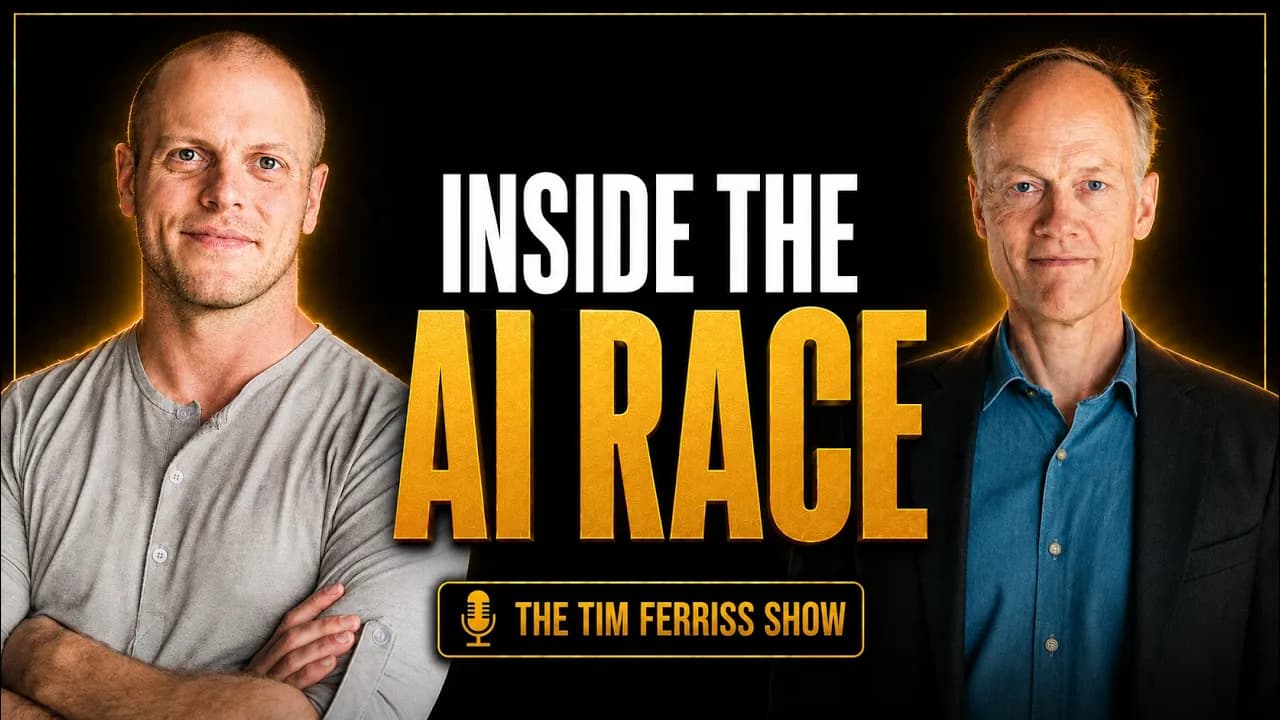
How To Prepare Your Mind for the Age of AI — Sebastian Mallaby
In a Nutshell
Sebastian Mallaby argues that people must actively prepare their minds to seize opportunities in the AI era, rather than outsourcing thinking to large language models and risking mental laziness. He uses AI selectively for tasks like rapidly summarizing research papers to accelerate his own thinking, but refuses to let it generate his writing because the process of writing itself defines his identity and understanding. The core message is to offload only narrow, low-value tasks to AI while preserving the core cognitive activities that give life meaning and prevent erosion of self.
These notes were generated by AI and may contain inaccuracies.
Sebastian Mallaby would put the phrase "prepare your mind" on a metaphorical billboard for billions of people to see. The expression originates from Louis Pasteur, who said "chance favors the prepared mind." The principle states that readiness allows people to maximize opportunities when they arise.
The phrase has appeared across Mallaby's books in unrelated contexts. While writing about venture capital, he encountered it at Excel Capital where founder Arthur Patterson used it to describe the firm's investment approach. The firm ran scenario exercises anticipating new technologies and the types of companies and entrepreneurs needed to exploit those platforms. The goal was to already understand 90% of a pitch before it occurred, enabling strong and rapid judgment in competitive situations.
Mallaby interviewed Ilya Sutskever from OpenAI and asked why he immediately recognized the significance of the transformer architecture on the day it appeared online. Sutskever read the paper, ran down the corridor to collaborator Alec Radford, and declared they would build a language model on top of the architecture while instructing the team to "stop everything you're doing" to pursue it.
Sutskever's response was that he possessed a prepared mind. He had been thinking about sequential data for language models since his PhD in Canada. When the transformer solution appeared, it was the breakthrough he had awaited for roughly a decade, allowing him to seize it immediately.
Mallaby references a Seattle Seahawks Super Bowl game against the New England Patriots. In the final seconds, the New England quarterback executed an interception that secured victory. When asked afterward how he knew where to run and where the quarterback would throw, the answer reflected a prepared mind. During training, the team had studied the Seahawks' formations and anticipated the specific pass that would result from a given formation. The defender ran directly into the ball's path and intercepted it.
Mallaby identifies the prepared mind as especially critical in the age of artificial intelligence. The risk with large language models is that people become lazy and request the models to supply what to think whenever information is needed. This approach does not lead to happiness or satisfaction. People must continue the hard work of preparing their minds because that work defines human identity. Mallaby references Descartes' "I think, therefore I am" and states that "prepare your mind" becomes a more important slogan than ever.
Mallaby compares the question to physical exercise such as going to the gym or doing cardio. While not mandatory, such activity benefits people on multiple levels and some find it enjoyable. He asks what the equivalent practice is for knowledge workers who wish to prepare their minds and avoid becoming mentally "impotent" the way many have lost navigation skills due to Google Maps.
Mallaby argues the Google Maps analogy is flawed. It is acceptable to offload a narrow, unpleasant mental task to a machine, but it is not acceptable to offload all thinking. The purpose of offloading specific tasks is to free mental energy for activities that provide genuine satisfaction and meaning.
Mallaby uses large language models to rapidly learn about the scientific output of interview subjects. The models have ingested arXiv papers and can summarize a scientist's three key papers, trace the progression between them, and compare the work with that of another researcher interviewed two weeks earlier. This use accelerates learning and helps him think more, not less, by eliminating time spent locating and laboriously reading papers himself.
He is not concerned about hallucinations in this context because he will interview the human scientist directly and can cross-check all information.
Mallaby refuses to have AI generate his writing. He states that current models perform poorly at long-form writing and are "terrible for anything longer than about 800 words," though they can handle short emails. Even if models improved, he would not outsource writing because the process is central to his identity. He explains: "I think through my writing, I come to understand what I understand and think what I think and believe what I believe through writing."
Mallaby acknowledges that AI writing quality will continue to improve. He references experiments reported in The New Yorker or The New York Times in which a famous novelist had AI generate pieces in their own voice. Professional readers and editors could not reliably distinguish the author's work from the AI-generated text. An economist writer conducted a similar test; professional economist journalists could not identify which witty columns were his versus those generated by the model.
Mallaby notes that while current limitations exist for long-form work such as 20-page chapters, improvement is inevitable. Nevertheless, he intends to retain the activities that constitute his sense of self.
The discussion emphasizes the importance of identifying the activities and processes that define personal identity so that delegation to AI does not unintentionally erode one's sense of self or self-worth.
Keep Tim Ferriss in your library
Save the videos and channels worth coming back to, and find them again in one place.