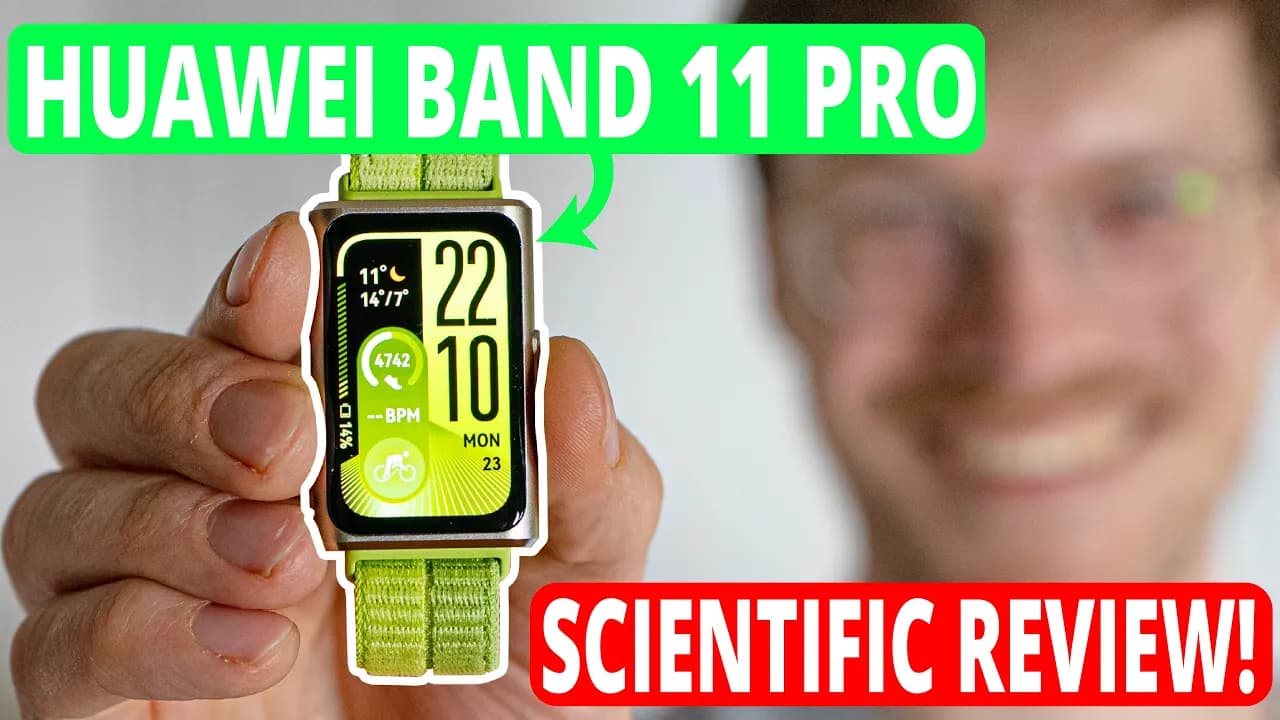
Huawei Band 11 - FULL Scientific Review!
In a Nutshell
The Huawei Band 11 delivers poor heart rate tracking during running and outdoor cycling, with the aluminum version showing 0.88 correlation and plastic version 0.67 correlation versus ECG chest strap, and both versions ranked among the worst performers across all tested activities. Sleep stage tracking also performed poorly against EEG reference, with deep sleep agreement only 53-66% and light/REM sleep agreement below 50%, placing both versions among the lowest-ranked devices. The reviewer concludes the Band 11 cannot be recommended for health or sports tracking, recommending instead the Huawei Watch Fit 4 for heart rate or Whoop/Oura/Pixel/Apple devices for sleep tracking.
These notes were generated by AI and may contain inaccuracies.
Testing focused on heart rate tracking performance and sleep stage tracking performance of two Huawei Band 11 variants. The devices lack GPS tracking but cost significantly less than the Pro model. Two black versions were tested: one with an aluminum outer case and one with a plastic outer case. The aluminum version weighs 1g more than the plastic version. Both variants cost approximately 40 to 45 euros. The sensors are identical between versions, and no performance difference was expected based on the material.
The reviewer is a post-doctoral scientist specializing in biological data analysis. Heart rate tracking was tested during exercise against an ECG chest strap as the reference device. Sleep stage tracking was tested against the Z Max EEG headband, described as a silver standard for sleep stage tracking in scientific studies.
For indoor cycling, the aluminum version showed a correlation of 0.88 with the reference device, indicating mostly good performance with some instances of detecting too low heart rate. The plastic version performed better with a correlation of 0.97. Both versions showed occasional sudden drops in heart rate detection that could not be explained. This performance was characterized as good enough for the price point.
When compared to all devices tested between 2025 and 2026, both Huawei Band 11 versions ranked as medium to low performers. The aluminum version performed among the poorer performers, while the plastic version ranked slightly better. Both performed similarly to the Huawei Band 11 Pro. Better performers included Apple Watches, more expensive Huawei devices, the Huawei Watch GT Runner 2, Huawei Watch 5, Huawei Watch GT 6, and the Huawei Watch Fit 4.
Running showed significant performance issues with both versions. The aluminum version displayed a cloud of points above the reference line, indicating detection of too high heart rate, particularly in higher heart rate ranges. This was attributed to cadence lock, where the stepping frequency interferes with heart rate detection. The plastic version showed similar performance issues. Individual running sessions showed both devices detecting too high heart rates, with the aluminum version reaching implausibly high readings up to 180 bpm.
Both Huawei Band 11 versions ranked among the worst performers for running heart rate tracking. The Pro version performed slightly better but still not among top performers. Top performers included various Apple Watches, Amazfit Helios strap worn on the biceps, Pixel Watch 4, Huawei Watch GT 6, and Huawei Watch Fit 4. The conclusion was that the Huawei Band 11 cannot be recommended for running if heart rate tracking is the focus.
Outdoor cycling showed poor performance with correlations of 0.82 for the aluminum version and 0.67 for the plastic version. The plastic version's low correlation included instances where it detected half the actual heart rate. Some bike rides performed adequately, but one long session significantly impacted the overall results. This may have been influenced by using a different bike with different hand positioning.
Both versions ranked among the worst performers for outdoor cycling, performing similarly to the Huawei Band 11 Pro. Better performers included Apple Watch, Amazfit Helios strap on biceps, Pixel Watch 4, Huawei Watch Fit 4, and Huawei GT 6. The conclusion was that paying more for premium Huawei models provides significantly better sensors and processing.
Weightlifting, typically the hardest exercise to track, showed correlations of 0.93 for the aluminum version and 0.88 for the plastic version. Both versions frequently missed heart rate peaks during exercise sets. The recommendation was to use a chest strap for weightlifting heart rate tracking, as the Huawei Band 11 was not considered good enough.
Both versions ranked in the higher area of performers for weightlifting but were still not considered good enough. Devices considered potentially good enough included Apple Watch 11, Powerbeats Pro 2, Apple Watch SE 2025 Ultra 3, Amazfit Helios strap on biceps, and Apple AirPods Pro 3. These devices might have some dropouts but would not record incorrect heart rates.
The Huawei Band 11 cannot be recommended as a dedicated heart rate tracker. Both the standard and Pro versions are not good enough compared to current competition. The devices might have been adequate in 2023, but many brands have improved their technology. Upgrading to Huawei Watch Fit 3 or Fit 4 would provide significantly better heart rate tracking performance.
Sleep stage tracking was tested against the Z Max EEG headband, which measures brain waves and is specifically designed for sleep stage tracking in scientific studies. Combined with Dreem 2, the scoring method has been proven good enough to provide general impressions of device performance.
For the aluminum version, deep sleep agreement was 66% with 23% misclassified as light sleep. Light sleep agreement was 40%, and REM sleep agreement was 46%. These results were characterized as okay at best for deep sleep and not very good for light and REM sleep.
The plastic version showed similar results with 53% deep sleep agreement, and REM sleep agreement of 48% and 47% for light sleep. Limited data was available with only four to five nights per device, totaling eight to nine nights combined.
Both Huawei Band 11 versions ranked among the poorest performers for sleep stage tracking, close to the Huawei Watch GT Runner and Huawei Band 11 Pro. All Huawei devices clustered in the same poor performance area. The U Band performed worse, while Coros performed similarly. Chinese devices generally performed worse, suspected due to less investment in polysomnography reference data collection for model development.
Polar and Garmin were characterized as middle-tier performers using models from approximately 7 years ago. Google Pixel watches and Fitbit devices ranked among better performers due to recent investment in updated models. Samsung has improved over time but remains second-tier. The Oura Ring and Whoop Strap performed well. Apple devices showed variable results, with some users experiencing good performance and others experiencing worse results. The Eight Sleep Pod performed well on the reviewer's body.
The top five performers in sleep stage tracking were the Whoop Strap, Oura Ring, Apple Watch, Pixel Watch (including Fitbit devices), and Eight Sleep Pod. The Eight Sleep Pod functions as both a sleep tracker and an active temperature control system for the mattress, capable of cooling and heating each side of the bed independently.
The Huawei Band 11 cannot be recommended for sleep stage tracking. Results were consistent across multiple metrics including average sensitivity, Cohen's Kappa, and worst sensitivity measurements. Both the aluminum and plastic versions ranked among the worst performers regardless of the metric used.
The Huawei Band 11 and Band 11 Pro cannot be recommended for health and sports tracking based on this testing. For users wanting to stay within the Huawei ecosystem, the Huawei Watch Fit 3 or Watch Fit 4 would provide much better heart rate tracking, though sleep stage tracking would still not be great. For more premium options, Huawei GT models offer excellent heart rate tracking. For sleep stage tracking focus, recommended brands are Eight Sleep, Google Pixel, Apple, Whoop, or Oura. The Whoop Strap was recommended as providing a good overall package for sports, health tracking, app experience, and sleep stage tracking. The Pixel Watch was recommended for Android users, while the Apple Watch was recommended for iOS users despite app experience limitations.
The speaker still needs to complete a full 24:19 test of the Huawei Band 11. They are curious about viewer experiences with the device, particularly those who purchased the Huawei Band 11 or already own a Huawei Band 10. Key questions include whether users get good heart rate tracking from this device or if they are considering upgrading to a more expensive device.
There is no significant performance difference between the aluminum and plastic versions of the Huawei Band 11. The look and feel of both versions is basically the same. If the plastic version is significantly cheaper, users should opt for that version. The speaker notes that if users decide to purchase the Huawei Band 11 or consider alternatives, they might explore other devices including Garmin devices, Whoop Strap, Oura Ring, or a Whoop Strap worn on the biceps.
The speaker encourages viewers who want to purchase the Huawei Band 11, alternatives like the Eight Sleep Pod, or anything on Amazon (including small items like coffee beans or toilet paper) to use their affiliate links provided below. Using these links helps support the channel and often provides the best discount possible.
Given that viewers watched the Huawei Band 11 video, the speaker suggests they might also enjoy the video on the Huawei Band 11 Pro or the video on the Eight Sleep Pod.
Keep The Quantified Scientist in your library
Save the videos and channels worth coming back to, and find them again in one place.