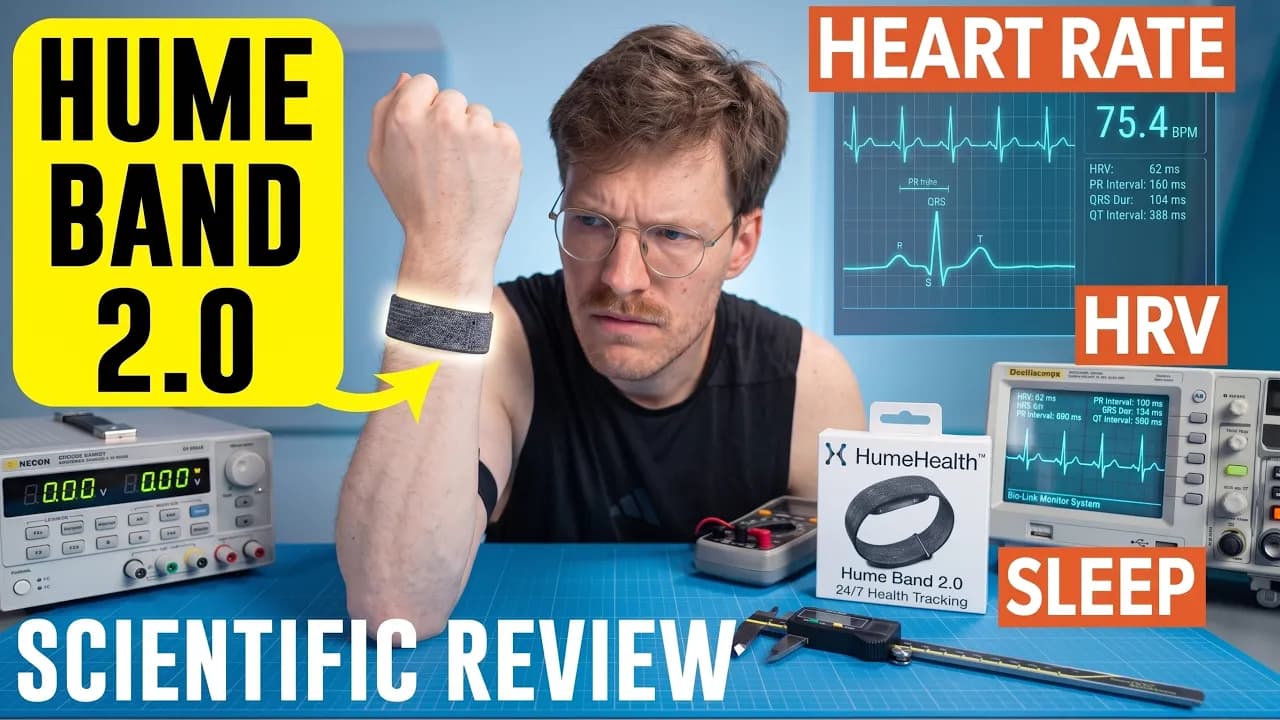
HUME Band: DO NOT GET THIS! (Scientific Review)
In a Nutshell
The Uband is essentially a rebranded $20–30 AliExpress device sold at a $250 premium, with the company misrepresenting stock-photo models as its scientific team. Its sleep-stage algorithm performs poorly—only ~40-50 % agreement with a research-grade EEG reference—often producing unrealistic copy-paste cycles and missing expected overnight trends. Heart-rate readings are similarly unreliable, with frequent spikes or under-reading, making the device unsuitable for its claimed price and scientific positioning.
These notes were generated by AI and may contain inaccuracies.
This is the worst wearable I've ever tested. The reason is not because the measurements aren't reliable, though those also aren't that great. The Yume Band sells its hardware at a premium where the exact same hardware can be obtained for a fraction of the cost on AliExpress. The band ships from more or less the same location.
The company blatantly lies on their website. They use stock image models and pretend they are scientists that developed the band. The same John Cardiff PhD is used with two different pictures, both from the same stock image website. The Ument costs $250 or $249. Many outlets and influencers recommend this device without awareness of these issues.
The reviewer was contacted by the company multiple times for partnerships. After replying that they wanted to talk with their scientific board, specifically John Cardiff who wrote an interesting book, the company ghosted the reviewer. A few months later, the same person from the company contacted the reviewer again, seemingly having forgotten previous interactions.
The reviewer suspects the company actively contacts many influencers, hoping some don't do due diligence and don't actually test the device. This video serves as a PSA for anyone considering the Uband or promoting Yume.
The reviewer is a post-doctoral scientist specializing in biological data analysis. The Zmax EG headband was used as reference device, specifically designed for sleep stage tracking and used in several scientific studies, considered the silver standard.
Only three good nights of data were obtained with both the band and reference. Some nights of the Y band were excluded because they were so weirdly tracked that results would look super bad. The best nights of the Y band were used for analysis.
Data export is not possible, requiring manual conversion based on app screenshots. According to European regulation, detailed data should be provided upon request, but the company replied that screenshots should be taken instead.
The sleep stages show agreement percentages where perfect agreement would show 100% on the diagonal. The awake column is ignored because the reference detects many short awake moments or arousals that aren't full awake moments.
Deep sleep shows about 50% agreement, with 40% detected as light sleep instead. Light sleep shows 40% agreement, with much detected as deep sleep, REM sleep, or awake time. REM sleep shows 40% agreement, with much confused with light sleep.
One example night from November 25th shows the reference on top and Y band on bottom. The Y band detected a lot of deep sleep near the end of the night where deep sleep isn't normally expected. The patterns show what appears to be copy-paste jobs of the same sleep cycle repeated multiple times, with REM sleep not increasing and deep sleep not decreasing as expected in normal sleep architecture.
The reviewer suspects Yume takes a basic sleep cycle and copy-pastes it multiple times with some tweaking based on movement, without substantial scientific training behind the algorithm.
The Y band ranks on the bottom left of an overview chart showing average agreement versus worst sleep stage performance, making it one of the worst devices tested since 2025 based on average sensitivity. It performs worse than Huawei devices.
Top performers include Oura Ring, Apple Watch, Pixel watches, Eight Sleep Pod, and Whoop strap. Samsung Galaxy watches are getting closer but not quite there yet.
The Whoop strap has a similar form factor worn on the biceps, and the reviewer suspects the Y band is based on the Whoop strap but implemented poorly in terms of tracking.
Using average sensitivity weighted differently and Cohen's Kappa, the Y band performs worst for both metrics out of every device tested. The same top performers apply: Pixel, Apple, Eight Sleep, Oura, Whoop strap, with Galaxy watches getting closer.
Heart rate during the night should show a hammock shape with decreasing heart rate then gradual increase upon waking. The Y band was compared to the Oura Ring rather than a chest strap reference due to data export difficulties. The Oura Ring is known to be super reliable for heart rate measurement.
The Y band shows heart rates up to 120 BPM during the night, which would not occur even walking to the toilet. Individual nights show the baseline agrees well but the Y band has unrealistic spikes. Some values appear close to double the actual heart rate, indicating poor signal quality.
Heart rate variability measurement couldn't be properly compared because the Y band doesn't state which formula it uses. Multiple formulas exist for calculating HRV. The values appear in different ranges between devices, making direct comparison impossible. Given the heart rate discrepancies already observed, HRV is suspected to be unreliable as well.
All measurements during the night - sleep stages, heart rate, and heart rate variability - are not considered reliable. The device performs better than random but most devices do better. The $250 price for what is claimed to be a science-backed band is problematic when compared to the $20-30 AliExpress version where lower expectations would apply.
The reviewer states: "Just be upfront and sell me a cheap thing and don't pretend like it's a more expensive thing than it actually is."
Heart rate was tested during indoor cycling, outdoor cycling, weight lifting, and running using a Polar H10 ECG chest strap as reference. The Y band shows points away from the perfect agreement line, especially measuring half the actual heart rate at times.
Indoor cycling examples show way too low heart rates being measured in the middle of segments. Running sessions show peaks measuring lower than half the actual heart rate, with some data missing entirely. Weightlifting data was limited but showed incomplete peak detection.
The app isn't poorly developed and generally works quite well. Some people may get value from the product. The company uses trustworthy wording on their website and sends periodic emails with useful information, but the measurements don't seem very good.
The reviewer notes bias from discovering the AliExpress product that looks identical externally, with the same charging dock, and connects to the Yume app as a Y band. Materials on the outside may be slightly different, but otherwise it's basically a clone of a cheap AliExpress brand.
The reviewer does not recommend getting the Uband at this point. Alternative recommendations include Whoop strap, Pixel Watch, Apple Watch, Galaxy Watch, or Eight Sleep Pod for sleep improvement. Affiliate links are provided for these devices to support both the channel and the purchaser's wallet.
Keep The Quantified Scientist in your library
Save the videos and channels worth coming back to, and find them again in one place.