"I Just Sold Everything” - WTF Happened To Bitcoin?!
In a Nutshell
Bitcoin has dropped over 50% from its high due to risk-off flows, ETF outflows, whale selling, exhausted catalysts, and lost conviction in its "digital gold" narrative. MicroStrategy holds 4% of supply at a ~$75k average cost and faces an unrealized $12.5B loss, with its financing structure shielding it from forced sales. Historical cycles show bottoms near the $53k realized price, and while bearish forecasts target $47-55k, long-term bulls still project $150k-$1M, with the speaker maintaining a small, DCA-based allocation for money they can afford to lose.
These notes were generated by AI and may contain inaccuracies.
Bitcoin has fallen more than 50% from its all-time high. Previously the best performing asset of the last decade, it is now being called worthless by some of the best investors in the world. Micro Strategy admitted they may eventually sell, raising questions about whether Bitcoin is broken or if this moment will create millionaires.
Investors are rotating out of risk assets like cryptocurrency into safer assets such as cash, bonds, and treasuries. Money is also flowing into higher-upside opportunities like AI, reducing liquidity available for Bitcoin.
Previously, ETF purchases required funds to buy underlying Bitcoin, pushing prices higher and attracting more buyers. Now, ETF selling forces liquidation of underlying Bitcoin, driving prices lower.
Large holders sold approximately 25,000 Bitcoin in a single recent week, triggering panic among other investors.
A year ago, excitement surrounded a potential strategic Bitcoin reserve, new ETF launches, institutional demand, and price targets of $250,000, $500,000, and $1,000,000. Much of this has already occurred. Legislation has stalled. Gold, silver, and AI have taken market attention. Without new capital inflows, there is no new buying pressure.
Bitcoin was promoted as digital gold and a hedge against inflation, chaos, centralization, and money printing. When real chaos occurred, gold, stocks, silver, and even Nokia rose while Bitcoin fell. Loss of narrative leads to selling, which triggers more selling.
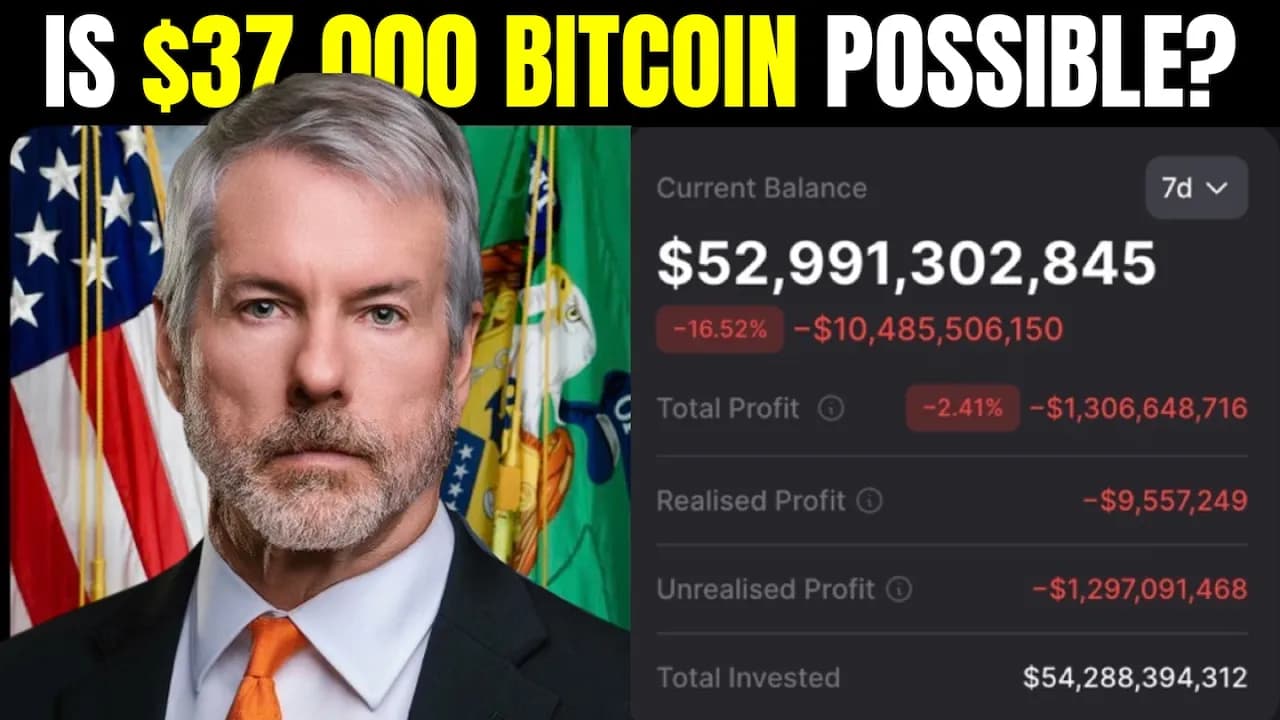
Micro Strategy, originally a software company, began converting its corporate treasury into Bitcoin in 2020. The company raised capital through investor money, debt issuance, and stock sales to purchase additional Bitcoin. It now controls 4% of the total Bitcoin supply, purchased at an average price of approximately $75,000, representing roughly $64 billion invested.
At the current Bitcoin price of $60,000, Micro Strategy shows an unrealized loss of approximately $12.5 billion.
Micro Strategy did not use margin loans that would force liquidation at specific price levels. Capital was raised through convertible debt and preferred stock, meaning shareholders absorb losses rather than triggering forced Bitcoin sales.
Micro Strategy created a dividend fund to raise additional capital for Bitcoin purchases, with the stock priced around a $100 target. The dividend stock has fallen substantially below this level, with the market pricing in potential inability to pay promised dividends. The main Micro Strategy stock has also declined sharply.
The company adjusted its framework to include a larger reserve, increased dividends to attract buyers, and authorized potential Bitcoin sales. This shift triggered criticism and a new class action lawsuit investigation by a law firm. A nearly identical lawsuit filed one year prior was dropped.
Cook Unity delivers chef-prepared, restaurant-quality meals directly to customers. Offerings include signature dishes from award-winning chefs, Food Network stars, James Beard winners, and Michelin-starred chefs. Meals are handcrafted in small batches from eight elevated kitchens across North America. Pricing is lower than typical grocery or restaurant costs. No grocery shopping, cooking, meal prep, or dishes required. Customers select 4 to 16 meals per week, pause or cancel anytime, and personalize preferences. Use code graham50 at cookity.com/gram for 50% off the first order.
Bitcoin has experienced multiple major drawdowns over 17 years:
- 99% decline in 2011
- 56% decline in 2012
- 83% decline in 2013
- 84% decline in 2018
- 50% decline in 2021
- 74% decline in 2022
The current ~53% drop aligns with historical patterns.
Bitcoin has followed a consistent four-year cycle: gradual accumulation, price grind higher, parabolic advance creating FOMO, followed by 50-80% crashes. This pattern has held for 15 years without failure.
In early 2017, videos were made at $1,000, then at the $17,000 peak, and again at the $3,500 bottom. The $3,500 level marked the actual bottom. A $10,000 investment at that price grew to $350,000 at the subsequent peak.
The realized price represents the average price paid by all Bitcoin holders and functions as the market's break-even point. The current realized price is approximately $53,000. Every prior bear market (2015, 2018, 2022) saw Bitcoin briefly fall below this level before forming a bottom and then rising parabolically.
- Billionaire Jeremy Grantham called Bitcoin a useless speculative mechanism headed to zero.
- Warren Buffett shares a similar view.
- Cryptoquaint suggests a potential bottom near $53,600 and notes weak demand.
- 10X Research forecasts a low around $55,000, with the bottom forming between late August and October.
- Some charts point to $47,000 or lower before reversal.
- A 4chan post that correctly predicted the October 2025 top in 2023 forecasts the next all-time high in September 2029.
- Coin Shares projects $120,000-$170,000 by year-end.
- Standard Chartered forecasts $150,000.
- ARK Invest maintains a long-term target of $1,000,000 by 2030.
- Extrapolations from prior cycle highs and lows suggest eventual prices between $150,000 and $400,000.
Bitcoin has survived the largest liquidation event in its history, tariffs with China, military conflict in the Middle East, the most hawkish Fed in years, and Michael Saylor breaking his "never sell" promise, while still trading at $60,000—unimaginable six years ago.
Only 46% of Bitcoin remains in profit, matching the 2022 crash lows. Data indicates a potential real capitulation event may still lie ahead. No one can predict outcomes with certainty.
8-10% of the portfolio is allocated to a Bitcoin ETF using money that is not needed for other purposes. Dollar-cost averaging has been used for years. If the price rises, holdings are maintained. If the price falls, additional purchases are made. An 80% decline would not change the strategy.
Tax-loss harvesting is currently employed: selling the Bitcoin ETF to realize losses that offset capital gains, then repurchasing. Physical Bitcoin holders face no wash-sale rules and can sell then immediately repurchase.
- Control emotions: euphoria leads to buying tops; fear leads to selling bottoms. Only investors who feel neither have consistently made money.
- Buy only what you can afford to lose.
- Position size should be small enough that a 50% or greater drop causes no sleep loss or panic.
- Act opposite to gut feelings: euphoria suggests avoiding purchases; fear of further declines often marks good entry points.
With negative sentiment prevailing, current conditions may represent a reasonable entry for risk capital, but Bitcoin should not be viewed as a guaranteed path to wealth. Every crash differs and nothing is assured.
Keep Graham Stephan in your library
Save the videos and channels worth coming back to, and find them again in one place.