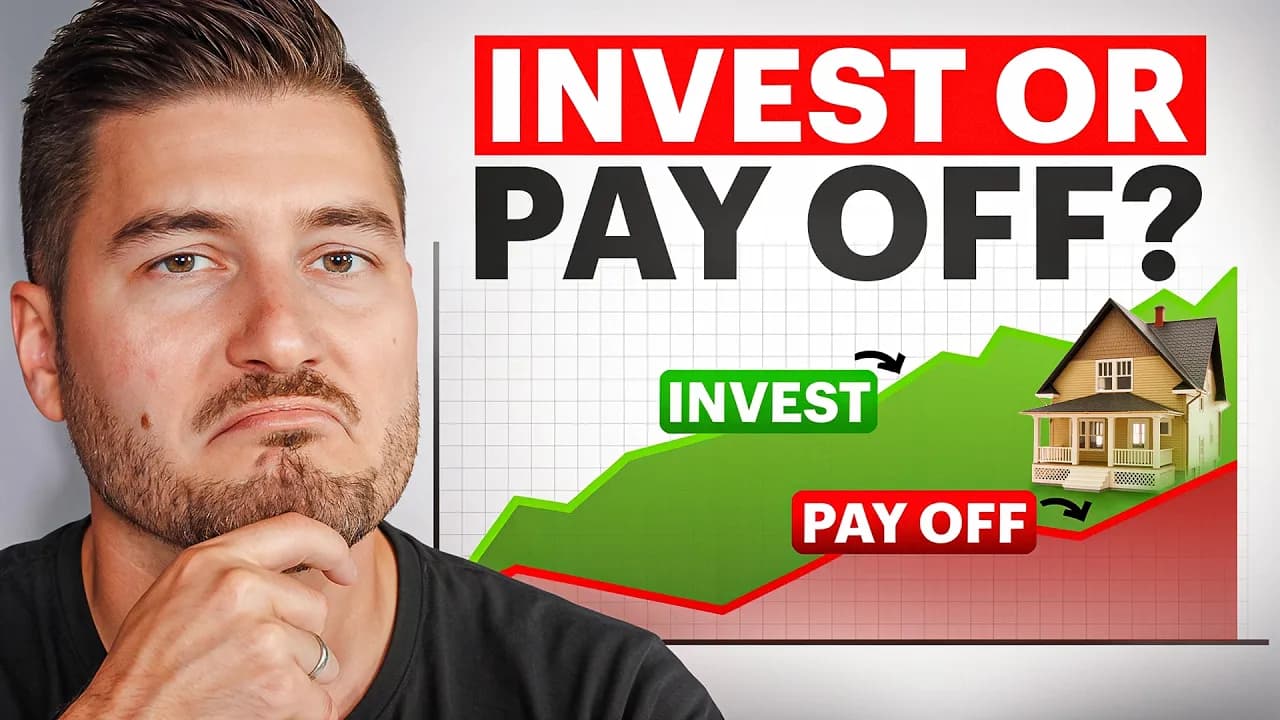
I Paid Off My 2.875% Mortgage…Dave Ramsey Was Right
In a Nutshell
The speaker paid off 2.875%–3.6% mortgages despite the math favoring arbitrage, because the unexpected mental relief from being debt-free outweighed the lost 4–5% spread. Research and personal experience showed debt elimination reduces anxiety and improves decision-making regardless of interest rate or account size. The new advice prioritizes cash buffers, 401k matches, and high-interest debt first, then treats mortgage payoff as a personal peace-of-mind choice once those are covered.
These notes were generated by AI and may contain inaccuracies.
The speaker is taking a significant risk by going against everything previously said about debt. After years of advising against paying off low interest rate debt and instead arbitraging money in markets, the speaker now questions that position. Mathematically, it makes sense not to pay off a 3% mortgage since stock market returns exceed that rate, and below a certain point it functions like free money. However, after paying off three super low interest rate mortgages, an unexpected sense of relief emerged that had never been anticipated.
A Twitter poll asking if anyone regretted paying off their low interest rate mortgage received almost 4 million views and 1,500 replies, with almost nobody expressing regret. This prompted the speaker to examine the non-mathematical aspects of being debt-free that calculators cannot capture.
Growing up, the speaker was taught that all forms of debt were bad. Credit cards were considered traps, loans were for people who couldn't afford things, and purchases should only be made with cash. This philosophy meant no credit cards or payments, only a basic debit card and savings account.
At age 21, after working as a real estate agent for four years and saving commissions, the speaker wanted to buy real estate in 2011 when homes were under $100,000. The choice was between buying one house outright or using $100,000 as a down payment for three properties, leveraging the spread between mortgage rates and property returns.
The speaker was denied a loan not due to insufficient funds or inability to afford payments, but purely because of no credit history. This experience flipped the entire philosophy on debt. Credit and debt became viewed as tools to be used rather than avoided, capable of generating millions of dollars when used strategically.
At 21, instead of buying three houses at $60,000 each in cash, the speaker could have purchased 12 properties with 25% down. Those properties would have appreciated to approximately eight times their original value. The key principle identified was the spread: borrowing at 5% to invest at 12% creates 7% return on money that was never originally owned.
After recognizing debt's potential, the speaker spent years opening credit cards and using every available method to boost credit score. This led to mortgage approvals, including a first mortgage on an $800,000 West Los Angeles property at 3.375% for 30 years, followed by a duplex at 3.5% and another at 3.6%.
The speaker calculated that paying off these low rates made no mathematical sense. Using the example of a $600,000 duplex with 20% down at 3.5% interest generating 8% net rental returns created a 4.5% spread, plus additional returns from property appreciation.
The speaker viewed fixed-rate mortgages as extremely safe because rates couldn't increase, rents remained stable, and inflation effectively reduced real debt burden. When inflation matched the 3% interest rate, the debt essentially became free money. The standard advice given for 10 years was never to pay off mortgages below 4-4.5% and instead invest the difference in the S&P 500.
The speaker promotes Policy Genius as a life insurance marketplace allowing comparison of quotes from top insurers. 20-year life insurance policies start at $276 annually for $1 million coverage. The platform provides clear options for coverage amounts, prices, and terms, with licensed agents handling paperwork and questions.
After paying off mortgages at rates as low as 2.875% fixed for 30 years, the speaker experienced unexpected relief. The debt category on a Rocket Money account dropped by millions of dollars, creating a freeing sensation despite no previous worry about making payments. The debt represented mental space that wasn't consciously recognized until it disappeared.
Research revealed that paying off debt leads to reduced anxiety, better decision-making, and improved cognitive test performance across all income levels. This effect wasn't limited to debt amount but included the number of accounts, regardless of size or interest rate.
Paying off a 3% mortgage is described as an emotional rather than financial decision. While market returns mathematically exceed mortgage rates, the peace of mind gained from debt elimination is difficult to quantify. Research indicates that financial satisfaction impacts overall happiness equally to job, health, and relationships combined.
A study from the Journal of Public Economics found that 38% of households voluntarily paying down mortgages instead of maximizing tax-advantaged retirement accounts made suboptimal choices, costing 11-17 cents per dollar due to the perceived safety of mortgage payoff.
Research shows cash on hand predicts life satisfaction better than income, investments, or net worth. Paying off all available cash into a mortgage leaves no liquidity, which is problematic since mortgage companies won't return principal when needed. The recommended approach is maintaining a cash buffer while paying down debt.
The speaker acknowledges that optimization becomes less enjoyable over time, with fewer things to think about becoming more valuable than maximizing returns. The advice hierarchy is:
- Maintain an emergency fund
- Take employer 401k match
- Pay down high interest debt
- Consider mortgage payoff for mental clarity once other financial priorities are addressed
The speaker notes that individuals with hundreds of millions in debt may sleep well, while others avoid even car payments, and both approaches can be valid depending on personal values. For those comfortable with arbitrage below 4-4.5%, that approach remains mathematically sound, but mental clarity benefits should be considered.
Keep Graham Stephan in your library
Save the videos and channels worth coming back to, and find them again in one place.