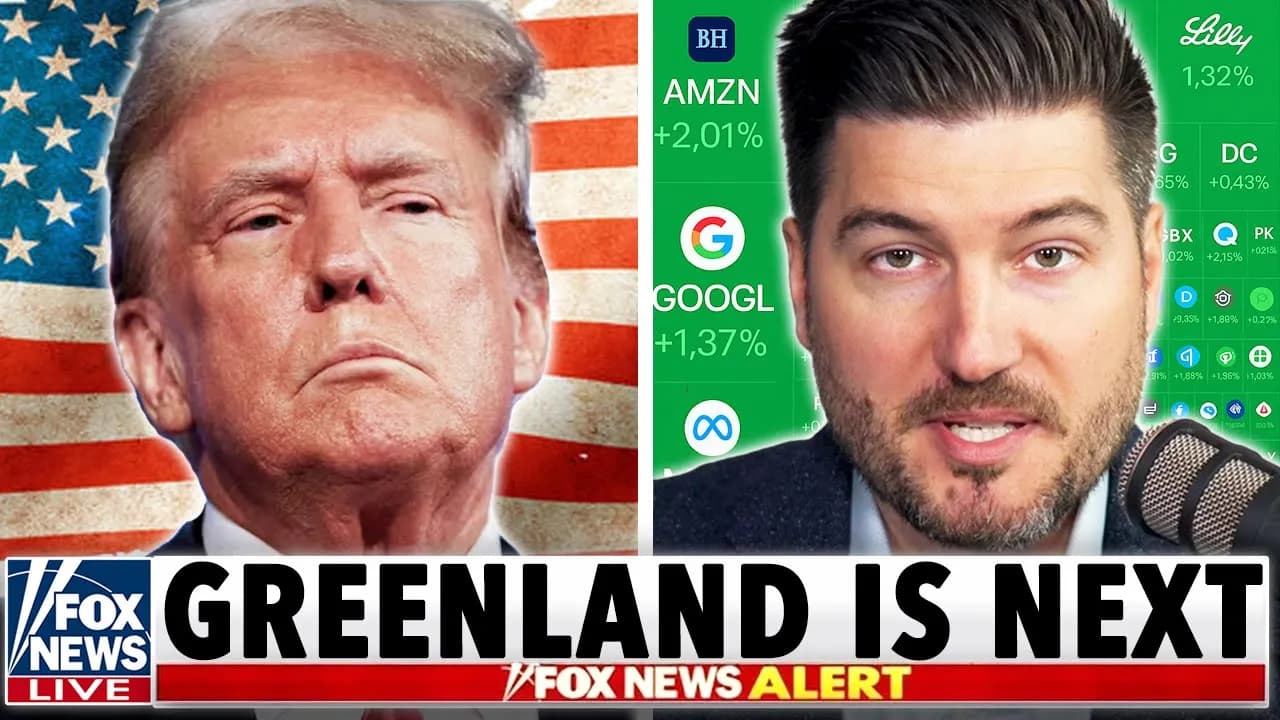
Iran Is Next (Venezuela Was Never About Oil)
These notes were generated by AI and may contain inaccuracies.
The United States moved into Venezuela and captured Nicolás Maduro, removing him from power almost overnight. This changed the geopolitical chess game completely and happened very fast, catching many off guard. Common explanation: getting rid of Maduro and grabbing Venezuela's oil for American oil companies and Trump's billionaire buddies. Venezuela holds roughly 300 billion barrels of oil reserves, the biggest in the world. At $57 a barrel, total value roughly $17 trillion. Even wholesale at 50% off, worth close to $9 trillion—more than the GDP of every country on Earth except US and China, roughly four times Japan's economy. Oil still powers the world, but oil has very little to do with this. If about oil, operation would have happened years ago when production was higher and infrastructure less damaged. Oil story is easiest to explain, but real reason is how global power works today. Video explains why Venezuela was important to US, why China, Russia, and Iran matter. Iran in big trouble; people taking over cities. If they start killing people like in the past, US will get involved, hitting them very hard where it hurts—not boots on the ground.
So, Iran's in big trouble. It looks to me that the people are taking over certain cities that nobody thought were really possible just a few weeks ago. Uh, we're watching the situation very carefully. I've made the statement very strongly that if they start killing people like they have in the past, we will get involved. will be hitting them very hard where it hurts. And that doesn't mean boots on the ground, but it means hitting them very, very hard where it hurts.
Once you understand this chessboard, you'll understand the rest of the world, where it might go next, and how it affects investments. Story not just about oil and Venezuela—much more interesting.
Hi, my name is Andre Jick. Marco Rubio: US doesn't need Venezuela's oil; has plenty. Not allowing oil industry controlled by US adversaries.
First of all, let me go back up. We don't need Venezuela's oil. We have plenty of oil in the United States. What we're not going to allow is for the oil industry in Venezuela to be controlled by adversaries of the United States. You have to understand, why does China need their oil? Why does Russia need their oil? Why does Iran need their oil? They're they're not even in this continent. This is the Western Hemisphere. This is where we live. and we're not going to allow the Western Hemisphere to be a base of operation for adversaries, competitors, and rivals of the United States.
President not mastermind; Pentagon analyzes US interests and presents plan to president for yes/no. Three main things for US action:
- Rival power in strategic region.
- Region affects global trade, security, or leverage.
- Inside or close to America's enforcement zone (military bases).
Venezuela checked all boxes.
Geographically in Western Hemisphere, US core security zone for hundreds of years. Close enough to threaten US mainland if another country puts military there.
Resources: US has plenty oil, but needs strategic materials for weapons, electronics, defense—rare earths. China has rare earths but needs oil. China invested $100 billion in Venezuela, close friends. US doesn't want China dominating, getting discounted oil, using own currency instead of US dollar—key leverage point.
They're going to from now on do trade in their own currencies. Get right around the dollar. They're creating a a secondary economy in the world totally independent of the United States.
Venezuela hosted foreign advisers, intelligence sharing—huge threats for power projection inside US security perimeter.
Pentagon decision: geography + rival presence + resources (rare earths, silver, gold, currency settlement) + security (militaries close together). All three at once in America's hemisphere triggered action.
Gemini credit card: no annual fees, earn up to 4% back in over 50 cryptocurrencies instantly (set to Bitcoin). 4% on gas/transit/ride share, 3% dining, 2% groceries, 1% everything else. Mastercard World Elite, works internationally. Card holders who earned/held Bitcoin for 1 year saw average 279% appreciation. Get $200 Bitcoin on $3,000 spend in first 90 days: gemini.com/andre.
Monroe Doctrine (1823, President James Monroe): Western Hemisphere not open for foreign powers to colonize, militarize, or use as base. Originally vs. European empires—US stays out of Europe, Europe stays out of Americas. Evolved to block any rival influence threatening US interests economically, militarily, strategically.
We sort of forgot about it. It was very important, but we forgot about it. We don't forget about it anymore. Under our new national security strategy, American dominance in the Western Hemisphere will never be questioned again.
Marco Rubio's words borrowed from it: no hostile power projection in US hemisphere. Invoked in Cold War, Cuban Missile Crisis. Response escalates when threats too close geographically.
Venezuela got too close/friendly with adversary US doesn't want building home/resources here. Been coming long time, but tipped now.
Heartland Theory: Control center of Eurasia (Eastern Europe, Russia, Asia)—most defensible, resource-rich region—control world.
Rimland Theory: Control edges/coastlines/trade routes/perimeters around heartland for advantage. Rivals box you in, limit trade/naval access/power projection. Landlocked disadvantaged.
Russia example: huge Eurasia territory (Heartland), but landlocked/frozen. Crimea: year-round warm-water Black Sea port to Mediterranean. Ukraine between Russia and sea—if NATO, cuts Russia off from maritime routes.
World not just oil; future rare earths, data infrastructure, weapons, electronics, AI, robots. US problem: One Big Beautiful Bill Act—DoD set aside $7.5 billion for critical minerals ($1 billion+ spent stockpiling). US 100% import-reliant for 12 critical minerals, >50% for 28/50 essential to security—irreplaceable. China controls 60-95% global processing; 91% rare earth elements—choke point leverage.
Venezuela: huge deposits coltan, rare earth elements, gold, bauxite, strategic materials for electronics/weapons. China worked with Venezuela, routing to Chinese processing—center of supply chains at source. US nightmare: defense materials extracted/processed by competitor, reintroduced to market.
Venezuela action: deny China/Russia leverage over supply chains, military presence, currency experimentation, geographic proximity. Forces negotiations favorable to US. International law meaningless without enforcement.
Theory: superpowers consolidating non-negotiables by geography.
- Russia: Ukraine (blocks maritime access, boxes in).
- China: Taiwan (semiconductors, supply chains, Western Pacific).
- US: Western Hemisphere (Venezuela, Cuba)—no rival bases/resources/supply chain threats.
Next likely Iran:
- Controls northern Strait of Hormuz—15% world oil passes daily (Saudi Arabia, UAE, Kuwait, Iran, Qatar exports). Classic Rimland leverage.
- Supplies cheap oil to China/Russia outside US enforcement—weakens sanctions, boosts independence.
- Coordinates with Russia (drones/weapons since 2022).
- Threatens Israel (key US ally, military tech buyer, Middle East proxy).
Iran fits: Rimland energy threat, oil to adversaries, bypasses US dollar, pressures ally, interests in Venezuela. Theory: Iran next for US, Taiwan for China, Ukraine for Russia.
Keep Andrei Jikh in your library
Save the videos and channels worth coming back to, and find them again in one place.