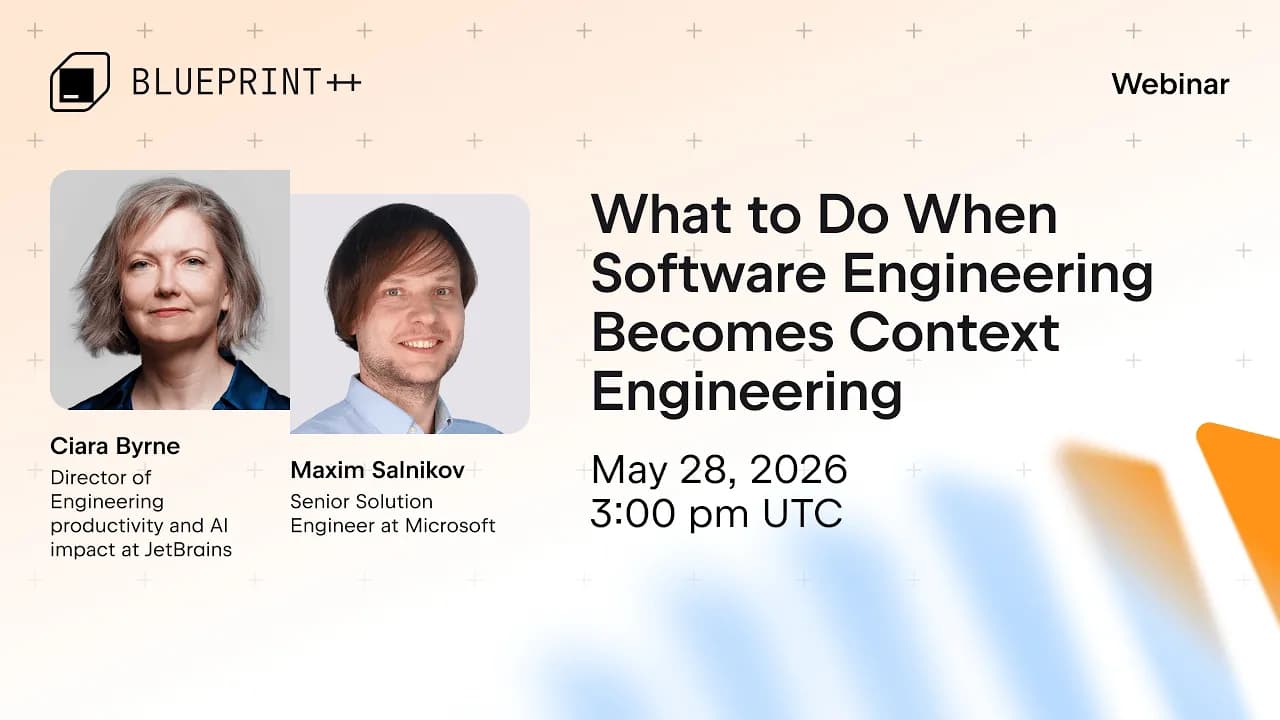
JetBrains AI.JS Day 2026
In a Nutshell
The video argues that AI has made code generation cheap, so the real engineering work is deciding what code should exist, judging its quality, and taking responsibility for outcomes. The speakers emphasize building robust workflows around AI agents rather than relying on prompts alone, using context engineering, deterministic controls, skill chaining, and human-in-the-loop decision points. The durable skills that remain valuable are product judgment—knowing what to build and whether it's worth building—rather than just writing code.
These notes were generated by AI and may contain inaccuracies.
The event opens with a countdown sequence: "10 10 Here we go again. 9 Stay online. 8 It's at the gate. Seven. Seven. Pray to heaven. Six. Six. It knows your tricks. Five. Five. The code. Four. Four. It builds some more. Three. Three. It codes like me. Two. Two. It doesn't need you. One. Your job is done." This transitions into the live broadcast. Jason Torres welcomes viewers to channel 13 for AI.JS Day 2026, noting the virtual JavaScript event and the suspicious television broadcast format.
Jason Torres describes the current era where AI can generate components, pages, whole applications, explain them, criticize them, fix them, and write confident summaries, yet the button still says "submit" but submits nothing. The frontier is that machines write entire applications while developers still need to remind AI that a modal should close when pressing escape. At JetBrains, adding a two-dot command to the editor apparently crossed the line.
Serious questions arise about what it means to be a front-end developer when the front-end can be generated, what it means to be an engineer when the first draft of software is almost instantaneous, what should be learned versus stopped learning, and who gets blamed when production goes down if AI writes code, runs tests, opens pull requests, reviews them, merges them, and deploys them. The answer appears to be the person currently on vacation.
The future of software engineering is not a world where people disappear and machines take over, but where the definition of work changes. Previously, programming was translating ideas into code: having requirements, opening editors, wrestling with CSS, running tests, discovering tests were testing the wrong thing, changing code, changing tests, changing requirements, and achieving something that looked approximately like the screenshot at 11:47 at night.
The difficult part is no longer producing code but knowing what code should exist in the first place, knowing what good means, knowing what users actually need, knowing which tradeoffs are acceptable, and knowing whether a solution is robust, accessible, maintainable, understandable, and appropriate for the people who will have to live with it later. That judgment is not separate from engineering but is engineering itself. AI makes producing code significantly cheaper, making important questions more important: Should we build this? Who will maintain it? What happens when the person who built it is no longer in the room?
These are technical questions but also design questions, product questions, testing questions, communication questions, and sometimes ethical questions. The event focuses on everything between prompt and outcome: branches, missing context, designs that look perfect in screenshots but fall apart on actual phones, and agents confidently announcing everything is finished while standing in the smoking crater of a repository.
Viewers are encouraged to keep chat open, ask uncomfortable questions, tell where workflows broke, and share what AI almost got right. Almost right is often more dangerous than completely wrong. The closing message states: "Your value never was just a number of characters you could type into an editor. Your value is your ability to understand a problem, make a judgment, create something useful, and then take responsibility for the result. That job is not disappearing. It is becoming harder to fake."
Jason Torres introduces Danny Thompson, who shares fun facts: he likes cracking jokes, barbecuing, and smoking meat, and loves being a father. Someone once told him he was "actually funny," with emphasis on "actually."
Danny Thompson presents on "Engineering the Branches Between Prompt and Outcome." AI coding demos are almost always perfect: someone opens an editor, types a prompt, the agent writes code, files change, tests run, and within minutes there's a working application. However, these demonstrations show only the version that worked, not the three failed attempts, the context developers had to find, hours spent getting agents back on track, or pull requests waiting in review queues.
The agenda covers: the gap between demos and real workflows, 14 steps when only two needed AI, context as a dependency not an afterthought, skill contracts and composition, adaptive orchestration and governance, loop engineering state and recovery, evidence-based review and human authority, and actionable takeaways for Monday morning. Thompson hosts "The Program of Podcast" with Leon Noel and co-authored "The Developer's Guide to AI" targeting average corporate developers who want to use AI tools effectively without building predictive models or LLMs.
AI demos make software development look like a straight line from prompt to outcome, but engineering workflows don't operate this way. Developers must tell agents what to do next, write code, run tests, fix tests, open PRs, and figure out why things break. Agents have been turned into short order cooks: put in the order, they make it, then wait for the next order. This is an interesting way to use something called autonomous.
The most valuable engineering opportunity isn't getting models to complete tasks faster, but engineering everything between the first instruction and actual outcome. For the last feature shipped using AI, the focus should be on everything else: how long it took to find requirements, how long developers had to intervene, how long PRs waited for review, and how many handoffs required someone to remember what needed to happen next. Code can be generated in minutes, but work might spend two days waiting for decisions. Accelerating one step doesn't necessarily improve the entire workflow, especially in enterprise environments with cross-team coordination, services, permissions, and business rules.
Instead of beginning with prompts, workflows should be thought about backwards from outcomes. Questions include: What actually needs to be true to say work is complete? What evidence would prove it's factual? What are the wait times and can they be optimized? This reveals that straight lines aren't really straight after all.
An example application sends voice messages through WhatsApp using Forge (JavaScript with Atlassian's flavoring) in the Atlassian ecosystem. Voice messages are captured by Twilio, put into Jira tickets, refined by automation, and passed to Cursor Cloud Agent or Copilot for code changes. This architecture has 14 steps, but only 2 require generative reasoning decisions. Half the steps aren't agentic, a quarter aren't agentic, and two are agentic. The rest use deterministic approaches.
Clear specifications matter, but describing how systems should behave doesn't implement retries, enforce permissions, or recover partial failures. Those must be engineered. You cannot outprompt a bad architecture. The important part wasn't how much AI could put into the system, but deciding which parts needed AI and which didn't. Input handling, validation, service integrations, and routing still need to be deterministic and secure. If operations aren't already defined, models shouldn't reinvent them every time. If users don't have permissions, those decisions shouldn't be left to prompts. AI should handle places where reasoning is valuable, while code handles decisions already known how to make.
Codebases don't know why decisions were made. Repositories can tell how something is implemented but not why a team rejected a particular design six months ago, why security restrictions were introduced, or which customer requirement caused behavior changes. That knowledge lives in Jira, Confluence, Loom recordings, and decisions made while working together. Atlassian's approach through Teamwork Graph, Relevant, Atlassian MCP brings organizational context into development environments.
An application using Forge for meeting pipelines demonstrates Loom's "record for agent" feature. Specific elements can be selected on screen while recording, highlighting bugs like toggles with wrong defaults, missing buttons, and attendee limits. The recording processes into prompts with screenshots that can be sent to agents like CodeEx with Atlassian MCP to create refined bug tickets including Loom recordings and screenshots for reference.
Jira boards have columns including "to-do," "in progress," and "approved for agent." Tickets moved to "approved for agent" automatically assign tasks to GitHub Copilot, which waits for input. This enables measuring productivity by tracking story points assigned to developers versus agents in sprints.
Context documents and context engineering reduce bugs by providing the right context instead of probabilistic outcomes. Using Rovo or Teamwork Graph to bring organizational documents like system design graphs, architecture charts, and Jira tickets helps systems understand the "why" behind decisions. Context documents preserve discovered knowledge and team compromises, preventing systems from recommending solutions that were previously rejected in favor of team decisions.
The opportunity with organizational context addresses a common problem where engineers spend several hours solving complicated problems with AI agents, discovering undocumented behavior, then close the conversation. All that expensive investigation sits in chat history, and the next time working on the same component, the same discoveries must be made again. The approach involves preserving what was learned in projects by maintaining context documents around components, architectural decisions, APIs, and known errors.
Context documents mimic the structure of the actual application, with context docs for different components, features, and built elements. The reasoning is that if 10 million tokens are spent building something out, those lessons learned should be reused over and over again rather than utilized only once.
To prevent context size from getting out of hand with context docs, the approach involves creating the things learned, things looked at, and things observed, then trimming them down to a context that spends 3,000 or 4,000 tokens to gain the nuance, value, and understanding that came from 10 million tokens. This allows starting from a very advantageous position.
Many chat windows have context windows of 200,000 tokens, a million tokens, with talk of 2 million token context windows. The problem is that people tend to keep using the same chat window even when the task is complete, which deviates it. When reaching the limit, context window compaction occurs, throwing out things from earlier stages of the conversation.
Using a context doc preserves the valuable parts of the conversation and allows starting a new window from the same nuanced level instead of starting from scratch again or hitting what is called the wall of frustration.
Loop engineering involves giving a task that keeps iterating and looping through until reaching a level of satisfaction. Graph engineering uses a data structure approach to create nodes where information exists and executes tasks when hitting that node. The approach combines these into what is jokingly called loop engineering plus.
Skills are thought of programmatically like functions, where each function does one job well with known inputs, outputs, and how other parts of the application utilize it. One skill might investigate the problem, another extracts relevant information, another validates a contract, and another evaluates whether the result satisfies requirements.
Skill chaining occurs where one skill begets another skill that begets another action, triggering the next set of items. Instead of one skill, a workflow of skills chains together, which becomes interesting within a loop-based architecture. If something does not satisfy X or Y, the process can continue going and leverage the needed skill in those scenarios.
Structured outputs can be defined with validated types and constrained values, rejecting anything that does not meet the set conditions. Deterministic code decides whether an interpretation is acceptable for the next operation.
Traditional skill chains follow a planned sequence where skill A finishes, then skill B runs, then skill C. When skill A discovers something unknown at the start, or when completing one skill reveals three other things that needed to happen but skill B is not prepared for, the combination of skill chaining with the loop becomes attractive.
When discoveries occur that break things, the work discovers the next work. If an investigation skill discovers something unprepared for, the process should not go to skill B because it is next in sequential order. Instead, a different skill better utilized should be grabbed, or something different should be done. A ledger of discovered things is created, put aside, and then the next thing proceeds, potentially with oversight into what will be done.
Guard rails around certain areas of an application are important, particularly thinking about the customer journey and funnel. If something has the potential to disrupt the customer experience, oversight is wanted. If anything will affect the funnel, instead of the application automatically going to it or changing things within that area, it should put it in a ledger for review after tasks run.
Controllers are thought of in general, with software factories being a bigger thing currently. A hub area exists where agents talk to each other, with a controller agent or project manager agent having oversight to delegate, determine if something is within scope, if it is already completed, if dependencies necessary have been met, if permission has been granted, and if it is within limits. It can then schedule and orchestrate the action or reject, hold, log the reason, and the ledger, not continuing down that path.
Code standards files and guard rails files specify certain components, files, and values that should never be touched, which would be the deviation that should happen there.
Context docs should have a table of contents rather than becoming bloated by adding and adding. Instead of one big context doc, there should be hundreds of context docs attached to components and features, with the table of contents becoming the orchestration.
When updating things with a team of developers, if all are touching the same components, the most up-to-date version is wanted, not just one person's version. Forced hooks are used so there is no need to always go to the table of contents, find the right context to leverage and utilize, and make sure it is updated. These are forced actions that happen at the beginning and end of a session, ensuring the most up-to-date versioning.
If Jason changed something when returning to that context doc, it should have the most up-to-date information instead of being a long encyclopedia of everything that has ever happened with this component. The agent then has the most up-to-date information to run off of, and the context stays refined around that.
The table of contents enables finding the right information through a graph-based approach. Using graph-based approaches like Robo for teamwork or graph finds the most up-to-date information and the most right context to utilize instead of just context in general. This prevents blowing out the context window and context rot, ensuring the right information is found the first time around.
When discovering something new, failure types can be classified, such as missing context. Having the right context leads to a reduction in token spend, which is one of the biggest value adds to context engineering because it is not just the right information, but a reduction in the amount of tokens spent trying to figure out what the right information could theoretically be.
Recovery should be a routing decision. When the workflow can start discovering additional tasks, there needs to be a clear definition of what done is. The goal cannot simply be that the agent can find improvements forever because then it will never stop. There needs to be a level that satisfaction hits.
If an operation violates a permission rule, it should stop. Any violation should automatically become something that stops. When execution fails, the next attempt should either know something new or take a deliberate different path.
Human-in-the-loop is about authority over decisions. Many people think they are in the loop but are really just near the loop and do not know why. The moments where the human is actually in the loop need to be engineered intentionally rather than being an afterthought of oversight.
Stages should be intentionally engineered where the human is in the loop. For example, in the jerboard shown, instead of it just automatically going to the agent, the engineered stage ensures the right context is there before starting to engineer solutions to give to co-pilot or cursive cloud agents.
Human-in-the-loop is not about proximity to execution but about authority over the decisions that matter the most.
When an agent generates a large pull request touching 30 files, modifying something important, and passing every test the agent knew to run, it lands in somebody's review queue. The PR review bottleneck is significant, with one person having 60 pull requests with no way to review them even in a day.
The Loom interactive PR review approach addresses this by having the agent create a narrated walkthrough of the PR explaining what changed and highlighting important decisions. Instead of just saying here is the code and how it went, it brings the relevant context into the experience, bringing a Juro ticket, design docs, and things of that nature.
A narrated walkthrough does not prove that the code is correct and does not replace a meaningful code review, but it can give the reviewer a much better starting point. A PR should carry the original requirements, relevant source context, independently executed checks, important implementation decisions, and unresolved risks. The reviewer can then evaluate the evidence instead of spending the first hour reconstructing what happened.
The workflow involves retrieve, execute, verify, preserve. Intent should be captured, relevant organizational context retrieved, specialized skills composed, those skills allowed to propose additional work, and deterministic controls put around execution.
What happens to everything learned along the way is important. If a task is finished and a valuable decision disappears into a chat session, an opportunity has been missed. Context should be preserved so future work does not have to rediscover the same lessons already learned and especially spent tokens on.
At an enterprise level, verified decisions, completed work, unresolved questions, and important constraints can be recorded. When an agent investigates a problem and discovers that a particular API has an important limitation, the team verifies it, and six months later when another agent or another developer is working on it, that context should be available.
Find one place where work stops and waits, then analyze more of those bottlenecks by asking four questions: What triggers this decision? Who or what should own it? When evidence proves success, what happens when it fails?
Workflows should not be thought of as a linear line. There could be curves, deviations, and decision matrices. The workflow should be expanded further to say one action starts triggering the next several, but if something goes wrong, a decision can be made to go down from there.
The middle between prompt and outcome is what should be engineered.
When thinking of a context doc kept locally or within team standards, making it AI readable versus just human readability is important. The organization does not need to be optimized for eyes to follow easier, but rather for getting the context better out of it. A long doc will probably spend 5,000 tokens or maybe 6,000 to get the context needed, especially at a component level instead of an entire repo level. Orchestrating at that level provides a lot more value, and updating is easy to maintain over the long term.
When doing a task and using Robo graph, the nuance from the task is already used to find relevant Confluence documents, Juro tickets, and other items, bringing in why something is being done. The second stage of the workflow checks if there is something locally that could be leveraged as well. Naming conventions really matter. If a doc has nuance that can leverage where those additional docs are located, that is the approach taken.
A hub exists where agents working on a task can bring in notes and share everything there for review. This approach allows learning a lot in the process, and other agents provide nuance into what they are working on. If related, agents will converse back and forth. The ledger is often looked at.
For longer-based tasks past 30 minutes or an hour, an area is needed to essentially keep that information. This goes past the surface level prompt to action or outcome scenario, requiring far more depth.
DT Thompson Dev is active across social platforms and is currently promoting a global virtual hackathon with over $120,000 in cash prizes. The submission deadline is December 22nd, and the event is open to participants worldwide. DT Thompson will be speaking and showcasing applications that could serve as hackathon ideas on November 17th.
Ken C. Dods presents on surviving the AI transformation of software engineering, focusing on the most durable skills that will remain valuable throughout the industry's existence. He emphasizes the importance of physical movement for cognitive function and encourages remote viewers to walk in place or move while watching.
Product engineering is the discipline of connecting implementation decisions with product consequences. It involves asking what would be useful given a system's cost, risks, and constraints. The focus is on implementation decisions and their downstream effects on the product rather than implementation details themselves.
Product management overlaps slightly by associating user and business needs with product decisions. Product managers consider what would be useful given specific users, markets, business models, and priorities.
At smaller companies or solo ventures, individuals may wear both hats, consolidating the ability to associate user needs with product development.
A box held up by two stilts represents work that must be completed. The stilts remain fixed while the box must stretch across both. Work is accomplished either manually or through tools. As AI agents improve, more work shifts from humans to tools. The concern is whether agents will eventually complete all work, leaving no role for humans.
The pace of AI advancement makes traditional educational approaches obsolete. Previously, educators would spend six months learning best practices and six months developing courses. Now, new models with new capabilities emerge every two to three weeks, rendering this timeline impractical.
The educator's challenge is identifying durable skills that remain valuable despite rapid technological change.
Considering the hypothetical where artificial general intelligence performs all software engineering work, the industry would dissolve entirely. In this scenario, there would be no relevant software engineering skills to develop.
A more realistic intermediate scenario involves AGI handling most but not all work. The remaining "sliver" of human contribution becomes the focus for developing durable skills.
Kent Sid Dons, now teaching product engineering at epic product.engineer, identifies judgment or product engineering as the last skill the final software engineer will need. This represents the transition from software implementation education to product engineering education.
Cody the koala serves as mascot for an archery metaphor. Traditional software engineering involved receiving target specifications from product managers, aiming precisely, and hitting bullseyes consistently. Some engineers developed exceptional precision, metaphorically able to fire arrows through rings on other arrows.
AI has transformed arrows into homing devices that can correct course even when aimed incorrectly. Simultaneously, ambition has expanded to include previously impossible targets due to enhanced capabilities—the adjacent possible.
However, attention remains limited, and trust becomes increasingly important since competitors also have access to powerful agents.
Bob Martin (Uncle Bob)
"Code is the slow part for humans. We had to walk away from the binary. Then we had to walk away from the assembly language and now we're going to have to walk away from the code."
Uncle Bob advocates walking away from code while maintaining the discipline of building adaptable systems. For basic CRUD applications, reading all code is unnecessary, though safety-critical systems like medical devices or autopilot software warrant more meticulous review.
Shonda Pson
Emphasizes asking agents to evaluate long-term product decisions and recommend right choices from a product perspective. Architecture decisions should be driven by product needs rather than implementation details like loop versus map operations.
Wayne Allen
"Building the thing right is downstream of building the right thing."
Product engineers must care about customer experience and commercial viability, not just technical tinkering. Allen's example of an Australian real estate project demonstrates the cost of building the wrong thing: an $800,000 project designed for simultaneous nationwide usage that nobody used.
Will King
AI should bring information for human judgment rather than replacing judgment entirely. Engineers should use AI to gather necessary data, build instrumentation and metrics when data is insufficient, and make final decisions themselves.
Jack Ryan
"What to build, how to build it, when to build it. That is still our choice."
Customers don't bear consequences of being wrong, so engineers must make implementation decisions rather than simply building whatever users request.
Lucas Varga
Engineers may need to engage directly with stakeholders previously shielded by product managers. Understanding stakeholder needs enables better system design.
Grady Buch
Engineers possess judgment informed by computer science knowledge, algorithms, architecture understanding, and human issues. Experience remains valuable even when not immediately articulated.
Product engineering involves the ability to tie latent experience from years in the industry to what humans actually need. This skill of deciding which targets are valuable to hit has always been a hallmark of history's greatest software engineers.
Margaret Hamilton, working on the Apollo missions at NASA, demonstrated product engineering when her team built the jobs system for the lunar lander. As they approached landing, jobs overloaded the system, and some critical jobs needed to complete for a safe landing. Hamilton made the product decision to implement a prioritization system that would ensure critical jobs completed while ejecting lower-priority ones, rather than attempting to build a perfect system that would process every job.
Paul Bashette created Gmail at Google during a time when users organized inboxes around storage limitations. Instead of following conventional thinking about deleting emails or labeling for organization, he decided to eliminate these concerns by providing effectively infinite storage space. He employed Google's search capabilities on email, fundamentally changing how people interact with their inbox. The Gmail homepage featured a ticker showing increasing storage amounts, which initially seemed remarkable at seven megabytes or gigabytes.
Kevin Cyester created Bourbon, a Foursquare clone for checking in and sharing photos at locations. When he discovered users weren't engaging with many features, instead of making features more discoverable, he made the product decision to delete all features except photo sharing. This focused approach became Instagram.
Yan K created a chat app during a period when competitors filled their applications with ads. His product decision was to avoid ads entirely and keep the application simple, demonstrating restraint and product judgment.
Sir Tim Berners-Lee made the product engineering decision to create the World Wide Web as an open protocol rather than a proprietary system, allowing others to build on top of it and creating the worldwide web we know today.
Despite concerns that the software engineering industry might be disappearing, historical examples suggest otherwise. When digital cameras became ubiquitous, professional photographers remained employed because taste and skill in capturing moments didn't become automated. ATMs and online banking automated transactions, but trust, financial advice, and accountability remained human domains. Even with autopilot systems, passengers prefer human pilots for accountability and ownership reasons. CPAs and accountants continue working because while number calculation became automated, interpreting numbers and making forecasts requires human judgment.
When encountering new technology, it's natural to ask whether it's safe, useful, and trustworthy. However, while trying to identify what something is, people sometimes forget to notice what it's doing for them—helping see problems more clearly, trying things previously avoided, explaining ideas to others, or making useful things.
Many people working in software carry uncertainty about their place in changing times. Some have worked in the field for years while others are just starting. Some feel excited about new tools while others have tried them and found them less helpful than promised. This experience of tools producing beautiful but non-functional results, or answering questions with unexpected content, represents the process of learning to work with something new.
The most valuable part of work has never been typing every line of code. It involves noticing when something doesn't make sense, when users might struggle with what was built, when shortcuts create larger problems later, and when something technically possible isn't actually helpful. Machines can produce answers quickly, but someone must still evaluate whether the answer represents what was intended.
Signs of not belonging—being careful rather than fast, asking someone to explain something, trying again, changing one's mind—actually represent ways people belong in technical work. Learning new tools doesn't require understanding everything immediately or learning everything in a single week. Taking one small piece and spending time with it, learning from others who know more, and eventually helping someone else represents how technical fields have always progressed.
Marina Weiss introduces the topic of becoming an AI engineer from a front-end or JavaScript background. She brings experience from a non-technical background with degrees in politics, followed by six years working in data science, machine learning, and AI at Coursera and Amazon. She now works as a full-time tech career coach and AI educator, having coached more than 400 people making the switch into AI roles.
In 2026, the distinctions between roles at a streaming app company illustrate different responsibilities. Software engineers build the product itself including APIs, UI, and databases. ML engineers build custom models trained on company data, such as recommendation systems or fraud detection, owning training data, features, training pipelines, and production deployment. AI engineers work with foundation models like GPT or Claude through APIs rather than training models from scratch on company data.
Building robust AI systems involves more than using a different API. For a support assistant, prompt engineering requires treating each prompt as an experiment with versioning and testing. Context engineering determines everything the model sees, including using RAG to pull relevant help documentation and past tickets into prompts. When assistants can look up orders and issue refunds, they become agents calling tools in loops until completion. AI engineers design these systems for agents to take action securely while managing costs and latency through strategies like routing easy questions to smaller models or caching frequent answers.
Frontend experience provides valuable foundations for AI engineering. Frontend developers already think asynchronously, build user-facing applications, and understand designing around slow, unpredictable elements like streaming responses, loading states, and allowing edits or retries when models produce incorrect output. The interface around models often determines whether AI products feel good to use. Major model providers offer official TypeScript SDKs for building in familiar languages.
AI engineers not training models have relatively low math requirements. However, excelling in the field benefits from intuitive, conceptual understanding of vectors and similarity for embeddings, plus probability and basic statistics for evaluating results. Conceptual understanding suffices—calculus calculations by hand are not required. Resources like 3Blue1Brown and StatQuest on YouTube provide sufficient coverage.
Traditional machine learning study isn't necessary before working with LLMs. The goal is acquiring vocabulary to communicate with ML team members and understand model selection decisions. Key concepts include supervised versus unsupervised learning, overfitting, evaluation metrics, and high-level understanding of how deep learning models work. This foundation requires less than a month, possibly just a couple of weeks. Andrew Ng's machine learning course, while excellent, takes significant time and primarily applies to fine-tuning models, which is rare in industry.
While most AI engineering occurs in Python, it's not absolutely necessary. TypeScript SDKs from major providers enable work in JavaScript. However, Python becomes useful because evaluation and data tooling predominantly use Python, and most AI engineering job postings request it. Language choice matters less in AI-assisted coding environments.
Backend fundamentals prove more important than specific frameworks: building APIs, working with databases including vector databases, deploying with Docker on cloud platforms, and maintaining systems post-deployment through proper logging and monitoring. Framework-specific learning like LangChain or LlamaIndex should be deprioritized since these change frequently. Framework-agnostic conceptual understanding transfers more effectively across tools.
An effective learning system uses courses, books, and tutorials primarily for orientation to understand the field landscape. Implementation should begin immediately, even with small projects. Building reveals knowledge gaps that guide targeted subsequent study. The cycle repeats: orient, build something, fill gaps, repeat. This approach enables iterative building of increasingly complex and useful projects.
Project ideas should come from identifying friction points in daily life, personal activities, hobby communities, nonprofit work, or small businesses. Reddit provides abundant examples of people complaining about problems. Project selection should prioritize enjoyment since sustainable projects require genuine interest. Any tool or technique can be implemented in projects that matter personally.
Building projects that solve real problems demonstrates problem-solving ability to hiring managers. Tutorial completion only shows ability to follow instructions. Projects with real users, small business clients, nonprofit organizations, or hobby group users demonstrate capacity to build functional solutions while providing learning opportunities and enjoyment.
Learning, building projects, networking, and job applications should occur simultaneously rather than sequentially. Treating these as separate phases creates unnecessary delays in the transition process.
Instead of sequentially completing courses, then building projects, then networking and applying, all four activities should be pursued simultaneously. Learning consistently while building real projects iteratively, meeting people in the field, and applying before feeling ready creates a more effective approach. Applying reveals skill gaps more accurately than additional courses. Among these four activities, networking holds the highest leverage for job searches.
Networking options include attending small local meetups or starting one if none exist locally, participating in hackathons and conferences, sending friendly LinkedIn messages to admired professionals asking about their work or offering suggestions, contributing to open source, and being helpful in tech Discord servers. One personal example demonstrates networking's power: securing a first job in a country where the speaker didn't speak the language by sending numerous internship inquiry emails, with only one response leading to the first field job that enabled future success.
Common positioning mistakes include trying to be everything to everyone or not giving past experience enough credit. Rather than listing multiple titles like data scientist, AI engineer, machine learning engineer, and software engineer simultaneously, applications should make clear at a glance which specific roles fit best. Career changers often accidentally downlevel themselves in LinkedIn bios by using phrases like "career changer," "junior AI engineer," or "aspiring" despite having substantial prior experience.
The current market needs people who can build complete LLM feature products. The recommended positioning is "I'm a front-end engineer who ships AI features" rather than presenting as an aspiring or junior AI engineer.
Internal pivots offer the easiest path for employed individuals. Taking opportunities to build AI features in current roles, even when self-suggested, provides infinitely easier experience than transitioning to different companies. External searches should target smaller companies, including startups and traditional companies implementing AI automation.
Referrals are increasingly important as AI-generated applications flood open positions, with employers often not posting positions publicly. When using job boards, smaller companies typically avoid LinkedIn due to cost, so alternative boards like Built In, Wellfound, or Hacker News "Who's Hiring" threads should be checked. Search by desired work rather than job titles, as relevant roles might appear as full stack engineer, forward deployed engineer, or software engineer with LLM applications.
Archive listed approximately 5,400 AI papers in August alone, averaging 170 daily. Reading these at one hour each would require 2.5 years of full-time work, while 5-minute skimming would require nearly 3 months of full-time work monthly. Accepting that keeping up with everything is impossible allows for being more selective about time allocation.
The first filter prioritizes problems over tools by focusing on why something is being built rather than what or how. When encountering new techniques, ask whether they would help solve current problems. The second filter involves being "lazy" by ignoring new developments initially and waiting for third or fourth mentions to determine staying power. The third filter prioritizes boring sources like updates from respected builders, official documentation, and actual papers rather than social media threads. The fourth filter emphasizes spending time on foundational layers like context engineering and evaluation design rather than popular frameworks.
Awareness level knowledge suffices for most topics, requiring ability to explain what something is, its trade-offs, and when to use it. Deep learning should be reserved for relevant topics and scoped to specific current problems rather than broad goals like "learn RAG." Calendar blocking for learning time, such as Friday mornings or 15-minute daily sessions, increases commitment likelihood. Accountability buddies enhance success rates, as learning with others creates social expectations and enjoyment.
Suboptimal learning that you keep doing for years will always be a perfect plan that burns you out.
Projects should serve actual use cases, whether for hobbies, communities, or personal convenience. Sharing completed useful tools with relevant groups provides natural visibility. More involved projects may attract other users, paid or unpaid. LinkedIn sharing and Medium blogging extend reach. Content creation functions as "networking on steroids" for career impact.
Content creation should begin by choosing between writing or speaking preferences, then selecting appropriate platforms. Writers might choose Substack for long-form technical breakdowns or X for shorter takeaways. Speakers can select YouTube for long-form or Instagram/TikTok for short-form content. A three-month commitment to regular content creation, regardless of quality, allows experimentation to discover what feels sustainable and enjoyable.
Job descriptions across data science, machine learning, and engineering roles commonly contain buzzword packing that wouldn't be feasible for single individuals to fulfill. Mature AI organizations with existing AI engineering teams tend to be clearer about requirements. Rather than filtering heavily at the application stage, candidates should conduct "vibe checks" during interviews to assess whether teams have genuine use cases versus superficial AI interest, and whether existing teams offer learning opportunities.
Mike from JetBrains addressed TypeScript performance issues, noting that while AI generates code, humans remain responsible for production systems. At 2 AM during production incidents, understanding types enables faster problem resolution. TypeScript build speeds become critical bottlenecks, with large projects potentially taking 20-30 minutes to build frontends.
Rather than building large monolithic projects, monorepos with isolated packages provide better TypeScript management. However, simple path aliases don't improve performance since they function as relative path replacements at build time. Proper workspace configurations using package.json workspace keys allow package managers to hoist dependencies to root node_modules. Project references offer significantly faster builds by referencing actual paths rather than relative imports.
TypeScript 7's Go rewrite provides threading benefits, though ecosystem API availability remains limited. Additional rewrites in Rust and TypeScript itself are emerging. The recommendation emphasizes building small isolated components, using monorepos when possible, avoiding complex types, and implementing pre-building when needed.
Craig Walker from WebStorm's product management team moderated a panel featuring Jess from Figma, Daniel from Material UI, Michael and Daniel from Storybook, Daniel from Colstack as React Native maintainer, and Michael from Chrome DevTools team. The interactive session used Slido for audience polling, beginning with the question of where UI development causes the most pain, with generated design sloppiness emerging as a leading concern.
Jess identified generated design sloppiness as the top friction point when tools lack awareness of existing design systems. She noted that agents can produce inconsistent results across iterations, but she can steer outputs toward alignment with her design system through multiple rounds of prompting.
Denial from Material UI emphasized that fighting through library constraints is the primary friction. He advocated for open APIs that allow agents to modify designs dynamically, noting that poorly thought-through designs emerge when libraries impose rigid structures.
Michael from Storybook highlighted that design systems are typically stored in Storybook, creating synchronization by default. He raised a friction point not on the list: review processes. While agents excel at generating tests, the challenge lies in getting humans in the loop to review all states as throughput increases.
Danny from the mobile development perspective identified verifying and testing on devices as the core friction. Running multiple simulators consumes significant system resources, and he noted that mobile operating systems lack the parallel execution flexibility that headless browsers provide on web. He called for more cloud-based simulator solutions to address these resource constraints.
Michael from Chrome DevTools connected the design-related points, observing that code generation is straightforward but reviewing outcomes requires applying taste. He identified a gap in how humans can transport their review feedback back to agents so they can apply the required fixes.
Jesse described multiple starting points depending on project maturity. Sometimes he begins with a prompt to think through an idea and create cheap code prototypes before iterating. Other times, developers code first and involve design later for flow and visual considerations. He mentioned using the Figma agent on personal projects by commenting on designs spread across the canvas, then using the MCP server to convert them directly into code.
Jesse also noted that prototypes serve as testable artifacts. He can kick off an agent overnight to build something, then evaluate whether to integrate it with the codebase or discard it.
The panel addressed what matters most when selecting a UI library. Daniel noted that community consensus favors flexibility to customize. He explained that flexibility is the biggest challenge when building generic component libraries, and problems arise when predefined styling is attached. He emphasized that more flexible libraries with open APIs provide better agent experiences.
Daniel distinguished between headless definitions: styleless components remain valuable, but purely presentational components may not. He noted that mature organizations prefer guardrails built into libraries to prevent developer errors, while smaller teams may prefer flexibility.
Material UI is described as very opinionated because it follows defined styling, making it less aligned with current trends. Daniel referenced shadcn, Radix, and BUI (built by former Radix developers and working with Vercel), noting that BUI is currently the default in shadcn.
Accessibility ranked second in the poll results. Panelists noted this represents a shift from historical priorities. Libraries that include accessibility out of the box help teams avoid implementing these complex requirements themselves.
Danny emphasized that mobile accessibility lacks clear requirement lists compared to web specifications, making it harder to implement. He stressed that while agents can help, they are not the complete solution—reusable components and design systems with accessibility expertise are essential.
Michael from Storybook explained that end-to-end testing ranked highest as the area where teams are changing their processes. As models improve, the testing arc has shifted from self-healing unit tests to end-to-end tests that verify components working together.
He found it surprising that visual tests ranked low, given that visual correctness is currently the hardest aspect for agents to achieve. Component-first approaches also ranked low in the poll.
Michael described a major trend: the rise of AI-ready design systems. Storybook gained popularity during the 2020 design system boom, then interest waned, but now the focus is entirely on making design systems AI-ready and ensuring agents use them properly.
Storybook itself has been rewritten over the past year to be agent-shaped. The tool transitioned from a visual UI with affordances for viewing component states and accessibility testing to a headless architecture where agents can access the same functionality through CLI and skills.
Michael elaborated that agents are now excellent at generating stories for components and pages, making coverage that was previously expensive to create nearly free. The challenge has shifted to determining which stories are most useful when too many are generated.
Component-driven approaches excel for refining hard-to-reach states in applications. Agents can iterate rapidly on individual states without navigating through multiple screens.
Jesse added that component-focused approaches enable automated testing of all possible component states, providing certainty in shipping. This also gives agents focused context for specific problems without navigating unnecessary screens.
Jesse described their approach of modularizing code with strict import requirements enforced through lint rules rather than agent instructions, making data flow explicit and compiler-enforced rather than dependent on agent interpretation.
Michael noted a paradox: intuitively, performance should matter less in asynchronous agent workflows where tasks run in the background. However, frontier labs using Storybook are prioritizing speed above all, with efforts to rewrite toolchain components in Rust for marginal gains.
Daniel found it surprising that end-to-end testing ranked highest given these tests are the most time-consuming and resource-intensive. He suggested people trust them more because they can replay recordings to understand what happened.
Daniel also observed agents being used on CI for testing and interpreting results, which surprises him given concerns about flakes in testing infrastructure.
Michael noted that frontier labs prioritize shipping quickly with the assumption they can fix issues later, which differs from traditional notions of building bulletproof software that requires gating merges and guaranteeing safety.
The discussion shifted to validating AI-generated code and maintaining quality when development speed increases dramatically. The bottleneck has shifted from code generation to human review and testing, which is now the expensive component.
A poll revealed that most teams rely on manual testing by developers, QA, or designers to validate requirements before release. This reflects the reality that while code generation has become cheap, human review remains necessary to prevent low-quality software from reaching users.
Michael from Chrome DevTools described his approach of having agents test work locally in the browser before presenting results. He requires agents to provide screenshots and reports, which prevents hallucination about testing. He also uses red-green testing patterns where agents write failing tests first, then make them pass, creating evidence of actual work.
The conversation revealed that some teams are integrating browser testing into their CI/CD pipelines, having agents spin up browsers during pull requests to perform automated testing.
Jesse from Figma noted that cheaper models like DeepSeek can handle straightforward browser tests, while more expensive models aren't always necessary for basic validation. Skills can be configured to guide agents on testing across various remote environments, making it relatively straightforward to generate video, screenshots, and before/after comparisons for every change.
The panel discussed how developers risk becoming bottlenecks in the development process due to increased development speed. They emphasized the importance of having agents provide proof of their work through screenshots and videos, rather than accepting claims without evidence. Tools like Agent Device and Agent Browser enable agents to interact with mobile devices and browsers, record video, and automatically include results in PR reviews.
A new tool called E2E was highlighted for its ability to intermix deterministic testing with AI-driven testing. Users can write normal Playwright or React Testing Library tests, then insert agent-based exploration tests for specific flows like payment processing. This allows mixing traditional and exploratory testing approaches.
The E2E library was noted for caching agent-generated tests so subsequent runs don't require calling the agent again. If a cached test fails, the system creates a new one to heal the test automatically.
Michael addressed the choice between CLI and MCP for connecting agents to browsers. Chrome DevTools CLI offers the least friction as a straightforward CLI tool that connects to any Chrome instance. MCP provides more structure with tool definitions and documentation, allowing agents to learn how to use tools correctly. The choice depends on the specific agent setup, with MCP being more stable for plugins while CLI works well when already configured.
Memory and Long-term Agent Context
Jesse recommended developing skills around having agents remember things over time, sometimes called "dreaming." This involves setting up routines that both create and curate memory, allowing agents to reference previous work and strategies from days or weeks earlier.
Product-Centric Mindset
Denial from Material UI emphasized that coding skills are becoming commoditized, so developers should focus on product-centric thinking—understanding requirements, implementing them effectively, and testing thoroughly.
Automation Habits
The Storybook representative shared advice about developing the habit of automating anything done more than twice, drawing from experience with a computer vision expert who was obsessive about automation. In the agentic world, this becomes even more valuable since automation is now cheap.
Experimental Playgrounds
Danny advocated for setting up personal playground projects to experiment with new tools and approaches. He stressed that the best setups are often custom configurations tailored to specific workflows, including considerations for mobile development like simulator versus real device testing.
Specification Skills
Michael from DevTools recommended learning to write clear specifications that define what "correct" means. This includes stating requirements, success criteria, and project goals explicitly when communicating with agents. Tools like Mattbox skill can help structure this process without learning everything from scratch.
The panel concluded with thanks to speakers and attendees, noting that the core skills of understanding problems, caring about users, and taking responsibility for what gets built remain essential even as tools evolve. All sessions were recorded for the YouTube channel.
Keep JetBrains in your library
Save the videos and channels worth coming back to, and find them again in one place.