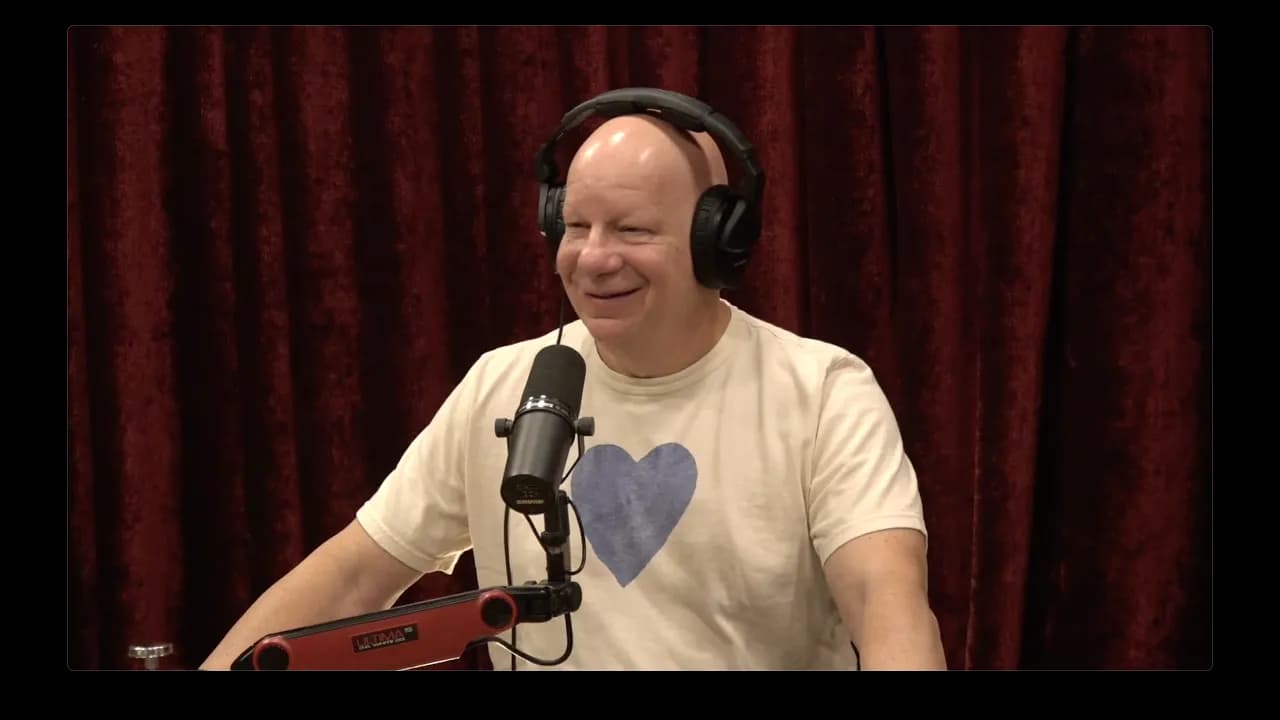
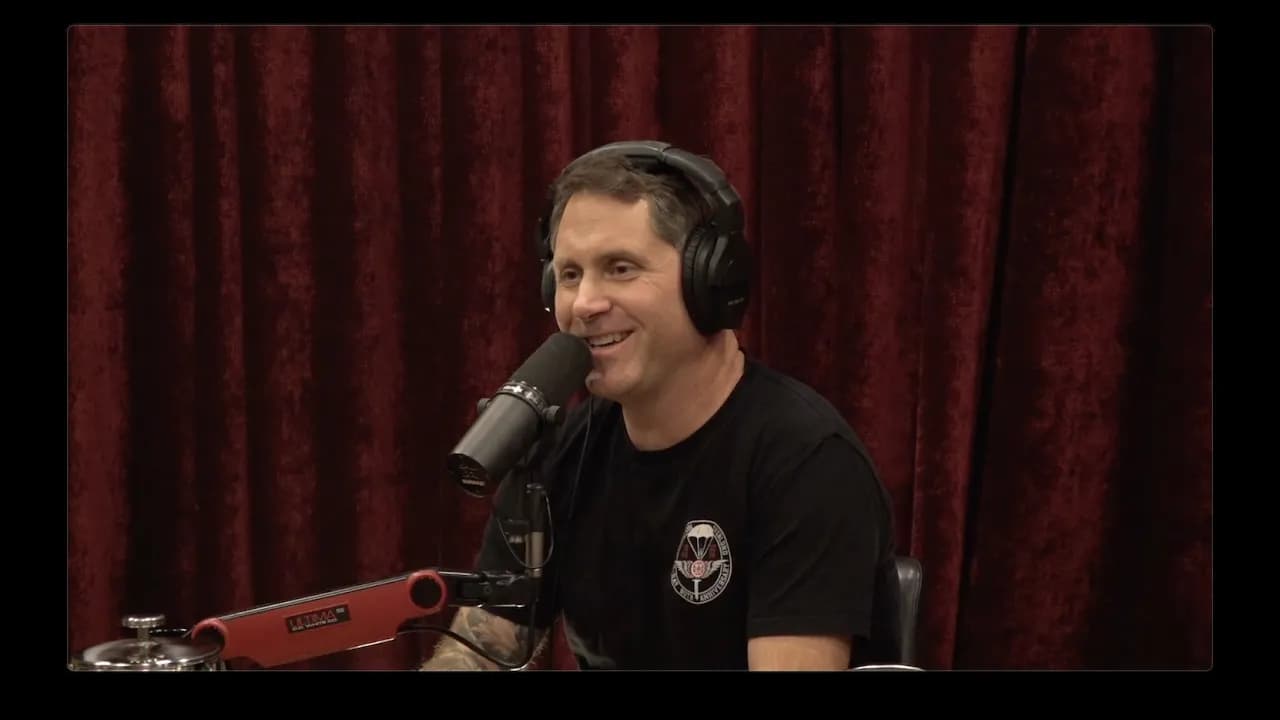
Joe Rogan Experience #2538 - Joe DeRosa
In a Nutshell
Joe DeRosa and Joe Rogan discuss the Mothership comedy club's business model of prioritizing performer pay and creative environment over profit maximization, while DeRosa advocates for voluntary adversity through training and self-discipline to maintain mental health. They explore how corporate greed and shareholder pressures corrupt industries from healthcare to food production, arguing that individuals with resources should create ethical alternatives rather than maximizing extraction. The conversation covers comedy's meritocratic nature versus Hollywood's gatekeeping, DeRosa's martial arts background and brain damage concerns, and broader themes of economic mobility and personal responsibility in achieving success.
These notes were generated by AI and may contain inaccuracies.
Joe Rogan discussed his progression through various coffee machines, starting with a tea dipper-style device that functions like a French press for individual cups. He moved to an Aeropress, which he uses daily, describing it as a glass tube with a metal mesh filter at the bottom where you pour hot water over ground beans and press down to make a single cup quickly. He prefers this method because it eliminates plastic components, noting that traditional coffee machines have plastic parts throughout where water flows.
He mentioned trying expensive Italian espresso machines that grind beans fresh but typically break within a year, requiring expensive repairs at distant shops. He referenced a company called Simply Good Coffee that makes an all-steel espresso machine, which he follows on Instagram but hasn't used yet.
Rogan prefers making larger volumes of coffee at once rather than single servings. He uses an all-metal French press with no plastic parts, which he described as the easiest and best-tasting method because it retains the oils from the beans. The metal mesh filter removes grinds while preserving more flavor compared to paper filters.
Joe DeRosa mentioned missing the convenience of traditional Mr. Coffee machines where you can set it at night and wake up to coffee already made, plus having cold coffee available in the afternoon. Rogan countered that French press coffee tastes superior and suggested DeRosa's reluctance stems from laziness, comparing modern conveniences to historical survival tasks like tanning buffalo hides.
Both agreed on grinding coffee beans immediately before brewing. DeRosa uses a simple grinder that takes exactly 13 seconds for the precise amount needed for one strong cup. The process involves pouring grounds into the French press, adding hot water, waiting one minute, then pressing the plunger.
Rogan recommended an electric kettle with temperature settings, including one specifically for French press at 200 degrees. DeRosa initially resisted this, thinking it meant using a stovetop pot, but became interested once he understood it was an automatic electric kettle that beeps when ready.
Both hosts drink their coffee black without cream or sugar. DeRosa mentioned comedian Tony Hinchcliffe's elaborate coffee preferences, joking that Hinchcliffe needs an umbrella and pineapple in his coffee. Rogan referenced Alton Brown's method of using a milk steamer to cook eggs by foaming them, though he expressed skepticism about the technique compared to traditional sunny-side-up eggs.
The conversation shifted to Austin dining. Rogan mentioned Jeffrey's as potentially the best steakhouse in the city, rated number two in the country. He also praised J Carver for using Argentine grills with live fire over wood. DeRosa preferred Red Ash for both steak and Italian options, and mentioned The Kimberly as another excellent spot.
Rogan frequents Eddie V's for martinis and shrimp cocktail with bartender Gary. He noted that many top Austin restaurants share ownership groups. When DeRosa first moved back to Austin, comedian Tommy Pope helped him discover quality restaurants by bookmarking locations in his Google Maps.
DeRosa shared memories of Frankie and Johnny's (or Frank and John's) in New Rochelle, describing it as an exceptional Italian restaurant. He believes the movie "Frankie and Johnny" with Al Pacino was based on this establishment. He mentioned the surrounding areas like Mount Vernon as possible alternative locations.
DeRosa discussed the psychological impact of achieving financial stability after years of uncertainty in comedy. He described the profound moment of being able to eat at restaurants without worrying about the bill. Rogan referenced Brian Kenny's observation that this freedom represents a major life change beyond basic necessities like housing and family care.
DeRosa practices gratitude at the supermarket, reminding himself that he can select whatever groceries he wants without financial concern, acknowledging that many people lack this privilege.
The hosts debated whether experiencing poverty builds necessary discipline and ambition, or if society would benefit from eliminating food and shelter insecurity. Rogan suggested that knowing hardship creates appreciation for what one has, while questioning whether this struggle is essential for developing drive.
They discussed how some wealthy individuals with trust funds become aimless and insecure, while others like Eden Brolin (Josh Brolin's daughter) maintained strong work ethics despite their background. DeRosa noted that Eden worked regular jobs like hosting at The Stand in New York and avoided the entitlement often associated with nepotism.
Rogan referenced the TV show "All in the Family," noting that Archie Bunker's lifestyle as a cab driver - including their house - would represent significant wealth by modern standards, highlighting how economic conditions have changed since the 1950s when single incomes more easily supported families.
Joe DeRosa mentions several actors who stand out as genuinely good people outside of the typical Hollywood bubble. Billy Bob Thornton is highlighted as particularly cool and gave DeRosa a shirt after he complimented it. Woody Harrelson is described as one of the best people, extremely friendly with zero ego, always chill and present. Matthew McConaughey is also mentioned as great.
DeRosa recounts meeting Woody Harrelson when he came to Kill Tony. After the show at Mitsy's, they were drinking and Harrelson remembered the name of DeRosa's special from a plug five hours earlier. Harrelson had said "I'm going to watch your special" and then said "I never promised you a rose garden," which was the actual name of the special. This impressed DeRosa as a sign of how thoughtful Harrelson is.
DeRosa shares a story of randomly running into Matt Damon in Italy at a restaurant. DeRosa was already seated when Damon walked in and sat under a picture of himself on the wall. DeRosa had previously met Damon at a UFC event. Damon gave him a big hug and they talked. DeRosa describes the moment as very meta - looking at a photo of Matt Damon and then having him walk in and sit right there.
Joe Rogan asks if DeRosa has seen Autofocus, the Bob Crane movie. They discuss the film and speculate that Crane's friend may have killed him. They describe how Crane would get laid on the road by waiting for Hogan's Heroes reruns to air on TV, then sitting in front of the television. There's a scene where he has a bartender put on channel 22 and a woman recognizes him from the show.
The conversation turns to Hogan's Heroes, which ran from 1965 to 1971 with 168 episodes over six seasons. They note how remarkable it was that nobody died in the show despite it being set in a Nazi concentration camp during World War II. The show featured lovable, bumbling Nazis as characters. They mention Colonel Klink's catchphrase "I see nothing" and how the show portrayed prisoners surviving the series.
They discuss how much society has changed in terms of sensitivity, noting that Hogan's Heroes was a comedy about prisoners of war in a Nazi concentration camp. DeRosa mentions the closest modern equivalent might be Tarantino's Django Unchained, which has a scene making fun of the Klan with Jonah Hill in a cameo role.
Hogan's Heroes aired from 1965 to 1971. They discuss how new television was as a medium at that time. The Honeymooners originally aired from 1955 to 1956 with only 39 episodes in one season. Jackie Gleason decided to end the show despite its massive success, saying they had nothing left to say. He later turned down a three-year contract worth the equivalent of $132 million today.
Gleason went on to do other work including playing Minnesota Fats in The Hustler in 1962. DeRosa notes that Gleason was actually a skilled pool player who could run 75-100 balls in straight pool. The Honeymooners sketches were originally over 35 minutes but were restricted by the half-hour format. Gleason had $7 million left in his contract in 1956.
They discuss how only one cast member of The Honeymooners received residuals. Art Carney received $3,500 a week (equivalent to $42,000 today) while Audrey Meadows received $2,000 a week. Jackie Gleason Enterprises was running the show. DeRosa mentions he receives residuals from News Radio but notes they're not life-changing amounts except for people like Jerry Seinfeld who own their shows.
Rogan encourages DeRosa to keep acting, praising his work on News Radio. He describes multicam sitcom acting as the hardest type of acting because you have to land jokes and gags while making it convincing. DeRosa disagrees, calling sitcom acting easy compared to standup. He mentions working with Dave Foley, Maura Tierney, Vicki Lewis, Andy Dick, Kathy Alexander, and Stephen Root.
DeRosa recommends a show called Lucky on Apple TV about a lady with big eyes who is beautiful but unusual looking. They identify her as Anya Taylor-Joy, who was in The Queen's Gambit and The Witch. DeRosa mentions wanting to watch The Witch but his family won't watch it with him.
DeRosa expresses admiration for director Robert Eggers, calling Nosferatu the best vampire movie. They discuss The Northman, which DeRosa didn't love because he wanted more battles. Rogan defends it as perfection. They also discuss Nicole Kidman's appearance in The Northman and whether she had plastic surgery, with DeRosa saying it took him out of the period piece.
They discuss the upcoming Neuromancer adaptation, noting it's going to be a TV show rather than a movie. William Gibson wrote the 1984 book that introduced the term "cyberspace" and the concept of a "consensual hallucination experienced daily by billions of authorized users." They note The Matrix drew from these concepts.
The conversation turns to how The Matrix was a cultural phenomenon that changed everything, but subsequent Matrix sequels were terrible. They discuss whether the Wachowskis got their great ideas from Neuromancer and then couldn't replicate that success. They also mention a lawsuit involving a woman who claimed to have written a story similar to The Matrix.
They discuss Harlan Ellison's Outer Limits episode "Demon with the Glass Hand" and how he sued James Cameron over The Terminator, ultimately getting paid because there were similarities. They note this doesn't necessarily mean Cameron stole anything, as there can be parallel thinking around concepts like AI and robots becoming people.
In 1979, the Outer Limits episode "Soldier" featured combatants from a future war arriving in the present, including a relentless futuristic soldier sent to kill. Harlan Ellison argued that The Terminator borrowed this core setup. Commentators often mentioned his Outer Limits episode "Demon with a Glass Hand," but Ellison himself reportedly said his principal claim concerned "Soldier," not that episode. The dispute ended in an out-of-court settlement rather than a court ruling, with Ellison being paid to settle the matter quietly.
Ellison is widely regarded as the premier science fiction writer by many fans of the genre. His notable story involves being told by his college literature professor that he had no talent, leading him to punch the professor in the throat and get expelled.
The discussion addresses the broader question of how many bad teachers have ruined kids' futures by telling them they have no talent. Many stories exist of terrible teachers who discouraged students from pursuing their interests.
DeRosa attended UMass Boston through the continuing education program to avoid taking SATs. He only attended for three years while focusing primarily on fighting, which was his main concern. He taught at Boston University and competed in kickboxing and taekwondo.
He became a four-time state taekwondo champion and fought all over the country. In 1988, he tried out for the Olympics, made it to nationals, won the states, and reached the third fight at nationals in Miami before losing. He realized he was no longer enthusiastic about fighting after this experience.
DeRosa noticed he was getting brain damage from sparring, particularly kickboxing sparring. After training sessions, he would lie in bed with his head ringing and throbbing. He realized he was doing this for free with no money in the sport, and there was no UFC at that time.
He observed other fighters he trained with deteriorate during the time he knew them, watching their personalities change and their movements become compromised due to brain damage from knockouts. He decided to get out before becoming that guy at the gym who had no future beyond fighting.
DeRosa was talked into doing standup by friends, which marked the beginning of his comedy career. He did the MTV Half Hour Comedy Hour five years into his standup career.
DeRosa got on the television show Hard Ball with Jim Brewer, which was cancelled after six episodes. He then got News Radio right away. He only auditioned for two shows ever - Hard Ball and News Radio - and got both, calling it the luckiest streak of all time.
When Disney gave him his first development deal, they asked if he knew how to act. He responded that he didn't know why they were giving him money. This was during the 1990s when sitcoms like Roseanne and Seinfeld were gold mines.
Because acting was never a desire of his, he didn't get nervous during auditions. He viewed it as not real acting like Marlon Brando, but rather pretending something was happening in a newsroom, comparing it to being easier than standup and kickboxing.
DeRosa didn't notice any cognitive compromise like forgetting things or difficulty thinking, but believes he got some brain damage from the years of being hit from ages 15 to 21. He thinks this may play a part in his impulsiveness and his liking of scary things, things that make him nervous, and things that are really hard to do.
He describes how voluntary adversity - forcing yourself to do hard things - makes the rest of life easier. When you do difficult voluntary activities, other seemingly hard things become manageable by comparison.
DeRosa describes his hypoxia workout using a box in his studio that removes air to simulate 15,000 feet above sea level. The interval training includes sprints on an Airdyne machine, kettlebell cleans and presses or swings, and sled work with varying resistance in 50-second, 40-second, and 30-second intervals.
He emphasizes that everybody should do something hard because it keeps him sane. Without regular exercise, he experiences more anxiety, feels uncomfortable, doesn't feel good, and becomes more irritable. When he works out hard and does what he's supposed to do, he feels great, friendly, happy, light, and finds life easy.
DeRosa is described as a very happy-go-lucky guy who is very friendly and always in a good mood. He rarely comes into the comedy club upset. He views being upset as a choice that doesn't do any good unless trying to accomplish something difficult.
He argues that regular life in America, especially when wealthy, doesn't warrant being upset. He compares his situation to people in Gaza or Ukraine hiding in bunkers, emphasizing the fortune and luck he's had in life.
He doesn't get bothered when people talk negatively about him, saying "Okay, like talk that shit" and viewing negative opinions as more valuable in the commodity of attention in the market of hot takes.
DeRosa polices himself as much as he can and gets mad at himself more than anyone else when he messes up. He doesn't need external validation and is interested in doing the best he can and hoping people like it.
He acknowledges that the little things get to him and that he needs a physical outlet to calm his mind. The suggestion is made that he needs to get a trainer because he won't do it on his own.
A good trainer should start slow with someone who doesn't work out, beginning with simple bodyweight stuff, mobility exercises, and different movements to get joints moving before building up. The trainer should ask about previous workout history and start appropriately rather than pushing too hard immediately.
DeRosa mentions his friend Chuck, Mexican OT's dad, who offered to train with him and emphasized going slow without overwhelming him. Chuck is described as jacked and knowing what he's doing.
The discussion warns against trainers who are meatheads or don't know what they're doing, as they might push too hard and overwhelm beginners. A Prius analogy is used to explain that you can't push a beginner's body like a race car - the suspension would fall off and there's no traction.
Jelly Roll lost almost 300 pounds from an initial weight of 500 pounds. When first met, he could barely make it up the stairs to the comedy club. Now he's fit, healthy, runs all the time, and can run six miles on a treadmill while talking and breathing comfortably.
At a benefit show, Jelly Roll hopped over a railing after performing, which DeRosa pointed out as amazing given his previous 500-pound weight. The transformation took years and demonstrates the process of slowly building fitness.
The approach emphasizes starting with 10 push-ups a day, then progressing to 12, then 15, then 20 over time. Bodyweight squats starting with 10 repetitions, going to 90 degrees. Walking is recommended, particularly with a weighted vest of 20-25 pounds.
The key is feeling a little better with more vitality and blood flow, then building upon that foundation. DeRosa was building slowly with three days a week before going on the road in August caused his routine to taper off.
Momentum makes discipline easier once you get started. Writing things down is recommended - having a whiteboard with exercises listed makes you more likely to do them rather than keeping plans in your head.
DeRosa had a list in his phone of exercises with 20 reps each, continuously adding exercises. However, exercise apps can be confusing with too many questions, and while good ones exist, finding the right one is challenging.
Pavel Tsatsouline, who brought kettle bells to popularity in America, emphasized that strength is a skill. When working on skills like kettlebell cleans and presses, you shouldn't be exhausted. The transcript cuts off mid-sentence at this point.
Instead of working sets to complete exhaustion, do half the repetitions when fresh, rest completely for up to five minutes, then repeat the same number of reps. This approach maintains correct form throughout, reduces injury risk, and still delivers the same total volume of work. The focus shifts from pushing to failure toward skill development and consistent technique.
Muscular endurance training benefits from going to failure, but building general strength does not require it. Farmers develop tremendous strength through repeated daily tasks like lifting hay bales and hammering posts without ever training to exhaustion. The key factor is overall volume rather than intensity to failure.
Pavel Tsatsouline's method of splitting sets and resting fully between them reduces injury likelihood while preserving training volume. This style of training produces very few injuries compared to failure-based approaches.
During a NATO summit, Trump reportedly avoided Air Force One entirely by hiding in an airport catering container, then boarding a military jet for a secret departure. The press and some White House staff were placed on the older Air Force One as unwitting decoys without being informed that Trump was not aboard. The New York Times reported that reporters on the older plane were not told Trump had not flown with them, making them unknowing participants in the ruse.
When Michael Jackson died at Neverland Ranch, officials lied to the press by stating he had already been pronounced dead at a hospital. The deception was necessary to prevent fans from blocking transport of the body once word spread that he had died at the ranch. The extreme fame level made normal procedures impossible.
Jackson owned a vast music publishing catalog including the Beatles and Eminem's work. He purchased Eminem's catalog after being mocked in a video. When recording his final album, he took a $200 million loan from Sony using a portion of his catalog as collateral. Associates claimed Sony deliberately failed to promote the album to force Jackson into defaulting on the loan and losing the publishing rights.
The doctor who administered the drugs that killed Jackson stated that Michael had been chemically castrated as a child to preserve his high voice. This would explain his thin, testosterone-deficient physique compared to his brothers, who all have thicker, more masculine builds despite Jackson's athletic dancing background.
Michael Jackson's signature dance moves originated from the 1974 film "The Little Prince" starring Bob Fosse. The movie contains the moonwalk, the kick and point with toes, and other trademark movements that Jackson adopted. Fosse maintained extraordinary stamina throughout his life despite heavy substance use including speed, cocaine, alcohol, and cigarettes while choreographing Broadway shows.
Shane Gillis consumed 80 drinks per week according to his own admission to a doctor investigating possible food poisoning from chicken fingers. The doctor determined the illness was alcohol-related rather than food poisoning. During a beach gathering, Gillis had consumed 17 Bud Lights before encouraging others to drink more, not wanting to be alone in "drunk land."
Diaz became extremely popular in New Jersey, where restaurant staff and patrons recognized him immediately and provided special treatment. Despite his local fame, he decided to return to Los Angeles for the comedy scene, noting there weren't enough comics or opportunities in New Jersey to sustain his career at the desired level.
Comedy functions as both an individual and team sport. While each performer competes against their own previous performances like golf, the community aspect is essential. Green room discussions provide taglines and forgotten bits that improve acts immediately. The atmosphere at venues like the Comedy Store during peak years from 2014-2019 elevated everyone's performance level through constant activity and high-quality sets happening around them.
Being around other great comics is incredibly important for professional development. Hubs like New York, LA, and now Austin create environments where comedians can constantly improve by watching and performing with top talent. Tuesday and Wednesday nights at the Comedy Store featured Murderers Row lineups including Jesseleneck Diaz, Greg Fitzsimmons, and Domera, with occasional appearances by Bill Burr and Chris Rock when they were in town.
The move to Austin wasn't primarily about Kill Tony. Tony and the speaker were already friends who had done the show together, but the speaker didn't become a regular part of the show until after moving to Austin. The primary reasons for relocating were loving Austin from previous time living there, wanting a new challenge after doing New York and LA, and recognizing the emerging comedy scene.
Austin represents the best place for young comics to pursue comedy because they can actually afford to live there as human beings while developing their craft. Both New York and LA have become unaffordable for young performers. This creates a competitive environment where established comedians must constantly bring their best material, as they're often following five unknowns who are swinging for the fences and trying to prove themselves.
The Mothership has a structured talent development system with two open mic nights and a dedicated talent coordinator who watches performances, gives advice, provides showcase spots, and helps comics get sets around town. There are five other comedy clubs on the same street, making it possible to walk between venues including Sunset, Creek, Vulcan, Black Rabbit, Rosco's in East Austin, and Cap City on the other side of town.
Kill Tony's format emphasizes pure comedy with one-minute sets that leave no room for virtue signaling or applause-seeking. The environment is meritocratic where the only thing that matters is whether you're funny, regardless of appearance or background. The show features diverse lineups including trans performers, disabled comedians, and people from all walks of life, including homeless individuals who have launched careers from the show.
Kill Tony has grown dramatically from performing in the Comedy Store's belly room with only comics in the audience to selling out Madison Square Garden for two nights. The speaker first did the show in the belly room and later experienced the Vulcan during South by Southwest when it felt like Thunderdome with two levels of excited crowds. The show sells out in one minute and has crashed ticket systems multiple times due to overwhelming demand.
During COVID, the speaker and Tony performed at the Houston Improv in July when everyone was scared, marking the first standup in months. Concerns about potentially spreading COVID led to taking time off rather than risk giving it to older guests. After moving to Texas around November, outdoor shows at Stubbs required testing with some positive results leading to removals.
Ron White hadn't performed standup in eight months when he went on stage at the Vulcan and received a standing ovation. After murdering for 15 minutes, he grabbed the speaker by the shoulders and declared they were going to keep doing shows and needed to open a club. This moment was pivotal because Ron was the original reason for moving to Austin in 2018, as the speaker wanted to be around at least one comic even if standup never resumed.
The speaker looked at multiple potential club locations but found them overpriced due to the real estate frenzy when Californians were moving to Austin during the pandemic's beginning stages. Prices increased dramatically, with some properties seeing 100% increases as sellers became delusional about values.
The Mothership building was originally the Alamo Drafthouse, which was the only movie theater in the country serving food and alcohol during films. The building dates to 1924 and has housed various venues including a punk rock club where Black Flag and Red Hot Chili Peppers performed in 1986, a pool hall, and a nudie movie theater before becoming the Alamo Drafthouse.
The speaker lived in Austin in 2000 and frequented the original Alamo Drafthouse, viewing it as symbolic of what made Austin special. Now the Mothership occupies that same building, creating a full circle moment where the venue represents the speaker's connection to Austin and the local comedy scene.
The original space had movie theater seating with a sharp angle and high stage. Renovations involved raising the floor to create a flat center with slight elevation in the back, lowering the ceiling while maintaining balcony views, and keeping two existing balconies. The UFO projector in the entrance displays upcoming performers, and the center contains a required fire extinguisher.
Multiple comedians contributed ideas to the club's design: Louis CK advised lowering the ceiling in both rooms and making the Little Boy stage smaller, Brian Simpson suggested the green room lights and monitors, and Tony may have contributed the timer concept. Everyone involved had input on the final design.
The goal wasn't to make money but to break even while ensuring comics get paid what they're worth. The philosophy holds that audiences come to see comedians, not to buy drinks in empty rooms, so performers should receive the majority of revenue. The speaker's profile helped avoid typical club owner challenges with agents and booking issues, and paying performers more attracts talent despite upsetting other venues.
Joe DeRosa discusses his approach to running a comedy club, emphasizing that making money was never the primary goal. The business model was built around making 20% of ticket sales and liquor revenue, with the conscious decision to break even rather than maximize profits. The focus was on creating an awesome environment for comics and audiences, prioritizing the creative experience over financial gain.
DeRosa explains that having financial resources put him in a position where he felt obligated to do the right thing by creating the best possible creative environment for comedians. The goal was to make an inclusive space that welcomed everyone and supported the comedy community.
The conversation shifts to why more wealthy movie stars don't use their resources to create passion projects rather than blockbusters. DeRosa contrasts this with the music industry, where rock stars frequently start labels and support other artists they admire. He questions why movie stars rarely take 10 million dollars to make the art films they actually want to create with their friends.
DeRosa discusses the Brett Easton Ellis novel American Psycho, arguing that the Christian Bale film adaptation, while good, is not as dark or brutal as the source material. He describes a particularly disturbing scene where the protagonist goes to dispose of a body only to discover the real estate agent has already removed it, creating an unsettling unspoken understanding between the two men.
A key scene was cut from the American Psycho film that appears as an extra on the Blu-ray. In the book, a character climbs into a fan vent at a club and disappears, never to be seen again. This scene raises questions about whether events are happening in the protagonist's head, adding to the psychological ambiguity that DeRosa believes is essential to the story's impact.
The Shards is Brett Easton Ellis's latest novel being adapted for television by Ryan Murphy. The story is a fictional autobiography set in 1983-84, following Ellis as a teenager dealing with a serial killer targeting teenagers while simultaneously coming to terms with his sexuality. The adaptation is described as capturing the book's essence more accurately than previous Ellis adaptations like Less Than Zero.
The discussion turns to Luigi Mangione, the man who assassinated a United Healthcare CEO. DeRosa questions whether the insanity plea undermines the narrative of Mangione as a crusader against healthcare injustice. He argues that the very act of targeting and murdering a healthcare executive suggests mental illness, regardless of the legitimate grievances against the healthcare system.
DeRosa provides a detailed analysis of why people celebrated the healthcare CEO assassination. He explains that health insurance companies operate on a business model of denying as many claims as possible to maximize profits, even when claims are justified. This creates a system where people pay for insurance expecting protection, only to be denied when they need it most.
The systemic problems include quarterly profit pressures that force companies to prioritize shareholder returns over customer care. DeRosa notes that there's no truly ethical option in the current market - consumers must choose between different companies that all operate under the same profit-driven model.
DeRosa shares his personal experience of having to decide whether $600 monthly health insurance is worth the cost, especially given the likelihood of claim denials. He describes how this creates genuine anger when people pay premiums only to have legitimate medical needs rejected.
The conversation addresses the hopelessness felt by younger generations who are told they'll never own land while watching private equity firms buy up housing to lease back at profit. DeRosa mentions his stand-up bit about this reality, which resonates strongly with audiences because of its accuracy.
DeRosa argues that the shareholder model forces companies to prioritize quarterly profits over long-term value or ethical considerations. He uses the example of the Star Wars sequels, where Kathleen Kennedy admitted shareholder demands forced rushed production that compromised quality.
The discussion returns to DeRosa's comedy club as an example of running a successful business without maximizing profits. He emphasizes that anyone with resources could choose to operate this way, creating happier work environments where everyone benefits rather than just extracting maximum value from employees and customers.
DeRosa provides concrete examples of corporate cost-cutting, including bags of powdered sugar consistently weighing less than advertised (1.2-1.3 pounds instead of 2 pounds) and potato chip bags being mostly air. He also mentions the avocado oil scandal where products labeled as containing healthy oils actually use cheaper seed oils.
DeRosa recommends Vandy chips, which are made with beef tallow and salt rather than vegetable oils, describing them as the best potato chips available. He notes these can be purchased online and represent a return to traditional cooking methods.
Real food products like those soaked in beef tallow are rich in fat and likely good for health. Quality food products with healthy ingredients have largely disappeared from regular stores and must be purchased online. Companies making quality products get bought out by large corporations like Pepsi or Kellogg's, which then change ingredients to make them cheaper while maintaining the appearance of the original product.
Rayo's pasta sauce was acquired by a major corporation and the ingredients were altered. Steve Schirripa from The Sopranos had an amazing organic sauce with high-quality ingredients that was delicious, but he discontinued the business because it became too difficult to maintain. The business struggled to keep up with demand after appearing on a podcast, and Schirripa ultimately bailed on the venture.
Operating a sandwich shop in New York required constant price increases to maintain profitability, not due to greed but because of the economic demands of the city. The business became less enjoyable than originally intended, leading to the decision to exit. Small businesses face pressure to either scale up prices or sell out to larger corporations offering substantial buyouts like $50 million.
Los Angeles lost approximately 70% of its restaurants during the pandemic. The meat industry created a monopoly situation where prices were artificially inflated by claiming high demand and low product availability, though some of this reflects genuine market conditions while others capitalized on the situation.
Capitalism is considered superior to alternative systems despite its flaws, which stem from human nature rather than the system itself. When people escape the world of necessity and operate from a position of choice, they can run businesses based on enjoyment rather than profit maximization. However, most people chase external markers of success like bank account numbers, addresses, and vehicles.
Some regulation is necessary, but excessive regulation stifles business, as seen in California where overregulation has created a massive government bureaucracy. During the pandemic, California lost population while doubling the size of government, creating jobs through expanding government programs and using tax revenue as a slush fund. This system benefits government employees while problems like homelessness, street cleanliness, and school funding remain unaddressed.
Senators' actual income far exceeds their official salaries due to donations and other sources, creating powerful incentives to maintain political positions. The system rewards those who compromise and cater to constituents rather than those genuinely trying to accomplish objectives. Politicians learn to read public sentiment and adjust their stated positions accordingly, leading to support for contradictory or nonsensical positions.
The film Charlie Wilson's War, directed by Mike Nichols and starring Tom Hanks and Philip Seymour Hoffman, illustrates how well-intentioned foreign policy decisions can create larger problems. The movie depicts efforts to fund Afghanis against Russian invasion, which succeeded in driving out the Soviets but led to funding cuts for rebuilding efforts. The film ends with a warning that "the loonies are in the hen house," referring to Osama bin Laden's rise in Afghanistan. The real history involved funding the mujahideen, which later contributed to bin Laden turning against the United States.
Becoming a massive movie star while maintaining morality and ethics is extremely difficult due to the corrupt nature of the Hollywood system. Genuine people like Woody Harrelson are rare in the industry, and many successful actors live elsewhere and only visit for work. The system requires full compliance with prevailing political opinions, with any deviation resulting in being cast out.
Comedy and podcasting offer authentic pathways to success where performers create content and audiences decide its value through attendance and engagement. Unlike Hollywood, where talented actors may never work due to political misalignment or lack of connections, comedy provides open mic opportunities and road work for anyone with talent. This independence allows comedians to survive even if mainstream entertainment returns to restrictive PC culture.
The documentary "Frank" about Frank Stallone reveals that talent alone is insufficient for success in entertainment. A team of people strategically navigating the system is required. The Academy Awards nomination process involves expensive PR campaigns, with consideration votes leading to billboards and marketing efforts costing millions of dollars, making the "overnight success" narrative misleading.
YouTube has produced major talents that Hollywood could not suppress, despite the industry's desire to eliminate the platform. Stand-up and podcasting represent a larger, more authentic lane than traditional entertainment pathways, as the content is real and not curated to meet external standards.
Keep PowerfulJRE in your library
Save the videos and channels worth coming back to, and find them again in one place.