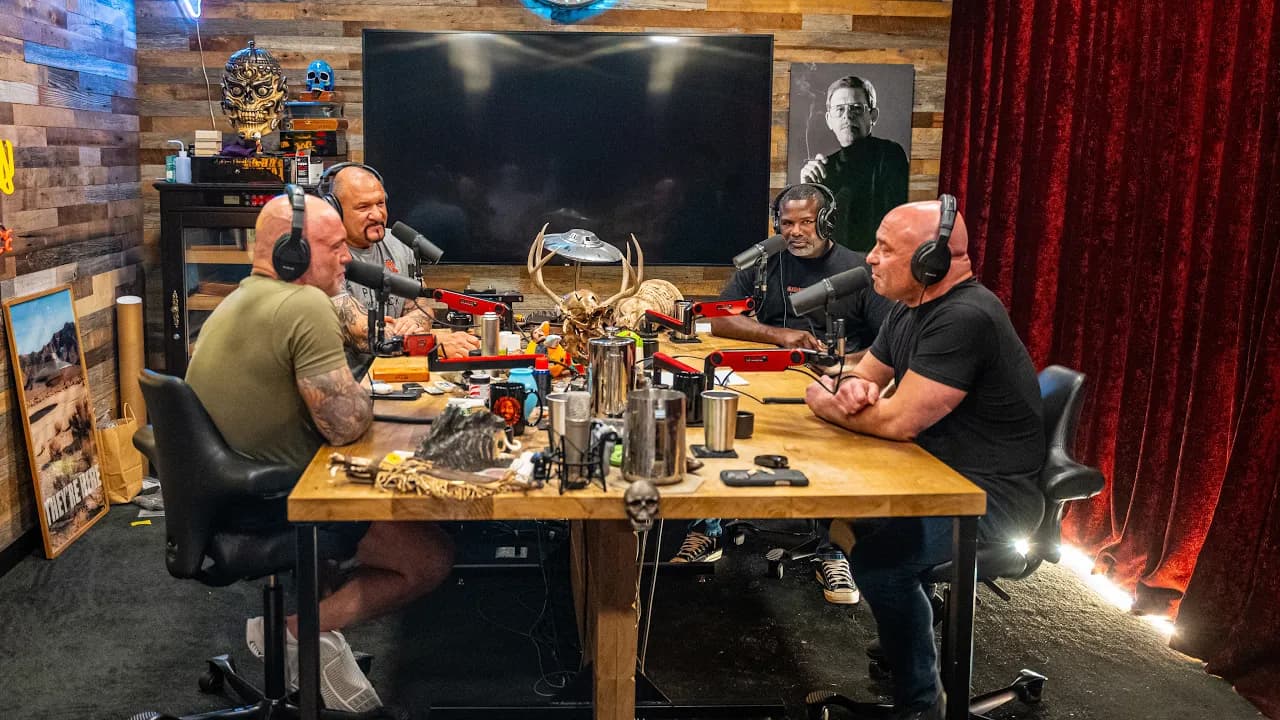
JRE MMA Show #182 - Protect Ya Neck
In a Nutshell
Joe Rogan and Matt Serra discuss aging in combat sports and rock culture, arguing that consistent training preserves physical capability while inactivity makes recovery nearly impossible after age 50. They criticize inconsistent refereeing—particularly stand-ups from dominant positions like Damian Maia's back control on Kamaru Usman—and outdated rules like the 12-to-6 elbow ban. The conversation covers fighter durability concerns including Jorge Masvidal's post-transplant risks and Conor McGregor's questionable recovery from his leg break, while praising technical innovations like oblique kicks and exploring why advanced catch-wrestling submissions like the executioner remain rare in MMA despite being available.
These notes were generated by AI and may contain inaccuracies.
Joe Rogan and his guest discuss Tommy Lee. He was described as a big kid who never had to grow up after getting famous at 18. Rogan mentions working with him as a bodyguard and notes that Tommy was always cool and never a dick in their interactions. They discuss Tommy's interest in bonsai trees, including his zen garden setup and how he trims hundred-year-old, two-hundred-year-old, and three-hundred-year-old bonsai trees that are passed down through generations with paperwork documenting their history. The trees are kept small through trimming, creating artistic forms. They also mention Tommy being a gearhead who talks about cars, including buying an old Corvette and putting a supercharger on it.
They discuss the famous Tommy Lee and Pamela Anderson sex tape, noting it was one of the first celebrity sex tapes that allowed them to get even more famous afterward. Both were already super famous, and their relationship was described as their "superpowers unite." They also mention Tommy was with Heather Locklear. The conversation covers the wild nature of rock and roll life, specifically what it must have been like for Tommy at 18 as the drummer for Mötley Crüe.
The conversation shifts to older rock stars who continue touring. They mention David Lee Roth and Brian Johnson from AC/DC, noting that Brian Johnson's screaming vocal style is unsustainable and no vocal coach would recommend it. They wonder about older rock stars having groupies, including 60-year-old groupies who have kept "that flame lit since the 80s." They discuss Mick Jagger having a young child in his 80s, and Al Pacino also having a child later in life. The discussion covers whether it's responsible for an 80-year-old to have a child, noting that by the time the child is five, the father could be gone. They debate if the young woman might want the child to "leave something behind."
Rogan shares a story about a 68-year-old friend named Longo who was upset that Rogan was complaining about being 58 when Longo is 68 and still goes to the gym every day. They discuss how Longo looks good with dark hair and no "Ronald Reagan hair." Rogan notes his own stubble is at least 60% gray and that he trims his beard because a gray beard makes him feel like he's "slipping into the grave." They compare aging to people in the 80s and note that people didn't have TRT or red light therapy back then.
They discuss Henzo's 30th anniversary event for his academy, where they saw original guys they hadn't seen in decades. Most people looked good because they continued training. The key point is maintaining training - if you don't maintain, you can't get it back, especially at 50 you can't take three years off. Starting training at 46 without prior experience is described as a hard road. They emphasize going slow to avoid injury, as getting hurt defeats the purpose. Healing time increases with age - kids heal like Wolverine, but older people take much longer.
Rogan talks about choosing who he rolls with and not trying to "slay everybody on the mat" because you're the sensei. He compares the body to a Corvette that can only do so many laps before breaking. He mentions everybody he knows has had surgery. In Philly with Brady and Piper, they want to grab him and do moves, but he tells them to grab younger guys instead. Brady is described as particularly dangerous to roll with.
They discuss Brady's fight with Buckley, noting the level of domination was shocking. Brady is described as explosive and inconsistent - his Morales fight was tough, but when his head is in it and he's dialed in, he's terrifying. When he grabs you, you start making noise. His fight with Leon was particularly notable. Brady has great coverage when on top due to his big back and excellent balance, staying multiple steps ahead on the ground. During one fight, he appeared super calm with a placid face.
The conversation turns to the 12-to-6 elbow rule, which is still enforced in places like Jersey under old unified rules. They argue the rule doesn't make sense - you can elbow other directions but not this way. Rogan notes that in a fight, instinct takes over and a 12-to-6 elbow might be wide open. The rule creates inconsistency for fighters and referees. You can knee someone in the face and run and jump with a knee, which has produced crazy knockouts like Masvidal versus Askren.
They discuss Jorge Masvidal potentially wrestling again after his double lung transplant surgery from about a year or two ago. They're concerned about infection risk, noting that transplant patients take immunosuppressant drugs that make the immune system work differently. CT Fletcher is mentioned as having a heart transplant and dealing with complications from medication that causes swelling. They note that with a transplant, a bad flu could kill you because your body is trying to reject the foreign organ.
They discuss two people who received pig heart transplants - one lived 60 days, one lived 40 days. Pig hearts are apparently similar in function to human hearts. The broader discussion covers organ transplant mortality rates: 91% survive the first year after heart transplant, then numbers drop. At five years, survival is in the 80s or 90s, and at ten years, about half are dead.
They discuss Belal Muhammad potentially fighting Jorge Masvidal. Rogan worries Masvidal's strong will might lead him to unrealistic expectations after cheating death and getting his family back. They suggest maybe a friendly wrestling role instead of a real fight. Masvidal is described as an animal. Rogan mentions seeing an interview where Masvidal's first question was whether his opponent could wrestle and if he'd been cleared.
Rogan discusses Lyoto Machida's career, noting he was a big promoter of getting him into the UFC when he was Bellator and RIZIN champion. Machida was criticized as boring, but Rogan argues he wasn't boring - he was destroying guys like Douglas Lima and taking them down with zero chance of escape. Machida was described as ragdolling opponents. He was brought into the UFC late, already having hip problems that eventually required replacement after 15 years in combat sports plus wrestling years.
They discuss the Damian Maia versus Kamaru Usman fight as close to style versus style, with Maia's wrestling against Usman's jiu-jitsu. Maia got Usman in a dangerous position with one hook in, over-under, on his back. Usman was in real danger from the best back specialist in the UFC. The referee separated them, which Rogan argues should never happen from that position. Maia had Usman in a "six out of 10" spot for him. Getting the back is difficult and requires time to establish, and separating fighters from dominant positions is problematic.
Rogan argues against standing fighters up when the crowd boos after a few seconds of defense. He notes how hard it is to get Kamaru Usman to give up his back. Usman has very few instances in his entire career of being in disadvantageous grappling positions - Leonard had him for a moment, and Chimaev was winning the third round and almost won that fight.
The position was extremely dangerous for Kamaro. The progression showed Maya working methodically into a dangerous position with full double under hooks. Maya had the arm entangled and was close to beating the arm, with the possibility of starting to beat him up with the right hand from that position. The whizzer was the only thing keeping Kamaro safe, but it had been reduced to about 40% power due to the positioning. The referee's decision to stand them up was described as a giant mistake and the worst stand-up anybody has ever gotten in the UFC.
Refs sometimes listen to the crowd and feel responsible for maintaining fast action. Organizations also apply pressure because they want exciting fights. However, certain situations require accepting that the sport is not always the most exciting for moments, even though it delivers excitement in other spots.
Maya's combination of wrestling and jiu-jitsu was highlighted, noting that once he got a hold of you, he was probably going to put you out. His striking was not as good as Marillo's. Marillo was discussed as having a fighter in the UFC now. The speaker first saw Marillo when starting jiu-jitsu at Carlson Gracie's place, where he also saw Vitor, Sergio Cohen, and Mario Sperry training. This was during the period when Vitor was about to make his UFC debut.
Carlos Betto was also at the Carlson Gracie gym. Randleman was described as built like a He-Man figure. Carlson had a great team with many savages. The speaker received his black belt from Laboro, who was described as a good guy. Before 1993, jiu-jitsu had no schools, but now they are everywhere. The world owes the Gracie family for their impact on culture through MMA and jiu-jitsu training.
The UFC started the whole thing, with the Fertitas and Dana involved, but the Gracies initiated it. The speaker heard about the UFC concept in 1992 at a seminar with Horian and Hoist discussing different ideas. At the time, it sounded ridiculous like Blood Sport on TV. The speaker didn't watch until UFC 2 on videotape from Hollywood Video and was amazed they actually did it.
The speaker's progression included starting with karate, then finding a good taekwondo school, then boxing, then kickboxing, and finally jiu-jitsu, realizing at each step how much was missing. Bruce Lee tried to find what style was real. In 1988, nobody knew what worked. Wrestling was thought to be worthless. Grappling arts were considered worthless. The speaker learned wrestling was not worthless in high school after getting beat up.
Wing Chun has value if you know all the other aspects, as Anderson Silva demonstrated with hand trapping and elbows. There are moves opponents are not used to seeing that can work in the right context. Wing Chun is only valuable if combined with other training like Muay Thai, western boxing, or jiu-jitsu. By itself, it is useless.
Dan Henderson hit Hector Lombard with a back elbow or back forearm while standing. This exemplifies techniques that work because opponents do not see them coming, opening up other big shots.
The number one thing people should add to their training is point fighting karate, not Wing Chun. It provides a huge advantage when executed properly, as seen with MVP in his prime. The physical demands make it difficult for those from wrestling backgrounds who are used to being heavy and square, rather than turning sideways and jumping in and out.
An underappreciated elbow from a wrestling position resulted in a knockout while hopping on one leg. The technique involved holding the opponent's leg and landing the elbow during a takedown defense.
Wonder Boy in his prime had an enormous advantage with his movement. Serial Gone moves like a basketball player despite being 250 pounds as a heavyweight. Basketball develops plyometrics and the ability to change direction. Heavyweights who move light on their feet have a giant advantage because only one unanticipated entrance is needed to land a clean shot.
Travis Brown in his prime was a bad dude who moved light on his feet, possibly due to playing basketball. He knocked people out with elbows from the clinch. Arlosski also moved light but had wars that took their toll.
The speaker fought Mafia Holloway, a famous black belt point fighting champion, during taekwondo tournaments. He could not touch Holloway, who moved forward and back with darting speed different from continuous fighting speed. The experience demonstrated the value of learning to move quickly and jump out of range.
When training Tyron Woodley to fight Wonder Boy, the approach involved going to karate schools to get karate kids for sparring rather than regular tall kickboxers. The focus was on dealing with the movement, length, and different pace rather than takedowns.
Jonathan Hagerty fought Yukiza in a technical fight involving continuous movement, stance switching, and boxing from the outside. Hagerty caught him in exchanges after constantly giving different looks. Yoza was known for crushing opponents' legs with calf kicks.
Bringing Hagerty to America was discussed. ONE Championship should promote Muay Thai as it is exciting with multiple options including knees and throws. Dana White previously stated people do not like kickboxing because they associate it with 1980s PKA karate on ESPN, but young people love martial arts and knockouts.
Rico Verhoeven's boxing success was discussed in relation to kickboxing visibility. Verhoeven performed phenomenally against Usyk, bullying him and using his weight effectively. He was up by approximately eight points to one or two according to some observers. Usyk is not a real heavyweight but is considered the greatest heavyweight of all time skill-wise. Tyson in his prime was favored for his ability to demolish the division.
Rico is a giant from the Netherlands at approximately 260-270 pounds with crazy cardio. He maintained pace for 10 rounds as a heavyweight. Usyk is a 220-pound guy who adds weight for fights. Dutch kickboxers are known for being giants and tough.
The speaker has a hard time watching anything but mixed martial arts but loves jiu-jitsu. The new He-Man movie Masters of the Universe was described as good with a Thor Ragnarok type feel that was fun and a little goofy without taking viewers out of it. It did justice to the original for those who grew up with it.
Jared Leto played Skeletor and was reportedly not allowed to do interviews or talk to the rest of the cast because they were worried he would do nutty things in character, similar to sending dead rats in the mail during The Joker role. Will Smith reportedly commented on the rat incident.
Heath Ledger's Joker performance was so definitive that everybody stopped and recognized it as the Joker. Joaquin Phoenix's sequel was widely considered the worst movie ever made. Tim Dillon described it as such. The musical approach may have been an attempt to diffuse the Joker movement following the BLM riots.
Sequels are normally not as good as the original, with one speaker mentioning they saw some of a sequel and once it started singing they were out. Good sequels mentioned include Terminator 2, Empire Strikes Back, and Rocky II. One speaker questions why the character takes someone to the zoo in the beginning of Rocky II, and the other explains the joke was that the mean bodyguard says to take her to the zoo because the "retards like the zoo," and then the character takes her there to propose.
The speakers note that people were different in the 1970s, described as "animals," and that this was before the internet.
The Matt Sarah channel on YouTube features series reactions and movie reactions. The speaker mentions watching House of the Dragon reactions on the channel.
One speaker is in the middle of watching From, on season 4, episode 5. The show has only four seasons total, with the fifth and final season not coming out until 2027.
The speaker loves Game of Thrones and says The Night of the Seven Kingdoms was phenomenal. However, House of the Dragon is the one they like the least because it's a lot of gloom and doom, all characters are pricks, and there's no one to like or who's noble. The third season is all fighting with nothing but going at it, and the speaker finds it good.
One speaker watched the entire series of Game of Thrones recently over four or five months, watching two to three nights a week. Watching it without years between seasons makes it incredible, and they describe it as the greatest epic adventure show in the history of the world. Special effects are still perfect even though the show is 10 years old.
One speaker is listening to the audiobook of Red Rising, a 2014 dystopian science fiction novel. They are more than halfway through the first book and describe it as set in the future on Mars, like Game of Thrones in space. Their black belt Jedi Joey Beans recommended it. The speaker acknowledges they are listening to an audiobook rather than reading it physically.
One speaker started watching Battlestar Galactica because of the others and is on the first season, about 10 episodes in. There are about 20 episodes per season. The show is described as underrated, and watching the entire series is incredible.
Widow's Bay on Apple TV is about an island that's cursed and a man trying to make it the next Martha's Vineyard. It has spooky elements but quirky humor. Apple TV releases some bangers, and Silo is another great one mentioned.
The Beast in Me is on Netflix and is about an author and a psychotic rich guy who lives in her neighborhood. Claire Danes stars and can act her ass off. The show got 98% on Rotten Tomatoes.
One speaker started watching The Pit, which is about the ER room in Pittsburgh. The main character plays a doctor in the ER room.
One speaker fell off Land Man because they don't care about the wife and find the daughters annoying. The wife plays a stripper. The plot involves interesting elements with cartels, but then shifts to taking seniors to a strip joint and the wife's outrageous behavior. The speaker mentions having ADD and not being able to take it. Another speaker agrees the women were caricatures. A question is raised about why the lawyer and others live with Billy Bob Thornton and his family, and it's explained as a plot point because there's only one house on the ranch, which serves as both office and home. Billy Bob Thornton is excellent in the show, and Taylor Sheridan said he wouldn't have made the show if Billy Bob wasn't in it. Andy Garcia is also great in it.
One speaker loved Things to Do in Denver When You're Dead when they saw it, but hasn't seen it in decades. Another hates it. The group discusses how some movies from the past don't hold up when rewatched.
One speaker watched Hell Comes to Frogtown starring Rowdy Roddy Piper. The movie combines Mad Max post-apocalyptic elements with Escape from New York. In the future, everyone is sterile except Roddy Piper's character. He gets caught with the general's daughter and is fitted with a jock strap with explosives. His mission is to go to Frog Town, which has a harem, and impregnate everyone or else they'll blow him up. The speaker found the movie while spending time on the toilet with an iPad and looking for weird or different movies on Prime Video. They watched the whole movie in two sittings. The budget was $1.5 million in 1988. Return to Frog Town was released in 1993 direct to VHS. The movie only got two out of five stars from TV Guide and three from DVD Talk.
They Live is discussed, with one speaker noting it might be a comedy. The group talks about how some 80s and 90s movies become comedies when viewed today. Road House is mentioned as a bad movie where everything is bad except Patrick Swayze's hair. The writing is bad, the bad guy is bad, and the karate scenes are fake and dumb looking, but it's still awesome. Sam Elliott was brought in as backup despite being an 80-year-old who could barely walk. The bad guy tells Patrick Swayze's character he used to fuck guys like him in prison. Sam Elliott is described as the real-life Marlboro man and is great in everything.
The group discusses how everything in the 80s was bad and people were dumb because there was no internet and they were only exposed to what was in their area. Miami Vice is mentioned. Roger Ebert's review of Road House noted it was on the edge of a good bad movie. Jean Cisco called it outrageous in terms of cartoon-like plotting and dialogue and lamented Swayze's mindless posturing.
Road House is a cult classic that people still talk about. Every actor has been in a couple of lemons. Daniel Day-Lewis might be an exception, though some didn't love the Lincoln movie. Abraham Lincoln: Vampire Hunter is mentioned as crazy and something that should have been made in the 80s, like a comic book.
A new werewolf movie by the same guy who did Nosferatu is coming out. The trailer was just released. It takes place in some foreign country with characters speaking a strange language.
One speaker thinks Nosferatu by Robert Eggers is the best vampire movie of all time, better than Interview with the Vampire. It's more terrifying, hypnotic, and creepy than other vampire movies. Gary Oldman's Dracula is mentioned as great. A specific scene is described where a character goes to Nosferatu's house to sign a contract in a language he doesn't understand to sell a house, and Nosferatu wants the character's wife because he's eternally connected to her. The scene where Nosferatu is revealed is the creepiest scene ever.
Lost Boys was good when it came out but would seem corny today. There's now a Broadway show for it. One speaker saw the Spider-Man Broadway show and the Rocky Broadway show and found both horrendous. The Rocky show has boxing with a ring pulled out, but the guy can't box. Theater people are described as silly.
The speaker can't stand theater and assumes Stallone did the Rocky play. The beloved Oscar-winning story is referenced as a cover story.
Bernthal was praised for his performance in Dog Day Afternoon on Broadway. He starred in The Punisher Netflix series, with the first season noted as good while the second season was considered weak. The special One Last Kill was highlighted as particularly strong, described as a 45-minute to one-hour standalone piece rather than a full movie. Bernthal also appeared in The Walking Dead, playing a creepy friend character.
Bernthal attended acting school in Russia. He is scheduled to appear as The Punisher in the upcoming Spider-Man: Brand New Day film. Tom Holland was praised for never having done a bad Spider-Man project.
The conversation noted the lack of job security in the Spider-Man role, with actors frequently being replaced. Toby Maguire's return after 20 years was mentioned as evidence of potential longevity through the multiverse concept. Tom Holland was described as looking young compared to the college-aged character Spider-Man is traditionally portrayed as.
Spider-Man: Into the Spider-Verse was described as enjoyable, with the option to watch in color or black and white. Nicholas Cage's performance in the film was praised. The Unbearable Weight of Massive Talent was discussed, where Pedro Pascal plays a drug dealer and fan of Cage who hires him, leading to involvement with a cartel. The film was rated B+ and compared to Pulp Fiction's role in reviving John Travolta's career.
Cage was described as a fascinating actor who has been around for a long time. The premise of actors getting paid large sums to attend parties and events was discussed, with examples of people being flown to places like Dubai for such appearances.
Sean Penn met El Chapo in Mexico and wrote an article about the encounter for Rolling Stone magazine. Conor McGregor wore an El Chapo shirt mimicking the photos Penn took with El Chapo.
The upcoming fight between Conor McGregor and Max Holloway was analyzed. The second and third rounds were identified as critical for determining McGregor's condition after five years away. Concerns were raised about McGregor's gas tank and whether he has been training seriously or primarily partying.
If McGregor knocks out Holloway in the first round, it would significantly boost his standing and potentially lead to a massive fight with Justin Gaethje for the BMF title at 170 pounds, with McGregor reportedly not wanting to cut weight.
Max Holloway was described as a big guy who walked around at 176 pounds when fighting at 145. Dustin Poirier believes Holloway has a bigger frame than McGregor despite being the same height. Holloway struggled with bigger opponents like Dustin Poirier initially but came back bigger.
Holloway's move back to 145 after fighting at 155 was criticized as potentially too hard on the body. He looked solid and thick at 155 against Gaethje but appeared compromised at 145.
The possibility of a Holloway vs. Gaethje rematch was discussed if Holloway defeats Ilia Topuria. Questions were raised about whether the first fight would have been different without Gaethje landing an early kick that shattered Holloway's nose.
If Topuria defeats Holloway, a rematch would be difficult to justify. Patty Pimblett was suggested as the next opponent if he defeats Saint Denis. Pimblett was favored to beat Saint Denis due to better striking and jiu-jitsu, though Saint Denis was acknowledged as having wrestling advantages.
Saint Denis switched camps after losing to Moicano and showed improvement. Patty Pimblett was noted for getting hit frequently, which would be problematic against Topuria's sharp striking. The fight between Pimblett and Topuria was described as potentially huge, with suggestions to hold it in London.
Pimblett went five rounds with Justin Gaethje despite getting poked in the eye and taking significant damage. He was praised for improving with each fight and standing up to great shots. His development since arriving in the UFC was noted positively.
Topuria's liver shots in the second round against Holloway were highlighted as particularly clean and effective. Multiple shots landed, demonstrating his precision.
Aaron Pico was praised for his body work and comeback performance. His aggressive style was noted, along with concerns about his chin after multiple knockouts. His debut was described as overly aggressive against a skilled opponent, but his recent fight showed intelligence and skill retention.
The mental aspect of chin durability was discussed, with the idea that believing you cannot be knocked out contributes to resilience. After the first knockout, fighters may develop hesitation. Physical factors include repeated head trauma tearing the fascia lining inside the brain, reducing shock absorption.
Examples of brutal knockouts mentioned include Edson Barboza vs. Terry Etim, Michael Chandler vs. Tony Ferguson, and Cheeto Rivera vs. Frankie Edgar.
Rogan was the first fighter stopped by a backfist in the UFC. Initially considered unusual, backfists have since become common in MMA.
Rogan and Eddie Bravo discussed techniques that would work in MMA before they became common. Rogan initially believed front kicks to the face were ineffective and too difficult to land, preferring them to the body. Anderson Silva's front kick knockout of Vitor Belfort changed perceptions, followed by Machida vs. Couture. Front kicks to the face became frequently used after these examples.
Michael Chandler's front kick knockout of Tony Ferguson was described as one of the worst. Chandler stated he had not practiced the technique and simply saw an opening.
Chandler's loss to a younger fighter was discussed, with suggestions that it may be time for him to retire at age 40. The opponent was described as a scary striker at 155 pounds with excellent taekwondo movement combined with boxing hands.
Volkanovski was praised as a well-rounded fighter with great fight IQ. His willingness to coach after his career was noted, with suggestions that he could help develop fighters' wrestling and takedown defense.
Carlos Prates was identified as a fighter to watch after his knockout of Jack Della Maddalena. Prates was described as having fun during the fight and treating it like target practice against a high-level opponent. His Muay Thai background includes 29 wins and 5 losses in 34 fights at a high level.
Prates demonstrated comfort in striking exchanges and sensitivity developed from world-class Muay Thai experience. His calf kicks caused significant damage, with Maddalena screaming in pain.
Kevin Morales was discussed as a potential opponent for Jiri Prochazka. Morales has a wrestling background that could complement striking against Prochazka. The fight was suggested to be saved until both fighters are ready.
Prochazka was described as having a long frame with significant reach. He showed strong performance in the fifth round against Ian Machado Garry, coming back aggressively. He was noted for remaining calm in bad positions and being dangerous. His knockout of Leon Edwards was highlighted as impressive given Edwards' striking ability.
Makhachev's grappling was described as having a vice grip, with opponents noting they have never been grabbed with such strength. His size at 155 pounds was questioned, with observations that he appears to be around 190 pounds when standing next to others.
Makhachev was predicted to potentially be better at 170 pounds without weight cutting. Garry's footwork and length were noted as potential advantages early in a fight, but repeated takedowns would likely lead to control on the ground.
Garry's Muay Thai experience was cited as a factor that could make him competitive, though Makhachev's wrestling and grappling were considered dominant factors.
Ian Garry is fast and accurate with clean striking technique. His movement has no wasted motion. He's not physically overpowering opponents but relies on sharp technique rather than strength.
There was discussion about an interaction between Ian Garry and Khamzat Chimaev where Garry patted Chimaev on the back too aggressively. The gesture was described as halfway between a hug and a slap, with some male dominance involved. The pat on the back felt aggressive enough that it could be interpreted as hostile rather than friendly. Chimaev wasn't wrong to react to it. The group noted that slapping someone hard on the back is different from a friendly gesture.
When first meeting someone, some guys try to squeeze during a handshake. This was described as painful and unnecessary, prompting an urge to smack them.
Ian Garry struggled with Shavkat Rakhmonov on the ground a couple of years ago, but he's getting better. Garry almost finished Shavkat with a rear naked choke. He also hit Shavkat with an oblique kick to the knee, which was the reason Shavkat needed knee surgery. Ian even made a post about it. The oblique kick technique is legal and devastating when thrown sideways to the knee. Shavkat has had two surgeries since that fight.
Ian Garry has high fight IQ and is able to solve problems against difficult opponents like MVP and Carlos Prates that other fighters struggle to beat.
A technique shown was identified as a Wing Chun stomp on the wooden dummy. Wing Chun works as demonstrated.
Tall fighters are difficult to deal with because they can hit from six inches further away. The strategy involves coming in behind a double or triple jab. Short fighters often get latched onto by the head when fighting taller opponents.
Oblique kicks to the knee are legal techniques. Shavkat Rakhmonov had ACL surgery before the Ian Garry fight and may have re-injured it. One technique can change a fighter's whole life and career trajectory.
Shavkat Rakhmonov was thought to be coming back and rehabbing from an accident or injury. He's good but the sport waits for no one as new fighters come up.
Ethan Ewing's fight was cancelled. He was scheduled to fight on short notice versus Bo Nickal at Madison Square Garden. Bo Nickal lost his last fight and is having a hard time lately but is a young fighter who showed spectacularly in his debut and on Contender Series. Ethan Ewing is slick and good. He's part of the new breed of fighters like Cory Sandhagen who constantly switch stances and give different angles, making them hard to pattern.
Ethan Ewing was pulled from the card due to injury. He was supposed to fight an undefeated opponent named Basratt. The card includes Ben Whittaker and Sandhagen, Patty Pimblett, Conor McGregor, and Max Holloway. Robert Whittaker is moving from 170 to 185 to now light heavyweight at 205 pounds. He's six feet tall and walks around around 230 pounds. Nikita Krylov is a legit 205-pounder who can kick and was lighting up Yuri Prohaska before getting caught.
Cody Garbrandt's chin has been compromised from too many fights. He's 35 years old with a July 7th birthday. He started his career really young.
Adrien Yanez went through a bad streak but is very skillful and a good boxer. He looked good in his last fight and is a 450 favorite.
Conor McGregor and Max Holloway had an interview at the White House with monitors set up for each. They were arguing back and forth. Conor said Max wouldn't lay a glove on him. Conor cracked people up during the exchange.
Max Holloway is a world champion and one of the all-time featherweight greats. He beat Dustin Poirier and won the BMF title. He lost to Ilia Topuria but has had impressive wins. Max can fight with no weight cut and never gets tired. His fifth round is as good as his first. His discipline is exceptional and he trains extremely hard. Max pointed to himself while talking during fights, showing confidence.
In his prime, Conor McGregor was elite, as shown against Eddie Alvarez. Conor is a sprinter whose endurance was never the best. If he cracks you early, you're done. He has the touch of death and is accurate and fast. He knocked out Jose Aldo in devastating fashion. Conor might try to wrestle Max Holloway, but Max has strong ground game and survived Charles Oliveira. Conor may shoot for takedowns if he's not in it for a war, but that could tire him out more.
Conor looked focused during an interview. If he prepared correctly and gets into the mindset he had when entering the UFC, he could surprise people. The humiliation of losing to Dustin Poirier with a broken leg and the subsequent partying raise questions about his training and mindset. If Conor gets tired, Max talking trash and teeing off could get rough.
Charles Oliveira took Max Holloway down in a way nobody else has. Charles is a monster on the ground. Max had to survive things that would make other people tap.
Islam Makhachev made Max Holloway look bad and got him to tap almost immediately. Islam's squeeze is phenomenal and cuts off blood flow. His arm triangle from half guard against Drew Dober was devastating.
The Japanese necktie is effective for shorter-armed fighters. The technique involves funneling under for an underhook, getting behind the head, cinching down, and tucking the neck into the chest. You grab a leg and lean on the shoulder while pinning the shoulder to the mat to trap the head and chest. It's a neck crank that's horrible once the head gets at that angle. The far leg is better for control when stepping over. The gloves in MMA make certain chokes harder to finish, especially rear naked chokes.
Eddie Bravo's grip is preferred because it provides better leverage with the forearm behind the neck. TJ Dillashaw demonstrated a different grip that cradles the head. Once the head is trapped in the chest, the opponent is in a terrible defensive position because the head is at a nasty angle.
It's nasty, but it's just not seen in MMA and the reason why is unclear because it's available when guys are trying to get the darce and they can't get it. There are a lot of times the legs are tangled up and it's horrible because you have this level. When Khabib tapped Conor, everybody said it wasn't even a choke, but he was doing the same thing across the neck on the back. It's horrible. It's going to break your neck. That's what it feels like, but it's even worse because it's sideways and you have your body on it.
The worst move never seen in the UFC is the executioner. There has never been anybody getting the rear naked choke from back mount where you reach over and go guillotine from the back. Somebody got something like that recently. It was the Scottish twister. The Scottish twister is a little different. It's still nasty as hell. You're leaning back and it's horrible on your neck. Anything that attacks the spine is horrible. The executioner is the worst because you have rear naked hooks and you have the head back this way and you're going like that.
That's a catch wrestling thing that started popping up at 10th Planet around 2003 or 2004. Eddie Bravo likes to call it the executioner, but he wasn't the only guy doing it. Other guys had figured it out. When you're in north south, a lot of guys know that position. When you're in rear naked choke position but you have the arm wrapped like that, the amount of pressure on the spine is just crazy. It's about 100 percent. Long Island knuckleheads will be making sure everybody signs a waiver on that.
It's such a bad position to try to defend. You have no strength to defend it. It's a wrap. It's hell and it's not seen in the UFC. It's available. Some guys could get this. A lot of times you're trying to fight the rear naked choke or you're trying to get the rear naked choke and the guy's defending. If you switch to something like this, if you could find a way to get into a position like this, the opponent is not going to defend that.
The truth is that a lot of guys in the UFC or in MMA in general don't really practice jiu-jitsu from that standpoint. They do anti-jiu-jitsu because they think that their chances of winning a fight on their feet are better. Their idea is just defend the takedown, get back to their feet, or just use basic jiu-jitsu. Stuff like this that's available to them, they don't know it or they don't practice it enough for it to be instinctive for them to do it.
The first problem is that they're just trying to get up to their feet. Gilbert Burns versus Damian Maia shows when you match his jiu-jitsu a little bit and he finds the opening, if he doesn't match his jiu-jitsu he'll use that, but then he has to move a certain way that gives enough space to get to his feet.
The Bellator champion from Ukraine fighting in the UFC is Magomedov. His ground game is so sweet. In his last fight he beat up his opponent with a takedown that goes right into arm triangle. It's all in the hip. Then he goes knee to the belly, just crushing him. His setup for Neil Magny was so smooth. He put it on Neil and then break dances afterwards with a little windmill. That guy can move and he's really good. He's dangerous.
Shawn Alvarez would be doing the windmill. He has one KO loss to Jason Jackson. Jason Jackson knocked him out. He just murdered him, just ran across and beat him up. Big John and Josh Thompson brought him up on the podcast as the most unheralded, the most underappreciated of the guys that are out there. That's a problem when you're not in the UFC. If the UFC picks him up, it's going to be kind of late. He had to dig through the rubble of his house to get his Bellator belt. He went back to a war zone to get his belt. A Bellator house got a Bellator belt. Imagine his UFC belt.
Big John McCarthy was the referee when the title was won, but one thing that always irks is when there's a foul or something and you're in that mindset with a guy looking to do bodily harm. Big John makes jokes like "Hey, what do you see? You say ugly." Making jokes like that makes you want to say "Big John, get the fuck out." It's the same as the guy looking to give you a high five out there. It always irked and it just stuck out when his name came up. He's not a bad guy. He's a great guy. Now that he's back reffing, maybe make a note of that and put his name in the hat.
They're getting a little bit better about warning people for fouls, but not better about taking points. They did for a little while and it was hot and they were taking one point and everybody was like yes. The new rule should be eye poke equals one point. Don't poke eyes. If you jab someone in the eyes, one point right away. You know not to do it. Sometimes it happens. If it happens, you get a point taken away. Nut shot gets one point. Unintentional nut shot gets a warning because you could kick while kicking and hit in the nuts without trying. The rough one is the call on the back of the head when you're trying to put a guy away because he's moving his head. It's hard. That spot is a lot smaller than what most people think. It's like a little small piece.
It should be okay to hit the back of the head. If everybody had the Osbourne haircut, it'd be okay. Just don't get him in his hair. In the fight with Renzo Gracie versus Ben Spijkers, if you're allowed to elbow the back of the head from rear mount, Renzo was dropping bombs on him and then stepped on and put him to sleep with his jacket. The guy was being a prick before the fight. He was a piece of shit. He was calling his room all night long. The guy had his people harassing Renzo. He was a dick and went to greet him and said something about having eyes like his girlfriend but prettier. Renzo is one of those guys that can go from a smile to a boha in two seconds if you're a dick. If you're not a dick, he's the nicest guy in the world.
That position just shows you if you're allowed to do that, this is it. Once he gets them in back mount, watch this. Boom. That's a wrap. You can only take so much. The guy has a gi on. Is that inherently dangerous? Is it that much more dangerous? What we're doing is already dangerous and it also is very effective. Are we removing a very effective technique that would end fights, and if so, are we doing it to protect the fighter? If we are, why are we allowing a lot of other stuff? Why are we allowing flying knees? Why are we allowing side kicks to the knees? Why are we allowing wheel kicks to the head? Why are we allowing heels to the head? There's a certain amount of things already allowed that are so bad for you. Why don't you allow a shot to the back of the head? It needs to be explained like to a child. Why is it okay to slam your elbow full blast into someone's temple but not this spot? You could drive your elbow down into their eye socket. That's okay, but the back of the head is bad.
The back of the head is fine if you knock someone out from the back of the head and you didn't mean to, like a head kick. How many head kicks wrap around and hit the back of the head? Wonderboy in his UFC debut went over the shoulder and hit the back of the head and knocked the guy out cold. The back of the head round kicks land a lot of times. Ernesto Hoost knocked dudes out with back of the head head kicks in kickboxing. That's how he knocked out Maurice Smith. He snuck it around over the shoulder and hit him in the back of the head. Anatomy is going to dictate that. That's what you're supposed to do. So that's legal. No one says that's an illegal blow. Overhands hit a lot there.
If that happened in the UFC, everybody would cheer. You couldn't say that's an illegal blow even though technically that's the spot where they can constitute a legal blow. Wheel kicks happen like that all the time because it's coming from that angle from behind. The guy tries to duck under and hits him right in the back of the head and no one complains. The referee never says stop striking the back of the head. It never happens. It's only when they're turtling and they're throwing arm punches, which is the least power, less powerful than a full kick to the head. The reality is if you were in that position and the guy could throw elbows to the back of the head, that would be a wrap in that same position where you're on a guy's back.
What about headbutts? Not even standing up. When in a clinch and buried in, it's good for short guys. When getting in that clinch, Mark Coleman would get in your guard and headbutt the hell out of you. The only guy to solve that puzzle was Maurice Smith. Maurice Smith was the first guy to solve that puzzle. He dragged him out with cardio and defense off his back with good butterfly guard. Mark Kerr murdered Fabio Gurgel with headbutts too. Headbutts when you were on top is brutal. The first UFC fight attended was in Birmingham, Alabama, and it was that fight. It was a huge upset. Everybody was nervous. The only one rooting for Maurice Smith was because of obvious reasons. Maurice came over the house and worked out. Maurice was going to fight Mark Coleman and was going to get killed. He was 260 pounds. He was a wrestler. He takes everybody down. Then when Maurice was leg kicking them, he said come on Mark, ground me and pound me. Wap. He was talking to him while he was doing it. When Mark would move towards him, he'd move away and got right back in. Those leg kicks were brutal too. Maurice was the first guy to bring world class leg kicks to the UFC.
The Lion's Den guy actually Pedro, Paul Varleans, had sick leg kicks. He knocked out Pete Williams. He knocked him out with a head kick first. Maurice beat him first by decision. It was a five round decision. He just beat him up. Williams caught him with a kick. Pete Williams head kicked with shoes on. The good old days. Head kicks with shoes on.
One of the first fights seen was a Japanese dude and Valiji in the UFC. They were grabbing each other's underwear. They were giving him a wedgie. The dude he was fighting was literally grabbing his shorts and giving him a massive wedgie during the fight, holding the whole thing. It was totally legal in the UFC. It was bare knuckle back then. The first fight worked was bare knuckle in 1997. Vitor was the only guy that had gloves on. Tank was one of the first guys for sure. Tank might have been the first guy and then Vitor wore them too. Vitor was 19 years old and first fought in the UFC tornado. He ran fight. He looked like the Hulk. When he first fought in the UFC, he only weighed 200 pounds. When he fought Scott Ferrozzo, when he fought Tra Telligman, he weighed 200 pounds. Then he gained tons of weight and fought Randy. When he fought Randy, he was like 240. That messed him up too. He got too big. That was what Randy got cut in that one. That was a different one. That was in the UFC later on for the light heavyweight title.
Telligman has lost his pec rather in a car accident when he was a baby. That's crazy. This is Brad Kohler. This is a different fight. This is UFC 12. Japan 1997 was when Frank Shamrock fought Kevin Jackson. Any Armbar. That was pretty crazy. Randy looks older there than he does now. Peptides. It wasn't Japan though. There was a Japanese fighter who fought Valiji. Wid Ishmael. It was either UFC 12 or UFC 13. Wid Ishmael UFC. If you find that, you'll find it. The dude was giving him a super wedgie. You were totally allowed to grab shorts. You could punch guys in the nuts. Acne punching John in his balls. Remember that dude? What about Gary Goodridge in the crucifix? Paul Herrera. So here it is. Look what the dude's done to Luigi's pants. Luigi's pants. Jesus. All the way up the crack of his ass because the dude had a hold of his shorts. I do remember earlier in the fight. I'd rather that be McKenzie Dern. He's giving the wedge to. But yeah, look at this dude. Here it is, bro. Oh my god. So this was the first UFC that was worked.
The Japanese guy has the gloves on as well. So Vitor had them on, but Valiji is bare knuckle. You're allowed to grab it back then. Look at the Japanese guy has gloves. Valiji's bare knuckle. Hilarious. Isn't that crazy? He's really grabbing his balls. He's up there grabbing his nuts. I think you could grab nuts. It's got to be so uncomfortable. Hey, look how he's grabbing a fence. He's like yeah. Full on grabbing the fence and Big John's trying to pry his hands away. He just grabs him again. He just don't even let go. At least back then, I guess you couldn't grab the fence. So there was a rule. He's grabbing it again. Look at the grab. Look at the grab. That's the most blatant fence grabbing of all time. Big John, would he get on it? John. John, slap his hands away. John, do something. John. Johnny's grabbing the fence. They really. It was like a suggestion back then. It was not even a rule. Were you allowed to grab the fence? I think he knocked his hands away. He was saying don't grab the fence, but only like a little. He's kind of not that enthusiastic about enforcing it. And it was like as he was letting go already, he was like grabbed it. Yeah, that was the first UFC worked. The rules back then were so weird. Shoes. Wrestling shoes. It's weird how you know like wrestling shoes would change everything. You get so much more grip on the cage. So much more ability to move. The wrestlers would love it. But also foot locks. That's what that would be a problem. Heel hooks be a real problem.
When first started training, remember with Chuck back in the day, he used to wear wrestling sneakers and stuff and remember being like, you know, wanted as much for the street as possible. Remember that was the mentality. So wear the wrestling sneakers and like yo, fuck this. Guys are grabbing your foot and like yo, fuck that. And also like setting up arm bars and stuff like when you try to grab the foot and throw it over now. You've got a grip on something that's like textile like you could hold on to that. A foot is hard to hold on to. They get sweaty and they're all slippery. Nah, no good. When hearing Jens Pulver, he going to wear shoes or worse. That was. Hey. Hey, Jamie. Could you find Dean Thomas's rolling knee bar on Jens Pulver? I bet they don't even have that. I think Jamie can find that. Oh, it has to be online. Everything's online. Dean Thomas. Those fights. Those old fights. I mean, those are history. I'm a pseudo fighter, you know. I remember seeing that interview because I was. You remember seeing it? I studied it because I was gonna fight you. Oh, and I'm like, ah, try that meatball on me, motherfucker. Jens Pulver had some laser beam punches back in the day. I know. I remember when he knocked down Lewis. I was like, I got to fight this guy. Oh, that was a bad one. Jens, you got him in his prime, too. Yeah, but I. He crack did not want that guy punching me. Yeah, you can't be wearing shoes. It's just knee bar. Yeah, it's just too much. Too much of an advantage. That was an old school one, too. You did it almost like you're going to give your back to him and roll. I think you should let him. Look at this. Here it is. Look at this. Who is that? Look how lean you are. Oh man. Inside heel hook with shoes on. That's a
Inside heel hook with shoes on wraps up the previous clip. The injury looked severe with audible pops heard multiple times. Dean Thomas described hearing the pops during the submission. Heel hooks are particularly hated because they can ruin careers entirely. The group discusses various gruesome injuries including a Kimura dislocation that snapped a humerus during a straight jiu-jitsu tournament when the opponent refused to tap.
A break like Weidman's shin injury creates a traumatic difference compared to breaking a hand or childhood arm. Frank Mir broke his femur in a motorcycle accident when someone t-boned him, snapping his thigh bone, and was never the same for years afterward. Recovery from such injuries takes significant time to return to full form.
Questions arise about how much Connor can use his left leg after it snapped in half. While he appears to be kicking bags and training, full recovery remains uncertain. Chris Weidman was shown kicking Hector Lombard in a Russian jiu-jitsu event with unusual rules allowing only body punches and leg kicks.
The Russian event featured strange regulations where competitors could leg kick and body punch. Chris kept kicking while Hector punched him in the neck. Videos exist of fighters standing next to each other and leg kicking into submission, which can cause serious damage. Pedro Hizzo's leg kicks left visible damage including altered vein patterns on Randy Couture's leg, requiring six months of recovery.
Weidman was killing pads backstage with such force it was difficult to hold them. The conversation shifts to comedy and Harland Williams putting a gourd in his pants and using fake legs for humor. His movie Wingman receives praise for being consistently funny.
Comedians now fund projects themselves like Theo Von and David Spade with Bus Boys, and Tom Segura producing independently. This approach avoids studio interference where executives protect their jobs and Mercedes payments rather than understanding comedy. Movies like Talladega Nights and Tropic Thunder were made before internet complaints began affecting content decisions.
Hyper-violent movies face no backlash while comedies encounter restrictions. Attempting to make Superbad or Tropic Thunder today would fail due to content standards. Robert Downey Jr. in blackface and Ben Stiller's full makeup in Tropic Thunder represent content that studios would reject. Collateral gets praised as an awesome movie despite extreme violence in scenes like the alley shooting.
Collateral features a scene where Jamie Foxx's character is zip-tied to a steering wheel. The movie originally considered Russell Crowe and Adam Sandler. Tom Cruise's performance receives acclaim, with his alley tactical draw clip used for CIA training due to its precision. Edge of Tomorrow gets referenced as another Tom Cruise project.
Clubs remain packed because audiences want to hear unfiltered material. People understand jokes don't represent literal beliefs, similar to how Bob Marley didn't actually shoot the sheriff. The Tom Brady Roast on Netflix garnered 55 million views in its first week, demonstrating demand for uncensored comedy.
Cancellation attempts fail as people flock to cancelled individuals, increasing their popularity. Kanye continues selling out arenas with popup shows in Miami and San Antonio. Tony Hinchcliffe described Kanye's Tampa show as featuring him standing on a spinning globe while performing two and a half hours of hits. Every sound and lighting effect gets coordinated with purpose.
Prince demonstrated similar genius-level control, calling Baltimore for a benefit concert after the Freddy Gray incident. During soundcheck, he refused to let Jay-Z, Beyonce, and another artist join onstage, telling them it was his stage and they should leave if unwilling to follow his direction. Prince could play any instrument and once forgot his own hits during a performance, remarking he forgot all the good material he created.
The Michael Jackson documentary receives positive reviews with the nephew's portrayal earning praise. The film presents a cautionary tale about childhood fame. The same doctor who killed Michael with propofol claimed his father chemically castrated him as a child to preserve his high voice. Michael appeared significantly thinner than his brothers, lacking typical testosterone development while maintaining an unusually high pitch into adulthood.
Castrati were created by surgically removing boys' testicles before puberty to maintain soprano voices for opera. This practice dates back to 400 AD in Constantinople. Only one recording exists of a castrato from the 1800s. The practice began as punishment in prisons where inmates discovered to have good voices were castrated. Michael Jackson's high voice and thin build align with effects of pre-pubertal castration.
Matt Serra discusses his Brazilian jiu-jitsu gym locations including the new Stewart, Florida facility. His YouTube channel and Ground Control USA website provide training information. Shogun Fights next event occurs November 14th. Dean Thomas promotes Deep Waters airing Mondays at noon on Paramount Plus alongside Jorge Masvidal, Chris Weidman, and Dustin Poirier. His film Flowers releases soon with praise for its ending.
Keep PowerfulJRE in your library
Save the videos and channels worth coming back to, and find them again in one place.