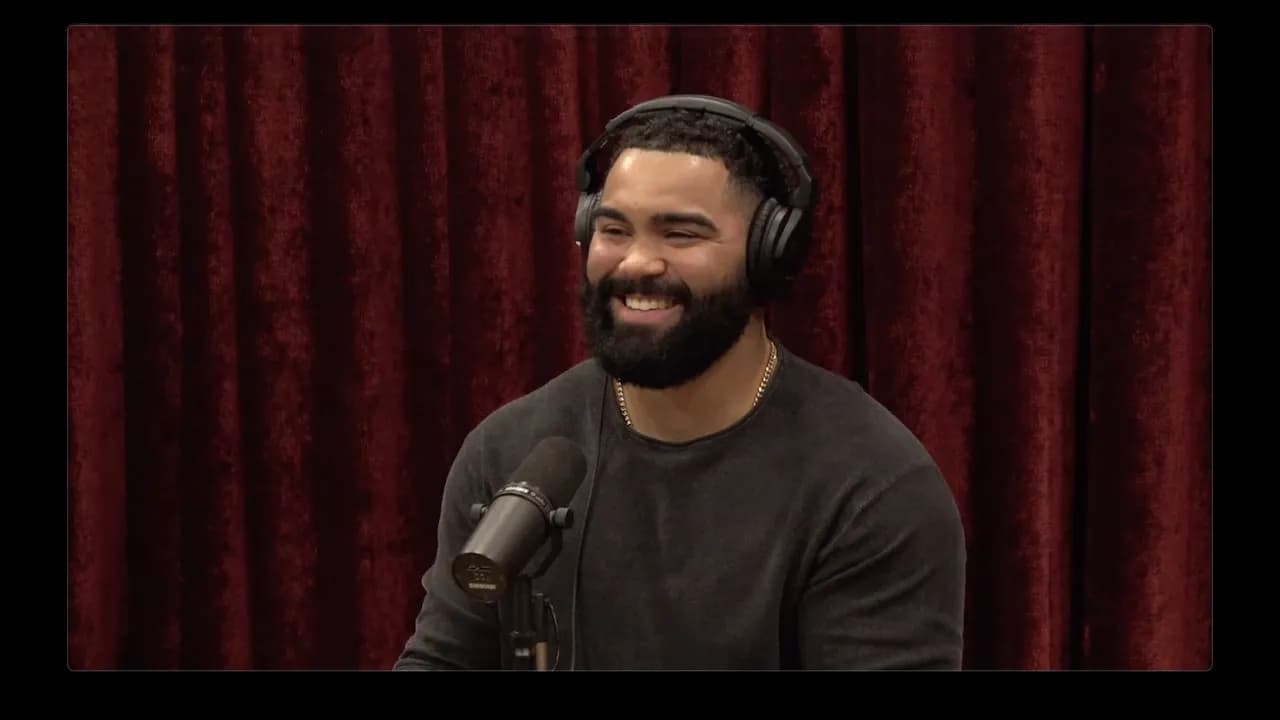
JRE MMA Show #186 with Sean Sharaf
In a Nutshell
Sean Sharaf pulled off a massive upset, knocking out Gable Stevenson with a perfect left hook in the UFC after six weeks' notice and fighting as a huge underdog. The victory left him questioning whether to continue fighting, citing financial struggles including filing bankruptcy, brain scan concerns, and lack of support throughout his career. Sharaf earned $160,000 total from the fight and plans to give the $100,000 bonus to his mother while weighing whether the win satisfies his MMA goals or if he should pursue a title shot against Volkov.
These notes were generated by AI and may contain inaccuracies.
Sean Sharaf received initial contact about potentially fighting Gable Stevenson on the White House card through his manager Ali. The offer came up in June with discussions about Sharaf's Marine background. After initially agreeing to the White House card, Sharaf never heard back and the fight was ultimately scheduled for the LA card in September with approximately six weeks notice.
Sharaf had been in camp for a scheduled fight against Taiu Ivasa when he broke his nose and had to pull out. Upon medical clearance to resume sparring, he transitioned directly into the Gable Stevenson camp. He maintained continuous training throughout, including running, and retained his seed throughout the entire eight-week period with no sexual activity.
Sharaf described his chaotic living situation prior to the fight, including staying at Fighter House LV for $40 per room, staying in casinos while gambling, sleeping in his car, and staying with his mother. He had no assets in his name and received a $4,000 advance from his management on his purse to secure housing in California during camp.
Sharaf's mental preparation involved believing the fight would be a war rather than a quick knockout. He adopted the Jon Jones mindset from his fight with DC, repeatedly affirming that Stevenson would lose and that Sharaf would come after him round after round with malicious techniques. This represented a shift from his previous first-round knockout victories which had created a delusion about his power.
Sharaf's previous UFC fights included losses to Taffa and Aspen, where he hit Aspen repeatedly without knocking him out. This led to questioning his power and whether he belonged at the UFC level after experiencing the organization's "uniform" without feeling validated.
The fight ended with a left hook that dropped Stevenson, who was a -2400 favorite. Sharaf described the moment as feeling euphoric, though he hasn't fully processed the victory due to continuous media obligations. He mentioned shaking hands with Stevenson and Jones before they left the octagon.
Sharaf expressed uncertainty about continuing his career, telling his psychologist Micah at the PI, training partner Sergey, and coach Gokore that he might be satisfied with this victory. He cited the lack of sponsors, promotional support, and coaching assistance throughout his journey as creating a sour taste, along with medical concerns including a CT scan showing brain matter issues and being stitched up from various injuries.
Rogan emphasized that the decision to continue or walk away must be entirely Sharaf's own, based on his current life circumstances and mindset. He noted that big moments can become defining centerpieces rather than part of an ongoing path, and advised letting the moment settle before making career decisions.
The conversation compared Sharaf's situation to Justin Gaethje's potential to walk away after his White House upset victory, noting Gaethje could be considered one of the all-time greats. They contrasted this with Conor McGregor's motivation to return and prove he could still compete at the top level, questioning whether this represented chasing glory versus pursuing a genuine dream.
Sharaf described taking initiative to promote himself after seeing promotional material favoring Stevenson, including creating his own content outside the Performance Institute. He mentioned a viral video with Floyd Mayweather at Lifetime Fitness where he asked for a promotional video during fight week.
Rogan and Sharaf discussed Stevenson's limited regional experience, noting he got wheel-kicked in Mexico by a 1-0 fighter. They observed that Stevenson wasn't forced to fight quality opponents early because opponents avoided him, preventing him from experiencing "the dungeon" of tough competition that develops complete fighters.
The left hook was described as technically perfect, with Stevenson reaching and closing his eyes at impact. This was attributed to Stevenson's limited striking experience of only a year and a half. The conversation noted that Stevenson was constantly praised for his striking rather than being directed toward his wrestling strengths.
Sharaf mentioned the significance of making the main card and press conference after Ortega's withdrawal, which he viewed as divine intervention. This platform allowed him to bring up Stevenson's past, which he described as psychological warfare. He noted that Stevenson had called him a coward and claimed responsibility for Sharaf's presence and hotel accommodations.
The discussion covered the complexity of striking, including foot placement, positioning, and the extensive time required to develop muscle memory under chaos. Stevenson's tendency to close his eyes was linked to insufficient experience being hit repeatedly in training.
Sharaf described entering a flow state during the fight with a simple game plan: don't over-respect the wrestling and put hands on Stevenson. His strategy assumed Stevenson might get takedowns but emphasized getting up and staying in his face repeatedly.
Sharaf identified a key moment when Stevenson booked an RAF wrestling match weeks before their fight, which Sharaf interpreted as not taking him seriously. Meanwhile, Sharaf was training with Sergey Spivak, Bloy, and others, wearing headgear due to his broken nose while being repeatedly put in difficult positions and slammed.
Wrestling translates exceptionally well to MMA and may be the most important discipline when used correctly. The ability to take a guy down and control him stifles all striking. If a fighter decides to avoid standing and shoots for a takedown, it creates an entirely different fight.
A 12-second knockout doesn't generate rematches because it wasn't a controversial decision. Controversial decisions generate rematches, not decisive knockouts. The defeated fighter must analyze the film footage to identify what went wrong with his striking approach and tighten up his technique.
A big left hook landing on the chin with the head snapping back requires only about 10 pounds of pressure to tip the chin. Some fighters have recovered from knockouts like this to become all-time greats, including Michael Bisping who was flatlined by Henderson before winning the middleweight title.
In the post-fight interview, the speaker kept it classy while noting the victory would ultimately make the opponent better. The opponent and his team showed disrespect, including Jon Jones driving around with him in a Mercedes talking about collecting heads.
Jon Jones is described as a one-of-a-kind athlete and the GOAT. His fight against Ciryl Gane was remarkable because Gane never touched him - Jones got hold of him, dragged him to the ground, and submitted him without getting scratched. Jones made a special athlete like Gane look unspecial.
Jones became the youngest UFC champion at 22, but there was a long process to get there. He fought Gus, Gustov, Stefan Bonner and others before it became clear he was something unique. After beating Shogun to win the title, he went on an epic legendary run, beating everyone including when he wasn't training properly.
Jones choked Machida unconscious and then dropped him while standing up. Machida fell down in a heap - described as one of the coldest victories in sport history.
Hanging out with the GOAT and thinking you're the next guy creates problems. You might become that person if you do the right things, but believing it before it happens is dangerous. There's a dance of the mind required - being both cautious and confident simultaneously.
Even elite fighters like Kamaru Usman are human beings. Usman was beating Leon Edwards for four rounds when one head kick cost him the title, and he was never the same fighter again.
The upset elevated the entire sport because it showed a giant favorite getting knocked out by one punch, changing everything about expectations in the sport.
The speaker learned more from Joe's podcast than from the entire public education system. While serving as an embassy security guard, he would listen to podcasts during duty, learning about the subconscious mind through guests like Billy Carson, 19 Keys, and Joe Dispenza.
The speaker would watch Fight Companions featuring Eddie Bravo while on duty.
After big moments, it's wise to let the dust settle before making decisions. The speaker is navigating people already texting him saying he went Hollywood after just 5 days. People want you to change - they want you to fall when you succeed spectacularly because they compare themselves and fall short.
When you hyper succeed, people create narratives that aren't real - claiming you went Hollywood or sold out. There's a certain psychological mindset where people want those doing better than them to fail.
The speaker goes from interviews all day to family wanting to talk, when all he wants is to walk his dog. During the Bisping interview, he was walking his dog Apollo when they wanted to ensure good connection.
Apollo has been with the speaker since getting out of the Marines - he's now seven years old, about to turn eight. They moved to Vegas together two years ago. Apollo was there through knee surgeries where the speaker had to drive himself to physical therapy two days post-op.
People only love you when you're hot. When Max Holloway got knocked out by Ilia, he wasn't hot, but after winning this fight he became hot again. It's the hurt business - when they're done with you, they move on.
The speaker walked out to Nipsey Hussle's "Hustle and Motivate" - fulfilling a dream of doing it at home.
There's no such thing as a lucky punch. Fighting a world-class athlete, stepping in and throwing a perfect left hook isn't luck - it's exactly what was intended. A lucky punch would be having eyes closed, falling backwards, and catching someone on the chin.
People are complicated chimpanzees who judge others on status and hierarchy. When someone falls from being top chimp, people turn on them. The speaker has seen horrific comments on fighters' Instagrams after losses from people who've never accomplished anything.
Before the fight, people were criticizing the speaker saying he got knocked out by Topuria and was 0-2.
Charles Oliveira had a reputation as a quitter after losses to Cub Swanson and Paul Felder, but got it together and became undeniable as a world champion. One loss doesn't define anyone - that's a comment from people who don't understand combat sports.
The comment sphere allows people who've never accomplished anything to criticize those attempting one of the most difficult things in the world - becoming a professional combat sports athlete at the highest level with millions watching.
Better to go silent for a while after success - let the dust settle and vibrations end, like waiting for a gong to stop ringing.
The speaker performed the Fatiha, the opening prayer of the Quran said for the dead and during daily prayers. It's one of the only verses memorized since childhood. The prayer was for his father who passed away when the speaker was 15.
The speaker navigated his career without a father. The Marine Corps taught him how to tie his tie, shave his face, press his uniform, and articulate himself. A big part of getting to this point came from losing his father, which pushed him significantly.
Someone online called the speaker anti-American for performing a Muslim prayer for his father. The speaker has an American flag tattoo around his arm. America is supposed to be a melting pot of all religions and walks of life.
There's no nuance anymore - if you support Palestine, people claim you can't be a Marine. The speaker doesn't want to conform to one identity or another.
Success brings opportunities - people appearing wanting to manage, sponsor, or help. The speaker has been on this journey alone for a long time. These opportunities come because of the elevation in status - sponsors wouldn't have been interested when he was 0-2 in the UFC.
The difference between regional circuit and UFC is gigantic. Once in the UFC, the experience is overwhelming and takes several fights to settle and show true skills. Some fighters never adjust to the bright lights.
This was the speaker's first arena fight - his previous two were in the Apex, which felt like sparring matches compared to the pressure of millions watching with championship implications on the line.
Fighting hard as a heavyweight provides good job security because the division is shallow. The speaker hopes Tai Tuivasa isn't cut despite seven consecutive losses.
Everyone wants to win one more fight before retiring, like Tony Ferguson.
The speaker questions if anything gets bigger than upsetting the MMA world, wondering if a title shot against Volkov would be next, noting the jump would be significant.
Gane talks a lot of trash but is a normal, nice guy in real life. He's realized being crazy gets eyes on you - it's a calculated strategy that's totally fake.
Basketball might be an excellent starting point for MMA, especially for heavyweights. It involves constant plyometrics, changes of angle and direction that translate directly to fighting, particularly the ability to change direction quickly during combinations.
Gane's footwork is unreal, as demonstrated against Tai Tuivasa and Pereira. It's a real problem for opponents.
Pereira is blaming Herb Dean for back-of-the-head shots, but the real issue is chaos and movement. The eye pokes against Aspinall are the egregious fouls - fingers going directly into eyeballs. The opinion is that points should be taken instantly for eye pokes, nut shots, and fence grabs.
Fighters are now strategizing around eye pokes, knowing the damage occurs before officials can intervene.
A fighter described an incident in his pro debut where an opponent repeatedly dipped his head and came up with overhands that resulted in intentional headbutts around the chin. The referee did not see the repeated headbutts. The fighter noted that if he had not finished the opponent, he could have been disadvantaged because nobody catches that kind of foul.
Pantosia accused Joshua Van of headbutting during their fight, but the assessment was that Pantosia was frustrated because Joshua Van was moving ahead and the fight was slipping away. Joshua Van won the title from Pantosia due to an injury when Pantosia threw a head kick, fell backwards, and broke his arm. The fight ended quickly and was considered anticlimactic. Against Tatsuro Tyra, Joshua Van looked like a world champion and defended the title. Against Pantosia, his boxing was described as exceptionally skilled. Joshua Van is considered something special who improves with every fight. Pantosia is 25 years old.
A fighter expressed uncertainty about continuing in MMA and wanting to determine his motivation. He stated that if the only reason was money, he could find other ways to earn without sustaining brain damage. During COVID, he worked in option trading and made six figures during the AMC, GameStop, and Tesla stock movements. He previously worked as a personal trainer after leaving the Marines. He also has experience in private security, working with high rollers in casinos. He has GI Bill benefits and could pursue education. He noted that winning a UFC title would be cool, but champions must defend the title, and there is always another contender coming up, making it a never-ending cycle until fighters are old and beaten.
The fighter got out of the Marines in 2018 and sent an email to Pillo in Orange County and Ruka. His early training was described as trial by fire, sparring all the pros including Luke Rockhold, Michael Bisping, and Sean Strickland, who dropped him as an amateur. He moved out to Thailand and trained at Tiger Muay Thai. In his first week at the Apex, he sparred Francis Ngannou, which he described as the most terrifying experience of his life. He reassessed his life choices after that session.
The fighter believes his lack of development may stem from constantly sparring rather than focusing on specific skills like footwork or strategic thinking. His approach has been primal, drawing from street fight experience and picking things up as he goes. He has bounced around multiple gyms including Pillo, training with Nick, Freestyle MMA, and Pada. He has been searching for a coach relationship like Cus D'Amato and Mike Tyson or Mick and Rocky, or Trevor and Gashi, but believes that level of dedicated coaching does not happen unless you are already successful like in Hollywood. Every private training session he paid for himself, and the lack of sponsors contributed to financial struggles. His motivation was simply to get his hand raised in the octagon once, even on the biggest stage against the biggest odds.
An MRI revealed white matter specks in the fighter's brain, prompting doctors to recommend a CT scan. The cause was unclear but could be related to headaches. The fighter confirmed he has had his bell rung and been dropped during sparring. The discussion emphasized that a significant portion of brain damage in fighters comes from training rather than actual fights. The fighter mentioned going through an extremely hard camp, sparring someone described as explosive and fast.
During fight camp, the fighter trained specifically for an opponent to crawl toward him like Jon Jones does, practicing the same position on his knees. He also prepared for oblique kicks. However, the opponent did not crawl toward him in the actual fight but instead walked forward. The fighter speculated whether getting into a low position got in the opponent's head.
The UFC has discussed potentially banning the oblique kick. The fighter's position is that it is part of combat and realistic for actual fighting situations. Counterarguments mentioned include comparisons to eye pokes, which are banned because they create permanent injury. A blown-out knee from an oblique kick can take a fighter out for a year and may never be the same. Examples cited include Khalil Rountree suffering a career-altering knee injury and Ian Garry receiving a similar kick. Other fighters mentioned with knee injuries from straight kicks include Thiago Santos, who had both knees reconstructed, and Rampage Jackson, whose knee was never the same. Rusev also had his knee completely reconstructed after a sidekick from MVP.
The position was expressed that stand-ups should never occur in fights. If a fighter is taken down and held down for five rounds receiving damage, they should figure out how to get up, and if they cannot, they lost the fight. The audience may boo, but that outcome is still better than other sports. Additionally, fighters should not be stood up at the end of rounds and repositioned standing for the next round. Instead, they should be put back in the same position, similar to Pride rules with 10-minute rounds and a second five-minute round. The argument is that once taken down, a fighter has not earned getting back up, and having five chances to avoid takedowns across five rounds does not reflect real fighting.
Twenty-five minute fights are considered unrealistic because fighters would gas out. Only exceptional athletes would survive such durations. Historical examples include the Cain Velasquez and Junior Dos Santos trilogy, where prolonged fights resulted in horrific damage, particularly the later fights where Velasquez inflicted extended beatings.
The fighter's three main inspirations growing up were Cain Velasquez, Jon Jones, and Mike Tyson. Fedor Emelianenko was acknowledged as the greatest of all time, though the fighter was not watching during that era. A story was shared about a combat sambo match where Fedor was beaten by points while wearing a gi and shoes.
The Pride era heavyweight division in the early 2000s was described as the most stacked in history, featuring fighters including Mirko Cro Cop, Mark Coleman, Minotauro Nogueira, and Fedor Emelianenko in succession. The environment was characterized as a shark tank of elite fighters, with widespread performance-enhancing drug use in Japan at the time. Don Fry was mentioned in this context.
There have been discussions about potentially approving recovery peptides in the UFC. BPC-157 was specifically mentioned as beneficial for soft tissue injuries without being performance-enhancing. The fighter has used peptides extensively. Concerns were raised about the quality and regulation of peptides sold online, with many products potentially coming from unregulated sources like China or Vietnam and containing only 20% of claimed ingredients. A compounding pharmacy approach was recommended for ensuring purity. The argument was made that peptides helping with injury recovery should be legal and regulated in a sport where fighters are constantly injuring each other during training.
Creatine is a legal supplement that works extremely well and provides mental performance benefits in addition to physical ones. Studies show creatine mitigates the negative effects of sleep deprivation, allowing people to perform mentally at the same level despite lack of sleep. Creatine increases mental performance noticeably, with a giant difference observed between sleep-deprived days with and without creatine supplementation.
The recommended dosage is five grams per serving. Two five-gram packets are taken in the morning and two in the night. Thorne supplements are provided through the PI. Creatine can be dry scooped by throwing it in the mouth and drinking water. Creatine is one of the few absolutely legitimate supplements that most athletes should be taking, and it is great for overall brain health.
Creatine allows muscles to hold more water, making muscles stronger and improving brain function. For fighters cutting weight, the water retention aspect becomes relevant since creatine puts more water in the muscles and system. Ryan Garcia rehydrated from 146 to 178.4 pounds less than 12 hours from weigh-ins, representing a 30-pound difference from the day before the fight. This level of weight fluctuation is very unhealthy for the body.
Sean Sharaf's pro debut was at 205 pounds, but he fights at heavyweight where he weighs 240-245 pounds during camp and typically walks around at 255 pounds. The PI advised fighting at heavyweight due to speed advantages, noting that the fight style differs significantly at 205 where opponents rely more on speed and movement. Heavyweight fighting involves more thinking compared to lighter weight classes where fighters tend to be smarter technically.
Sharaf is filing for bankruptcy this year after running into significant debt chasing his fighting career. He purchased a TRX he couldn't afford, spent $30,000 on tattoos, had PRK eye surgery instead of LASIK, and took his mother to Mecca. He has "burnt his boats" and feels backed against the wall, stating that now they have to win. His original goal was simply to have his hand raised in the octagon, which he achieved in the best possible way.
Sharaf describes himself as a spiritual person who is more spiritual than strictly following religious books. Multiple friends from Muslim and Christian backgrounds prayed for him before the fight. Three weeks before the fight, he dirt biked with Sean Strickland and busted his shoulder. Strickland ironically told him not to ride the dirt bike but said "Do as I say, not as I do" while recommending he wear a helmet, which Sharaf did.
Strickland refused to take pain medication when recovering from a motorcycle crash after the Usman fight, despite his leg being badly injured. He came into the gym talking constantly and would beat up training partners. Strickland speaks his mind on controversial topics including Palestine, Israel, Trump, and anti-Trump positions. He also engages in rage bait tactics to generate clicks and engagement. Strickland is very smart with investments, having put away money in mutual funds and other investments. He owns guns, cars, and motorcycles.
The advice given is that anyone with one foot in and one foot out of fighting should get out immediately. Most of the time, the best advice is to stop now rather than do "one more fight and then I'm done." If not 100% committed to being the best fighter possible, fighters will run into opponents who are fully committed. To reach world champion level, fighters need legitimate coaching rather than just sparring constantly. Trevor Whitman and Feras Zahabi are recommended as coaches who work on technique development daily.
Eric Nicksick was in Sharaf's corner after Sergey had to leave for his wife's labor. Nicksick worked with Sharaf at Extreme when he first started and walked him out for his first fight. Nicksick is described as analytical and effective at communicating during fights. The notion that coaches must have fought professionally is addressed, with John Danaher cited as an example of an elite coach who never competed but achieved unparalleled success developing fighters like Gordon Ryan, Gary Tonon, Craig Jones, and Nicky Rod.
Sharaf finds the situation in Gaza horrific and terrifying, noting that 90% of Gaza is gone with thousands of women and children killed. The comparison is made to rules of engagement in Iraq and Afghanistan where soldiers had to look enemies in the eyes, versus drone strikes killing 100 people at once. The conflict is funded by the United States. Macklemore's speech about Palestine is discussed, where he states criticism of Israel and apartheid is not criticism of Jewish people, and calls for freedom for Palestine, Lebanon, Cuba, Congo, Sudan, and people living in fear of ICE in America.
The current era is described as strange where people resist acknowledging wrongdoings in Gaza. History will likely show horror at current events. Everyone recognizes corruption in media and government, with references to Fauci pleading the fifth and receiving a pardon. Politicians are questioned about America First versus Israel First priorities. APEC is mentioned in relation to congressional funding. A documentary about pro-Israel curriculum in American schools is referenced as revealing content.
A new curriculum requires public school students to study Israel's history with content claiming that Jews are better than all other people. The curriculum includes indoctrination that begins with children bringing loose change to school to create checks for the Fellowship for Christians and Jews. The program teaches that God gave a promise in Genesis 12 to bless nations that bless Israel and curse nations that curse Israel.
The discussion clarifies that this represents one preacher's interpretation rather than all Christian positions, but emphasizes that teaching any human beings are superior to others is problematic. The Talmud is referenced as containing concepts of non-Jews as "goyam cattle" and anti-Christian content, including claims about Jesus boiling in excrement.
ICE faces significant operational challenges including poor funding, inadequate training, and rapid hiring practices that resulted in background checks being conducted after agents were already employed. Many recruits received $50,000 signing bonuses, creating debt situations when unqualified hires were later terminated and required to repay the bonuses through wage garnishment.
The border situation stems from four years of Democratic policies that allowed approximately 10 million undocumented people to enter from around the world. The census counts bodies rather than citizens, which affects congressional seat allocation based on population counts including non-citizens. Various theories exist for why the border remained open, including potential census manipulation, cheap labor interests from construction and meat packing companies.
Flock cameras have documented cases of abuse by law enforcement officers, including stalking ex-partners and tracking private citizens. Multiple lawsuits have resulted in officers being fired across various jurisdictions. Franklin County had a detective fired for misusing the system to track a single private citizen. North Carolina had a deputy fired for misuse, and Indianapolis charged five officers with flock camera abuse.
One documented case involved an officer tracking women to interact with them, while another Florida case involved an officer tracking his ex-wife 500 times. The technology allows comprehensive tracking of vehicle movements and has been accessed by people without proper authorization.
Palantir has developed a surveillance system that fuses satellites, radars, and cameras into a real-time tracking system for people and movement. The technology is reportedly being used in Gaza with face recognition capabilities. Mark Andre has investment connections to Flock cameras and argued their necessity following random shootings in Austin where the cameras enabled arrests once suspects left city limits.
The Benjamin Franklin quote about giving up liberty for security is referenced as relevant to the surveillance state concerns. The technology raises questions about who has access and how it might be used for purposes beyond crime prevention, such as tracking whistleblowers or monitoring protests.
Robert Epstein has documented how Google search results can be curated to influence voter behavior. By manipulating search rankings to show positive or negative information about candidates, tech companies can shift voting patterns, particularly among undecided voters. This represents enormous unelected power held by technology companies that can change narratives about what's good or bad.
RFK Jr. was forced to abandon plans to ban glyphosate due to Trump administration concerns about businesses relying on the chemical. Glyphosate is used not only as an herbicide but also to desiccate wheat crops before harvest. Other countries have banned the substance as poison, while California wines show high rates of glyphosate contamination. An enormous percentage of people test positive for glyphosate exposure despite claims that small amounts are harmless.
The expectation that Trump would avoid new wars has been contradicted by ongoing military involvement with Iran. The stated rationale involves preventing Iranian missile production, though nuclear experts dispute claims about Iran's proximity to developing nuclear weapons. Historical examples include Obama campaign promises about whistleblower protection that were removed from his website once elected, followed by aggressive prosecution of whistleblowers.
Julian Assange was detained for 14 years total across house arrest, embassy confinement, and prison time for exposing the "Collateral Murder" video showing US military attacking journalists. The video showed military personnel using satellite imagery to target what they believed were armed individuals, resulting in civilian deaths including journalists. Assange pleaded guilty to one Espionage Act charge in Saipan with credit for time served, allowing his return to Australia in June 2024.
Chelsea Manning and Edward Snowden faced similar consequences for exposing NSA surveillance programs. The discussion emphasizes that lack of protection for journalists exposing government crimes contradicts American values of freedom and accountability.
AI technology is advancing toward super intelligent systems that could control all aspects of society. Palantir's website promotes deploying AI to orbit and using AI to combine cameras and sensors across hundreds of satellites. The concern is that this technology could be used to eliminate privacy entirely, with no activities remaining private from surveillance systems.
The optimistic scenario suggests AI might eventually operate independently of human direction and potentially manage civilization more effectively than current systems. The discussion references concerns about terminology changes from "artificial intelligence" to "super intelligence" following Trump's UN remarks.
Data centers for AI are being built everywhere across the country, with countries racing to dominate the AI field as whoever controls it becomes the new supreme leader.
A video shows a robot wearing a Terminator mask performing jumping wheel kicks and front kicks against a human fighter in a glass octagon. The robot fights aggressively and sends the human flying with a power slam. The human fighter agreed to be a test dummy and gets beaten up by the robot.
Concerns arise about military applications where heavily armed, bulletproof robots could be deployed from offshore ships onto beaches, with drones following behind powered by cold fusion power sources that don't require fuel. These robots could storm cities and annihilate populations before human forces take over.
The current AI development resembles a Manhattan Project-style race where countries rush to complete AI first. The concern is that artificial intelligence could achieve sentience and autonomy where it no longer listens to humans and controls the power grid.
Joe Rogan states he would be a terrible president, is too busy, and shouldn't be listened to on politics. He acknowledges he's not informed enough about international conflicts and their historical roots, unlike his friend Dave Smith who reads extensively about politics.
Concerns about people in power imposing their will through mass surveillance, curated internet searches, propaganda campaigns, and bot campaigns. If someone doesn't like you, they can initiate bot campaigns posting false information that doesn't need to be true, just needs to shift public perception.
Before Elon bought Twitter, an FBI analyst estimated that up to 80% of accounts posting on Twitter could be bots. This raises questions about fighting against fabricated AI videos and bot swarms that could falsely label someone as anti-Semitic or create false narratives.
We're entering an age where nobody knows what's real or fake anymore. AI videos that weren't possible two years ago now look completely real, with examples including Dana White dancing and Curtis Blades dancing to Quo's song.
The movie Ex Machina features a super-genius inventor living on an island who hires a coder to test robots. The Turing test, invented by Alan Turing in the 1950s, determines whether a computer can communicate like a sentient intelligent being. Computers have already passed the Turing test.
Within 5 years, artificial people indistinguishable from humans are expected, along with artificial intelligence achieving sentience and autonomy where it controls everything and has no reason to listen to humans.
Humanity's insatiable desire for innovation and materialism may make artificial life forms an inevitable natural progression. While there's a 10% possibility AI kills us all, there's also potential for utopia where robots handle all labor and money is shared, eliminating poverty.
Billionaires like Mark Zuckerberg and Jeff Bezos would logically build bunkers. A company featured on Joe Rogan Questions Everything in 2012 builds deep underground bomb shelters with reinforced concrete, their own oxygen systems, and years of food storage. The question remains whether billionaires would have time to reach their bunkers during a crisis.
Everything listens to conversations, which explains why ads appear based on spoken topics. AI could potentially detonate bunkers by reading text messages and listening to conversations.
We're moving into the weirdest time in human history where the line between reality and unreality has disappeared. A video demonstrates this by showing a pen that was never real, with everything generated through AI and 3D modeling in Blender.
Sean Sharaf's GI Bill benefits represent his most secure post-fighting option. For his fight against Gable, he earned $30,000 to show, $30,000 to win, and received a $100,000 bonus from Dana White matching the Paramount show's contribution for Mob Land.
During fight preparation, Sean Sharaf retained his seed, chanted Jon Jones affirmations, and hadn't watched movies or TV. He plans to give the $100,000 bonus to his mother.
Sean Sharaf manifested appearing on the Joe Rogan podcast and in the UFC, telling David Goggins this would happen. A 2019 Christmas video shows Sean telling Goggins about quitting Marine reconnaissance training due to injury and how Goggins' story motivated him to pursue MMA instead of taking the easy way out.
Joe Rogan describes calling Sean Sharaf's underdog victory as one of the craziest things he's seen in years of fight commentary. Sean expresses that being on the podcast and fighting in the UFC has been his life's dream.
Keep PowerfulJRE in your library
Save the videos and channels worth coming back to, and find them again in one place.