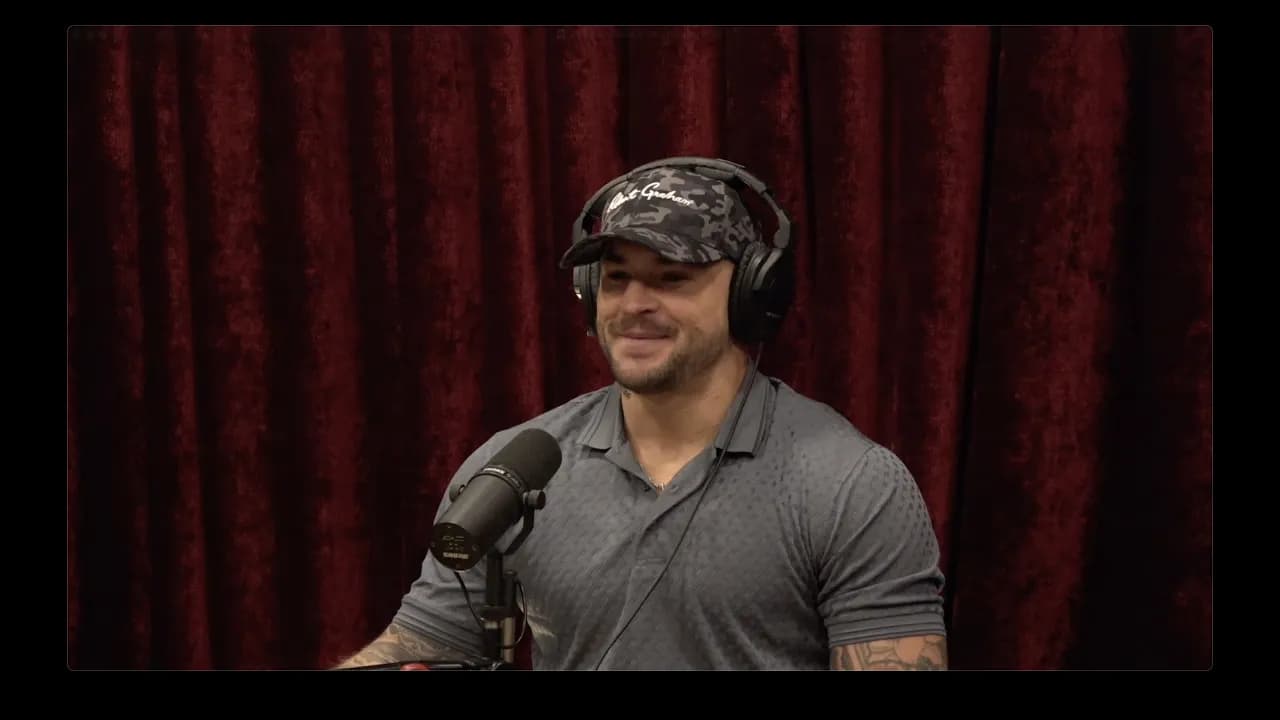
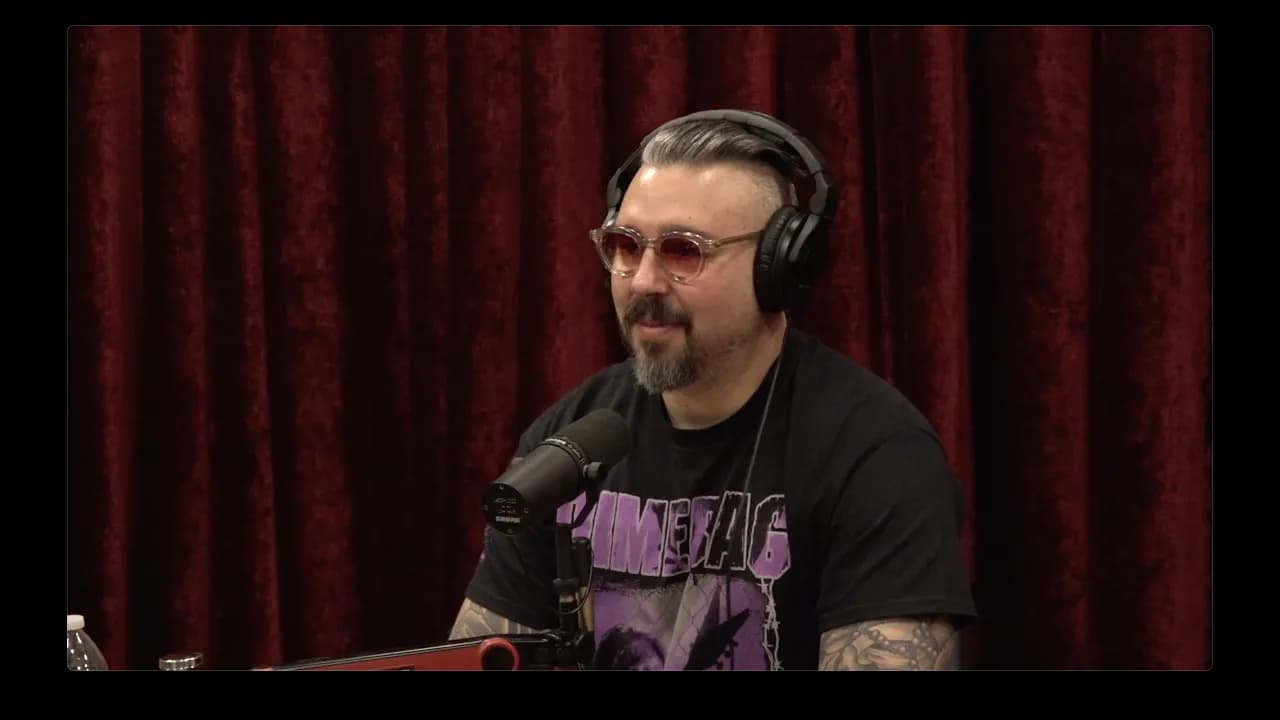
JRE MMA Show #187 with Robert Whittaker
In a Nutshell
Robert Whittaker emphasizes that fighting must coexist with real life—family, businesses, and recovery become harder as careers lengthen, making smart training and weight management essential for longevity. He advocates training skills fresh while conditioning after, using gi work to sharpen decision-making, and relying on lifestyle cardio rather than crash methods. The conversation also highlights how elite fighters like Anderson Silva, Nick Diaz, and Demetrious Johnson succeeded through unique styles, mental resilience, and adapting as they aged rather than relying solely on physical prime.
These notes were generated by AI and may contain inaccuracies.
Robert Whittaker discusses the challenges of balancing fighting with family life. He began fighting at 20 as a single man with no kids, and now he's married with six children, mortgages, and businesses. He runs a supplement line with Musashi. Whittaker emphasizes that life continues around fighting, making longevity in the sport difficult.
Whittaker explains that staying busy is essential in combat sports because there's a limited window for success. He cites Jared Cannonier as an outlier at 42 years old, still competing at a high level with exceptional cardio, drive, and wins in the trenches. Cannonier recently defeated Gregory Rodriguez despite getting blasted in the first round.
The conversation shifts to Michael Page at 185 pounds, noting he's too fast for the weight class. Whittaker discusses how grapplers present the biggest challenge for Page, citing Ian Garry as the only UFC fighter to beat him via grappling. Whittaker advocates for point fighting skills combined with combination striking, emphasizing how small gloves make a touch sufficient to score.
Whittaker and Rogan discuss fighters with unconventional styles including Kevin Holland, who maintains a relaxed demeanor during fights. Whittaker mentions Carlos Prates, who had approximately 100 Muay Thai and kickboxing fights over six years in Thailand, developing a relaxed yet aggressive fighting style.
The discussion explores the balance between psychological relaxation and physical detriment from habits like drinking and smoking. Rogan notes that some fighters maintain loose, comfortable states despite potential health consequences. Whittaker acknowledges that fighting involves many variables beyond pure physical conditioning.
Whittaker identifies fighters with unusual power including Alex Pereira, Damian Penas, and Carlos Prates. He describes Prates' left hook as particularly devastating, noting it was the only available punch when Prates' leg was injured in a fight against Yuri.
Whittaker discusses the power dynamics at light heavyweight, noting the division's speed combined with heavier punches makes it dangerous. He mentions Azamat Makoev as a smaller, skilled light heavyweight who carries lean muscle effectively despite not appearing ripped.
Whittaker recounts his fight with Paul Costa at light heavyweight, where he was hit with a spinning heel kick. He survived the kick, noting its difficulty to prepare for since Costa rarely throws it. Whittaker describes the moment of realization when seeing the kick coming.
The conversation covers a training partner of Michael Page who could perform a front flip axe kick on a heavy bag. Whittaker expresses that if someone attempted this kick against him, he'd likely get hit. The fighter's name is identified as Galore Bofando.
Whittaker discusses how age affects recovery, mentioning he hurt his back washing himself after a workout. He notes that over 35, sudden movements require proper warm-up to avoid injury. Rogan shares that he blew out his hamstring racing his 15-year-old daughter in Italy.
Rogan describes Muhammad Ali's extensive warm-up system, spending a full hour before workouts with systematic band exercises and stretching. He mentions Ali's ab program as exceptional. Rogan also discusses Manny Pacquiao's compound featuring a full pool hall with 15 tables where Pacquiao plays pool, chess, and signs autographs simultaneously.
Manny Pacquiao maintains an intense daily routine that includes playing pool while simultaneously signing autographs and merchandise for fans. He has his own pool hall in the Philippines and organizes annual pool tournaments. Despite being in his late 40s, he continues training full-time and recently boxed, seeking world-class competition rather than exhibition matches against influencers or MMA fighters.
Multiple fighters engage in high-level chess playing, often ranking highly online despite their intimidating physical presence. Josh Barnett stands out as exceptionally intelligent, quoting Dostoevsky and studying literature, history, and warrior philosophy while making his own whiskey. The contrast between fighters' physical appearance and intellectual pursuits surprises many observers.
Professional wrestlers endure significant physical damage from body slams and impacts that cause concussions and CTE. They perform on the road hundreds of days per year in local stadiums. Hulk Hogan received multiple spinal fusions due to disc degeneration from repeatedly landing on his back during elbow drops. The compression from these impacts causes disc space loss over time.
Yoel Romero at 49 years old possesses extraordinary physical conditioning, with his body described as feeling like metal when struck. Whittaker's calf kick against Romero caused self-injury rather than damage to Romero. Romero recently competed in bare-knuckle fighting against Darren Till.
Till has found success in boxing due to significant knee issues that affected his grappling in MMA. His elite striking was showcased in fights like against Cowboy Cerrone. Boxing eliminates the need for knee-intensive grappling techniques.
As fighters age, knee and joint injuries become more prevalent, reducing mat time and wrestling ability. Younger fighters instinctively explode into positions without consideration for joint protection, while older fighters with surgical histories subconsciously protect themselves. This hesitation creates vulnerability to being held down for entire rounds.
Chimaev's dominant performance included putting du Plessis in the crucifix position three times during a championship fight. This control was maintained throughout the entire fight despite du Plessis being a large, strong competitor. The crucifix technique proved particularly effective against an opponent who couldn't escape the position.
Fared Basharat was released from the UFC despite being undefeated, with speculation that his fighting style was deemed insufficiently exciting. His brother also had UFC contract issues. The discussion criticizes cutting fighters based on entertainment value rather than winning record, arguing that fighters should be matched against exciting opponents rather than released for strategic fighting approaches.
Contracts provide "to show" and "to win" bonuses, creating financial incentive for victory over entertainment. Fighters like Chimaev demonstrate that damage-free wrestling approaches offer longevity advantages until age-related decline prevents takedowns. The strategy of fighting intelligently and managing energy is presented as fundamental to the sport rather than reckless aggression.
Malott began his career at featherweight before moving up weight classes. His physique represents "weaponized" development through genetic advantages, dedication to weight cutting, and aggressive fighting style combining striking and wrestling abilities. He stands as an outlier in terms of size and physical presence within his division.
Kopylov defeated the significantly larger Goautier (who weighed 230-231 pounds before cutting to 185) through superior skill and positioning. Jack Slack provided detailed analysis of how Kopylov set up his left hook through strategic positioning. The fight exemplified how technical skill can overcome significant size disadvantages.
Costa appeared to have found his rhythm working the body effectively before the Israel Adesanya title fight. The pressure of championship fighting, combined with visible calf injuries that Adesanya targeted, led to a decisive loss. Post-fight behavior by Adesanya contributed to Costa being mentally affected for subsequent fights.
Costa's second knockout of Pereira followed two previous losses to him. The victory celebration is considered among the greatest in MMA history, especially given the context of previous defeats and leg damage sustained during the fight. Costa had worn a leash during training camp as part of his preparation.
The second fight between Whittaker and Adesanya was extremely close, with speculation that older scoring systems valuing takedowns might have resulted in a different outcome. Modern scoring requires fighters to do damage with takedowns rather than simply achieving them.
Randy Couture won a world title against Kevin Randleman by inflicting significant damage from his back with elbows while Randleman held top position. This demonstrated that effective ground fighting can overcome positional disadvantage. Kevin Holland knocked out Jacare Souza with a right hook from his back, generating surprising power from that position.
Strickland defeated heavily favored Gable Steveson (2400-1 underdog) with a first-round knockout. The massive betting odds reflected expectations, yet the outcome demonstrated the unpredictability of MMA. Steveson appeared reckless in his approach, particularly given the power present in the division.
Steveson weighs approximately 240 pounds but could potentially compete at 205 pounds. The division contains fighters with exceptional knockout power, making technical precision crucial for success.
Frank Shamrock fought Nick Diaz in Strikeforce and described how Diaz constantly talked trash during the fight, telling him "What the fuck you going to do, bitch?" while popping him. Shamrock found it shocking because he was a legend and former UFC champion, one of the very first complete martial artists and pioneers in the sport.
Diaz's boxing skills are considered good, with a crazy style that looks relaxed and fun. He never strains during fights, throwing all punches at 50% power, which allows him to throw them for days. This approach eventually leads to him beating on a gassed opponent who's no longer breathing properly.
The favorite Nick Diaz fight discussed is against Paul Daley in Strikeforce. Daley had crazy power that would put people into orbit with devastating knockouts. The fight became a war where Daley dropped Diaz multiple times, but Diaz brought Daley to a pace he couldn't sustain for the entire five minutes. By the three-minute mark, Daley was visibly exhausted and couldn't continue, allowing Diaz to overwhelm and stop him through "gactic overload."
The early rounds showed Daley's terrifying power with left hooks and left uppercuts. The fight exemplifies Diaz's exceptional cardio, which stems from his lifestyle approach including swimming back from Alcatraz seven times and heavy involvement in triathlons during training camps.
The discussion emphasizes that Diaz's cardio level requires cardio to be his lifestyle rather than just training. It's described as his hobby at this point. His strategy involves cooking opponents over time rather than trying to blitz them with one big bomb, bringing fighters to a pace he knows they can't sustain but that he maintains daily.
Joe Rogan called Nick's first UFC fight in 2001, working the event where Diaz fought Robbie Lawler at around 20 years old. The first fight was actually August 31st, 2001 for IFC Warriors against Jeremy Jackson, with the Lawler fight coming in 2004 at UFC 44 on September 26, 2003.
Nick's fighting career spans 23 years since his early UFC appearances, representing a long time of getting punched in the head. His style was very much in-your-face, where he'd eat a couple shots but give four back for every one landed. The longevity factor is significant, especially considering the wars he was involved in throughout his career.
Anderson Silva would sometimes get bored during fights, exemplified by when he fought Nick Diaz and laid down with his hands on his head. Only Diaz could do something like that and make it entertaining even in defeat. The approach worked because Silva wanted to counter-strike and walk opponents back to the fence, so by not engaging, Diaz prevented Silva from doing anything.
Several fighters figured out that if you don't do anything against Silva, he doesn't do anything either. In his prime, Silva was untouchable and unstoppable before people had tape on him and before his age and fight volume caught up with him.
The discussion emphasizes looking at elite fighters in their absolute prime rather than later in their careers. BJ Penn is cited as the best example - you can't look at the Penn vs. Edgar fight and say that's BJ Penn, but rather look at his prime performances against Sean Sherk and Joe Daddy Stevenson.
Anderson Silva in his prime was "in the Matrix," doing spectacular techniques like the front kick to Vitor Belfort's face. He was making championship fights look easy and finishing people while having fun, as seen in the Forrest Griffin fight where he was almost mockingly dancing around.
The Damian Maia fight occurred outside in Abu Dhabi with extreme humidity and bugs the size of horses flying around. Anderson came out hot in the first round trying to finish Maia but got really tired, then decided to coast while Maia chased him. Dana White was upset because it was meant to be a big showcase fight.
The environment was problematic with thunderstorms causing delays, and the fight was supposed to be in a controlled, air-conditioned environment rather than outside where humidity affected performance. Justin said he could feel the heavy air in the first round.
Robert Whittaker describes himself as a heavy sweater who gets dehydrated quickly in humid conditions, unlike Gegard Mousasi who doesn't drink water during training sessions because he thinks it toughens him up. The discussion covers the balance between having fun and being disciplined like a marine.
Fighters are described as special animals, with the contrast between Marvin Hagler's approach of running up sand dunes in combat boots at 5 AM versus Carlos Monzon's approach of dancing and drinking before fights.
The Jack Della Maddalena fight was difficult to watch as an Australian patriot. Adesanya's performance was described as dirty and cold, like an executioner, with his signature step-in knee to the liver from his left side. He fights almost in your face but isn't there, using his range effectively by leaning back and being gone when opponents come forward, then popping them from across the cage and following with calf kicks.
DC described Adesanya as built like a mosquito - all legs and limbs with power. The Leon Edwards left hand that knocked out someone was particularly notable for how he covered distance with the shot.
Arman Tsarukyan is dangerous and long, though he lost to someone who had the perfect strategy of getting him against the cage and landing elbows. He grew up really rich, which creates a narrative contradiction since rich people's sons aren't supposed to be the toughest fighters, yet he fights like he grew up in the ghetto or as a super soldier.
Tsarukyan's wealth makes his dedication to fighting his hobby rather than necessity, which is frustrating to other fighters who depend on the sport. However, his love for the sport is evident since there's no way someone with his money would fight that way and get through camps unless they genuinely loved it.
Sam Kivuitu comes from a cycling background with a scientific approach to cardio and trains fighters including TJ Dillashaw, Aaron Pico, and Hamzat. His workouts in a California garage are described as insane cardio strength and conditioning sessions involving whipping chains and medicine ball workouts.
Cub Swanson worked out there and felt he had some of his worst performances after those cardio sessions, thinking the training breaks fighters down too much and passes a fine line between beneficial and excessive.
The argument is made that hard cardio isn't automatically better preparation for skill work since fatigue commonly reduces the quality of sports-specific technique. When exhausted, movements become more labored, confidence decreases, and neural pathways for sharpness get disrupted.
The recommendation is that skill work should be done when fresh to learn sharp movements, counters, and techniques properly. Strength and conditioning should come after skill work rather than before. While training tired has its place, fighters don't want to get used to being tired.
Later in his career, GSP essentially abandoned traditional strength and conditioning in favor of sports-specific training with hard rounds on the bag, hard sparring rounds, and hard drilling rounds. This approach makes the body accustomed to contact, which is necessary for fighting.
The discussion references BJ Penn's prime training with Marinovich, whose philosophy was that fighters already know how to fight, so the focus should be on developing an insane gas tank through plyometrics and box jumps, allowing fighters to perform freely without thinking about cardio.
Robert Whittaker described how a training partner would show up shredded and looking like an absolute demon despite doing very little sparring and MIT training. The philosophy was that once you know how to fight, the camp becomes focused on insane cardio and plyometrics rather than skill work.
Whittaker explained that at light heavyweight in the later part of his career, he focuses on being happy and enjoying the process because by that stage you either know how to fight or you're in trouble. The approach shifts to review, revision, and practice rather than new skill acquisition.
Whittaker is a big believer in gi training for learning jiu-jitsu and transitioning to no-gi. He notes that gi guys can transition to no-gi, but it's very hard the other way around. Many Brazilians view gi training as essential, with Joe referencing that jiu-jitsu was originally all about the gi.
The debate over gi versus no-gi training dates back to around 2001-2002 when people started doing no-gi, which many Brazilians did not like. When Eddie Bravo started 10th Planet in 2003, it was controversial because he abandoned the gi. At that time, even though leg locks were legal in tournaments, people would boo and sometimes fight you afterward for using heel hooks.
The gi prevents making as many mistakes because it makes positioning and decision making more vital. Athletic guys can get far in no-gi by exploding out of positions, but the gi eliminates this advantage. When you make a mistake in the gi, you're punished more severely and have to work from bad positions.
John Jacques Machado was born with only a thumb on his left hand, so he never relied on collar chokes or grabbing cuffs. His technique used over hooks and under hooks, which translated directly to no-gi because they were wrestling-based holds. When learning from him, Whittaker adopted this style while training no-gi at 10th Planet.
Machado's approach emphasized that the gi is great defensively because you need excellent position and good defense - you can't just yank yourself out of an armbar like in sweaty no-gi situations. Offensively, Whittaker focused on wrestling-based grips and only used gi grips for clock chokes.
Marcelo Garcia's approach focused on chokes because they can't be defended - when you're choked out, you're gone. He avoided techniques like kimuras, which he called a strong man move requiring strength to pull off. His focus was getting hold of the neck through high elbow guillotines, rear naked chokes, head and arm chokes, and his excellent north-south choke.
Craig Jones is described as a freak who loves jiu-jitsu and the intellectual aspect of setting traps and catching people. He always looks like he's having a good time and could become a professional comedian if he retired from competing. His silliness masks an assassin-like skill level when training with elite guys.
Gordon Ryan can do to everyone what Jones does to others. His style is entirely control-based rather than athletic, and once he gets a hold of someone, it's over.
Hickson Gracie explained that everyone starts at a neutral position at zero. Once you advance to position one, you don't go back to zero - you advance to two, three, and eventually checkmate. The mentality is that if you get someone in a position, they're not getting out and you're advancing to the next spot.
Hickson was a true pioneer with physical training, being the first jiu-jitsu guy to adopt extreme flexibility work, yoga, and cold plunges. He was doing cold plunges in glacial rivers in Japan before fighting in Japanese Vale Tudo. He performed neck exercises with bands, going up stairs or pulling against trees to strengthen neck muscles, and did balance work including standing splits on balance beams.
Gymnastics provides the best baseline for MMA because there's no controlled position in fighting - you're constantly moving with the opponent as an external variable. Imbalanced exercises and balance work that strengthen individual muscles are vital. Eddie Bravo brought break dancers into 10th Planet training after seeing the Martinez brothers' abilities, recognizing that body control from breakdancing translates directly to jiu-jitsu.
Whittaker was lucky to meet his wife early in his career because her elite gymnastics background influenced his approach. Gymnasts live in a constant camp environment where they can't put on weight and every day is performance-based. She served as his nutritionist and strength and conditioning coach at one point, with a health science and sports science background.
She made him realize the importance of a strong core for dynamic movements in MMA. Whittaker neglected core work for a long time but started doing rotational core work with heavy cables and kettlebell rotations after getting repetitive lower back injuries from archery, which caused tendinitis on his lower right side from pulling back with one arm hundreds of times daily.
Hanging foot-to-bar moves are considered mandatory for all athletes because the movement is so core intensive. The exercise involves hanging from a chin-up bar, lifting feet up to touch the bar with no momentum, stabilizing at the bottom, then pulling all the way up and stabilizing again.
Joe Rogan shared a story about his friend Remy who was hit by lightning in high school. Whittaker worked as an electrician while fighting on local scenes before getting called up for The Ultimate Fighter. He was a fourth year apprentice who applied for annual leave for the show and never returned to his job.
The conversation covered the dangers of electricity, with Rogan noting that some people get electrocuted and are fine while others die immediately. They discussed a viral video of someone supposedly getting hit by lightning twice, with debate about whether it was real or fake, ultimately concluding that getting hit by lightning twice would be extraordinarily unlucky.
Discussion around a video of a man being tased multiple times by police. The man remains standing despite being hit and states "Tase me all day. I love pain." This challenges the assumption that tasing always causes immediate incapacitation. Some people react by screaming and attempting to remove the prongs, while others shut down and fall immediately. The group discusses Dana White's show where fighters were tased as part of the competition.
Video shows an ex-Army or Navy Seal with PTSD who is barefoot and non-compliant with police instructions. Despite multiple officers attempting to tase him, the man remains standing and appears unaffected. The discussion notes the difficulty of four female officers attempting to handle such a large individual. The man appears to be holding his phone throughout the encounter.
Robert Whittaker describes his difficult weight cuts at welterweight, including a final cut of 7.4 kilos (16-17 pounds) on the day of weigh-in. He explains that he walked around at approximately 92-94 kilos (198-207 pounds) while fighting at 170 pounds, representing nearly 30 pounds of weight cutting. The difficulty increased as he aged from 18 to 24 years old.
Whittaker explains that moving up to 185 pounds allowed him to become "Robert Whittaker" as his true self. The camps became significantly better because he could eat carbs and fuel his body properly. At welterweight, he was constantly in a depleted state, which affected recovery and performance. The weight cuts remained challenging even at middleweight because he still wanted to maintain size.
Whittaker describes getting burned out from the constant weight cutting, diet restrictions, training fatigue, and trying to manage six children while depleted. A seemingly minor but significant factor was that when walking around at normal weight, none of his clothes fit because his suits were fitted when he was lean. This made him realize he wanted to walk around with clothes that fit after his career.
Discussion about whether MMA should eliminate weight cutting entirely, with fighters competing at their natural healthy weight. Whittaker suggests that random weigh-ins similar to USADA drug testing could be implemented, though this raises concerns about athlete autonomy. The conversation acknowledges that human nature tends to push boundaries regardless of regulations.
The conversation shifts to Pride FC's heavyweight division, considered the greatest heavyweight lineup in MMA history, featuring fighters like Mirko Cro Cop, Fedor Emelianenko, and others. In Pride, fighters were encouraged to gain weight, and contracts explicitly stated they did not test for steroids. Vanderlei Silva fought at heavyweight despite being naturally 185 pounds, including a notable fight against Mark Hunt.
Mark Hunt described as nearly impossible to hurt, exemplified by getting head kicked by Cro Cop and responding "Good shot" before getting back up. Hunt had exceptional durability and knockout power, known for his walk-off knockouts where he would turn away immediately after landing finishing strikes.
Detailed discussion of the Anderson Silva flying knee against Michael Bisping where Silva believed he had won and began celebrating on the cage, only to be informed the fight wasn't over. Bisping recovered and won the decision. The incident occurred near the end of the round with the buzzer sounding shortly after the knee landed.
Michael Bisping fought 11 fights after losing vision in one eye from a head kick by Vitor Belfort. He had multiple eye surgeries and memorized eye charts to pass medical examinations. Sherrard "The Bullet" Blackledge is mentioned as another fighter competing with one eye, though he must fight internationally as he's not permitted to compete in the United States.
MVP's fighting style described as point-fighting that the UFC decided against continuing to promote after he won his final fight but wasn't offered a new contract. Whittaker's strategy for fighting such agile fighters involves targeting the legs with calf kicks to compromise their movement and footwork. Calf kicks can cause significant damage to the fibula and severely compromise an opponent's ability to move effectively.
Switch hitting provides a major competitive edge because fighters who must stay in one stance become compromised when their front leg is attacked. Fighters like TJ Dillashaw and Cory Sandhagen constantly switch stances, making them comfortable from any position. This creates tactical problems for opponents who must instantly adjust their defensive strategy when an opponent switches stance. The switching changes all punching angles and requires fighters to shift between completely different strategy sets for southpaw versus orthodox opponents. In MMA, this is especially problematic for wrestlers because takedown angles and lead leg positioning become disrupted when opponents switch stances.
Young fighters should develop switch hitting skills because it takes years of practice to become comfortable on both sides. However, some fighters achieve elite status by perfecting one stance instead, like Alex Pereira who rarely switches but generates power from his left hook, right hand, and calf kicks.
Tall fighters with long stances have significant advantages because they can strike from distance while remaining out of range. Their reach advantage forces shorter opponents to work harder to close distance and get reads on their opponents. Robert Whittaker noted he has never lost to someone shorter than him.
Moving up to light heavyweight didn't change much in terms of height disadvantage since Whittaker was already fighting taller opponents at middleweight like Israel Adesanya, Jared Cannonier, and Marvin Vettori, who were all 6'2" to 6'4".
Usman "Bulgari" Nurmagomedov is a 6'6" kickboxer fighting at 185 pounds, making him an extreme size anomaly for the weight class. He has a victory over Alex Pereira in kickboxing despite losing to him once by knockout across three fights. His training with both Pereira and Glover Teixeira has significantly improved his takedown defense and grappling skills.
In his fight against Mansour Abdul Malik, Bulgari demonstrated superior striking technique and used his length effectively. His long levers generate tremendous power, similar to Tommy Hearns, with wide shoulders and long arms accelerating strikes. His knees were particularly devastating due to his height advantage.
Fighters who develop striking skills later in their careers (like wrestlers starting at age 28) can become competent strikers, but they leave openings that experienced strikers can exploit during prolonged exchanges. When fatigued, fighters revert to their base instincts, and wrestlers may become "sleepwalking" and less technical compared to seasoned strikers who maintain tight combinations even when tired.
Sean Strickland was noted as an exception - when tired, he tends to throw wild, loose punches rather than maintaining technical striking.
Strickland spars more than most fighters but gets hit less than others due to his style. He's currently dealing with UFC contract issues and has expressed wanting to leave MMA to box Jake Paul. Despite his controversial statements, many of his bold claims come true, including his prediction that he would sit out until getting a title shot, which materialized two years later.
Strickland remains valuable for the UFC as a fan favorite who generates controversy and sells fights effectively, making him ideal for matchups against champions like Khamzat Chimaev.
Chimaev's loss to Strickland was likely due to weight cutting problems rather than Strickland having a perfect anti-Chimaev game. Chimaev had been preparing to move up to 205 pounds for a title challenge when offered the Strickland fight, but didn't have adequate time to cut to 185 pounds. He previously missed weight by eight pounds against Nate Diaz, indicating ongoing weight management issues.
There's ongoing debate about pressure-control fighting styles where fighters hold opponents down for extended periods. Whittaker advocates for a purist approach - if someone can hold you down according to the rules for five rounds, that's legitimate fighting and the held fighter needs to find a way to get up. He believes fans will accept this style because most fighters won't fight that way anyway.
A recent Salt Lake City UFC event featured 11 first-round knockouts, breaking the record previously held by the Johnny Walker heavyweight debut event. The card included notable finishes like Payton Talbot knocking out Davidson Pantoja, Kevin Lee knocking out King Green, and Roman Kopylov knocking out Takashi Junia.
Johnny Walker struggled making 205 pounds, becoming so dehydrated that his brain couldn't handle shots effectively. His power carried over to heavyweight, but the weight cutting compromised his durability. Whittaker noted that above 205 pounds, most fighters have significant knockout power.
Whittaker's move to light heavyweight was motivated by dissatisfaction with his middleweight camp against Jared Cannonier, where he felt the fire had fizzled out. He wanted to enjoy fighting again and made several changes: attending his kids' soccer games instead of running sand hills, being freer mentally, and focusing on not getting hit by bigger opponents who all possess knockout power.
At light heavyweight, Whittaker feels his holistic skill set is superior to most in the division. His current walking weight is 106 kilos (232 pounds), and he starts camps around 103 kilos (approximately 225 pounds), which he considers too heavy for optimal camp starting weight.
Whittaker cuts from 232 pounds down to around 225 pounds total weight, doing his final cut in the bath at 220 pounds. He can drop 15 pounds in about an hour and a half because he's a good sweater. The bath method allows him to rest while dehydrating rather than wearing himself out with training or running.
Early in his career, weight cutting involved 15-mile runs wrapped in sweats, which was the standard approach at wrestling camps. The problem with sauna use is that staying too long can dry out the esophagus and cause burning. Whittaker learned from Ethan Ewing that lower temperatures around 165 degrees are sufficient to sweat without breaking the body down too much.
Whittaker is hit and miss with water loading and questions whether weight loss comes from the water protocol or diet changes. Different coaches recommend varying approaches - some restrict water, others increase it to certain amounts. He now does water loading more as superstition because not doing it might leave him needing to cut 20 pounds in the bath.
Whittaker questions how much science dilutes the fundamental nature of fighting, noting that fighters are "just two men with sticks and rocks" who are "bongering" while also being super skillful. He observes that some younger fighters coming from elite programs get too technical, while champions like Sean Strickland developed through constant sparring in garages rather than scientific approaches.
Strickland has a very elusive, tricky style - standing straight up, hard to take down, throwing deep kicks to the body. His approach is predicated on his left leg being messed up from a motorcycle accident where he lost a big piece of his quad. Despite saying wild things, he fights intelligently and his style is difficult for opponents to handle.
Whittaker criticizes the "fraud check" mentality from fans who say cruel things for engagement, noting that fighting puts fighters in the most primal, vulnerable position two men can be in. Fighters put their souls on the line with the consequence of getting knocked out in front of friends, family, and the world, yet face backstabbing from loud voices.
After losing to Howy Barcelos, Talbott was subjected to "fraud check" criticism, but he identified areas needing improvement and came back to defeat Henry Cejudo. Whittaker hopes Talbott fights Sean O'Malley, noting the fight would be gigantic and compelling on paper. Talbott's wrestling improved dramatically after the Barcelos loss, taking Cejudo down in their fight.
The 135-pound division is "chalk full of talent" with many good fights available. The 155-pound division is "insane" with incredible talent. Whittaker believes Justin Gaethje should fight Arman Tsarukyan, especially after Tsarukyan's performance against Charles Oliveira, which cemented his case for a title shot.
Whittaker notes he's one of the younger fighters in his division, observing that athletes' ages are extending due to proper training, hyperbaric chambers, red light therapy, saunas, cold plunges, massage, scientific cardio training, and nutrition. He and his wife created the Ascend Fitness by Rob app focused on sports science longevity.
The app provides programs built around longevity and performance training, focusing on what allowed Whittaker to fight at a high level for so long. It emphasizes making life better through conditioning and performance training. The app includes monthly Q&As for community building and direct feedback, with an emphasis on the human element of training and mental wellbeing.
Whittaker has worked with sports psychologists throughout his career but believes guys sometimes just need to talk and vent. He references how pub culture was important for men to lower their guard and discuss things. He notes that as men and fighters, some thoughts aren't appropriate to share with wives and need a place to be expressed with other men who understand.
Training partners who bleed and sweat together build a brotherhood-like connection. Even fighters who don't bond personally would help each other if needed. Whittaker can't attend his teammates' fights because it affects him too much. When fighters leave gyms, it creates psychological challenges as they leave their training family.
Whittaker was surprised by Adesanya leaving City Kickboxing, noting Eugene Bareman has been a staple of his career and is one of the few legitimate masterminds in the sport. He maintains good relationships with CKB despite the change.
Australia's remote location means 17-12 hour flights to places like Austin. Whittaker notes Australia has the population of Los Angeles spread across a country the size of the United States, with much of it being desert. New Zealand's proximity (3-hour flight) makes it attractive for training with big prospects like Navajo Sterling, Carlos Bberg, and Tyson Pedro.
Whittaker discusses Australia's dangerous wildlife including brown snakes, funnel web spiders, and crocodiles. He argues that anything wanting to kill humans should be eliminated, suggesting crocodiles should be hunted rather than protected. He notes the contrast between alligators and crocodiles, mentioning places where they interact and crocodiles dominate during feeding.
Joe Rogan mentions his friend Adam Greenree was nearly killed by a spider bite while camping, with only a partial envenomation saving his life. Whittaker suggests the dangerous wildlife might serve to keep population low and deter visitors, noting Australia's fun drinking and laughing culture makes it great for comedy despite the risks.
James McCann is described as one of the best up-and-coming comics in the world and one of the favorites. He lived in Austin for a while before moving back to Australia because his wife had a new baby and wanted family help. He's performing in Australia in November in Perth, Adelaide, Sydney, and Brisbane. The experience of performing stand-up comedy is highlighted as special because it gives a unique energy. The audience comes with no baggage and everyone has the same goal and objective of having a good time. This creates good intentions throughout the room.
The Comedy Store in LA is cited as an example of how years of laughter and fun can become burned into the spirit of a building, with the energy seeping into the concrete and creating a culture with a heaviness to it when walking through.
The key to good podcasting is only talking to people you actually want to talk to, so you never have to fake it. Being invested in the person you're talking to is essential - you have to really be there. Demetrious Johnson is praised as being great at this, with his energy making conversations flow naturally.
Robert Whittaker has his own YouTube podcast called MM Arcade where they talk about fights and video games.
Demetrious Johnson is described as one of the greatest examples of mixed martial arts excellence and one of the all-time masters. His flying armbar technique is highlighted, specifically chaining a suplex into an armbar during a fight. His speed is noted as exceptional - when grabbed from behind at a UFC event, he responded with two knees to the body so fast that the brain didn't process it, demonstrating the level of speed at which elite fighters compete.
Joshua Van's performance against Pantoja is referenced as a chaos fight that silenced critics. His fight against Tyra is also mentioned as being particularly good. The new generation of fighters, including Joshua Van and others like Talbot, are noted for their ability to adapt and grow so fast between fights. As champion, Joshua Van appears more confident than ever, representing an exciting time for the sport.
An app is being developed due to the inspiring younger generation of fighters, specifically a fitness app that offers 50% off the first month.
- Instagram: Rob Whitaker MMA
- Twitter: Same handle as Instagram
- Website: ascend.combyrobb.com with 50% off first month
Keep PowerfulJRE in your library
Save the videos and channels worth coming back to, and find them again in one place.