LIVE NOW: FOMC RATE DECISION + PRESS CONFERENCE 2026
In a Nutshell
FOMC held rates at 3.5-3.75% as expected, with Powell warning that inflation has risen to 3.5% due to energy shocks and tariffs, creating a more uncertain outlook. Powell announced he will stay on as governor until the DOJ investigation concludes, citing concerns about Fed independence. Markets are pricing in a more cautious Fed stance ahead with three dissenters already favoring a neutral position, while high-valuation stocks like SoFi and Intel face pressure from elevated multiples and disappointing fundamentals.
These notes were generated by AI and may contain inaccuracies.
Ricky from Techbud Solutions hosts a live stream on April 29th, 2026 at 10:53 a.m. Arizona time covering the FOMC rate decision and expected press conference with Jerome Powell, potentially his final appearance as Federal Reserve Chair.
The Nasdaq is up 0.28% at the start of the stream. The Fed rate monitor tool shows a 98.9% probability that the Federal Reserve will pause interest rates, suggesting this outcome is already factored into markets. Markets would react positively to rate cuts and negatively to rate hikes. Powell is described as a man of few words who avoids commenting outside his mandate.
The stream focuses on what Powell will say regarding rising inflation, potential adjustments to 2026 rate cut guidance, and whether an interest rate hike could be considered given current conditions.
Intel (INTC) is noted as up 9-10% on the day and described as a meme stock with irrational valuations. The company loses billions annually with a negative P/E ratio, yet trades on speculation that the Trump administration's 10% ownership guarantees success. This is compared to Trump's coin, noting that not everything under the Trump administration succeeds and failures can leave investors holding the bag.
Markets are described as consistently more bullish than bearish, with optimism that prices will continue rising. This creates dip-buying opportunities during selloffs for long-term investors. However, speculative stocks at overbought levels carry significant downside risk. Solid companies like Apple, Microsoft, and Nvidia may have inflated prices but generate actual profits, while Intel remains speculative.
The Fed's two mandates are price stability and strong labor markets. Current conditions include a weak labor market being replaced by AI and rising inflation from oil prices, creating challenges since the Fed cannot address both issues simultaneously.
A rate pause is already factored into markets given the 98.9% probability. If markets had priced in a rate cut and the Fed pauses instead, this would create a shock factor leading to aggressive selloffs. The key information needed is the Fed's willingness to cut rates in 2026 and whether guidance has changed.
At 11:00 a.m., the rate decision confirms the expected pause. Markets remain range-bound with Nasdaq trading between lows of 657 and highs of 661. The speaker anticipates most volatility will occur during the press conference scheduled in approximately 29 minutes.
With time before the press conference, the stream shifts to analyzing companies reporting earnings, using Investing Pro software for fundamental analysis. The speaker notes approximately 1,000 viewers in the live stream.
SoFi reported earnings during pre-market and dropped 13%. The company trades at a $15.83 average price against a $23 fair value target according to Investing Pro. SoFi has a P/E ratio of 48.6, net income of $481 million, but a $40 billion valuation. Revenue shows consistent quarter-over-quarter growth with large gap ups, but net profit remains weak due to high spending.
Key concerns include quality issues with personal loans, significant shareholder dilution from $3.2 billion capital raised in 2025 (including $1.4-1.5 billion in December), intense competition from traditional banks, execution risk on ambitious 30% revenue growth targets, and high stock volatility. The stock has fallen significantly over the past three months.
The speaker emphasizes that when valuations are inflated, companies must exceed expectations to maintain prices. SoFi's fundamentals are performing as expected but not exceeding the high bar set by its premium valuation. Historical patterns show SoFi experiences downturns followed by recoveries, potentially creating dip-buy opportunities for long-term believers, but current price action shows no recovery indication.
Robinhood is described as trading as a crypto proxy. The company missed earnings and revenue expectations, leading to significant drops. Consumer sentiment is expected to decline in 2026, potentially reducing trading activity and revenue. However, 24/7 or 24/5 trading and reduced PDT rule limits could provide growth opportunities.
Microsoft's earnings per share estimate is $4.05 with expected revenue of $81.29 billion. The company generates $300 billion annual revenue with $120 billion net income (33% margins). Microsoft Cloud surpassed $50 billion in quarterly revenue for the first time, growing 26% year-over-year.
Microsoft trades at a P/E ratio of 26.3 times earnings. Statistically, over the last 10 earnings reports, Microsoft exceeded expectations 8 times but only closed green twice, with pullbacks occurring the other 8 times. The stock recovered from $350 lows to current levels but has been stagnant, needing to significantly exceed expectations to avoid breaking support with a gap down to $360-370.
The speaker is invested in Microsoft long-term but has trimmed a portion of their position. Microsoft is viewed as not worth trading due to low volatility and consistent bullish bias as a Mag 7 company. Current market inflation suggests waiting for a correction rather than buying at present levels.
The speaker asks viewers invested in Amazon long-term whether they view current prices as a good deal for adding to positions. The discussion emphasizes that investors who bought Amazon at $100 or below have significant cushions and should not encourage beginners to buy at inflated current levels when the original investors themselves would not add more at these prices.
Amazon could be a good buy when uncertainty causes pullbacks. Markets present buying opportunities when they sell off, allowing investors to take advantage of deals. The speaker distinguishes between a trading account ($500,000) where positions are sometimes less than $100,000, and a larger investment account focused on buying good deals for quality companies. Markets pulling back is preferred not for short-term trading gains but for long-term investment opportunities.
You will only celebrate the pullbacks if you've prepared for it, not predicted it.
Investors cannot predict market movements but can prepare by paying attention to overbought and oversold levels. Amazon is relatively close to $300 per share, with potential upside from unexpected announcements or downside if consumer spending disappoints in 2026. AWS services could also influence performance either positively or negatively.
Using Investing Pro analysis, Amazon shows solid P ratios at 36 times earnings. Revenue and net income have increased significantly. The company generates $77 billion quarterly, with AWS accelerating to its fastest growth in 13 quarters at 24% year-over-year. Earnings expectations for the current quarter are $1.63 per share and $177 billion in revenue.
Amazon exhibits volatile earnings reactions with alternating drops and increases. As a Magnificent 7 company, it's considered too elevated for trading despite potential short-term gains if sentiment remains strong. The speaker views it as not a good enough deal for investment currently, though acknowledges individual risk tolerance varies.
The speaker emphasizes using software like Investing Pro not to find reasons to invest, but to identify reasons not to invest. SoFi investors could have identified the stock was trading at a super high P/E ratio despite growth, indicating a huge premium that made it vulnerable to correction upon any disappointment. Fundamental analysis helps connect the dots to determine whether companies trade at premiums or represent good deals.
Investing Pro is available through an affiliate discount link in the video description, breaking down to less than $10 per month at $9.50. The software helps users understand companies better for investment and trading decisions.
Cloud AI developments including Anthropic are taking market share from Microsoft. Competition is viewed as capitalism at work, instilling creativity and forcing companies to compete for business. Not all companies can lead, but they can all have a piece of the pie.
American Airlines faces headwinds from oil prices, which make up about 30% of their costs. Oil prices hitting 52-week highs through UCO is creating a poor outlook for the airline, with flights becoming increasingly expensive.
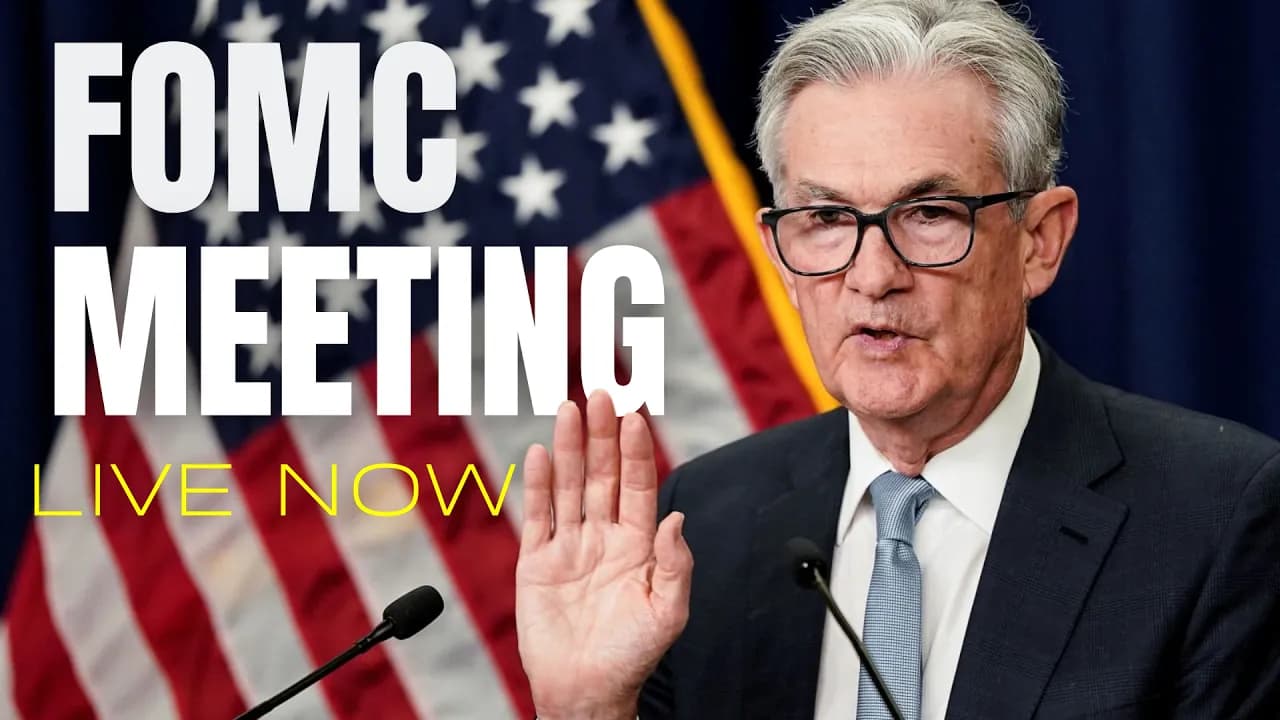
Jerome Powell's last FOMC press conference is about to begin, with plans to let him speak for 20-30 minutes before wrapping up the live coverage.
Powell states the FOMC decided to leave the policy rate unchanged, viewing the current stance as appropriate for maximum employment and 2% inflation goals. The US economy is expanding at a solid pace, unemployment at 4.3% has changed little, and inflation has moved up to 3.5% total PCE and 3.2% core PCE, partly reflecting Middle East energy price increases and tariff effects.
The target range for the federal funds rate remains at 3.5% to 3.75%. The economic outlook remains highly uncertain due to Middle East conflict, with higher energy prices pushing up inflation in the near term. Monetary policy is not on a preset course and will be decided meeting-by-meeting.
Powell congratulates Kevin Warsh on Senate Banking Committee advancement and reflects on the Federal Reserve's purpose to foster economic conditions for American families and businesses. He emphasizes the institution's resilience and collaborative decision-making process.
The US Attorney for DC closed the criminal investigation, with DOJ assurances they won't reopen unless there's a criminal referral from the Fed's Inspector General. Powell states he will not leave the board until the investigation concludes with transparency and finality, and will continue serving as governor after his term ends May 15.
Powell cites concern about illegal attacks on the Fed threatening monetary policy independence. He views these legal actions as unprecedented in the Fed's 113-year history and feels they threaten the institution's ability to operate free of political influence. He had planned retirement but felt he had no choice but to stay until these matters are resolved.
Powell does not see his continued service as interfering with the new administration and plans to collaborate with the incoming chair as a governor. He emphasizes working with the chair, trying to be heard while supporting when possible.
Powell explains the Fed's hypothesis that tariffs would lead to one-time price increases that would dissipate over time, expecting this to occur in the next two quarters. Energy shocks are harder to assess, with oil approaching $120 per barrel. The Fed will be cautious about looking through energy shocks given current inflation levels above 2% and ongoing tariff effects.
Three committee members dissented on maintaining the easing bias language. The number of people supporting a more neutral stance has increased, with core inflation at 3.2% moving in the wrong direction. The majority still supports keeping the language, with vigorous discussion about whether to change it given inflation developments.
Powell notes new leadership will be in place in six weeks and will have an important role in future decisions. He won't speculate on whether the easing bias will remain with oil at current levels.
Powell declines to give specific advice through the press but acknowledges every incoming chair reviews communications, viewing it as a healthy process.
Powell hasn't seen Warsh since a January dinner and expects a normal transition process. The previous transition with Janet Yellen was different as they worked in the same building for six years.
Powell reflects on low unemployment periods benefiting disadvantaged Americans with wage gains at the bottom of the income spectrum. He notes companies were setting up training programs for previously confined individuals, creating healthy societal dynamics during stable equilibrium periods.
Powell stated that the global pandemic inflation was not related to an overheated employment market. The inflation resulted from a global shock involving closing, reopening, and stimulus measures. Graphs of ten major economies showed nearly identical patterns across the US, Germany, France, and other countries.
He emphasized that the Fed must balance both dual mandates and currently does not view the labor market as a source of inflation. During the pandemic recovery, the labor market was overheated and tight, requiring concern at that time, but not presently.
Powell indicated he is waiting for the Justice Department investigation to conclude with finality and transparency before stepping down. He stated he will leave when he determines it is appropriate.
Michael McKee from Bloomberg Television asked about the two-sided view discussion on interest rates. Powell explained that three dissenters and other members who could have supported the position all backed the actual decision. No one advocated for immediate rate hikes. The debate centered on whether the Fed should maintain a neutral stance.
Powell noted this represents forward guidance and changes should be sustainable rather than requiring quick reversal. Markets understand the Fed's reaction function, so there is no communication problem to solve. The discussion was characterized as a fair and legitimate debate.
Powell stated that Fed credibility concerns are not driving his decision-making. Monetary policy will be determined by 19 people with significant stability. He compared the situation to every new Fed chair who must work with 18 colleagues on the FOMC, with 11 voting each year.
The chair's role involves creating consensus by understanding colleagues' thinking and pulling them together. Powell mentioned Kevin Warsh has the capabilities and skills to perform this effectively.
Howard Schneider from Reuters asked about Powell's plans to maintain a low profile as governor. Powell stated he would never act as a shadow chair and respects the chair's role. He served as governor for six years and worked closely with Chair Yellen after working with Chairwoman Bernanke for two years.
Powell expressed sympathy for how difficult it is to achieve consensus among the group. He plans to support the chair's direction when possible and be a constructive participant out of respect for the office of the chair.
Powell acknowledged that oil prices bleeding into core inflation represents a real prospect. The Fed's current policy stance is at the high end of neutral or mildly restrictive. The labor market shows increasing stability while inflation is misbehaving, suggesting this policy position may be appropriate for waiting and observing developments.
He noted visible impacts in airfares and potentially other areas, but the duration of strait closure remains unknown, making outcomes uncertain. The Fed is positioned well to wait and see how events unfold.
Powell explained that quarterly press conferences previously meant the Fed only moved at those meetings. During the pandemic, they moved at every meeting and sometimes between meetings, making communication without press conferences challenging. He noted that holding press conferences after every meeting has become the industry norm and standard.
This approach allows the Fed to deliver a unified message rather than having 18 different people delivering varied messages, which is helpful given the committee's widely disparate views.
Powell discussed the communications review from the previous year. Large changes to the dot plot or SEP lacked broad committee support, leading the Fed to move on without implementing major modifications. He acknowledged he was never the biggest fan of the dot plot but noted the difficulty in replacing it with something better.
The Fed remains the only major central bank that does not publish a forecast, partly due to the challenge of coordinating a 19-person committee. Powell stated that every new chair will naturally examine the communications suite and consider improvements.
Colby Smith from The New York Times asked whether the hawkish outcome involves extending the pause in rate cuts. Powell stated the committee believes the policy rate is in a good place. If rate hikes become necessary, the Fed will signal that intention. If cuts are appropriate, the opposite signal will occur.
Nobody is currently calling for a hike. The policy stance allows movement in either direction depending on how conditions evolve. The debate about changing guidance was closer this cycle but ultimately did not result in modifications.
Powell explained that determining when growth risks exceed inflation risks requires empirical observation. The US, as a major energy exporter with a less energy-intensive economy than in the 1970s, experiences substantially smaller effects compared to Western Europe or Asia.
Current effects reflect what's priced in—a relatively quick outcome. Prolonged conflict with higher prices would increase impacts. Powell acknowledged that higher gas prices reduce disposable income and create GDP pressure, with effects appearing in airline fares and petroleum-dependent products and services.
Edward Lawrence from Fox Business asked about the neutral rate. Powell stated the neutral rate cannot be known with certainty but estimated it between 3% and 4%, with the current rate slightly above 3.5%—at the higher end of reasonable neutral rate estimates.
The labor market continues cooling slightly, and Powell does not see a strong case for policy being meaningfully restrictive, characterizing it as mildly restrictive or neutral.
Powell addressed whether he is handing off a divided Fed, noting the committee has always had vigorous debates. The current situation involves four supply shocks: the pandemic, Ukraine invasion, tariffs, and Iran-related oil spike. Each supply shock can drive both inflation and unemployment higher, creating difficult central bank decisions.
The framework requires balancing achievement of both mandates, involving forecasts for each variable, estimates of time to return to target, and assessments of policy restrictiveness. Different risk tolerances and perspectives among committee members are natural given these challenging conditions.
Selina Wang from ABC News asked about Kevin Warsh's ability to withstand political pressure from President Trump. Powell stated Warsh testified strongly on this point during his hearing and Powell takes him at his word.
Regarding gas prices exceeding $4 per gallon and inflation reaching a two-year high, Powell stated he cannot predict future gas prices, which depend on how long the strait remains closed and reopening speed. Higher gas prices reduce disposable income and create spending reduction that offsets inflationary effects, making the appropriate policy response non-obvious without observing how conditions evolve.
When asked what message staying on sends to the president, Powell referred to his earlier statement.
Keep Ricky Gutierrez in your library
Save the videos and channels worth coming back to, and find them again in one place.