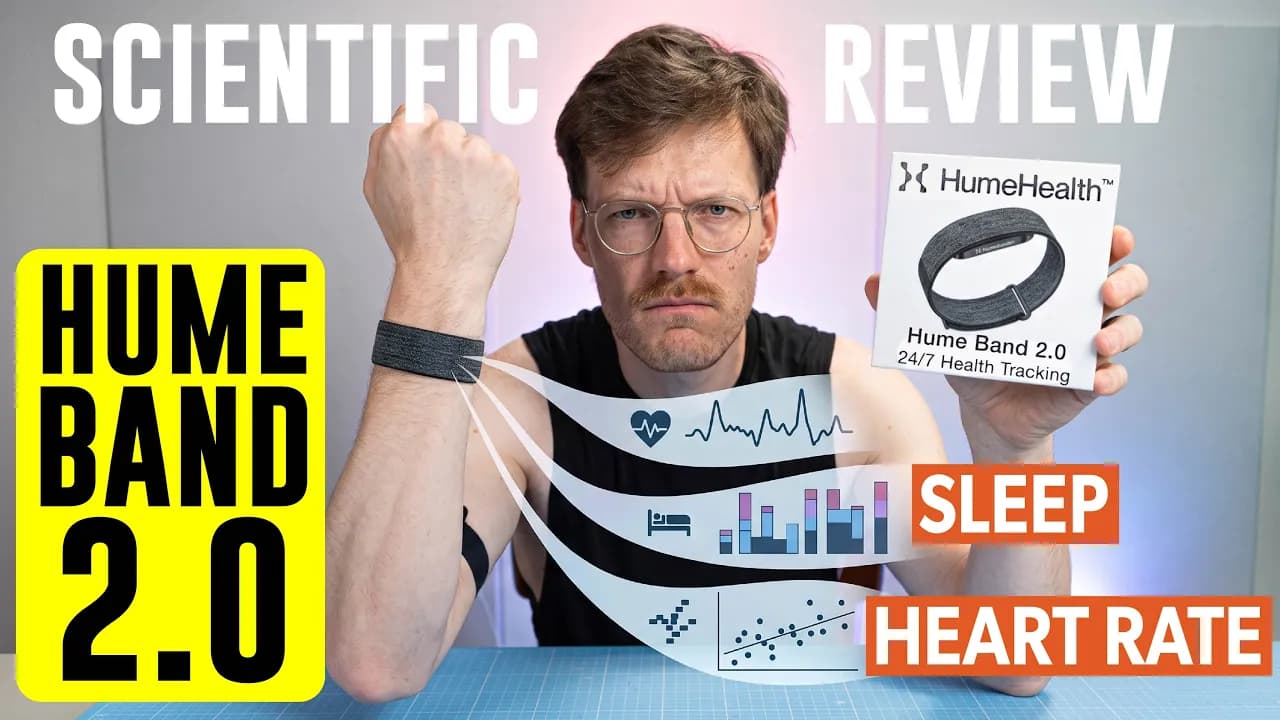
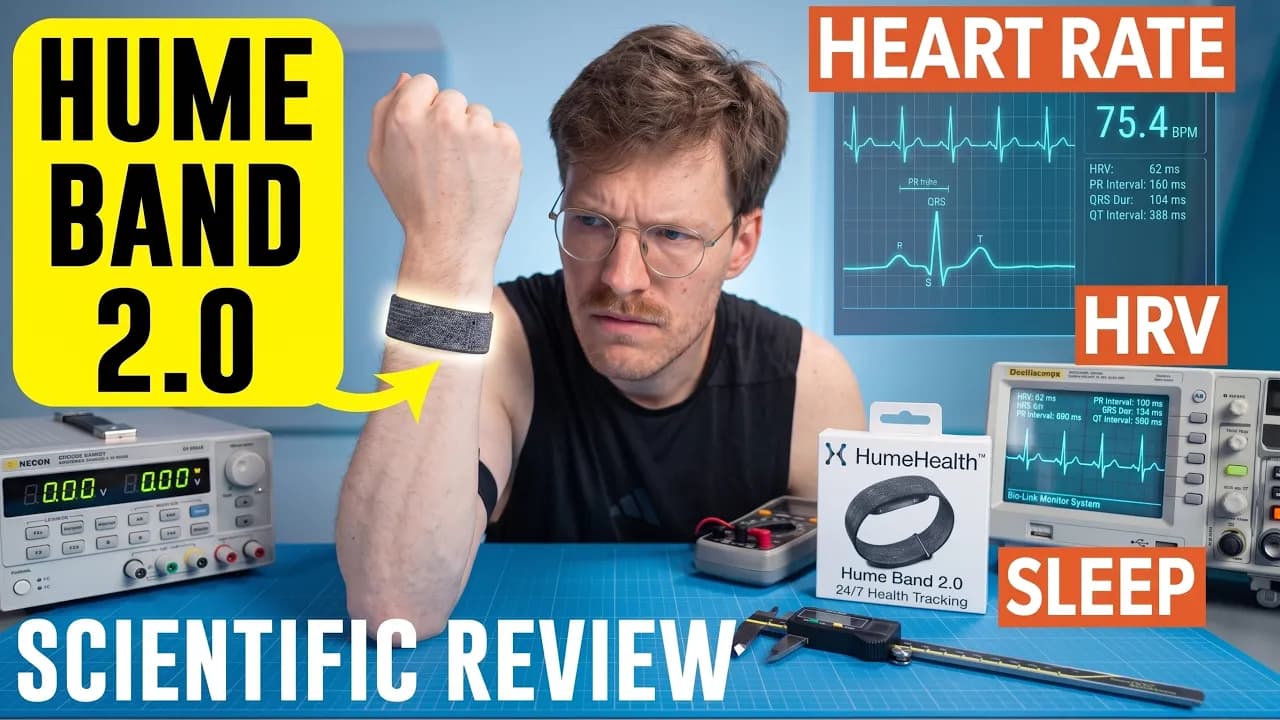
Luna Band: Beautiful! (Initial Scientific Review)
In a Nutshell
The Luna Band performs poorly overall: it underestimates heart rates during exercise (often by 30+ BPM), misclassifies sleep stages (especially deep and REM as light), and the app requires constant internet connectivity with poor data export options. Nighttime heart rate tracking is adequate, but the $150 device is outperformed by cheaper, more reliable alternatives like the Fitbit Air or Amazement Helio Strap. The modular design is a plus, but the sensor and algorithms fall short of current market standards.
These notes were generated by AI and may contain inaccuracies.
The Luna Band is priced at 150 dollars, positioned between the Fitbit Air, Garmin Circa, and Amazement Helio Strap. The video presents an initial scientific review of the Luna Band's data quality, conducted by Rob, a post-doctoral scientist specializing in biological data analysis. The review is limited to a few days of testing due to time constraints, making this an initial rather than comprehensive analysis.
The Luna app does not allow easy data export. The reviewer connected to Apple Health for heart rate data at one data point per minute resolution during night tracking. Sleep stages required manual extraction. Heart rate tracking during exercise could only be assessed by comparing the Luna Band app side by side with reference device apps. The reviewer notes that despite these limitations, results were clear enough to draw conclusions about performance.
The Luna Band is not competitive with current smart bands worn on the biceps or wrist. Better alternatives exist for most users. The reviewer mentions some aspects performed adequately while many others did not meet standards expected in the current market.
The Luna app has good visual design with a nice overview and includes expected data categories. The health tab displays sleep stages, heart rate during day and night periods, and activity tracking including outdoor and indoor cycling with heart rate monitoring. The app shows indicators for upcoming features including VO2 max and SpO2 measurements.
The app experiences connectivity problems where workout sessions cannot be started regardless of internet connection status. The app requires internet connectivity to function, similar to but more restrictive than the Fitbit Air. When internet is disabled, the home screen disappears and exercise tracking becomes unavailable, sometimes requiring connection to a secondary phone.
The device shipped from Asia, likely China, resulting in extended delivery times. No additional import fees were charged during this purchase, though this may vary. The product appears to use a drop-shipping model rather than local distribution.
Exercise heart rate tracking was tested against the Polar H10 ECG chest strap, recognized as one of the most well-tested reference devices. Due to export limitations, only one data point per minute was available from Apple Health connection, preventing connection to Strava or other data export options.
During indoor bike rides with multiple intervals, the Luna Band detected maximum heart rates around 125 BPM while the Polar H10 reference showed actual peaks significantly higher. The Luna Band failed to detect interval patterns accurately, showing broader peaks compared to the reference device's precise readings. Near the end of sessions, partial interval detection occurred but remained incomplete.
Outdoor bike rides showed even worse performance with consistently low heart rate detection in early portions. Maximum heart rate readings reached only around 130 BPM when actual peaks hit 163 BPM according to the reference. Average heart rate readings showed 116 BPM when actual values were substantially different, with missing detail in heart rate patterns and incorrect drop patterns near session ends.
Weightlifting sessions showed detected peaks below 105 BPM when actual peaks exceeded this threshold according to reference measurements. While some peaks were detected, maximum values remained consistently below actual heart rates. Vertical axis alignment attempts showed readings around 110 BPM instead of the actual 116 BPM averages.
Sleep stage tracking was tested over two nights against the Zmax EEG headband, considered a silver standard for sleep staging. The comparison method used confusion matrices where perfect agreement would show 100% on diagonal yellow lines.
The Luna Band showed poor agreement with reference data, detecting excessive light sleep overall. Deep sleep periods according to the reference were classified as light sleep by the Luna Band. REM sleep was similarly misclassified as light sleep. Light sleep detection achieved 65% accuracy, representing the best performance among sleep stages.
First night analysis showed partial deep sleep segment matching but with extra deep sleep detection by the Luna Band. The device stopped detecting sleep during brief wake periods even when sleep resumed afterward. Second night duration was roughly accurate but showed additional deep sleep detection, especially near morning. REM sleep segments were frequently missed or incorrectly classified as wake time.
When compared to previously tested devices using average sensitivity across three sleep stage categories on the horizontal axis and worst performance on the vertical axis, the Luna Band ranked among the worst performers near the Y Band and old Huawei algorithm. The Coros Pace 4 performed better despite having generally poor sleep tracking capabilities.
Best performing devices cluster in the top-right area of performance graphs, including Google Pixel watches, Fitbit devices, Whoop strap, Oura Ring 4, Apple watches, and the Eight Sleep Pod. The Fitbit Air at approximately 100 dollars provides good sleep stage tracking value.
The Eight Sleep Pod surrounds the mattress and provides independent cooling and heating for each side of the bed. This device has most improved the reviewer's sleep quality, particularly when combined with the cooling blanket accessory. The system efficiently removes body heat for cool sleeping environments but costs significantly more than wearable alternatives.
Nighttime heart rate tracking performed adequately when extracted from Apple Health data. The Luna Band captured heart rate patterns correctly, showing higher rates at night beginnings with gradual drops and steady periods. A reference device detected one peak possibly corresponding to brief bed exits. Correlation calculations showed generally good agreement though the Luna Band tended to detect slightly lower values in higher heart rate ranges.
The sensor and algorithms perform adequately during relatively still periods like nighttime rest. Performance becomes inadequate during exercise activities including indoor cycling. Alternative devices including Fitbit Air, Garmin Circa, and Amazement Helio Strap all demonstrate significantly better performance based on this initial testing.
The Luna Band features modular design allowing the sensor to pop in and out of different straps, similar to Fitbit Air and Amazement Helio Strap systems. The sensor array appears standard though photodiodes seem positioned deeply, potentially affecting reflected signal quality. The design philosophy appears sound despite performance issues.
Sleep stage tracking rated as poor based on two-night testing. Heart rate tracking during exercise rated as bad with inadequate detection of peaks and patterns. Nighttime heart rate tracking rated as quite okay to good. Design represents the main positive aspect alongside nighttime heart rate performance.
Established brands provide superior software despite some legacy issues. Garmin app allows connection of multiple devices effectively. Google Health app continues improving though data export remains challenging. Amazement Helio Strap app functions as a hybrid between Garmin and Whoop approaches with better data reliability than Luna. Whoop app provides the best overall experience but requires ongoing subscription costs.
Bevel represents an alternative app solution that connects to Apple Health and other platforms for improved data presentation. The free version excludes AI features while providing enhanced app experiences compared to native device apps.
The Luna Band cannot be recommended at current performance levels. Established brands offer better products with superior software developed through extensive sensor and app experience. Price-to-quality ratio does not compete with alternatives including Fitbit Air at 100 dollars, Amazement Helio Strap at 100 dollars, or Garmin Circa at 200 dollars despite higher costs for some alternatives.
Keep The Quantified Scientist in your library
Save the videos and channels worth coming back to, and find them again in one place.