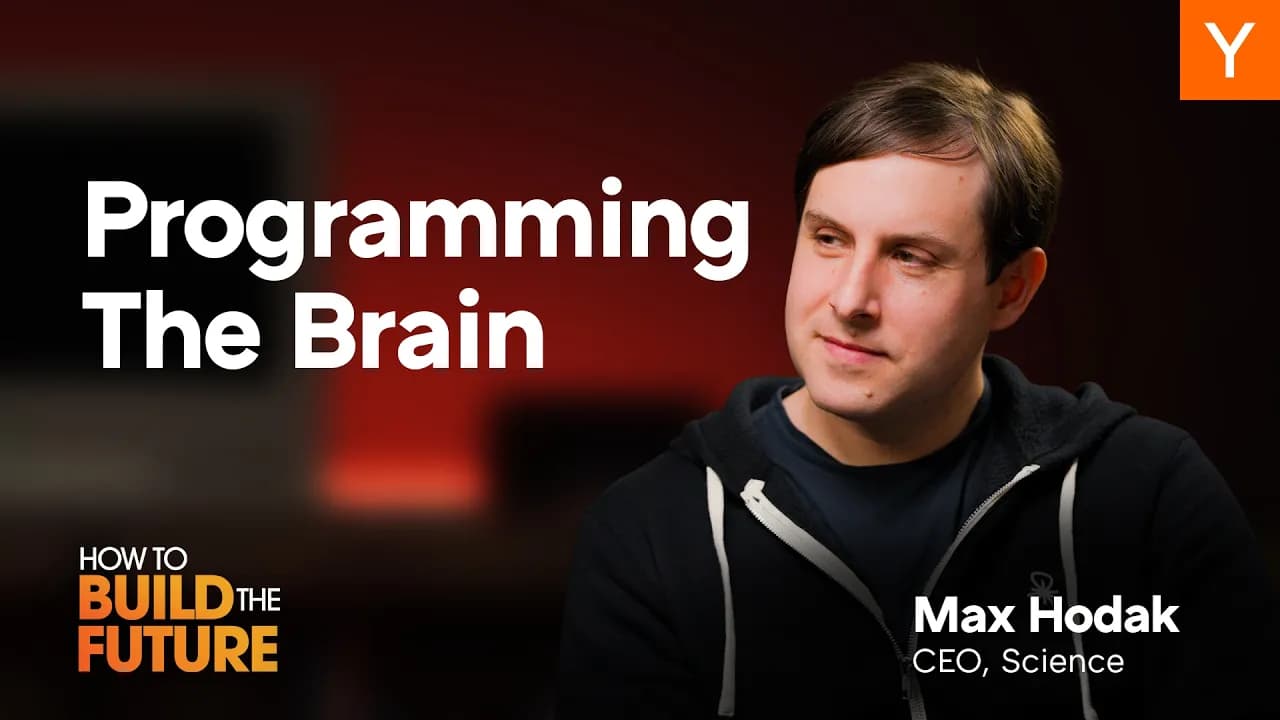
Max Hodak: What Really Kills Deep Tech Startups?
In a Nutshell
Deep tech startups fail due to broken infrastructure—procurement, hiring, performance management—not technology. Speed compounds through systems that eliminate approval bottlenecks, track true experimental costs, and enable distributed decision-making via continuous feedback rather than annual reviews. Success requires founders to develop independent judgment through hands-on experience, build custom internal tools as company operating systems, and focus relentlessly on reaching revenue sustainability rather than perpetual fundraising.
These notes were generated by AI and may contain inaccuracies.
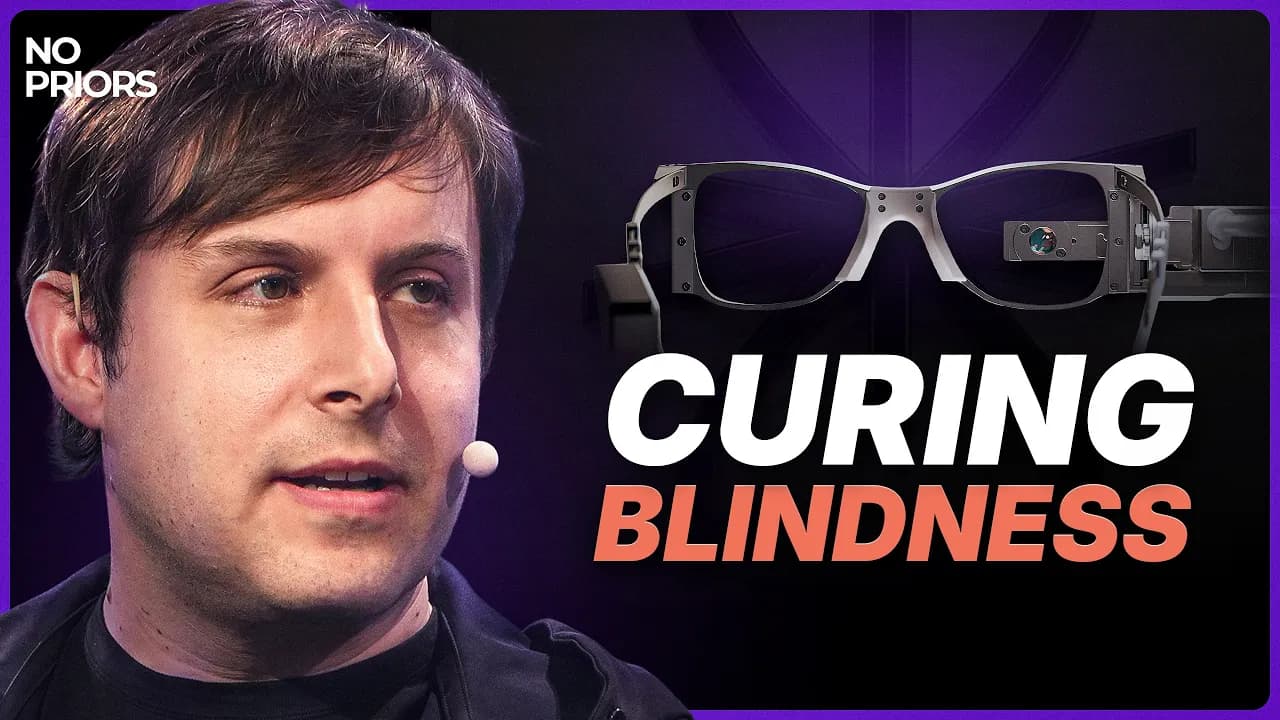
Max Hodak is CEO of Science, a company developing infrastructure for deep tech startups. He spent nearly 20 years working on brain-computer interfaces, beginning his career as an undergraduate at Duke working with electrode implants in monkeys to study neural activity during joystick-based games. Science's main product is a retinal prosthesis: a chip implanted under the retina that restores vision to patients who have lost rods and cones. The device uses solar cells on the implant that receive infrared projections from camera-equipped glasses, creating electric fields to stimulate the retina directly. The product completed major clinical trials and was featured on the BBC and Time magazine, with one patient completing a 300-page novel using the device.
Picasso noted that art critics discuss form, structure, and meaning while artists discuss where to buy cheap turpentine. This illustrates the principle that amateurs talk strategy while professionals talk logistics. For deep tech companies, there are few universally applicable lessons because startups face continuous streams of daily facts requiring local decisions. However, certain topics recur consistently across deep tech companies, particularly around procurement, hiring, and performance management.
Pure software companies avoid physical procurement, which explains why VCs favor software investments. However, any company working with physical products purchases thousands of items continuously—computers, microscopes, electronics, 3D printers, resins, and PCBs. Credit cards work for founders, but the 17th employee needs purchasing capability. Handing out credit cards creates approval bottlenecks where founders question $3,000 power supply purchases, potentially delaying work for highly compensated employees. The cost of delay far exceeds potential savings from auctions.
Procurement systems require vendor accounts, insurance, certification paperwork, quotes, purchase orders, and invoices, creating two-week delays. Dedicated purchasing staff become essential despite initial skepticism from academics transitioning to startups. The goal is maintaining speed while controlling overall burn through budgeting rather than individual purchase approval. Attribution becomes critical when purchasing bulk materials like gases (argon, silane, nitrogen), resins, and media that are distributed across multiple experiments. Without cost tracking, experiments appear free because they consume fridge-stocked media rather than dollars, making pricing impossible to calculate. Internal software called Helix manages purchasing and correlates all laboratory steps through a database, enabling accurate cost calculation—$40,000 per wafer iteration in one protocol.
With $20 million Series A funding over four years, approximately half of burn goes to headcount ($3-3.5 million annually for 20 people), plus $750,000-$1 million for 20,000 square feet at $4 per square foot, leaving roughly $3 million annually for research. Teams often perceive large funding amounts as making individual purchases inconsequential. Hiring quality separates successful from failed companies. The best companies emerge from scenes—moments enabling new company formation with unique nucleation. Initial hiring should target networks that produced the startup, as these individuals already speak the company's language, though this source cannot fill entire companies.
Hiring requires a defined, religiously followed process. Commercial applicant tracking systems were replaced with internal tools enabling company-wide voting on candidates. When applicants apply, the system selects 7-8 current employees with similar backgrounds for voting using categories: known good, strong yes, yes, no, strong no. This distributes initial screening across the company, preventing bottlenecks. Phone screens are also company-wide, evaluating judgment, horsepower, and agency. Approximately 17% of top-of-funnel applications advance to phone screens, with half proceeding to homework assignments.
Preferred homework assignments don't saturate, have high ceilings, and produce naturally scorable numerical outputs that can be plotted. AI-resistant homeworks are prioritized, such as GPU kernel optimization tasks where performance is measured against model benchmarks. Technical phone calls or on-site practical tests supplement when appropriate homeworks aren't feasible. The four-step process—initial voting, phone screen, homework, and full interview—represents the minimum information needed for hiring decisions, with at least 25% conversion from interview to offer required to avoid wasting time.
Market feedback on hiring quality arrives too slowly and through poorly behaved loss functions. Conventional annual 360 reviews are disruptive, surface known issues, and reinforce existing knowledge rather than providing new insights. A continuous feedback system called iGen reviews operates every 4-6 weeks, asking colleagues whether they would vote to hire someone again today using the same voting categories from initial screening. This creates a graph of feedback weighted by eigenvector centrality, similar to PageRank, where votes from highly-rated colleagues carry more weight. Dropout analysis runs 1,000 iterations with random edge removal to identify voting cliques requiring investigation.
Rate of iteration separates success from failure. Learning one thing weekly versus monthly creates insurmountable advantages. Shorter iteration cycles should be prioritized even when alternative approaches have redeeming characteristics, due to dramatic compounding effects. Speed derives from infrastructure—purchasing, recruiting, and spending processes are equally important as technical understanding. Deep tech companies rarely fail due to technology; they fail when organizations of hundreds of people and hundreds of thousands of square feet lack management systems, making strategy-to-execution connections impossible.
No blanket rules exist in startups—each fact pattern requires unique decisions. Founders cannot delegate judgment; CEOs must make decisions that make sense to them regardless of momentum behind alternatives. Academic environments allow grades to regress toward class averages through collaboration, but startup success requires differentiated judgment producing long-tail outcomes rather than average performance.
The reality might be that you don't know if your judgment is good yet. One way or another you will have to find out and that means making decisions that make sense to you even when you are totally alone in that realization. That is the only way to get to the really big outcomes. It is not that often that everyone else will think one thing and you'll be like, "You're all totally wrong." But it is a really eerie feeling like you'll get to a point four or five years into the company when there's hundreds of millions of dollars on the line and there's some really high stakes decision and only you can make it and then you will look around for advice because like in the beginning you'll get lots of like there's a bunch of things that are easily advised or easily figured out but you'll get to a key point years in and you'll look for advice and there is nobody to ask and at that point you must have a really good sense of the limits and boundaries of your judgment. That is a very eerie feeling and you have to be able to commit to it regardless.
The good news is that in my experience, it's very difficult to actually get stuck. You can get yourself into trouble and the action space is always larger than it appears. No matter what happens, there's usually like when you get like I think it's very easy to try and anticipate all kinds of problems that you'll never actually run into. And then you go and do it and then you get to a point where the system like you run into some real limitation. There's always a hundred ideas about how to make it better. This is sometimes phrased as action produces information. This idea is much deeper than it sounds.
In physics there's this quantity called action. If I throw a ball and it follows a ballistic trajectory that trajectory is totally set like when it leaves my hand unless it gets blown by wind some other like action is exerted on it. It will follow this ballistic trajectory which is in this sense like kind of an information minimizing trajectory. I can say it just followed it was ballistic that totally determines it. If something else happens you had to spend some energy time to cause that to happen. And so when whenever you exert like action into the universe that creates information like in a very fundamental sense and whenever you get stuck like you have to start like injecting action producing entropy. And this produces some fairly counterintuitive effects.
I've seen situations where the company is stuck in a deep local minimum and there's someone who is great in many ways but it's just the wrong fit for what that company needs at the time and removing them even though they individually are very strong unblocks the company and allows it to kind of enter a new phase. When you're when you get stuck you have to start doing things.
All the thing underneath the object level content of what the product you are building is you've got this you have all these support systems kind of the company like how the company does purchasing and accounting and recruiting and performance reviews and budgeting and safety and quality is the operating system of the company and that has a huge impact on how far you can take it. Speed is determined by infrastructure. Speed determines success and failure. You need to put more thought into these into getting these foundations right. If you do them right at the beginning, everything else is much easier. If you get them wrong, you'll end up like spending $5 million a month and feel like you have very little control over it. And then you're forced into coarser levers and harder decisions.
It really depends on specifically what you're doing. If your field only exists in basic research, then getting a PhD might be very reasonable. When things really start to work like if 20 years ago the best computer scientists were at CMU and Harvard and 50 years ago the best rock like if you wanted to work on rocket engines you were at NASA you were at a university you're at University of Maryland or somewhere and now they're at now the best computer scientists are at Google and Apple and OpenAI and the best rocket scientists are at SpaceX and Blue Origin and others. So when a field really starts to work, industry can just marshall such larger levels of resources and can just move so much faster.
A question has been why has academia stayed so relevant in the life sciences. And it's just the reality is that it doesn't work that well for most things. Like humans just aren't that good at drug discovery. And so if your field is really only in academia, then it can make total sense to get a PhD. But I think you know a lot of it is uncommon that startups don't get the technology to work. It is more common that they can't organize the human organizations to accomplish their goals and learning that is also a skill set. The only way to learn it. I think it's an oral tradition. You have to do it. And so if the choice is working at a really high performing company adjacent to where you want to be versus getting a PhD, I'd probably recommend the company. But it's not an absolute rule and it really depends on the field.
Anything that concretely you can put your finger on that separates that person from their high school class. If you have your average high school student. We just like want some concrete fact that is that. Ideally the best evidence of exceptional ability is are winning at legible competitive games. So this could be being a chess grandmaster. It could be winning design, build, fly or formula SAE competitions. There's a bunch of Silicon Valley deep tech companies that are basically built out of Formula SAE winners from college. People that just spent their college experience building things and racing them and finding out. You have to have that type of competitive feedback. It is tough to know if you're exceptional without having some legible competitive game.
We've never I don't think we've ever used LeetCode. Maybe some other people on the team do it in secret, but I've never asked it. Software in particular, the rewards to horsepower are so great that it really is just it's a field that attracts really smart people because it gives you this very rapid feedback. Like if you think about like there's a lot of really smart people in biology, but when you have a biological idea, it can take you many months to find out if it's a good one. In software, if you have an idea, you can often build it in a couple hours or you can get feedback within days. And so it has this really addictive feedback loop kind of like high frequency trading that just draws in really smart people.
We look for kind of over your life what signals do we have that you have done something interesting like it's uncommon for someone to get into their mid20s without having without there being some thing in their background that they went out and sought out and did. We increasingly don't directly evaluate programming. We evaluate try to evaluate thinking. So this is design questions like if we give you a domain how do you break it down? Can you understand the decomposition of the problem clearly? It's really measures of like can you think clearly rather than can you write code.
I don't have a PhD. I spent five years running a company for my CEO at Neuralink. There's one of the biggest lessons I think is that there are few really generic there's no generic algorithm for how to succeed at a startup. There's no like set of like five bullet points that can be conveyed that if you just like turn the crank your company will be successful. It is a long series of judgment calls. And so the most important thing is that those filters are tuned really well.
One of the most valuable things for me at Neuralink was I was working with someone who has empirically excellent judgment. Like we could get into trouble together and there'd be all like something would happen and there'd be two possible solutions that would make sense and I'd go to him and say like is it option A or is it option B? You'd look at and be like, "Oh, it's definitely option B. The problem would never recur." And having been in those situations where I was trying to make these bets kind of with stakes attached, looking forward in time, not getting feedback until later with that advice was incredibly useful for training those filters. And I don't know that there was really a shortcut. And I think that just hearing the stories when you're not there making the like really thinking about it because there are real stakes and then getting that feedback that is an essential part of the education of an entrepreneur that I think many people underrate.
It is really worth working for a company that has an excellent culture that you respect before jumping right into your own startup. It is relatively uncommon that startup cultures get rediscovered entirely from first principles. Usually they're passed down as oral traditions because there's a founding team that worked at another company which worked at another company and so they inherited it or in some cases where there's really a breakout where there's just some market dislocation that really enables a team kind of out of nowhere to build it. They'll often get it from the VCs but it's working with the people that have that judgment so that you can get that reinforcement learning as it's long series of facts is really important.
Absolutely. If the end of the artificial intelligence quest is super intelligent machines, I think the end of the BCI quest is conscious machines. The brain is composed of ordinary matter arranged according to the rules of chemistry, only things found on the periodic table. It seems tough to believe that there's like some new physics going on in there. And so there's we're looking for some mapping between the substrate activity and the phenomenal content. Now, if we had a tech if we had a magical BCI that allowed me to see the instant state of every neuron in the brain and drive them, I think we'd figure out consciousness pretty fast. I don't think I think this is a practical problem, not a philosophical problem. And but to prove it but first of all that practical problem is real and we'll have to do the stuff in humans and to prove any of this we'll have to do it in humans. I think the it is possible that you could use a BCI to prove it. We have some ideas about how to do those experiments but they are they're still a few some number of years off right that things going into humans now are are not designed to study consciousness but I do think that that is further down this path.
Neural interfaces are a very interdisciplinary problem. It uses everything from stem cell biology to materials and microfabrication to software to animal behavior to surgery. So there are many different entry points in it. One of the things that we found is that it's better to have a smaller team that can fit more of the problem in their heads and then compress it together. Contrast this to how academia usually handles interdisciplinary problems where they'll have an interdisciplinary center that pulls in very deep verticalized experts who are kind of meet at the center. And the problem is that they're all speaking different languages. And so it's often hard to really like even when they can communicate, typically you end up shipping the interfaces of those departments. Whereas for us, if we can kind of hold the problem in the head of a smaller number of people, we can shift around where the bottlenecks are.
Specific example of this is our protein engineering group has been able to develop much more sensitive like much better proteins for some things that we need to do which has allowed us to relax some electronics requirements. So if we have so specifically we have proteins called opsins that allow us to make neurons light sensitive so that if we shine light on them we can fire a neuron. The problem was that you needed to hit a neuron with a lot of light to fire it which means that you can't have that many light sources because it gets too hot. So, we've been able to make the protein more sensitive, which means that we can have more LEDs because each one can be dimmer. And so, we can we've turned this electronics problem into a biology problem that allowed us to relax those constraints. You don't get that as much when you have these interdisciplinary centers where there's like one group focused on one thing, there's another group focused on another thing. And so I would say being being able to have a broader perspective of more of the problem is really valuable. And then just have like really the as deep and clear an understanding of this as of the system as you can get. I think there's no substitute for being hands-on. It doesn't really matter like the you want some hard skill to get you in the door. Software, electric, electronics, mechanical, materials, something and then from there I would try to learn as much of it as you can.
We still definitely need humans. And in scientific research in particular, I mean, it's tough to predict like AI is clearly advancing very rapidly. I do think that you need to think about how to have your company be AI native in the sense that every like you want you want to gather all of the context all the stuff happening in your company and be able to make that available efficiently to agents because those are clearly a big part of the future. So for us in Helix really everything goes in there and one of the reasons that we did that was because not just is it powerful to have everything in one database to link together purchasing to quality to batch records and manufacturing so that we can trace stuff more efficiently but also so that we could give it all to agents. And so we found them to be a multiplier for the team not a replacement.
The three biggest areas that AI has had an impact for us so far are coding I mean that's like now basically all this like I don't I've written a lot of code in my life I don't think I've looked at the source very much the last six months that is getting really good. Regulations. So this is so if you're doing anything really interesting, you're going to end up regulated and then you'll probably end up dealing with these things called quality systems. And so a quality system I think triggers a lot of scar tissue for people because it's it's just the the quintessential heavy bureaucracy. Slow everything down. But the idea of quality itself is actually not a problem. The problem is that humans are bad at reading and interpreting these things. And so when we make a product, one of the things we have to do is identify all of the standards that might apply. And there's standards for everything. There's standards for like how the lithium-ion batteries plug into a PCB. There's standards for electrical insulation of the boards. There's standards for shipping label like the at some point you'll have to take your shipping packaging, print a label on it, and put it in a vibe box and show that the the corners of the label don't curl in a way that might cause it to detach. And so we you hire regulatory experts to go find all of the standards that might apply, make a list of them, and then have a spreadsheet which is like all of the evidence that you comply with all of the standards. So you have this this thing can take many many months. Historically AI has totally transformed it. I mean we can very quickly look up all the standards. We can very quickly generate the evidence tables. And I think that to the degree that there's kind of over I mean there is we definitely need to deregulate some things but I think that the combination of AI and regulation is a better fit than people think and you can use it to smooth a lot of stuff. Where the regulations are written in blood and largely good ideas it's just hard for humans to do it.
You can't really buy these things. There's no there are ERP systems out there, but there's no company that like loves their ERP system. Like, I don't know there's anyone who's really like, I want to spend more time in NetSuite. And on the contrary, there are a bunch of examples now of companies that grow up around a piece of software that's really fit just for them. Like YC famously has a lot of internal software that I think really makes YC work. Facebook also very famously invested heavily in internal tools and now has like I think gets a lot of efficiency from that. SpaceX and Tesla internally have a pretty giant piece of software called Warp Speed that runs a lot of their manufacturing and R&D processes. And so when one company grows up around like a harness fit to it, it can be very powerful. It is powerful in a way that the software that you can buy isn't. But this requires you to really look into the future because certainly, especially at the seed stage, this is not the thing that you would think you should be focusing on and historically it has not been.
I think this is a thing that has changed with agents. The fact that you can vibe code this now makes it a reasonable thing to think about. Historically software has been so expensive, you would have had to buy it and that's what everybody did for a long time. That was I think a worse world and that world has changed and so now there are better options available. But like I said, so like we previously had used a we used Greenhouse. Greenhouse required us to have a small number of people as a bottleneck at that at that first funnel stage. Replacing that with software. We were able to explore voting mechanisms and fairly detailed voting mechanisms that can that can make smart inferences about who would know about it know about an applicant. Things that you can't really do with the commercial software. And so for a lot of these processes, you should think about how you want it to work for you. It matter these are human organizations these human processes that have to be staffed and if they aren't done routinely will atrophy and there's things that make sense for different teams and founders in the way they view the world and think about it it really is all very different and but if you build a thing for that works for you and then you like bake that into the company so it like when you put something there it stays there it can be very very useful.
There's this meme that BCI is an artificial intelligence adjacent story and there's some of that like eventually like if AI is building super intelligent machines and BCI labs are building conscious machines and we're building brain-to-brain connections so that the boundaries between those things become less meaningful like at some point you want a super intelligent conscious machine that we can participate in. But that actually feels further away to me. I think in the near term BCI is really a longevity story. And I view longevity as really just healthcare. I mean just biotech. It's just that it hasn't like I think it is not right to say that the pharma companies or any of these these like past healthcare companies are not interested in cures. I think that that is what all of them want. It's just that that's been beyond our capabilities. And in neural engineering and people hear BCI think they think of motor decoding like I put some electrodes in motor cortex and now they can control it like a video game. I think neural engineering is much broader than that. We include our retinal prosthesis in that. We include cochlear implants in that. And this this I think is a contrarian take on all of healthcare. It gives you these effect sizes that you just don't really see in medicine. Like if you have a patient on on a dopaminergic drug for Parkinson's that works for some period of time, but it's a it's a relatively small effect after a little while. You turn on a deep brain stimulator and a patient goes from not being able to hold a cup of water to being able to write cursive in like 10 seconds. You turn on like if you want to talk about strong patient testimonials, you should see a newborn having their cochlear implant turned on. Like these are just when you deal directly with the brain as a computer, not only do you not have to solve some of these really hard biology problems that are just beyond humanity's capabilities, but you get these results very like pretty readily that again are just like you can get an engineering gradient, you can get them more reliably and they're just large effects. And so I see this as as a way to to extend and improve the life of of like of everybody. I mean there's the the brain is the thing that makes you you. It's the only thing that in principle you can't transplant. You can get a new heart or a new liver. You cannot even in principle get a new brain. And the brain is usually not the thing that fails. And so if you can deal with the brain directly, I think this is going to this is more of a of a radical longevity story than it is an AI one for the moment. Although all of these things will come together over some period of time.
As I mentioned, there are some tricks. So, for like for example, applying Markov chain Monte Carlo dropout allows us to detect things like voting clicks because now instead of seeing one peak, you'll see two peaks. That is a clue to look in look into that. It's I mean it's designed to be tolerant of these things. I think it is really fairly transparent. It's also not our only signal. It's one of several. If anybody's interested in this send me an email and I will share a document with the specific tricks but I want to understand a little more about how you were going to deploy it first. Some of this is tradecraft.
Sometimes I mean you you often see founders like especially more experienced ones pitching VCs for what they think is reasonable to ask for rather than what they need to run the experiment. You're raising some amount of money to go find out some answer. The answer to that might be no. The investors understand this like depending on what business you're in, but you have to actually run the experiment. And one of the the things like there are definitely some ideas that are worth funding with $50 million or zero dollars, but not $5 million. You won't run the experiment. It'll be really frustrating experience. You'll get an ambiguous outcome. And so my first piece of advice is like you should figure out what you think it's going to take to actually run the experiment, which is not the whole company. That is what is your next value inflection. You should have, no matter how ambitious and open-ended of your plan is, you should have some sense of like what is your next key value inflection point. What are the experiments that need to go into that? Price that out and then raise twice the money. So I would I mean there's some amount of waste. I think if
When running experiments, get waste down to 20 or 30 percent. Figure out what it costs to actually run the experiment, then raise twice that amount. You'll always discover new things, and there's usually some path through the mass. When you start the company, you're not going to get a guarantee that you won't be on a bridge to nowhere or that it will work on the funding you have. You're going to have to get in there and figure it out halfway through.
People should push for profitability sooner than they often think they need to. Even though the company is seen as a very open-ended deep tech company with a very long roadmap, the team remains relentlessly focused on revenue and is trying to get to sustainability. The company feels like it's constantly dying slowly of this money cancer that can be beaten into remission every couple years with fundraising, but then it eventually comes back. The goal is to end that feeling.
No matter how big a problem or vision it feels, you need to think about how to get to revenue so you can not just do it forever, but be valued on your long-term roadmap, not on your probability of dying. This really opens up another set of investors that wouldn't be relevant otherwise.
Beyond speed being the basis of success and infrastructure determining your speed, it is important to appreciate that there are no general principles. People are looking for shortcuts and a pathy set of instructions that are like "oh I figured it out," but that doesn't exist. Every one of these things is different. When you get to that moment in history, you're doing something new.
It is crazy that this is possible. For the vast majority of human history, if you were a smart 20-year-old that had an idea to make your society better and you raised this to the people with capital, the reaction was that you should pay attention to the harvest. It is not widely available that if you're a really smart 20-year-old, you can come to San Francisco and make the case and if it's an interesting idea, you'll get millions of dollars to find out. This is not the case for most of the world today and it's certainly not the case for most of history anywhere.
That shouldn't feel normal. This is given to push the frontier out, and when you're on the frontier, you're figuring it out as you go. That is the job. Rely less on things that feel like startup advice and more on how good your judgment is, how well that is refined in your domain, and remembering that you have to think for yourself.
In BCIs, there are often very limited by power and thermal constraints on the implants. This creates a strong pressure to implant as little as possible and do the rest off the body. You can't pass a wire through the skin because the skin is a very important immune barrier. The skin won't fully heal around it, and if you have any connector through the scalp, you're constantly at risk of a bacteria crawling down that and into the brain, which would be really bad for the patient. You really have to be able to close the skin.
That requires you to have implanted a radio or transceiver of some sort and getting the power on that down. There's a frontier at low power electronics which is really important. A lot of this is now becoming increasingly biology as biological engineering capabilities increase.
On those implants, one of the harder more open problems is what is called packaging. Colleagues in Europe call it tropicalization. This is the ability to keep your device in and the body out of an implant that you put in the body. There are no truly passive surfaces anywhere in the body, even bone is constantly getting remolded. If you put a device in, it's going to be getting attacked by the body and it's not regenerating itself. You need a material that is going to survive that for an extended period of time.
The classic example is the laser welded titanium can, which is seen in pacemakers or deep brain stimulators. You can't put a big titanium box in the eye. An earlier retinal prosthesis had a titanium box attached to the eyeball with a four and a half hour surgery, a little belt around the eyeball with a titanium box on the side of the eye with a battery and a little PCB. This didn't work.
The laser projection trick powers the device wirelessly. Having the next generation packaging with some type of conformal coating that can protect the implant, that is not degraded by the body, is also not harmful to the body, and is resistant to all the ways the body will try and kill it, is needed. That material science is a very open-ended field, and if you're interested in material science, that is a thing that needs progress.
Business is just like a fancy word for talking to people and doing things like sending emails. The retinal implant was originally invented by a professor at Stanford almost 15 years ago. It was licensed to a European company that was being tracked.
When the company started, four of the five co-founders came from Neuralink. In early 2021, the team looked around the world and asked what is the most valuable thing that can be done that would be likely to work in the near future, that would have a big impact to patients and allow the foundation for a scalable medical device company. The conclusion was that restoring vision to the blind by stimulating the retina was the thing. There's a choice of two types of cells in the retina that can be stimulated: bipolar cells or the optic nerve. This could be done electrically or optically. All four quadrants were explored. A state-of-the-art gene therapy was developed internally that optically stimulated one of those cells. A French company was identified as being state-of-the-art in electrical stimulation.
It's a small community where you can meet people and talk to them. It eventually made sense to acquire them. The license and technology were obtained, and the team works with surgeons and doctors all the time. If there's a new surgery to develop, this is best going through networks so that people are more likely to respond to your email, but surgeons are cold emailed all the time saying "Hey, we have a weird surgery to develop. Do you want to be a consultant?" and people reply.
There's a real cultural thing here. At SpaceX circa seven or eight years ago, probably 20 percent of that company is what might be characterized as committed Martian colonists and 80 percent are serious engineers. Those people are lunatics who just want to work on the highest performance methodox engines in the world. You need both of those cultures to be really successful long term. That's especially tricky in medicine because that's a very conservative, arguably very authoritarian culture for the most part.
At the company, about 30 percent is an overtly transhumanist mission and 70 percent are serious clinicians and scientists and researchers who think that those guys are crazy but are going to build some really valuable medical devices for critical unmet needs in the process. One of the things that makes the company very special is that it has both of those cultures and is able to integrate them. The company is able to simultaneously do some really cool research that is really at the edge of the Overton window while simultaneously running clinical trials in six countries now with an approved medical device in Europe and clinical trial results in the New England Journal of Medicine. You have to be able to navigate both of those things to really reshape the future.
Biotech remains capital intensive, and that is something to consider. It would not be recommended if you have a choice of other stuff to do. The realization almost 30 years ago was that if you could engineer, if you could alter the brain, you could alter reality. This was one of the biggest missions of the next 30 to 40 years: building these things. Every now and then, it seems like life would be way easier if going into AI instead of BCI had happened, but somebody has to do it.
Biotech is hard. It is a much harder path than many other things that can be done. But when you're successful, it has an impact on the really what you see elsewhere. Paul Graham wrote a long time ago that you get vibes in different cities. The vibe in Cambridge, Massachusetts is you should be smarter. The vibe in New York is you should be wealthier. The vibe in San Francisco is you should be more powerful. Especially with the rise of things like artificial intelligence, people realize that this isn't just about money. For many of the most effective startup founders, it's not about the money. It's about changing some way in which you want the world to be different. It just turns out that for that project, the for-profit company is an incredibly powerful way to marshall the resources required to cause the world to be different in that way.
This is not about money. This is about power. There are many different types of power. There's economic power. There's military power. But the power to heal the sick is a very dramatic one. When you get that, not only is that a real force to reshape the world, it's one that can be shared very readily. You can't share military power, economic power, but you can share the power of restoring sight to the blind or of giving life to the cancer patient.
The world is getting more complicated and there's big impacts of all the things that are being worked on by the people in this room. Biotech is hard. It's very capital intensive. It's a long road. When you start a company in this space, you're committing to a decade of your life that you will never get back no matter how it turns out. But the results of that when it works, the impact that this has on patients and their families is really unlike really any other sector.
A popular belief in tech that is wrong is even the whole basis of building Helix, which is contrarian. If you raise a series A and then you tell your investors that you're going to vibe code a purchasing system, any reasonable board is going to ask what you're thinking. That was able to be done because the questions were never received because the company is controlled. That's one narrow example.
Keep Y Combinator in your library
Save the videos and channels worth coming back to, and find them again in one place.