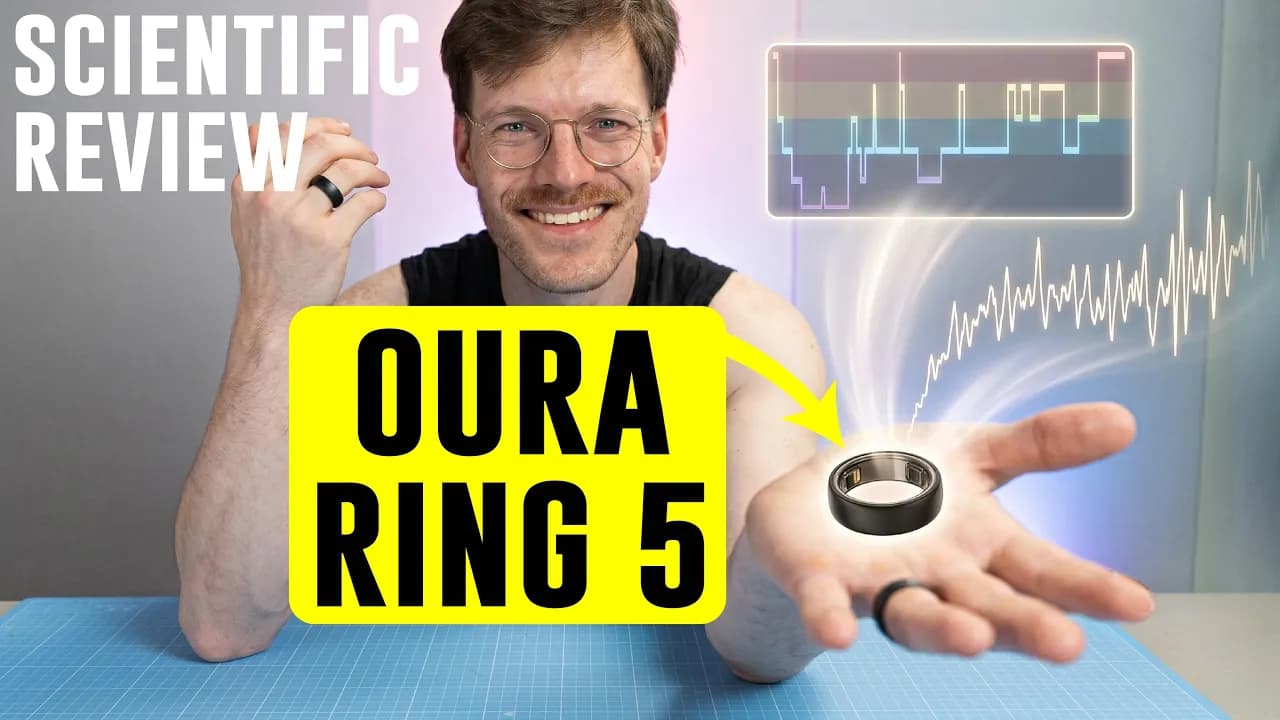
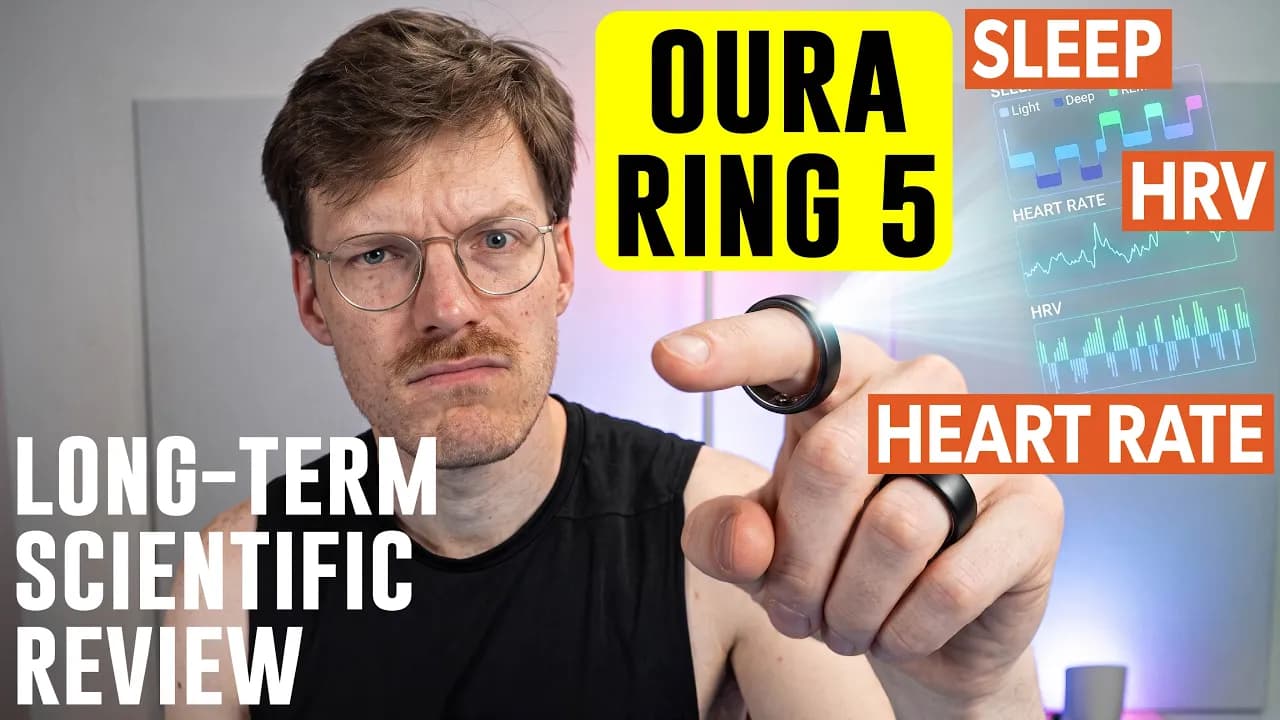
NEW Oura Ring 5: Everything We Know!
In a Nutshell
The Oura Ring 5 is a smaller, redesigned version of the Ring 4 with stronger LEDs, improved skin contact, and new software features focused on cardiovascular insights like blood pressure signals and nighttime breathing. No dramatic accuracy gains are expected for sleep tracking, but the key question is whether the new sensors deliver meaningfully better heart rate tracking during workouts like running and cycling. The reviewer plans to test this rigorously against a Polar H10 chest strap, with cautious optimism for steady-state exercise but skepticism for high-motion activities.
These notes were generated by AI and may contain inaccuracies.
The Oura Ring 5 was just announced. The headline feature is that it is smaller, with Oura claiming up to 40% thinner, lighter, and smaller. A smaller ring can be more comfortable, especially during sleep, and if a device is more comfortable, people are more likely to wear it consistently. This can matter for long-term health tracking for some people.
The smaller size is not the most interesting aspect. Most people will get used to a new size within a week or two and after that might not notice a difference. This might be different for people who find the older Oura rings too bulky.
The main differences to the Oura Ring 4 will be examined from a more scientific perspective. The questions include what new features Oura introduced, what changed in the hardware, whether the sensors changed at all, and whether better heart rate tracking during exercise can be expected.
This is not a review yet, only interpretations and expectations based on all the data and information that Oura has released so far. Oura has not offered to send a sample. Two Oura Ring 5 units were ordered with personal funds.
The most interesting new feature is the health radar and especially something called blood pressure signals. This is not a normal blood pressure measurement. The ring is not giving systolic and diastolic values. It is not telling users something like blood pressure is 120 over 80. It should not be seen as some kind of replacement for validated blood pressure cuffs.
Oura appears to be looking at longer term cardiovascular patterns, especially during sleep, and trying to detect what signals might be related to cardiovascular strain or even elevated blood pressure risk. A cuff directly measures the pressure by compressing an artery and a ring just cannot do that. Oura is looking for indirect signals from the finger, probably from the optical pulse wave information and other biometric trends.
This could still be useful if it works well but it is completely different in terms of claims that can be made. Testing cannot compare it as if it were outputting exact blood pressure numbers. One approach would be to find a person with high blood pressure to test it on. Another approach would be to measure blood pressure repeatedly with a cuff over many days or weeks and then see if the Oura signals actually correspond meaningfully to changes over time. The testing approach really depends on how Oura will be showing that in the app.
Oura is also adding nighttime breathing which seems to give a longer term view of breathing patterns and disturbances during sleep. This could potentially be useful, especially because breathing disturbances can be related to things like sleep quality and recovery.
There are also several broader software features like GLP1 insights, health record imports, and more proactive health related tools. Some of these are quite interesting, but they should be separated from the question of whether Ring 5 itself is actually more accurate because many of these are software layer features. These features might be useful but they do not necessarily tell whether the raw sensor data is better. They could even potentially be implemented on the Oura Ring 4 but Oura might decide to only give them to the Oura Ring 5.
The Ring 5 has a redesigned sensor architecture with more powerful LEDs and improved contact with the skin somehow. Some reports online also seem to indicate that the Ring 5 uses fewer signal pathways, so fewer independent signals than the Ring 4, 12 instead of 18. This sounds counterintuitive at first because fewer pathways might necessarily mean less data and therefore worse accuracy. However, if the remaining signals are actually better positioned, if the LEDs are stronger, and if the contact with the skin is more stable, it is possible that the signal quality actually still gets better.
Optical heart rate tracking is very hard on the finger during real workouts. It is especially hard for a ring on the finger because fingers move, users grip things, blood flow changes, temperature changes, and the ring is not necessarily equally tight in all environments. Running might be a bit easier than cycling because users are not necessarily holding on to something, and walking is even easier than that. Cycling, rowing, and some kind of intervals might be much more challenging for the ring.
In the past, no smart ring has ever performed well for heart rate tracking during exercise. A ring that is just slightly too loose or one on the wrong finger or rotated incorrectly can easily produce worse optical data. Testing will determine if the Ring 5 is more forgiving to different circumstances, different temperatures, and also to different users. Testing on some other people will also be attempted.
Live activity tracking is related to the heart rate tracking. Oura is now adding a more realtime workout experience in the app with things like pace and distance. However, based on some reporting, it seems that the ring itself might not provide the live heart rate numbers in the same way a sports watch or chest strap would. Instead, for live heart rate during a workout, users may need to connect an external heart rate monitor, so not the ring.
This is interesting in terms of choice. It could be a battery life issue because streaming continuous hardware data live from such a small device is not trivial, especially with a smaller battery. It could also indicate that Oura is not fully confident in a ring-based heart rate tracker during exercise or that it needs a lot of post-processing. Live heart rate is not that useful under that scenario.
Oura has historically been very strong for nighttime measurements from heart rate to sleep stages because users are not moving that much during sleep. Users are relatively still so Oura generally performed well across the board for sleep related metrics and Oura invested a lot of time in this. In sleep lab testing, Oura's sleep stage algorithm also appeared to be amongst the better ones out there.
For sleep stage tracking on the Ring 5, a massive change is not expected. Sleep stage tracking is expected to be very good unless the raw signal quality has changed substantially. If the raw measurements are still good, then sleep stage tracking should remain good as well. Sleep is just much easier in terms of environment for measurements because during sleep users are just laying still, not gripping handlebars, not doing intervals, and the ring can collect relatively stable signals over longer periods.
Sleep stage tracking, sleep heart rate, and sleep heart rate variability will probably be similar to the Ring 4, which is really good, maybe slightly better, but a dramatic difference would be surprising.
The launch of the Oura Ring 5 is a pretty solid launch at least from what can be seen so far, but it is nothing truly spectacular in the sense that there is no single feature where there is an immediate thought of wow, this is going to change everything. It is sort of a logical launch with a smaller device for the first time in a while that is really significantly smaller, better battery claims of a few days longer now up to 7 days, redesigned sensors, more proactive health features, and a bigger push into cardiovascular insights.
With Apple now also moving further into hypertension and blood pressure related notifications on the Apple Watch, it makes sense that Oura also tries to push in that direction as well.
The most exciting part is whether the new sensors are better at heart rate tracking during cardio exercise, especially running and cycling. Oura appears to be specifically claiming improvements for workout heart rate and that is exactly what will be tested. Comparison will be made to a proper reference, the Polar H10 ECG chest strap. Testing will not just look at average heart rate but also lag, peak detections, dropouts, and how it performs during intervals.
The expectation is that it might improve for steady-state running and walking because those are relatively easy exercises. There is cautious optimism there, but it might still be bad compared to wrist-based heart rate monitors. For cycling there is more skepticism because gripping handlebars can make finger-based PPGs much more difficult. For weight training or rowing there are not super high hopes. That does not mean it cannot be useful, but the same kind of performance as a chest strap should not be assumed.
The real question is not what the marketing says. The real question is what the data will say. Detailed testing will include heart rate accuracy during workouts, comparison of sleep stage metrics where possible like heart rate variability, nighttime heart rate, sleep stages, and an attempt to understand if these new health signals actually correspond to meaningful physiological changes.
If deciding to pre-order an Oura ring, using the affiliate link will support the channel. First check if there is some other way to actually get a discount because affiliate links that Oura provides do not provide a discount and getting the best price possible is recommended. Do not use the affiliate link in that case.
For anything purchased on Amazon, using the general Amazon affiliate link helps and does not cost anything. Given that the video watched was on the Oura Ring 5, the video on the much cheaper Fitbit and the video where the Oura Ring 4 was reviewed will likely be liked, where the strengths and weaknesses Oura has had in the algorithms can be clearly seen.
If any mistakes in the reporting are seen, comments are welcome because this is just interpreting everything read from Oura and seen online.
Keep The Quantified Scientist in your library
Save the videos and channels worth coming back to, and find them again in one place.