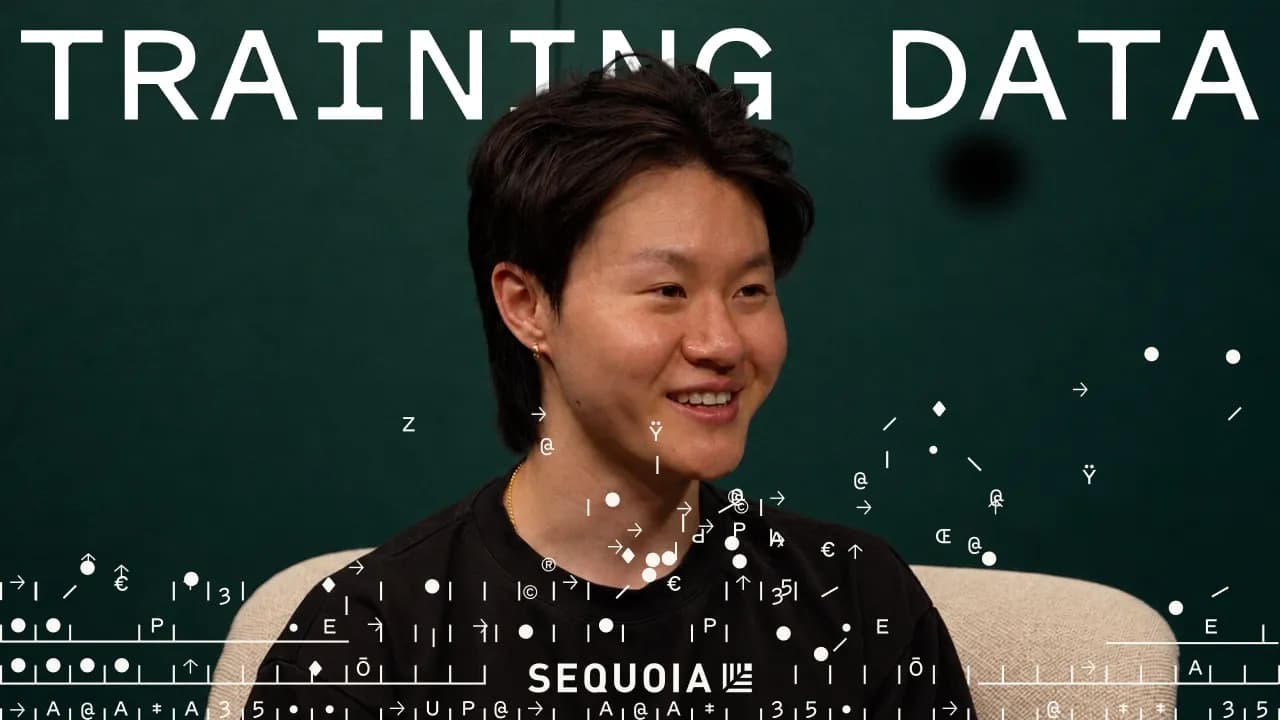
Physics Gets a Vote: Nominal Cofounders on Hardware Development in an AI World
In a Nutshell
Nominal's founders explain the hardware renaissance driven by re-industrialization, defense primes, and physical AI, where "physics gets a vote" exposes simulation-reality gaps, demanding centralized data platforms like Nominal to unify testing, manufacturing, and field ops—evolving from fragmented 2003-era practices to modern CI/CD equivalents. Key innovations include AI agents for anomaly detection, automated checklists, and projects like DARPA's CIPHER for real-time adaptive testing with digital twins, accelerating loops from design to production. Hardware firms will become physical AI companies, prioritizing data collection, rigorous testing, and agentic optimization to minimize real-world risks and unlock versatile designs.
These notes were generated by AI and may contain inaccuracies.
We're entering a period of much more hardware testing. The pendulum is swinging back as we grasp how little we understand about physical systems and our data deficiencies. It's a race to collect data and develop models. AGI designing a video game for a child might not need rigorous testing, but AGI building a physical toy would require ensuring it's not dangerous. The physical world is always different because it's where we live.
Cameron and Jason, thank you for joining. Nominal is the all-in-one data and AI platform for hardware engineering, used by companies from Anduril to the Corvette racing team in aerospace and defense, robotics, autonomy, and more. Notable stat: used by four of the top five US defense primes. Congratulations on recent achievements including the race.
America is rapidly re-industrializing. Macro tailwinds for Nominal include industrialization and hardware development with compressed timelines. People are building and fielding hardware products faster. Hardware testing plays a key role. More money is flowing into building hardware rapidly, especially in aerospace and defense. The paradigm of hardware development is shifting rapidly.
Software development evolved: companies managed versions locally, then centralized internally, then productized and outsourced like GitHub (version control system). This led to CI/CD and DevOps tools. Software testing is solved, but hundreds of thousands of hardware engineers at the frontier of software-defined hardware, autonomy, and robotics lack this. Nominal operates in that space.
Positive frame: Humanity reconciling oscillations; ambitions are in the physical world after two decades of SaaSification. Excitement to build real things. Companies like SpaceX, Anduril, Tesla prove infrastructure and tools for hardware development create massive competitive advantage.
Negative frame: Hardware offers defensibility—capital intensive, hard to manufacture metal, steel, electronics.
Physics gets a vote. At Anduril (2018-2019), simulation was in vogue, but real power is blending simulation outputs with real-world telemetry and sensor data logs continuously and iteratively. Hardware testing is where software-defined hardware touches reality first—tip of the spear for physical AI and system development. Nominal started as a narrow wedge in hardware testing.
Hardware organizations 25-30 years ago solved problems fragmentedly: separate teams for simulation, prototyping, manufacturing. Now, lack of common data platform is obvious. Traditional primes disrupted by incumbents like Anduril. Engineers need to carry logic and validation from early lifecycle to field monitoring in production.
SpaceX hired top engineers, found existing test software inadequate, built proprietary in-house platform—key to their acceleration. But thousands of new companies can't all do this; that's Nominal's motivation.
Status quo: Data stored locally on network-accessible storage, not cloud. Engineers download to laptops, run individual MATLAB/Python analysis (avionics, GNC, thermal engineers independently), post insights via screenshots, PDFs, PowerPoint—still bleeding edge for many.
Nominal rips industry from 2003 to 2020 with good software practices and sound data engineering, solving 10-11 hard software problems. Now pushing frontier from 2020 into today.
State-of-the-art is behind; catching up is first step to AI. Hardware engineers can't easily ask "what happened in last 50 tests relevant now?" because data isn't centralized. Primes recognize value, tired of in-house builds, partner with Nominal.
Insights trapped in hardware systems (data acquisition, test stands, lab testing). Small percentage reaches central repository with metadata. From "digital engineering" to physical AI. Nominal's semantic layer catalogs hardware data.
AI ambitions: Surface anomalies in 10,000 sensors at million points/second; automate tedious data ingestion/review. Example: Automate data checks for flight tests at remote locations via English-to-code prompts, freeing engineers for creative work.
Lifecycle: design, testing, manufacturing, production monitoring.
Testing neglected—no system of record (unlike design/manufacturing tools). Nominal as system of record for testing.
Business reason: Clear fast ROI—save seconds compounding to hours; surface hidden long-tail risks halting programs.
Testing is inherently iterative (experimental), aligning with Nominal. Vision: Author validation logic (checklists) in testing, version control, deploy to manufacturing end-of-line and edge for continuous hardware testing. Nominal as authoring hub for logic governing physical systems performance.
Hardware testing rich: Flight test involves physical machine, hundreds of people, pilot—closer to production use case. Physics gets a vote—where rubber meets road.
Nominal used for physical model development/training. Separates model performance testing on hardware; auto-finds anomalies.
Example: Robotic arm folding laundry—Nominal flags high-fidelity data segments (e.g., servo/motor issues) for model training.
Customers see data quality checks as non-differentiated; Nominal derives cross-use-case insights. Like coding verification agents, Nominal as verification agent for hardware design agents. Dream: Unit testing for hardware to enable fast learning loops.
Most companies have separate hardware/autonomy teams and stacks.
Robotic arm example: Three teams/stacks—
- Manufacturing (assembly, suppliers)
- R&D (prototyping, experimentation, model development)
- Fleet operations (field performance, telemetry)
Nominal spans all via continuous hardware testing—invisible thread: Field anomaly triages to R&D, traces to components.
Traceability key: Where did part come from, what tests undergone—complex at aircraft scale.
It's not feasible to run every single subsystem through every test all the time due to high costs in budget, time, and resources. Tracking test coverage is fundamental to good hardware engineering. Today, code can write substantial software, but significant advancements are needed for AI to design, manufacture, test, monitor, and innovate new hardware from scratch.
Trying to vibe code an airplane highlights the gap—perhaps it shouldn't even resemble a traditional airplane, especially for vertical lift. Recruiting software engineers to Nominal emphasizes that while the internet works well, we're far from vibe coding hardware. Even assembling IKEA furniture remains manual; designing custom IKEA furniture at home is a microcosm of the challenge. Many steps remain, centering on feedback loops (is this working?), training datasets for hardware AI research, data collection, cleaning, and standardization—core focuses for Nominal.
Companies using Nominal, by integrating data from tests, design performance, and manufacturing context, create datasets for AI to learn from. Audio data from operators talking during tests is valuable and should be incorporated. Previously, effort seemed unjustified, but now it's essential to centralize all data. Over the next couple years, collected data assets will unlock breakthroughs, especially in modeling, simulation, and CFD (computational fluid dynamics).
Nominal collaborates with the US Air Force and DARPA on CIPHER (Cyber Physical Systems Executing in Real Time). Traditional test engineering for major airplanes or weapon systems involves a giant matrix of deterministic test points (e.g., system between specific values under conditions), burned down sequentially over years.
CIPHER uses AI agents paired with digital twins to recommend the next best, knowledge-maximizing test condition faster than real time. This shifts from discrete flight-test-analyze cycles to a gradient curve of continuous adjustment, retraining models, and updating physics-informed surrogate models. High-endurance autonomous systems enable real-time or faster-than-real-time paradigm change in testing. This nirvana is emerging in early design phases but hard in testing; government test ranges make it possible.
The current administration is forward-leaning on AI. Previously, AI was a disqualifier in contracts for mission-critical applications due to risks—e.g., coding agents excel at frontend React but fail on backend, potentially harming customers. Skepticism is warranted but changing rapidly. The Department is experimenting more, with Collaborative Combat Autonomous Aircraft platforms pushing frontiers; Nominal works closely with them and vendors.
Nominal's business—collecting, visualizing, analyzing, iterating, and reporting data—is ideal for agents. Every point in the hardware testing loop can accelerate:
- Tedious data review and reporting: After analysis (e.g., battery subsystem performance synthesis), formatting for teams, VPs, PowerPoint, or customer PDFs.
Shift from 50 humans testing one product to one human overseeing 50 via agentic tools in Nominal. Chat interfaces enable queries like "plot the kinematics of the drone," replacing manual tasks. Building massive human-enriched datasets (e.g., mechanical engineering PhDs) is key.
Still early innings; even in 12 months, hope to remain humble about future changes. Could double software engineers on AI and still discover user-exciting features. Vision: Moneyball for hardware testing—obscure stats catching anomalies early (30 minutes vs. 2 days of shutdown). With rising data volumes, agents monitor like parent programmers, flagging out-of-family results from prior 50 tests.
More hardware testing ahead as we grasp limited understanding of physical systems and data gaps. Pendulum swings back to racing for data and models. Eventually, minimize real-world testing via AI agents optimizing design, manufacturing, testing steps, linking design-test spaces for minimal-time optimization—pre-simulate, agentic test once for 100% satisfaction. Explosion in testing fuses real-world data and models first.
Physical world demands rigor unlike untested AGI video games; toys for children require safety checks.
Yes—all hardware companies will become physical AI companies. AI accelerates design, generation, manufacturing, unlocking physical creativity like software. Hardware should be more flexible/versatile, not single-purpose.
Example: F-18 jet inefficiencies (extra stuff, inefficient rear fins) from poor testing processes. Optimal testing enables flexibility/versatility.
Feed historical data into AI to strip inefficiencies: Emboldened teams at primes and elsewhere are trying this, aligning with frontier efforts.
20 years of SaaSification aside, Nominal's customers require physics-aware software—e.g., data too expensive to ship to AWS for crunching to validate systems. Operate with principles many have forgotten. Nominal leads where software engineers will spend disproportionate time next decade in physical AI.
Yes—supply chain of hardware data (sensors to reports for launch decisions) requires touching every part to improve. Earn data capture by saving user time (e.g., shave an hour/day), not mandating cataloging. Workflows lead to hardware.
Partner Sean: "Hardware is the only moat." Unique insights; further along than indicated, selling to hardware companies with interesting developments ahead.
Exciting time for hardware, physical world, physical AI. Nominal builds GitHub equivalent, transforming engineer professionalism, reliability, speed—galvanizing space efforts. > All systems nominal.
Keep Sequoia Capital in your library
Save the videos and channels worth coming back to, and find them again in one place.