Rebuilding the Computer for the AI Age: Unconventional AI's Naveen Rao
In a Nutshell
Naveen Rao, CEO of Unconventional AI, argues that current computers are vastly inefficient for AI (gigawatts per model vs. human brain's 20 watts), facing imminent energy limits, and must shift from 80-year-old digital paradigms to brain-inspired nonlinear dynamics using physics for computation. Biology proves efficiency near thermodynamic limits via stochastic oscillators and trainable couplings, enabling rich state-space navigation without von Neumann bottlenecks. Their prototype chip, taping out this summer, demos generative models that "kick and run" dynamics to morph images (e.g., horses), promising orders-of-magnitude gains in intelligence per watt.
These notes were generated by AI and may contain inaccuracies.
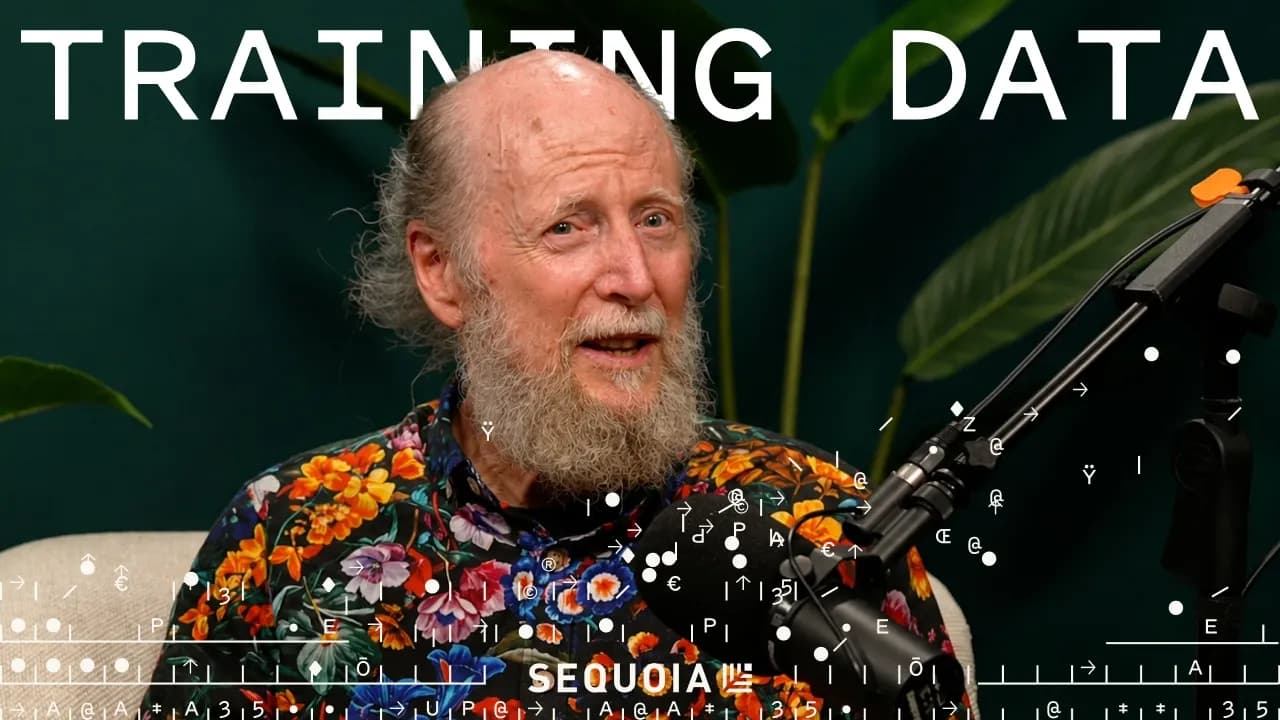
Naveen Rao is a pioneer in the AI space with a PhD in neuroscience. He started one of the first AI chip companies, ran MosaicML (one of the first AI training companies), and built all of Databricks AI. He left to start Unconventional AI as CEO, aiming to redefine the future of computing by bringing neuroscience back.
Naveen Rao: "Afternoon everyone. Super excited to be here. I'm Naveen Rao and CEO of Unconventional AI. We're unconventional because maybe it's actually the wrong word to use cuz I think we're going to change the name to conventional. It's a great time to be a startup. Having no baggage is a true competitive advantage. We can do things faster than traditional chip companies and full stack companies. We can get to tape outs in months instead of years."
Guarantee some audience members are trying to prove wrong the claim about ASI. Need much greater computer efficiency at the fundamental substrate level—how information processing happens at the physics level—not algorithmic or data efficiency.
Computers work the way they did 80 years ago. Digital abstraction and floating point numbers date to the 1940s for machines built on different substrates for different purposes. Now building machines for intelligence.
AI makes us more efficient (coding, running a thousand agents on a phone), but energy efficiency is the real question. Already using many gigawatts for AI inference and training. In 2-4 years, no more energy available for AI.
Electrical energy vs. food as energy sources for intelligence. Humanity's brains: 8 billion people at 20 watts each = 160 gigawatts total. World capacity: 9,000 gigawatts (US: 1,000 gigawatts), running everything (heating, electric cars, etc.). Even with 50% more (4,000+ gigawatts), current compute paradigm is vastly inefficient.
Inference per token (fully loaded, building/running model): megawatt to gigawatt range vs. human 20 watts. Evolution over 4 billion years created humans. Constraint: how quickly can we build intelligence on given energy.
To automate with lots of intelligence, need vastly more power-efficient computers.
Thermodynamic limit to intelligence per watt (Landauer principle): physical asymptote for compute per energy. Biology (human brain) is near it—pretty efficient after 4 billion years evolution, but ~2 orders of magnitude from asymptote.
Current computers: 3 orders of magnitude below biology. 2D lithography limits chips to lower efficiency. Focused effort can push to lithography limit.
Nvidia owns matrix math market but power efficiency (e.g., FP8 flop with memory access) improves incrementally, not dramatically.
Naveen Rao: neuroscientist and computer architect for 10 years, thinking about this for 30 years. Biology provides existence proof: human brains 20 watts, intelligence higher than gigawatts of current AI despite lower tokens per second. Will rival human discovery soon, but at high energy cost.
Brain wattage scales with weight: macaque monkey <1 watt; complex mammalian/insect behavior on milliwatts. Phone: 1 watt. Squirrel jumping branches: <10 milliwatts (1/100th phone). Biology created something amazing.
Brain is dynamic, uses nonlinear dynamics not matrix math. Time-varying interaction between neurons is the compute. No floating point/matrix math—richer due to dynamics. Stochastic, not strict 1s/0s (digital error crashes system).
Kuramoto synchronization: oscillators rigidly coupled converge regardless of start. Generalize to trainable flexible coupling for interesting dynamics through state space.
Electronic circuit: oscillators with trainable coupling fabric mimics brain dynamics—nonlinearities interact richly, represent much information.
Building chip this summer. From no team in January to full prototype in 6 months using AI.
Traditional von Neumann: loop over linearized time, write/read state (burns most energy).
Nonlinear dynamics: set initial state, "kick it and let it run"—physics does computation, state implicit. Use time axis of physics for computing (existing constructs do not).
Can train: steer system into arbitrary trajectories (e.g., traced Unconventional AI logo in state space).
Demo on model trained on images (cats homage to Andrew Ng; can do anything). Simple generative model: at t=1, backprop error from randomness to image class, then let run naturally.
Representation clumps meaningfully (e.g., animals). For horses: starts random, converges to horse-like at t=1, morphs between over time. Learned state space navigation between classes.
CPUs: fast single-threaded von Neumann (memory/cache ops). GPUs: parallel operands from memory, compute, write back. Compute-in-memory (e.g., Groq): fine-grained on-chip.
New: dynamical system overlaps state/function with physics—no separation between state/computation. Truly non-von Neumann. Compute efficiency and "galaxy braininess" increase.
"We've been thinking about this problem for 30 years. We're at the point where we can start to understand how brains work cuz now we can build them."
Thank you.
Keep Sequoia Capital in your library
Save the videos and channels worth coming back to, and find them again in one place.