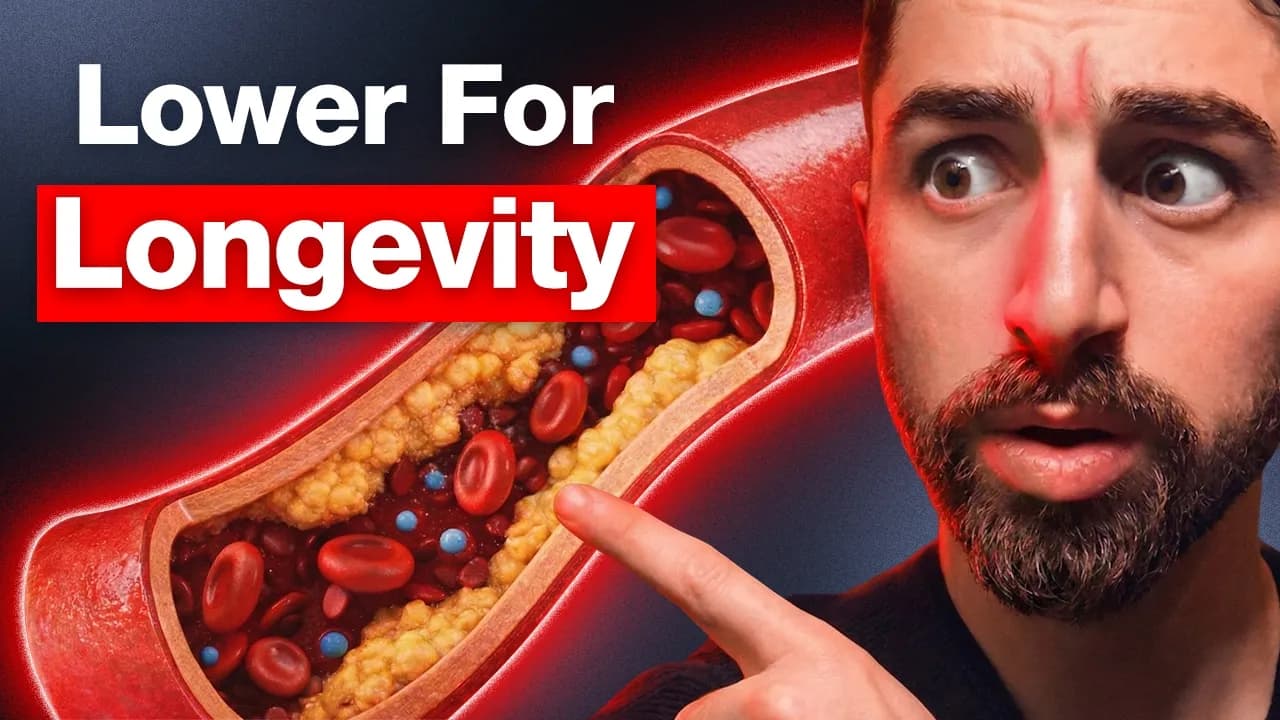
Reverse Heart Disease in 1 Year (Proven in RCT)
In a Nutshell
Sleep and exercise both reduce arterial plaque by suppressing inflammatory mutant blood cell clones produced in bone marrow and by lowering their inflammatory activity once they reach artery walls. In a randomized controlled trial, exercise alone produced 7% plaque regression in one year, outperforming GLP-1 drugs. Prioritizing 150+ minutes of moderate-to-vigorous activity weekly plus quality sleep is therefore the primary strategy for reversing atherosclerosis without medication.
These notes were generated by AI and may contain inaccuracies.
At age 23, the speaker developed extraordinarily high cholesterol and was repeatedly warned that plaque would develop in arteries within years and a first heart attack would likely occur by age 30. The speaker never experienced this outcome, and arteries remain perfectly clean on the most sensitive cardiovascular imaging. Special genetics were considered unlikely, and a fluke of fate was dismissed as unscientific. The explanation centers on two daily practices that reduce arterial inflammation, with one shown to cause plaque regression in a human randomized controlled trial published in the current year. Both interventions are free.
The video is structured in four parts. Part one covers clonal hematopoiesis as a risk factor for heart disease. Part two presents data from a 90,000-person study on sleep and exercise. Part three addresses reversing atherosclerosis through free interventions. Part four covers additional tools for arterial protection. The core interventions identified are sleep and exercise, both of which reduce arterial inflammation.
A study published in Nature demonstrates that sleep and exercise can modulate mutant blood cells that contribute to heart disease. The key concept is clonal hematopoiesis. "Clonal" refers to clones, and "hematopoiesis" refers to the generation of new blood cells in the bone marrow. The prefix "hemato" refers to blood, and "poiesis" means production. Clonal hematopoiesis therefore describes the production of new blood cells, including immune cells, that are clones of each other.
The bone marrow functions as an ecosystem where a healthy state features diversity with thousands to hundreds of thousands of cell lineages coexisting. Clonal hematopoiesis occurs when one lineage acquires a mutation that confers a survival advantage, allowing it to expand and crowd out other lineages. The winning lineage tends to be aggressive and inflammatory, shifting the immune system toward a chronic inflammatory state. This process parallels cancer biology but does not constitute full-blown cancer. The inflammatory cells migrate from bone marrow into artery walls and promote atherosclerosis.
The opening line of the Nature paper states: "Clonal hematopoiesis activates inflammation and increases the risk of atherosclerosis." Immune cells originate in bone marrow, enter the blood, and reach the heart through the pathway described as "bone to blood to heart." Mutations generated in the bone marrow can therefore directly damage the heart via these nomadic inflammatory cells.
Clonal hematopoiesis becomes more common with each decade of life. Most older adults who carry these mutations are unaware of their presence. Standard medical focus on cholesterol or apoB has not historically included discussion of mutant inflammatory cells. The absence of pharmaceutical interventions for this condition explains why it receives limited clinical attention, as medicine typically measures what can be acted upon with drugs.
Researchers combined data from the UK Biobank and the All of Us Research Program, totaling over 90,000 individuals. Physical activity was measured using activity monitors to examine associations between moderate to vigorous physical activity and clonal hematopoiesis. Greater physical activity correlated with reduced clonal hematopoiesis, with effects selective to certain clones rather than all clones. The pattern was consistent across both datasets and in both men and women.
The association persisted after statistical adjustment for body weight and BMI, indicating that exercise effects are not mediated solely through weight loss. Exercise appears to reach the bone marrow directly and alter the environment that determines which clones are generated and disseminated.
Sleep influences clonal hematopoiesis through a non-redundant, complementary mechanism to exercise. The two interventions act additively to protect arteries from mutant clone cells and inflammation. Mouse experiments were conducted to determine mechanism. Mice engineered with different mutations had blood that was 10% mutant and 90% normal. Animals were randomized to sedentary conditions, exercise, or sleep disruption. Over 12 weeks, mutant clones expanded steadily in sedentary animals. Exercise completely halted expansion of some mutant clones. Sleep disruption accelerated clone expansion, resulting in significantly more mutant cells in blood compared with both other groups.
Exercise suppressed specific clones without broadly impairing blood cell generation, preserving normal immune function. The interventions demonstrate specificity, functioning like cellular snipers rather than indiscriminate agents. Different mutations cause cells to express different proteins and surface receptors, rendering mutant cells more vulnerable to environments created by sleep and exercise.
Sleep and exercise affect clonal hematopoiesis at two distinct sites. First, they slow expansion of mutant clones in the bone marrow. Second, they reprogram mutant cells after they enter circulation and reach artery walls. Sleep disruption increased levels of a receptor on mutant clones that triggers inflammatory cascades within artery walls, amplifying inflammation. A normal sleep pattern produces the opposite effect. Exercise activates neurons in the brainstem that alter circulating hormones such as adrenaline; these hormones bind receptors on immune cells and reduce inflammatory signaling.
Each intervention therefore protects the heart through two pathways: limiting mutant clone expansion at their site of origin and reducing inflammatory activity once clones reach artery walls.
In animals carrying mutant cells, plaque area was measured across experimental conditions. Sleep disruption increased arterial plaque size. Exercise reduced plaque area, consistent with possible regression. These findings demonstrate that exercise and sleep produce measurable differences in actual arterial plaque, not merely changes in clonal hematopoiesis as an isolated biological phenomenon.
A randomized controlled trial published in Nature Metabolism in the current year enrolled 130 adults who were assigned to one of four groups: placebo, exercise alone, GLP-1 weight loss drug alone, or combined exercise plus GLP-1 drug. Exercise suppressed inflammation and produced a 7% regression of atherosclerosis measured by arterial ultrasound over one year. The GLP-1 drug alone did not produce statistically significant regression. The study authors concluded that vascular adaptations are more sensitive to exercise-induced hemodynamic and anti-inflammatory effects than to GLP-1 effects. Exercise therefore outperformed the GLP-1 drug for cardiovascular benefits in this trial.
GLP-1 receptor agonists remain useful tools and possess anti-inflammatory properties, but they are not replacements for lifestyle interventions including exercise. Their optimal use may facilitate healthier food choices and increased physical activity, creating a virtuous cycle.
Sleep and exercise should be prioritized. Sleep quality receives insufficient attention relative to quantity. Individual sleep requirements vary. Core sleep hygiene practices include maintaining a cool, dark bedroom and reducing intense light exposure, including blue light, approximately 90 minutes before bedtime. For individuals with persistent sleep difficulties, the peptide pinealon improved REM sleep, with some community members reporting up to a doubling of REM sleep duration. Prescription peptides that promote deep sleep have also been used.
Target at least 150 minutes of moderate to vigorous physical activity per week, incorporating both aerobic and resistance training.
Once sleep and exercise are optimized, additional interventions may be considered. Nattokinase, at doses around 10,000 fibrinolytic units, has been shown in uncontrolled human trials to reverse atherosclerosis and suppress arterial wall inflammation. TUDCA, a bile acid, appears to enter the vascular wall and reduce inflammation. Microplastics represent an underappreciated contributor to arterial inflammation. Research published in the New England Journal of Medicine found that microplastics accumulate in human arterial plaques, are taken up by immune cells, and promote inflammation. This accumulation is associated with a 350% higher risk of cardiovascular events.
Practical steps to reduce microplastic exposure include avoiding plastic water bottles when possible and never heating food in plastic containers. A microplastic-binding probiotic developed by Winona Labs combines bacterial strains that bind microplastics, increasing excretion rather than absorption. This product is used daily by the speaker.
The speaker was told more than seven years ago that high cholesterol would produce arterial clogging, yet arteries have remained healthy. Consistency with exercise and sleep is proposed as a primary reason. These behaviors alter biology from within, affecting bone marrow, blood, and arteries by slowing emergence of inflammatory immune cell clones, calming the inflammation they generate, and enabling endogenous healing and protective mechanisms.
Keep Nick Norwitz in your library
Save the videos and channels worth coming back to, and find them again in one place.