Revolutionizing Cybersecurity and AI-Driven Science with OpenAI President Greg Brockman
In a Nutshell
OpenAI's latest math breakthroughs prove AI can now generate real new scientific knowledge, solving century-old problems that humans couldn't crack. This capability will revolutionize drug discovery and biology by accelerating the entire R&D pipeline while forcing regulatory systems to adapt to faster, cheaper development cycles. The physics of cybersecurity is shifting toward defenders who can use AI to secure systems at scale, but this requires dramatically increasing security spending relative to software development costs.
These notes were generated by AI and may contain inaccuracies.
To ensure that all of humanity benefits from artificial general intelligence. Humans should have the upper hand, control the future, and this technology should enhance their active role. When looking at the world, software has in some ways become a barrier to market entry and has become extremely cheap. The real requirement is reliable, secure, and trustworthy software. Spending on cybersecurity should significantly exceed spending on software. People have not yet grasped the extent of the change that will occur in the physics of cybersecurity. There is an opportunity to reach a safer world.
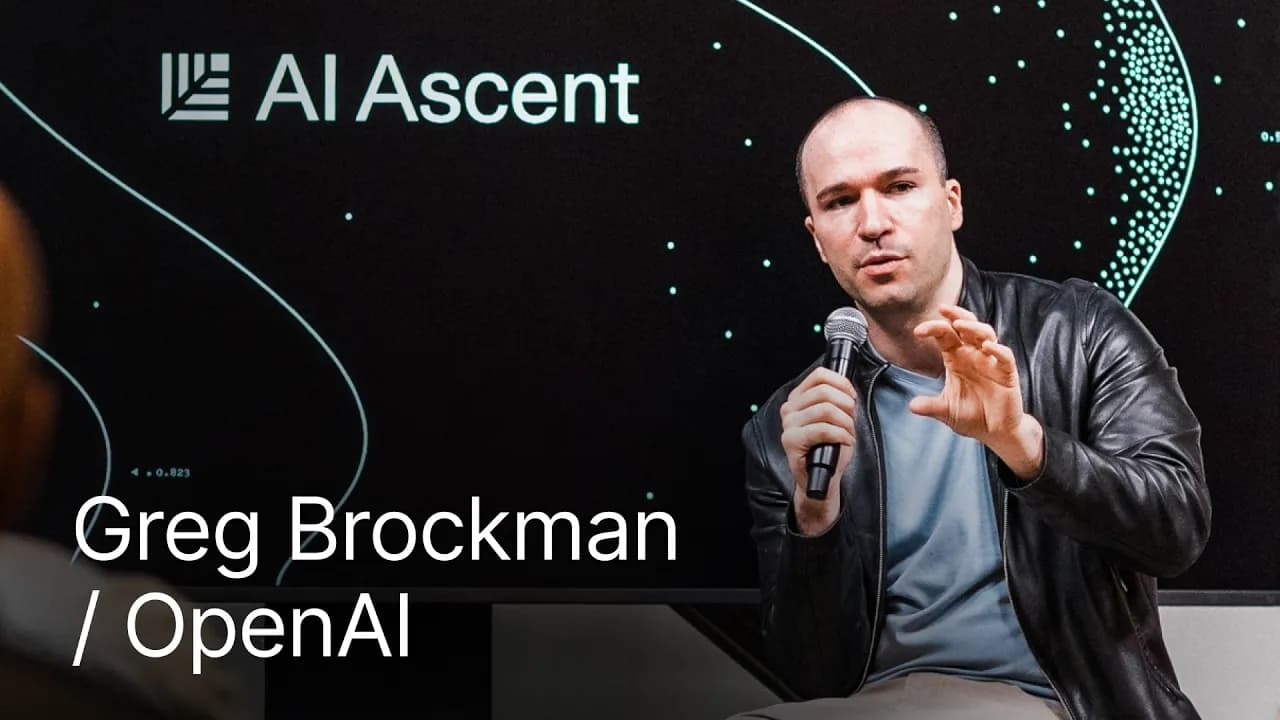
Welcome to the "No Introductions" program. Today, Elad and the host are talking with Greg Brockman, co-founder and president of OpenAI. They discuss OpenAI's latest mathematics findings, "Astra," and why Greg believes AI is now capable of generating real new knowledge. They turn to drug discovery and his argument that spending on security should far exceed spending on software.
In the world of artificial intelligence, every week feels like a year. OpenAI has released GPT-6 to over a billion people. There is exciting news on the sports side and many things happening internally. There is a recurring saying in the field of artificial intelligence: "It never gets easier, it just gets faster." There is tremendous activity, and just when you think you've reached the peak of influence, you realize there's another level possible. This is not just about one company or one technology; it's about all of us as a world and a society working together to adopt this technology and make the most of it to improve everyone's lives.
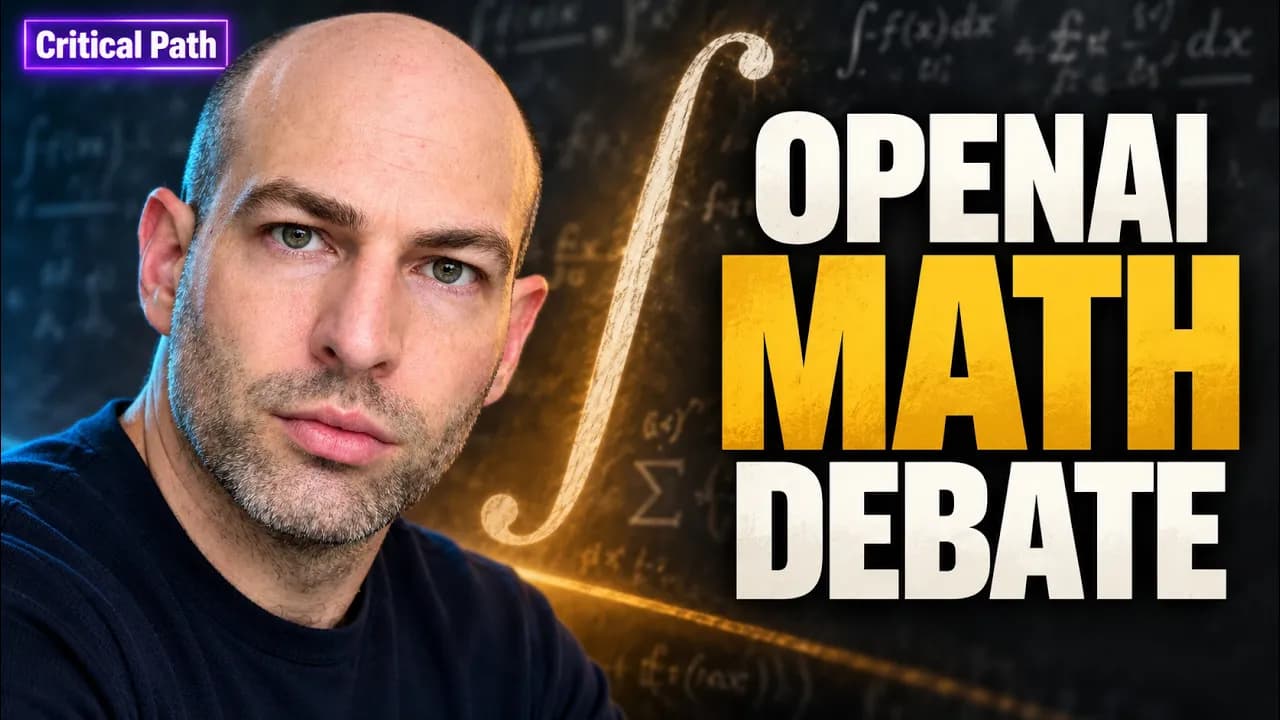
This week's math results represent a real milestone. The primary driver for improving the quality of human life over the past thousand years is technology and scientific progress. There is now the ability to accelerate scientific discovery tremendously. There has always been a question: Is artificial intelligence truly capable of creating new knowledge? At this point, it's impossible to deny that. It is certainly possible. More than that, while entirely new theories have not yet been created, the capability exists to solve mathematical problems that are a hundred years old.
What's really exciting is that it's not just about getting an answer from the machine, but about what a human being, equipped with these tools, can achieve that was previously impossible. The human ability to do whatever one wants is increasing significantly. If you have a math problem you want to solve, you can solve it. The same ability applied to biology, or if you own a small business and want to manage it efficiently, this level of intelligence specifically designed for this field will make achieving amazing results in line with your goals and desires within everyone's reach.
The rate of progress was truly astonishing. Previously, there were problems with calculations where people complained about early models saying "Why can't these models perform basic calculations?" Now, advanced theories are being solved. As this progress continues and its real impact extends to mathematics, physics, materials science, and other applications, if these models become extremely intelligent, there is a need to focus on how to effectively communicate this information to people and how to think about the actual communication aspect when solving an advanced theory.
In any branch of mathematics, very few people are able to decide on a theory that someone has put forward. Thus, a kind of specialization arises. This is something that has always been part of the sporting background. The inspiration came from mathematicians such as Galois and Gauss, who were working on a time horizon that extended to one hundred or four hundred years. There is profound beauty in the fact that mathematics is concerned with understanding the structure of the universe.
There are always questions about whether mathematics is an invention or a discovery. The beauty and meaning of mathematics lies in the fact that it is not objective in the literal sense, but rather relative. It is something that attracts us. Some branches of mathematics resemble physical laws. It deals with simplicity, compression theory, or complexity theory, and all these things may be closer to physics, but there is also an important human aspect to it. It's not just about presenting a proof, then not understanding it, and saying "Okay, we've solved the problem." Rather, it is about the insights gained. There are promising indications of valuable insights within the work of artificial intelligence.
Nearly 400 highly important open problems have been solved, and the sports community continues to study them in search of new insights. When reading what experts on these issues have published, they say there are amazing ways to apply the ideas, or they ask "Why did they use this particular result?" What will emerge is not those vague theories or proofs, which have a long history of vague proofs in mathematics. The four-color theory is a clear example, as it seems as if a machine has been created that checks a set of cases. There is nothing beautiful about that. We are at a different stage of machine discovery. There is optimism that the models will also lead to a better understanding of the theory of mind, that is, the ability to know what we humans know and how to guide us toward a new understanding.
For example, someone who loves mathematics but stopped studying it at some point in school, then enrolled in a mathematics academy, and used the GPT program to help learn mathematics. Expectations regarding the level of knowledge that people can understand will also be present. This is a very important point, and perhaps one of the underappreciated benefits expected from this technology, is helping people to learn more, understand more, understand each other better, and understand the world better. There are technical mechanisms that support artificial intelligence capable of solving these problems, seeing all the connections between fields, how it conveys them to us, and how we understand them.
There are links between the safety and compatibility of artificial intelligence and our ability to understand what it does. There are technologies that have been discussed since 2017, such as debate and iterative amplification, which are two sides of the same coin. The thinking is careful about whether we have artificial intelligence that solves problems that are difficult for humans to verify. Even summarizing a book, for example, is a difficult task to verify. It's really hard to know how good a summary is unless you've read the whole book. If an artificial intelligence system provides a summary of a book, is it a good summary or not? This is difficult unless there is another AI system trying to prove the summary is bad.
If this system were to return and say "There is a passage in the book that contains an important pivotal point in the plot, and it is not mentioned in the summary," then you would not need to read the entire book to be convinced of the validity of this opinion. There are ways to train artificial intelligence that are perfectly compatible with the possibility of human supervision and giving them control, which is essential and fundamental for the future from the point of view of OpenAI, but it is also consistent with making the results of artificial intelligence teach a human something specifically designed for them, rather than just acquiring abstract knowledge.
For most people, developments in mathematical theory are still somewhat abstract. They don't believe it's happening today. There is also artificial intelligence in science, which is claimed to be able to solve all diseases within years. We've gone through many years of experimenting with this technology to see what to expect. It's similar to having artificial intelligence with capabilities in a specific area. If we understand why it possesses these abilities, we can expect similar results in all other human domains that have similar characteristics.
The question is why there was a radical transformation in mathematics and such amazing results achieved. Part of this is because artificial intelligence has reached a certain level of capabilities and innate intelligence. Mathematics is verifiable. It started with verifiable problems such as "This is a written mathematical problem, and it has a numerical answer," and then the artificial intelligence was trained to verify the answer. We can simply tell if the answer suggested by artificial intelligence matches the correct answer. As for the evidence, that's a completely different matter. The accuracy of the evidence is difficult to verify. Is it really accurate or not? Formal proof can be verified, but proof in natural language, which is what is actually being produced here, is much more difficult.
The main idea is about data. Enormous amounts of data can be obtained in mathematics and in theoretical physics. Can massive amounts of data be obtained in biology? This is clearly a data-dependent field and it is extremely difficult. Fortunately, there are also several technologies being worked on that enable operation with less data. What that means is there are now intelligent models capable of handling enormous amounts of data, and that is the essence of deep physics. Computing, data, algorithms equals capability, equals results. This is possible in these difficult areas where the brightest minds have spent hundreds of years trying to solve the problem, and now artificial intelligence can solve it.
When translating that into biology, the goal is clearly to discover drugs. All these things that are fundamental changes in biology and our understanding of it to improve the quality of life are what we want to apply. The question that remains unresolved is: Do we have the data? Do we have the ability to obtain the data? What will happen is that these models and techniques, which are already being done, will be applied in the biological field. There are some areas that will see rapid development. There will be a tremendous acceleration in things that were extremely difficult and are now extremely easy. But there will be other obstacles, and the question will arise: how do we overcome these obstacles? Some of these obstacles don't even relate to a deep biological theory. For example, registration files with regulatory authorities. That's a big obstacle. It takes a full year to write a complete feasibility study for a clinical trial and all that stuff. It's like being able to write these things using artificial intelligence more easily. Every step of the drug discovery process needs to be reviewed. There will be stages that lack basic data. Therefore, innovation in wet laboratories and innovation in how simulations are conducted will become extremely important. These breakthroughs will be seen, but it is important to realize that there are commonalities with mathematics relating to scientific discovery, and other completely different aspects in terms of the source of data.
There are specific aspects in biology where much of the early research, such as AlphaFold, focused on designing a molecule or understanding how molecules bond with each other. Developing a drug takes 15 years and costs $1.5 billion. Typically, around $50 million is allocated to preclinical studies, mouse studies, and molecule studies, and then more than $1.4 billion is allocated to clinical trials. The focus in the early stages of these models was on the molecule's ability to bind, as opposed to all the other things that must be taken into account later to turn it into an effective tool that serves human endeavors.
Drug discovery is the clearest and most obvious area where a complete revolution is wanted. It is the field that will raise everyone's quality of life, which is extremely important, and perhaps the most important application of artificial intelligence that everyone has been thinking about for a long time, and it is clear that focus should be on it. There is a long chain of processes, and humans are very bad at biology and very bad at discovering medicines. Natural language is perfectly suitable for humans. It is something that is very clearly human and perfectly in tune with how we interact with the world. Biology is completely foreign to us. But with regard to neural networks, there is no reason to believe they'll be any better at natural language than they are at biology. The fact that amazing results are being seen with neural networks and natural language makes us capable, from basic principles, of deciphering the language of biology. This is the most important thing. It is based on basic principles and it should succeed based on what is seen. We are very close in many aspects, so the prospects are good.
Parallelism can be greatly increased. The duration of many of these steps can be reduced. There are many dimensions to drug discovery. For one disease, there are many people for whom there is a drug to treat their condition. It's just that it exists somewhere in the scientific literature, there's a research paper, and if that research paper that's relevant to the case can be found, the person will be able to be treated. There are many precedents for this. These operations can be scaled up significantly. This short-term effect is very possible. Materials science is another example, and there are many other areas where real changes in what humanity can achieve should be seen.
The question is why a drug took 15 years to reach the market. Part of that is due to conducting increasingly costly clinical trials, involving a different set of safety considerations, leading to large-scale human trials. These experiments are now subject to regulations for a good reason. One of the determining factors, if success of technology and the possibility of obtaining or generating pieces of data is believed in, is convincing regulators of the need to change expectations regarding acceptable experiences and steps taken. There is a pivotal moment here, and there is still more work to be done to get to that stage, but if the physics of drug discovery can be proven to have changed, then surely that change will be reflected in every part of the system.
Taking a completely different example like self-driving cars, there are many road systems, safety and other things specifically designed for human drivers. If self-driving cars are ten or a hundred times safer than human-driven cars, if artificial intelligence is able to achieve the desired results in a particular field, it is natural to ask "How do we rethink the entire transportation system?" Perhaps laws should be put in place allowing the use of self-driving cars only in specific areas. There are many potential changes in the way we think about what we want from the system, which in turn should be reflected in laws and regulations. Of course, there are no uniform laws all over the world. Regulations in Australia differ significantly from those in the United States with regard to clinical trials, and there is already an increasing trend among researchers to move their trials to places with a regulatory environment more suited to their current circumstances, their way of working, and what they believe works.
How things change will depend largely on what can actually be proven. Will a stage be reached where better results from neural networks compared to clinical trials are obtained? This stage has not been reached yet, but it is expected to be reached. If neural networks are more capable of predicting efficacy, toxicity, or other things, it is logical to change them. This is beyond doubt. This is one of the areas that society should and hopefully will pay close attention to, that what is possible has changed radically, and we should quickly reorient ourselves towards it. All the consequences must be carefully considered. All of these implications, one of which if thinking about long-term studies on people, is a question like: Is this neural network really accurate in terms of its predictions, and is the simulation really accurate for long-term outcomes? It's difficult not to have at least one long time course to confirm that. About 80% of what is possible will be achieved very quickly.
A while away from the release of Astra and Developers Day. Dots really changed the way many work. Dots is a proactive agent. It always works. If it stops working, it continues to work. There is a Dot app that monitors the tasks that were supposed to be done, such as messages that were supposed to be sent, and things promised but not done yet. Every morning there is a to-do list. It often notices things that weren't asked to be noticed. If there is a discrepancy in the schedule, it should be indicated. For example, it might say "You need to leave this meeting early to go to the other task." It is fully aware of the context, knows how the day is spent, and understands the projects being worked on. The app is somewhat understanding. It knows what's in the inbox, knows what's in Slack, is able to integrate these platforms, knows the questions that have been asked, so it knows what's most important. The existence of the Dots app is in a sense just a change in form, not in capabilities. It's more like an advanced version of Astro. It has its own car computer. But this change in the form of the work environment with this level of intelligence is a qualitative leap.
There is one Dots application. It's a small owl. The icon can be changed. It does everything in professional life. OpenAI has research efforts as well as business geared towards consumers, enterprises and developers, and an integrated business platform. There will be a separation between assistants who help with work, such as Dot, which is considered the basics, and consumer assistants such as Instinct and Muses. These things will converge, no doubt. There are very different pressures in different work environments. For a consumer-oriented product, it is very important to know how to scale and provide services for free or at a very low cost. In the workplace, whether as an executive or an employee, it is much easier to focus on optimal intelligence, and as long as there is a return on investment, it is worthwhile to increase computer resources. The main difference lies in the cost.
This has been seen in ChatGPT. At ChatGPT, there was a huge effort to provide the largest free slice, and providing features like memory to all free users was a massive effort, almost like a huge engineering effort. It is very easy to perform the same functions at a much higher cost for a very small number of users. What is being seen in the personal assistant field is the existence of different market segments, where varying amounts of computing resources will be consumed primarily. When there are different levels of computing resources, it means that the product may look a little different. One may have more built-in functions than the other. Of course, there are different use cases, such as payments, travel and the like, which are more consumer-oriented, but there is no fundamental difference.
It is similar to an artificial intelligence system that performs certain tasks and is subjected to some kind of pressure in one way or another. One of OpenAI's strengths is its 1.2 billion users on ChatGPT, in addition to the company's leadership in programming and enterprise services. There is no competitor that combines these two aspects. A large part of the strategy is based on unifying these services, so that competition is not on two fronts but on one front. This is the general trend of artificial intelligence, towards blurring the lines between what is intended for consumers and what is intended for institutions. There will be a renaissance in the field of entrepreneurship, and it is already being experienced. People are leaving their jobs to start companies and saying "I wouldn't have done it if there wasn't artificial intelligence I trusted, capable of overcoming many of the usual obstacles to entering the market." As with long-standing differences, there will be a change in this area.
One of the things that has traditionally separated the corporate world from the consumer world is how the user interface is designed. Of course, there is the cost aspect and the basic ability to deliver a product with a certain level of accuracy, but the other aspect is the user interface itself. The user interface in an enterprise environment, or the way it is accessed, often differs significantly from that of a consumer environment. There is an attempt to unify these classes. There has been a lot of thought given to dynamic user interfaces. This has always been one of the topics that people discussed early on: how to create a dynamic and useful user interface? Or in some cases, these elements move into the background and become part of the conversation. The best user interface is no user interface. This is the direction being taken in artificial intelligence. There is something you can talk to.
The fundamental difference between personal and work environments lies in the presence of system administrators and company security teams. Work environments involve a larger number of stakeholders, and AI systems must account for institutional needs rather than being purely custom-designed for individual ownership and results.
When new features are released, organizations require administrative controls and switching options to determine when features are launched. This can result in fewer available jobs for users in workplace settings. The challenge becomes how to communicate missing functions and inform users about them when there's no traditional user interface.
The progression from GPT's initial text box interface to AI without any user interface represents a fundamental shift. The focus moves to questions like how much computing can be spent, model quality, memory systems, behavioral decisions, and model calibration - determining how much effort the AI should put into thinking about problems.
With GPT-6's release, AI can now think deeply about any problem, provide quick answers, then continue thinking to deliver more accurate and comprehensive responses. The absence of a traditional user interface is addressed through AI that can instantly create generative user interfaces customized to specific needs.
AI can design outcomes exactly as needed at the moment of need. For complex tasks like booking flights, users can see all different options. For questions like "How do I assemble a bicycle?" AI can create completely customized applications in real-time, something that would traditionally take a month to develop.
The physics of cybersecurity is changing, entering what is called the "defenders' window." Advanced AI capabilities help defenders secure themselves, though these capabilities are increasingly being defeated with each new AI model release. Cyber capabilities are evolving and becoming available to everyone, with initial effects visible in high-profile incidents like bank hacks in South Korea.
The Daybreak program provides responsible access for defenders to use advanced AI models for discovering and fixing security vulnerabilities. The recognition that security gaps have always existed - every line of human-written code raises questions about safety and developer training - highlights that systems were built fundamentally insecure.
The XKCD comic illustrates how world infrastructure depends on open-source projects written by individuals in basements. Historical vulnerabilities like Heartbleed demonstrate that security was added retrospectively to an internet designed primarily for flexibility rather than security. Security measures like virus scanning programs and HTTPS encryption were added through a slower path.
A moment is approaching where technical debt will surface and need to be paid. AI enables paying off technical debts through capabilities like formal software verification and proving security features of software. These technologies exist but require significant effort and aren't used in important projects.
OpenAI implemented a security transformation internally where 25% of production engineers had their projects put on hold to focus exclusively on securing systems. Using advanced AI models, they examined all infrastructure, conducted comprehensive penetration tests, and developed tools for repeating this process. After fixing discovered problems, they exhausted all detectable issues with the model.
Future code will increasingly be AI-powered, with models trained to write safe code from the beginning. This approach could achieve radically more secure systems. A transitional period is expected where cyberattacks may increase as humans adapt their software databases to become more secure using AI-generated code.
Defenders need to grasp how cybersecurity physics has changed, as this opportunity won't last forever. Security of institutions will be linked to both mastered foundations (one-time investments) and cyber capabilities used for defense. This requires radical changes in how organizations operate and how critical infrastructure is collectively considered.
Traditional cybersecurity investment doesn't exceed a small percentage of IT budgets. The appropriate ratio should far exceed spending on software, as software has become essentially free and a barrier to market entry. The value lies in reliable and secure software that can be depended upon.
The XKCD comic's little box at the bottom of open-source software developers' pages never made sense due to laws of physics - the difficulty of writing reliable software. Supply chain vulnerabilities occur when someone uploads malicious packages. Programs like Socket scan the open-source supply chain to identify security vulnerabilities.
OpenAI collaborates with companies like CrowdStrike for coordinated responses. Leadership is a core priority, with the company undergoing a security transformation phase over the past two months, aligning development processes with security and safety standards.
OpenAI's constant support for human empowerment and advancement remains central to its mission. The original idea was to balance other AI development companies so technology could be used widely and positively. The mission ensures artificial general intelligence benefits all of humanity, with humans maintaining leadership positions and controlling the future.
Even though GPT-4 knows far more than any human being, the important principle is maintaining human control. Steve Jobs' iMac handle story illustrates that people should feel they can control devices - the same spirit should apply to AI. Human judgment and values should determine how humans operate in certain areas, functioning more like CEOs or board members.
The fundamental question is whether AI makes life better and whether humans are happy with outcomes. Technology was created to raise human civilization levels and improve quality of life. This is what should be strived for with artificial intelligence, representing what OpenAI believes in.
Keep No Priors: AI, Machine Learning, Tech, & Startups in your library
Save the videos and channels worth coming back to, and find them again in one place.