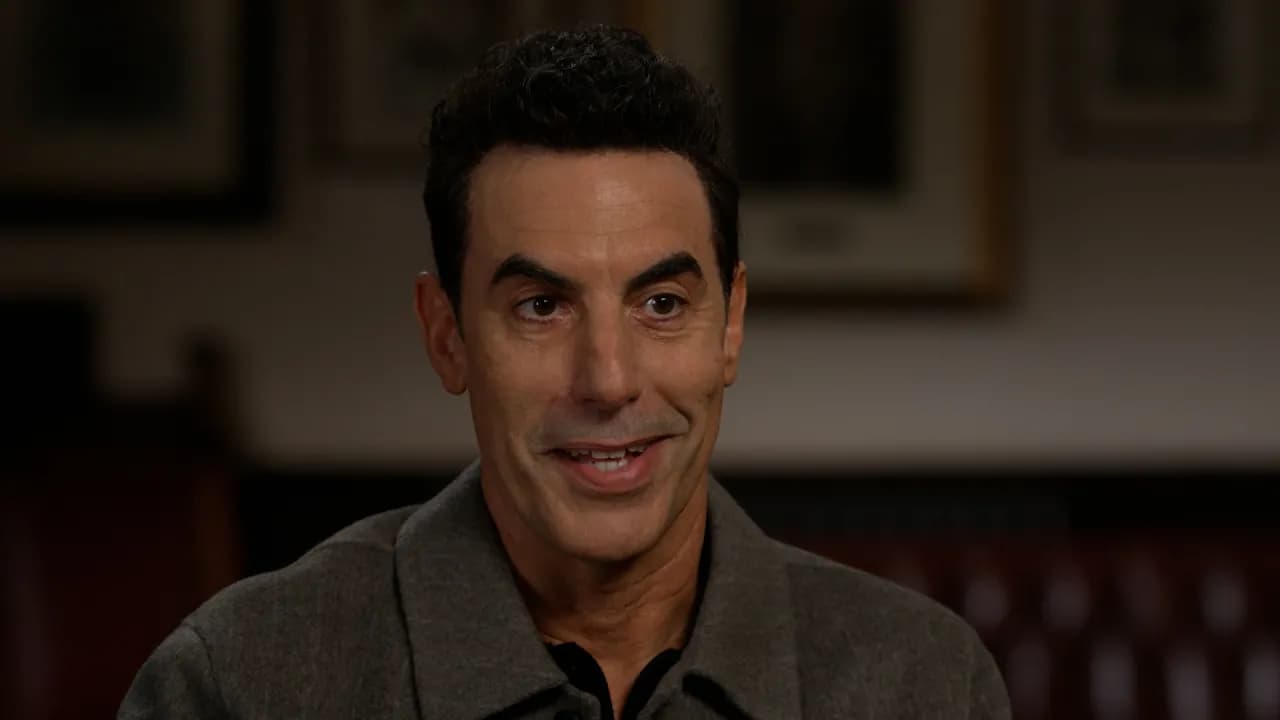
Sacha Baron Cohen: The 60 Minutes Interview
In a Nutshell
Sacha Baron Cohen has spent over 25 years creating undercover characters like Ali G, Borat, and Bruno to expose people's true beliefs by pairing experts with idiots. His comedy blends clown training with meticulous research to reveal both human kindness and underlying bigotry, with the goal of making audiences laugh while highlighting how democracies need shared truths. He views his work as holding up a mirror to society, testing how quickly intelligent people can be radicalized into dangerous beliefs.
These notes were generated by AI and may contain inaccuracies.
Sacha Baron Cohen has built his entertainment career creating characters that trick real people into revealing their actual beliefs. His main personas include the ignorant Kazakhstani reporter Borat, the fashion-obsessed narcissist Bruno, and the hip hop enthusiast Ali G. At age 55, Baron Cohen has been performing undercover comedy for over half his life, with increasing complexity, moral stakes, and physical danger requiring elements like trap doors and getaway vans. He combines being a mission-driven public intellectual with being an adrenaline junkie who invented his own comedy genre.
Baron Cohen wanted to be a comedian but was embarrassed to admit it, comparing it to saying "I want to be a supermodel" when others might question your looks. He experimented with a version of Ali G for years, creating an upper-class kid who used the same catchphrases as Ali G but spoke in an upper-class manner with phrases like "jungle massive." He tested this prototype among London skateboarders for a youth culture show he was hosting on cable. After skateboarding poorly and being told he was "whack," he revealed he was pretending to be a character, shocking the skateboarders. The head boss called him afterward and warned that trying that again would result in being fired, confirming he was onto something.
Ali G is a white imbecile and hip hop journalist who wants to be a black rapper. His debut on a satirical late night talk show in 1998 led to The Ali G Show, a smash hit in the UK that spawned an HBO series and feature film. The core concept was pairing the world expert in something with the biggest idiot in the world, creating humor through juxtaposition when the expert takes the idiot seriously.
Baron Cohen deployed Ali G on numerous credulous authorities, including former Surgeon General C. Everett Koop. He asked Koop ridiculous questions like whether the heart was "a bit crap" and whether it should have a different rhythm than "boom boom boom boom." Koop responded seriously, saying "No, you're way off base there." After more than 20 years, Ali G returned in new content, with Baron Cohen commandeering a double-decker bus to show his version of London landmarks like "Buckingham Fall" and "Big Ben."
When asked if he brings elements of his actual self to characters, Baron Cohen responded: "If I knew who I was, then I could answer that. But I don't know." He noted that Ali G resonates because at age 11 he was somewhat like Ali G. Baron Cohen grew up in northwest London as the youngest of three boys, son of a fitness instructor and an accountant. His mother had a distinctive voice that everyone at his high school could imitate, with phrases like "Sasha, telephone." He had a passion for break dancing and early hip hop, even providing entertainment at his own bar mitzvah.
Baron Cohen studied history at Cambridge University, where he discovered his love for performing on stage. He realized he loved making people laugh but also really liked making them cry, wanting to give audiences "the full emotion" and "bang for their buck." His parents thought becoming an actor after Cambridge was a ridiculous and impossible idea, and they were correct about the statistical likelihood of success. However, Baron Cohen pursued his goal by studying with Philippe Gaulier, known as the Stanislavski of clowns, who taught that clown characters should be "the stupidest creature that can ever be on stage" and used to say "More stupid than this and you die."
Baron Cohen brought his clown training to Borat, the bumbling anti-Semitic Kazakh reporter who toured America in 2006. The Borat movie was meticulously planned with extensive behind-the-scenes research into potential interview subjects. The film was both hysterical and revealing as an experiment where real interactions moved the plot forward, grossing $260 million. Baron Cohen noted that Borat shows both the kindness of people who are nice to him and exposes layers of hate and bigotry below the surface.
Baron Cohen's undercover comedy ventures into morally complex territory, creating ethically questionable bargains where the worse people look, the better it is for the comedy. When asked if he felt conflicted about baiting people into making fools of themselves, he responded that many of the Ali G and Borat interview subjects actually come across well.
Bruno was the flamboyant fashion reporter wanting to become "the biggest Austrian superstar since Hitler." The movie was conceived as a gay romcom but ended with a kiss in a cage match instead of a scenic, sentimental setting. Baron Cohen described lying down kissing his love interest while thinking "This is great" as chairs were being thrown. When asked about the ratio of fear to thrill during dangerous scenes, he said he was thinking about the scene almost entirely, remembering it vividly.
Baron Cohen earned Golden Globes, BAFTA awards, and Oscar nominations for Borat and his dramatic role as 1960s activist Abbie Hoffman in The Trial of the Chicago Seven. He played Israeli Mossad agent Eli Cohen in the miniseries The Spy and starred opposite Will Ferrell as French NASCAR driver Jean Girard in Talladega Nights. His greatest influence remains French clown Philippe Gaulier, whom he describes as still his favorite comedian of all time because Gaulier "completely inhabited the character" with laugh-out-loud funny silly voices.
In his new movie Who is America? (noted in transcript as "Ali G, Who is I?"), Baron Cohen plays multiple characters including a deranged leftist professor and former Mossad agent who interact with unsuspecting strangers. The result is designed to expose extremism at both ends of the political spectrum. He wanted people to laugh really hard while examining conspiracies and lies, testing whether intelligent people who believed in the "theory of race replacement" could be turned into murderers within hours. The production required prosthetic teams working for years and animatronic teams, with hundreds of things that could go wrong.
Baron Cohen feels he's holding up a mirror to society, with the primary objective being to get people to laugh really hard while smuggling in satire that hopefully makes audiences think when leaving theaters. He aims to show that democracies depend on shared truths while autocracies survive on shared lies. His dream was to make one classic comedy, which he felt he achieved with Borat, describing anything else as "gravy" and feeling very lucky.
Keep 60 Minutes in your library
Save the videos and channels worth coming back to, and find them again in one place.