South Korea’s AI Bubble Just Popped — America Could Be Next
In a Nutshell
South Korea's market crash was driven by extreme concentration in two chip stocks, leveraged ETFs, and retail speculation that triggered cascading margin calls when regulators warned of overheating. The US shows similar warning signs—top-10 stocks at 37% of the S&P 500, record margin debt, near-zero cash positions, and valuations at dot-com bubble levels—though America's market is structurally more diversified and lacks Korea's extreme single-stock leverage products. The core risk isn't total collapse but that if earnings growth disappoints or expectations normalize, a 20-25% drop could occur without a recession or catastrophe.
These notes were generated by AI and may contain inaccuracies.
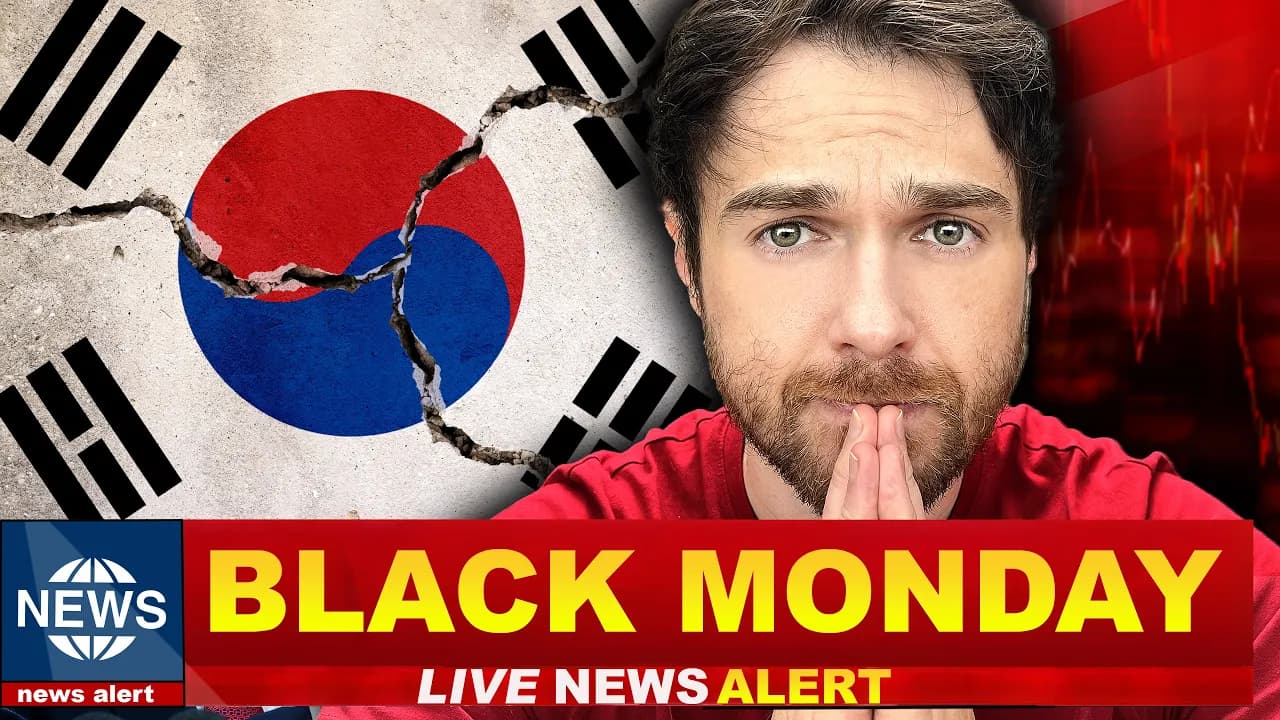
Korea's stock market has just undergone the fastest and largest drop ever in history, having fallen more than 20% in the last few weeks. Many of the same conditions are showing up in the United States: extreme concentration in just a few stocks, a massive rally being driven by AI, record amounts of retail leverage, and everybody piling into the same trade while the market is priced at its most expensive level since the dot-com bubble.
Just like the S&P 500 in the United States, Korea has the KOSPI index, which for a while was one of the best performing markets on the planet. The problem started when just two stocks made up more than 50% of their entire stock market index, meaning their diversified index of stocks was basically a giant bet on memory chips.
Earlier this year, Korea approved a 2x single stock leveraged ETF product that had never really existed before. In the first few months, 13.8 trillion won was chasing a rally that had already tripled. On June 22nd, Korea's top financial regulator publicly warned that the leveraged products had become dangerously overheated and even said he wished he had blocked those ETFs from ever launching. This led to a frantic and dramatic sell-off where chip stocks fell, but because they were leveraged, it forced margin calls, forcing even more sales, forcing the price to fall even further, forcing even more sales. Regulators have now banned single stock leveraged ETFs entirely and tripled the minimum deposit just to trade the existing ones.
Korea's crash required five ingredients: extreme concentration, a massive preceding rally, leveraged retail speculation, foreign selling, and doubts about AI. When going down that list, it is eerily similar to what we're experiencing today in the United States.
The S&P 500 is sitting around 7,400, which is about 8% higher than it was at the beginning of the year. The largest 10 stocks now make up roughly 37% of the entire S&P 500. Nvidia and Apple alone are almost 15%, and information technology as a sector is 38%. If those companies make up 37% of the index and they fall 25%, that is a 9% drop in the S&P 500 before the panic selling even begins.
The S&P 500's forward price-to-earnings ratio is about 20.7, which compared to the 10-year average of 19 isn't crazy. However, the Shiller CAPE ratio is sitting at 41, almost matching the dot-com peak which topped out at 44. The Buffett indicator, which measures total market value versus GDP, is sitting at 219, more than two standard deviations above trend. By almost every long-term standard metric, this is one of the most expensive stock markets ever in history.
Finra just reported that margin debt hit approximately 1 and 1/2 trillion dollars in June. This means that investors aren't just buying stocks, they are borrowing money to be able to put it in the stock market. The additional buying power certainly pushes prices higher when times are good, but it's also that much more brutal when prices eventually do fall.
Professional money managers are only holding about 3.6% of their portfolio in cash, which is basically all in on equities. Positioning is kind of maxed out and nobody's hedged.
US insiders are selling stocks at the fastest pace in history and are buying at only half the amount they normally do. Insiders do sell stocks for a million reasons including hedging, taxes, and diversification, some of it pre-planned in advance. When combined with record-high valuations, it's not exactly a vote of confidence either.
Incogni works by locating the websites that buy and sell your personal data, sending out legal requests to get them to remove this from databases. Incogni handles the process of making sure data brokers comply and follows up because data brokers continue collecting information even after they've removed it. Their unlimited plan now allows submission of custom links for removal. The service is available risk-free for 30 days.
Goldman Sachs just raised their year-end S&P 500 target to 8,000, up from 7,600. Their projections are based on earnings, projecting the S&P 500 to generate $340 a share this year, which works out to be 24% growth. Morgan Stanley believes the S&P 500 will rise this year, ending at 7,800. Citibank sees 7,700, and both JP Morgan and Wells Fargo see a relatively flat market for these next few months. No major bank sees anything other than that.
Blended earnings growth is now running near 25%, revenue growth is near 13%, 88% of companies are beating estimates, and analysts expect that momentum to continue throughout the rest of the year. The stock market rally is actually broadening with the Russell 2000 small caps up over 16% this year. The equal weight S&P 500 recently hit record highs. Corporate buybacks are already coming in at over $400 billion announced through late April, up 20% from last year.
The United States stock market is structurally different from Korea's. America's largest company makes up about 7% of the S&P 500 compared to Korea where two companies made up 50%. America's market has the deepest, most diverse buyer pool in the world including pensions, funds, institutions, other countries, and its own citizens. Korea's market was primarily funded by leveraged ETFs within their own citizens betting on very specific companies. America's leveraged single stock ETFs do exist but are a fraction of the overall market and don't make up anywhere close to what happened in Korea.
Earlier this year, Goldman Sachs published a scenario where an oil shock from the Iran conflict drags the S&P 500 down to 5400. The spread between their bull case and bear case was the widest range they've published since 2020. Barclays has mapped out a bear case near 5900. Veteran strategist Ed Yardeni recently raised his probability of a market meltdown to 35% citing the collision of the Iran oil shock with existing trade pressures.
The bull case depends on 24% earnings growth actually happening. It assumes sustained double-digit revenue growth, continued margin expansion, successful AI monetization, no recession, and no spike in interest rates. If earnings just disappoint and fall 5% while the price-to-earnings ratio compresses down to 16, that would be a 25% drop in the S&P 500 without a recession, without a catastrophe, without any panic selling.
The five biggest hyperscalers are expected to increase capital expenditures by roughly 534 billion through 2027, while their operating cash flows only grow by about 340 billion. This means they're spending about $1.57 for every dollar they get back. This can work if AI growth continues and they eventually scale up to these valuations, but if it doesn't, that's something to keep in mind.
On more than half of the trading days, the S&P 500 has moved in the opposite direction of the majority of its own stocks. This level of divergence hasn't been seen since the year 2000 and is usually a sign that something is wrong.
Money managers are 96% invested, so there's limited remaining buying power. Credit spreads are at 2.7%, which means bond investors are being paid almost nothing for the risk. Oil is constantly back and forth above $90 to $100.
The bear case is not that everything goes wrong. It's that market expectations go back to normal, and normal's still a long way down.
The honest answer is probably not that the United States is going to pull a Korea. Korea's market had two companies making up over half the index compared to America's 10 companies making up 37%. Korea's crash was accelerated by billions of dollars of leveraged ETFs that had to sell into every decline. America's leverage products only make up a fraction of the market. America has decades worth of circuit breakers ready to step in, deep institutional buyers, and trillions of dollars of 401k inflows that automatically buy every other week, no matter what. Korea's sell-off was triggered by their own public trash talking of the rally.
The lesson is that concentration plus leverage plus euphoria could lead to a pretty disastrous outcome extremely quickly. Even if you just own the index, a 20 to 40% decline is a tough pill to swallow, but it's not necessarily catastrophic if you're just able to hold through it and aren't forced to sell.
The typical person should maintain a 3-6 month emergency fund kept in cash at all times. Diversify across the United States, international markets, real estate, commodities, gold, maybe some alternative assets. Avoid leverage at all costs because it's too risky in the event the market falls. You never want to be forced to sell something unless you absolutely need to.
A 20-year holding period in the S&P 500 has so far never produced a negative result. If you just buy today and hold for 20 years, the stats are pretty good that you're going to end up making a lot of money during that time frame. The market does not have to be a bubble to be dangerous and it doesn't have to crash for you to get a good deal. All you have to do is stay patient and keep buying in.
Keep Graham Stephan in your library
Save the videos and channels worth coming back to, and find them again in one place.