South Korea’s AI Bubble Just Popped
In a Nutshell
South Korea’s KOSPI crashed 25% in three weeks after Samsung and SK Hynix—over half the index—plummeted on U.S. AI-spending fears, wiping out 320,000 leveraged retail accounts and triggering government intervention. The market’s extreme concentration, combined with widespread margin debt and 2x-3x leveraged ETFs, turned normal selling into a self-reinforcing liquidation spiral. U.S. margin debt now sits at a record 4.5% of GDP and the same hyperscaler AI capex that fueled the Korean rally is the single point of failure that could ignite an identical unwind stateside.
These notes were generated by AI and may contain inaccuracies.
Three weeks prior to the video, South Korea's KOSPI was the best-performing stock market globally, rising nearly 200% over the previous 12 months. By comparison, the US S&P 500 gained only 24% during the same period. Samsung rose over 500% at one point during the year, while SK Hynix surged more than 1,000%.
The US S&P 500 has its top 10 companies representing 36% of the index. In contrast, just two companies—Samsung and SK Hynix—account for over 56% of the entire KOSPI. This concentration stems largely from retail investors, with roughly 14 million individuals borrowing money to invest in these two stocks.
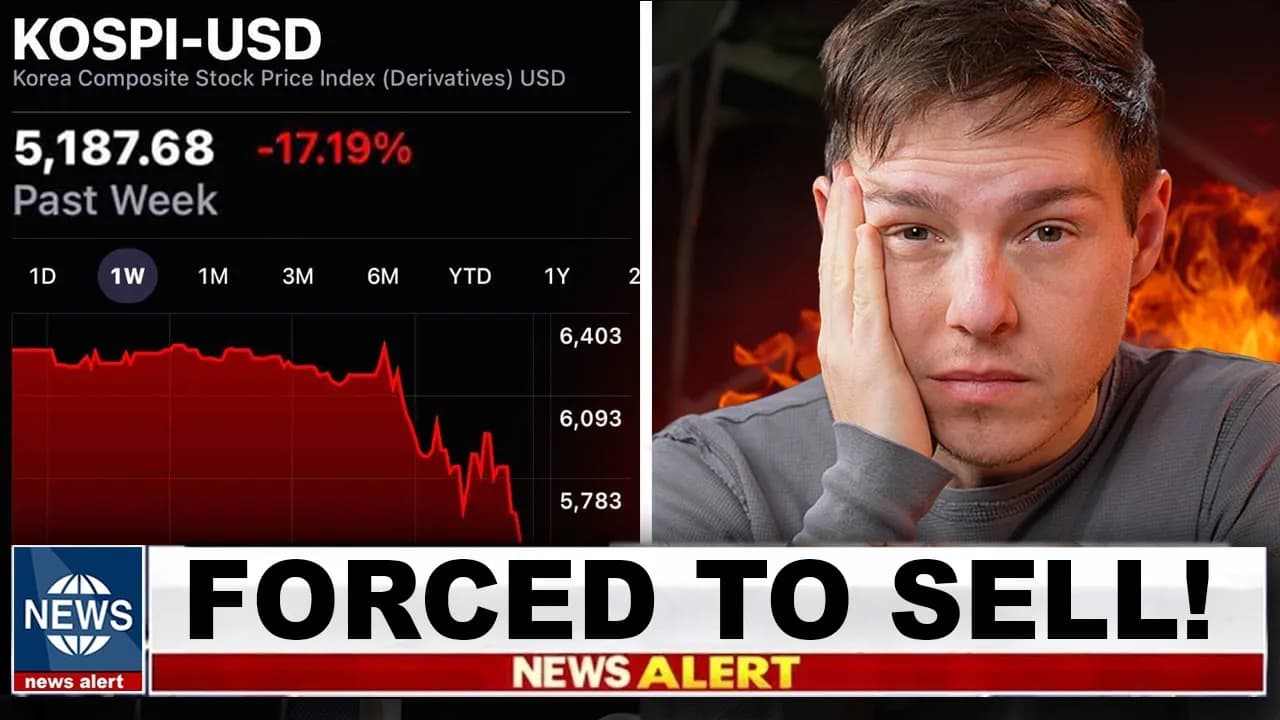
Within 21 days, the KOSPI dropped 25%. This triggered margin call thresholds in 1.2 million accounts—equivalent to one in every 30 people in South Korea. Over 3 trillion won in investments were automatically liquidated by brokers. Approximately 320,000 accounts were wiped out, some overnight. The South Korean president convened an emergency intervention for the stock market.
South Korea operates a faster, smaller-scale version of the same leverage-driven market structure used in the United States. The Korean events may serve as a preview of potential developments in the US market.
South Korea has 51 million people, with 14 million (one in four) participating as retail investors, often called "ants." Cultural expectations pressure young people to secure good jobs, own homes, and start families by certain ages. With housing prices making homeownership unrealistic for many, a generation turned to the stock market as their primary wealth-building vehicle. Finance influencers described the stock market as the "last chance" to build wealth.
Retail investors did not merely invest—they used heavy leverage, taking out personal loans and borrowing against salaries. Many purchased leveraged ETFs rather than regular stocks. A 2x leveraged ETF doubles market gains or losses; a 3x fund triples them. One investor featured in a documentary had a $650,000 portfolio up 150%, primarily in leveraged ETFs, but concealed her positions from family. At the peak, Koreans invested approximately 10 trillion won into leveraged funds focused on a single company. The government later acknowledged allowing such leverage may have been a mistake.
Samsung and SK Hynix together comprise more than half the KOSPI, making the Korean market effectively trade like a volatile two-stock index despite technically containing hundreds of companies. The rally originated from AI demand for memory chips used in data centers. US companies including Microsoft, Google, Amazon, and Meta spent $376 billion on AI infrastructure in 2025 and were projected to spend $725 billion in 2026, with substantial funds flowing to Korean semiconductor firms.
Korean retail investors and the broader economy bet on continued American AI capital expenditures. By July, Korea had the world's most concentrated major stock market, supported by leveraged retail investors assuming the AI trade would continue indefinitely.
US memory chip stocks began declining in late June due to investor nervousness ahead of Micron's earnings. This selloff spread to Korea with greater intensity because of the KOSPI's lack of diversification. In one session, the KOSPI fell 4.6%. Samsung and SK Hynix each dropped more than 9% in a single day. On "Black Tuesday," the KOSPI declined over 10% in one day—one of the worst single-day drops in Korean market history. A comparable 10% drop in the US would rank as the third-worst day ever, behind only 1987 and the Great Depression.
When stocks bought with borrowed money fall to certain levels, brokers issue margin calls requiring additional cash deposits or automatic liquidation. Forced selling drives prices lower, triggering further margin calls in a self-reinforcing cycle. Normally, about 2% of Korean margin accounts face forced liquidation; during the crash, the rate exceeded 10%. Leveraged ETFs worsened the situation: a 3x fund on SK Hynix would lose 30% if the underlying stock fell 10%, and daily rebalancing required selling into declining markets. Over the following two days, more than $600 billion was erased from Asian markets. Japan, Taiwan, Hong Kong, and China all declined. The only factor temporarily halting further KOSPI losses was a national holiday closure.
The South Korean president, who had previously encouraged stock market participation, called an emergency stabilization meeting. Leverage remains present in the system.
US margin debt as a percentage of GDP reached approximately 4.5% as of June 2026—the highest level in American history, exceeding peaks before the dot-com bubble, 2007 financial crisis, and 2021 meme stock period. Historical instances of margin debt extremes were followed by major market declines: June 1968 (pre-1/3 loss), December 1972 (pre-1973 crash), August 1987 (pre-Black Monday), March 2000 (dot-com peak), July 2007 (pre-financial crisis), January 2018, and August 2021. Official margin statistics capture only traditional brokerage margin loans and exclude leveraged ETFs, options, portfolio margin, and private credit, meaning actual leverage is higher than reported.
The top 10 stocks represent 36% of the S&P 500, with most tied to the AI narrative: Nvidia sells chips, Microsoft/Meta/Google buy them, and Micron supplies memory. AI spending by Microsoft, Google, Amazon, and Meta totals roughly three-quarters of a trillion dollars annually—matching the revenue of Nvidia, Micron, and the broader AI trade. Jim Chanos noted that returns on hyperscaler AI investments declined from approximately 40% operating income per incremental dollar invested a year and a half earlier to about 20% currently, trending toward 10%. Unprofitable AI companies (OpenAI and Anthropic accounting for 70-80% of AI compute demand) justify hyperscaler spending, which supports chip earnings and the leveraged stock market.
IPOs in 2026 reached over 12% of GDP in post-IPO market cap, more than double the 5% peak during the dot-com bubble. High IPO volume historically signals insiders selling at peak valuations.
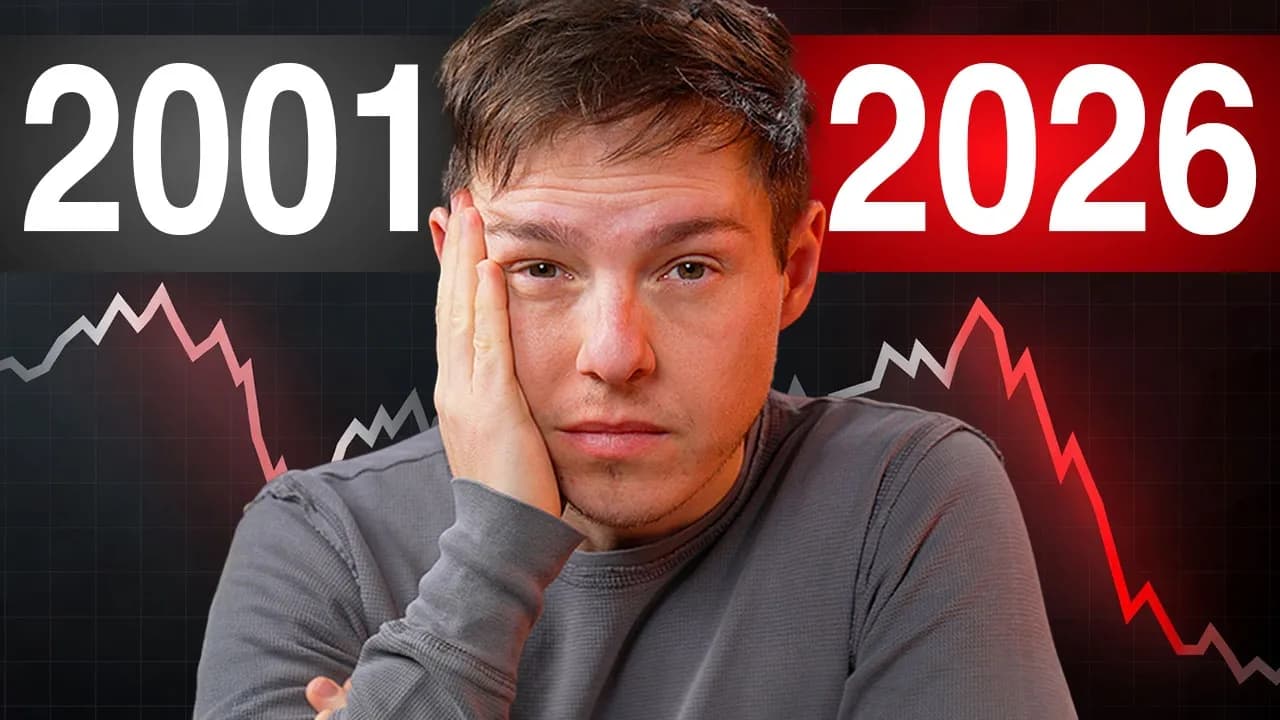
The critical metric to monitor is capital expenditures by Microsoft, Google, Amazon, and Meta. A single announcement of reduced AI spending by any of these companies could trigger widespread selling. Historical precedent includes Cisco's 2000-2001 experience when Coca-Cola's router orders fell from 10,000 to 2,000, collapsing Cisco earnings and contributing to a 78% NASDAQ decline. Jim Chanos anticipates potential reassessment of AI returns in late 2026 or 2027.
Scenario one: The Korean crisis remains contained, memory prices stabilize, hyperscalers maintain spending through 2027, and the KOSPI recovers. Some analysts project 6-12 additional months of AI growth. Scenario two: Korea represents the first domino; a hyperscaler CapEx cut initiates unwinding of record US margin debt (4.5% of GDP), producing margin calls, forced selling, and government intervention similar to Korea's experience.
Analysts express strong confidence that AI growth will continue and that current conditions do not constitute a bubble. A historical parallel notes that after the Titanic struck an iceberg, the vice president of the owning company stated absolute confidence in the vessel's unsinkability. Korean investors similarly expressed confidence three weeks before the crash.
Keep Andrei Jikh in your library
Save the videos and channels worth coming back to, and find them again in one place.