The Exact Order To Invest Your Money (Most People Get This Wrong)
In a Nutshell
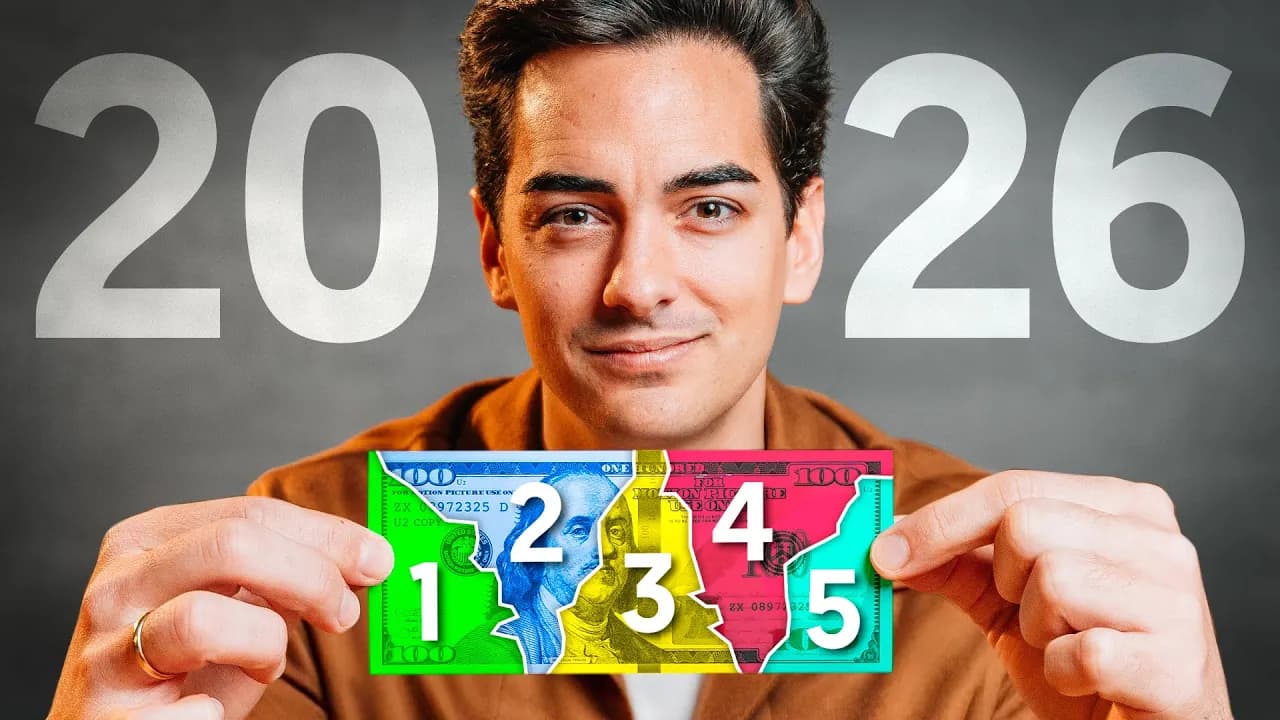
The exact order to invest prioritizes: (1) Build an emergency fund of 3-6 months expenses in high-yield savings; (2) Pay off high-interest debt (>8% APR) for guaranteed returns; (3) Capture full employer 401k match (50-100% instant return); (4) Max IRA ($7k/$8k limit); (5) Max HSA if eligible (triple tax-free); (6) Max 401k ($23.5k/$31k); (7) Taxable brokerage. Skipping this sequence forfeits tens of thousands to fees, taxes, and bad decisions—focus on boring foundations like emergency funds and debt payoff before aggressive investing to build real wealth through compounding. Consistency in this order outperforms 90% of people without needing hot stocks.
These notes were generated by AI and may contain inaccuracies.
One in three Americans has no emergency fund. Zero. Median amount for those who do: $500, down from $600 a year ago. Half the country debates Bitcoin or individual stocks while having a bucket full of holes. The order of investing matters as much as the amount. Get sequence wrong: leave tens of thousands on the table over lifetime. Get it right: lap peers without picking hot stocks. Most skip boring foundational stuff that builds real wealth.
Emergency fund isn't just money for car breakdown or boiler failure. It's a psychological safety net preventing catastrophically bad decisions. Without it: transmission blows in February, $3,000 in brokerage down 15%, sell at worst time, lock in loss, rack up interest on uncovered amount. Real cost: cascade of bad decisions, second/third/fourth order effects.
Vanguard studied 12,000+ investors: those with at least $2,000 emergency savings had financial well-being scores 21% higher than none. Biggest boost of any factor, larger than $500,000 income or $1 million portfolio. Not $200,000, just $2,000—psychological impact enormous.
How to Build Emergency Fund
- Start with $1,000 as fast as possible: covers most minor emergencies, changes money mindset immediately.
- Then 1 month expenses.
- Target: 3-6 months actual living expenses (not income), in high-yield savings account, liquid, earning yield.
- Alternatives: e.g., ESGOV SV. Protect purchasing power—cash is melting ice cube due to inflation. This is safety net, not for making money; preserve purchasing power elsewhere.
Average credit card interest: over 22%. Warren Buffett's Berkshire Hathaway long-term average: ~20%. Carrying credit card balance while investing in stocks: losing race monthly. Paying off high-interest debt: guaranteed return as investor. Most ignore because doesn't feel like investing.
Example: $5,000 credit card debt at 22%, minimum payments: pay ~$2,800 interest over 5 years (almost $3,000 working against you). Every dollar at debt: guaranteed 22% return tax-free. No index fund guarantees that.
Rule: Debt above ~8% annual interest before aggressive investing.
Debt Payoff Strategies
- Debt avalanche (mathematically efficient): list debts, pay minimums, extra dollars at highest interest first.
- Snowball method: smallest balance first for psychological win. Best strategy: one you stick to, like diet.
- Math: avalanche wins.
Thermometer rule: Below 8%, invest (e.g., 0% car loan—free money, put in ESGOV/high-yield savings/stocks). Above 8%, especially teens/20s: pay off immediately.
Exception to debt-first: employer matching contributions on retirement account—capture every dollar before almost anything else, even high-interest debt.
Typical match: 50 cents per dollar up to 6% salary. Example: $50,000 salary, contribute $3,000 (6%), employer adds $1,500 (50% immediate return before investments earn). No credit card beats guaranteed 50% day one. Free money employer obligated to give.
Check vesting schedule (some require 2-4 years stay). Even with vesting, math usually favors. Strategy: contribute just enough for full match, redirect rest to high-interest debt. Once debt gone, ramp up. Never leave match on table—sometimes 100% match.
After match and debt progress: IRA (individual retirement account) before maximizing 401k. IRA offers complete control vs. 401k's limited mutual funds (1-2% expense ratios).
Over 30 years, 1% fee vs. 0.03% index fund: tens of thousands lost to compounding.
2025 limits: $7,000 under 50, $8,000 50+.
Traditional vs. Roth IRA
- Traditional: tax deduction now, pay taxes on withdrawal in retirement.
- Roth: pay taxes now, tax-free withdrawals/growth in retirement.
- Early career/low bracket: Roth (pay low rate now, future untaxed).
- Peak earning/high bracket: Traditional (big deduction now).
- Unsure: split for tax diversification/flexibility.
HSA: most powerful investment account if qualify. Triple tax advantage:
- Tax deduction on contribution.
- Tax-free growth.
- Tax-free withdrawals for qualified medical expenses. No other account does all three.
2025 limits: $4,300 individual, $8,550 family. Requires high-deductible health plan (HDHP)—not for everyone, best if young/healthy/low medical spend.
Strategy: pay medical bills out-of-pocket, invest HSA in market, keep receipts. No time limit on tax-free reimbursement (e.g., reimburse 20 years later). After 65: like second traditional IRA (withdraw anything, pay income tax on non-medical).
Medical expenses guaranteed: Fidelity estimate average couple: $300,000+ healthcare in retirement. Max HSA 30 years at 7%: $400,000+ tax-free. Cheat code.
After match, max IRA/HSA: return to 401k, max it. 2025 limits: $23,500 under 50, $31,000 50+. Total shelter: ~$35,000/year tax-free. Average savings rate: 4-5% income—doesn't cover match.
Following sequence: top 5% savers.
Then taxable brokerage: total flexibility, no limits/restrictions (e.g., house down payment, early retirement bridge). Tax drag real: $10,000/year 30 years 7% tax-advantaged: ~$944,000. Taxable (after dividend/capital gains taxes): ~$700,000 ($244,000 tax difference).
- Emergency fund (foundation).
- High-interest debt (guaranteed tax-free return).
- Employer match (50-100% return, sometimes before debt).
- IRA.
- HSA (if qualify).
- Max 401k.
- Taxable accounts.
Investing since 2006 (age 18). Owned rentals, in market, built on one income. Advice to younger self: follow this sequence, especially 20s/30s for compounding. Not glamorous—financially free in 40s via boring stuff in right order, diligence.
Repeat sequence: emergency fund, kill high-interest debt, grab employer match, max IRA, HSA if qualify, fill 401k, then taxable. Consistency laps 90%—not smarter, just not distracted.
Whiteboard Finance University: courses on personal finance/real estate/investing/stocks, live market streams Thursdays, show portfolio. $10/month. Link in description.
Keep Marko - WhiteBoard Finance in your library
Save the videos and channels worth coming back to, and find them again in one place.