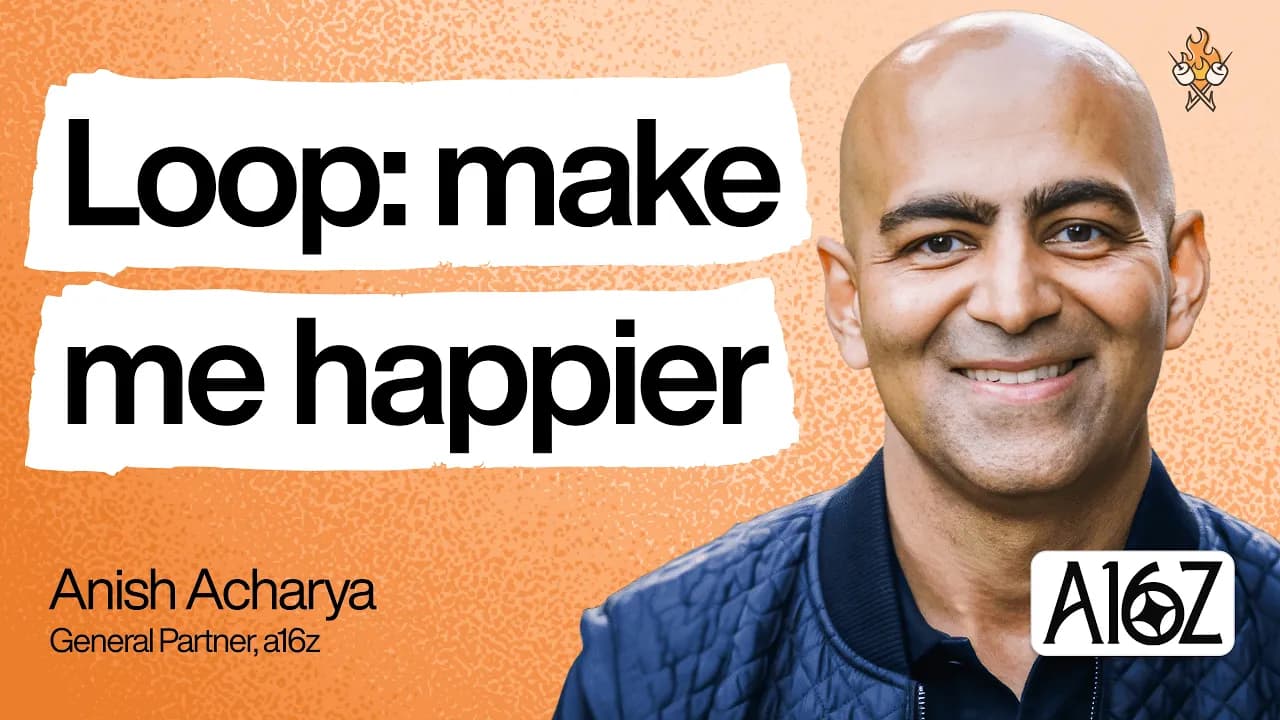
The Fastest Path to a $100M AI Business | Anish Acharya, a16z GP
In a Nutshell
Anish Acharya argues that current AI models enable genuine 100x product improvements, making product superiority—not distribution—the winning strategy. Founders should build narrow, deeply specialized products for small customer bases, charging high prices (like $200/month) to reach $100M with just 41,000 customers. The key is focusing on product problems over marketing, going insanely deep rather than broad, and testing extreme pricing to validate real value delivery.
These notes were generated by AI and may contain inaccuracies.
When a product cannot deliver 100x improvement over existing alternatives, distribution becomes the primary competitive factor. The common mistake founders make is convincing themselves that incremental improvements constitute dramatic leaps. A single silver bullet represents one dramatic improvement, whereas many lead bullets represent numerous small incremental improvements. Ten, fifty, or even one hundred lead bullets never equal a silver bullet. A genuine 100x value leap is required. With current AI models, silver bullets are abundant, making product superiority a viable winning strategy rather than relying solely on distribution advantages.
Anish Acharya is a general partner at Andreessen Horowitz investing from the AI apps fund, covering both consumer and enterprise opportunities. For consumer investments, preference leans toward companies that are weird and working. For enterprise investments, the focus is on companies that are working, though they may be weird. Anish identifies as an engineer and product person who writes code in his free time, describing the current period as an age of miracles and welcoming outreach from builders.
Customer acquisition cost represents a form of subsidy when customers lack sufficient motivation to try products independently. Organic product adoption occurs when customers are excited enough to try products without additional incentives. Early AI products including ChatGPT and Midjourney demonstrated this pattern, with all traffic being organic—a departure from consumer product adoption patterns observed over the previous decade.
Early data revealed two significant findings: substantial numbers of people were willing to pay for AI products, and AI companies exceeded previous expectations regarding customer payment ceilings. The non-trivial cost of goods sold for AI companies, particularly video generation products, necessitated charging real prices. Companies discovered that even as prices increased, customers remained willing to pay and often wanted to pay more.
Exploring the extreme case of high willingness to pay reveals two applications. First, software companies can achieve real revenue scale with relatively few customers—41,000 customers at $200 per month generates a $100 million run rate. Second, software should capture increasing portions of consumer spending over time, with AI and software products positioned to capture those dollars. This represents an optimistic prediction that more individuals will build large-scale AI companies while consumers have more needs met through software.
In the current environment, there are no marketing problems, only product problems. Products should not require customer acquisition costs today. Significant customer acquisition costs indicate insufficient product delivery. Founders can now deliver with unprecedented ambition, going insanely deep because models enable capabilities previously impossible.
Forty years of model development addressed intellectual aspects of human capability and society. Current AI models address the non-deterministic aspects of human experience including emotions, relationships, self-expression desires, and creative work. This represents a larger portion of human experience now addressable through technology.
AI code and related technologies collapse costs and difficulty of software creation, enabling small teams to build substantially more. Founders can execute at an order of magnitude lower cost, making it possible to go deep or go home rather than go bigger or go home.
Narrow startups build incredibly opinionated, deep products charging high prices for relatively small customer bases. The math shows 41,000 people paying $200 monthly creates a $100 million run rate business. Precedent exists with Google Ultra at $250 monthly, Grok at $300 monthly, OpenAI at $200 monthly, and Anthropic at $200 monthly. Consumers adopt these products organically and pay high prices because products deliver expected value.
The narrow startups approach involves building small, going deep, and charging a lot. Specialization serves as a new moat because founders can go much deeper for individual customers with collapsing software creation costs, making competitive products difficult to replicate without three years of roadmap development.
Building rich software ecosystems represents another competitive approach. Labs like ChatGPT attempt many things but may not prioritize building comprehensive software ecosystems around specific use cases. Meeting recorders that transcribe speech to text represent basic functionality, but capturing full value requires building complete office suites including spreadsheets, word processors, diary apps, and notes apps.
Product categories like AI code benefit from using multiple models simultaneously. Being able to use Anthropic, OpenAI, and Google models provides competitive advantage against labs that cannot build products using competitor models. Being multi-model serves as a competitive strategy in fintech and other domains.
Products can over-deliver on customer expectations, sometimes generating results better than customers imagined. When models must think hard to deliver extraordinary outcomes, the expense is justified and represents appropriate pricing. When products cannot deliver 100x improvement, distribution matters, but current models enable silver bullets everywhere.
Predicting total addressable market is considered a fool's errand and common source of failure for both investors and founders. Early founder thinking often focused on needing big markets without understanding specific market dynamics. Successful products emerged from building things founders wanted to see exist and felt passionate about, rather than TAM analysis.
When the iPhone App Store launched, only 6 million iPhones existed globally. Despite limited TAM, building there succeeded because the market felt like it was growing quickly and founders had energy for the opportunity. The lesson emphasizes focusing on value delivered to customers and willingness to pay rather than TAM considerations.
The most useful prompt for founders involves identifying the $1,000 monthly SKU of products. This requires determining what extraordinarily expensive products would need to accomplish, whether products deliver that value today, whether people would pay such prices, and whether pricing has been tested. Finding customers willing to pay dramatic prices indicates being on the right track, while free products requiring payment to customers for trial indicate being on the wrong track.
Paying customers typically receive value. Upstream factors like retention and customer acquisition cost provide measurable signals. Building in areas with great intuition enables feeling customer pain points directly. Customers often generate more roadmap ideas than founders. The overriding signal is inability to keep up with demand—the market pulling the product out of founders, often violently.
Founders face several psychological traps. Talking oneself into product-market fit indicates its absence. Seeking metrics to justify market fit rather than accepting business physics leads to unproductive calibration around retention and CAC benchmarks. Even best-in-class retention of 90% customer loss at year one creates difficult business conditions.
Power users represent a trap when founders mistake their satisfaction for broad market fit. Power users count as single data points on growth charts regardless of value received. Founders must either build for power users while capturing created value through narrow startup approaches, or build for mass market rather than substituting happy power users for broad market fit.
There are no marketing problems, only product problems. Be insanely ambitious on product, raise prices, adjust based on customer feedback, and avoid excessive focus on business books and frameworks. Build for small numbers of people, charge a lot, go insanely deep. This represents a 3-5-7 year opportunity rather than 20-30 year timeline. The abundance agenda means abundant capital and dramatic consumer interest in new products. Current conditions represent the best time to start companies seen in an entire career.
Keep EO in your library
Save the videos and channels worth coming back to, and find them again in one place.