The Last 5 Years of Labor
In a Nutshell
The automation abyss is already underway across thousands of individual value chains, with AI rapidly displacing human labor in specific tasks and workflows rather than through a single economy-wide event. Employment data shows real displacement: 376,000 information sector jobs lost since ChatGPT's launch, 284,000 customer service positions eliminated, AI cited as the leading cause of 120,000 layoffs in 2025, and young workers in AI-vulnerable roles seeing 11% employment drops. The critical insight is that while each value chain reaches its automation precipice at different times, once crossed, the wages from that work permanently disappear unless offset by ownership stakes in the automated systems.
These notes were generated by AI and may contain inaccuracies.
The automation abyss is happening now across every value chain individually. The speaker confirms belief in the automation abyss, stating it is occurring currently despite an earlier mistake in framing. In the book "Labor Zero," the prediction was that labor displacement would accelerate sharply with a tipping point before 2030.
In February 2025, a video titled "The Last Seven Years of Human Labor" was released. The concept originates from infrastructure automation engineering experience, where automation never occurs gradually. The automation engine processes nothing while being built and tested, then handles everything simultaneously upon execution.
Terraform allows changing one number in a file to provision either 10 or 10,000 servers. In 2011, Amazon published new code every 11.6 seconds on average, with 30,000 servers receiving updates simultaneously at peak moments. This demonstrates the rule: if something can be automated perfectly 10 times, it can be automated 10 billion times.
The UK Department for Work and Pensions had a backlog exceeding 30,000 pension claims. Using 12 software robots, the entire backlog was cleared within two weeks.
In 2025, Airbnb used artificial intelligence to rewrite thousands of test files. Engineers estimated the task would require 1.5 years manually, but AI completed 75% of the files in just 4 hours.
Companies do not automate entire operations simultaneously. Instead, they automate individual tasks, workflows, or jobs with specific requirements. A value chain represents what a business actually offers, distinct from how employees perceive workflows.
In 1998, lean manufacturing experts defined value chains: whenever a product exists for a customer, a value chain is created alongside it. The challenge is visibility. Successful value chain automation assumes control of the entire workload at once.
In February 2024, Klarna reported that its AI customer service assistant handled 2.3 million conversations in its first month, representing approximately two-thirds of all customer service conversations. This equated to the work of 700 full-time employees, with response times dropping from 11 minutes to under 2 minutes.
Salesforce CEO Marc Benioff reported reducing support team size from 9,000 to approximately 5,000 employees due to reduced staffing needs.
Duolingo spent approximately 12 years building its first 100 language courses. In April 2025, the company launched 148 new AI-created courses within one year.
At Goldman Sachs, teams of six people spent two weeks writing IPO prospectuses. AI now drafts 95% of these documents in minutes. CEO David Solomon stated: "The last 5% is what matters now, because the rest has become a readily available commodity."
In 2025, the Commonwealth Bank of Australia eliminated 45 call center jobs after implementing a voice robot. The bank reversed these decisions weeks later and apologized, acknowledging the positions were not actually redundant.
Klarna's CEO admitted excessive focus on cost had negatively impacted service quality. The company began rehiring people, with the CEO now describing human support as "VIP treatment."
The automation rule contains a critical flaw in the word "perfectly." Traditional software performs identically each time, but AI does not. Andrei Karpathy noted that a 90% working demo represents only the first nine. Each subsequent nine (99%, 99.9%) requires substantial additional work.
Each value chain must progress through its own sequence of nines before reaching its automation precipice. Some value chains reach this point within months, while others require years.
In 2012, Knight Capital's faulty code, intended to fulfill 212 customer requests, generated over 4 million requests within 45 minutes.
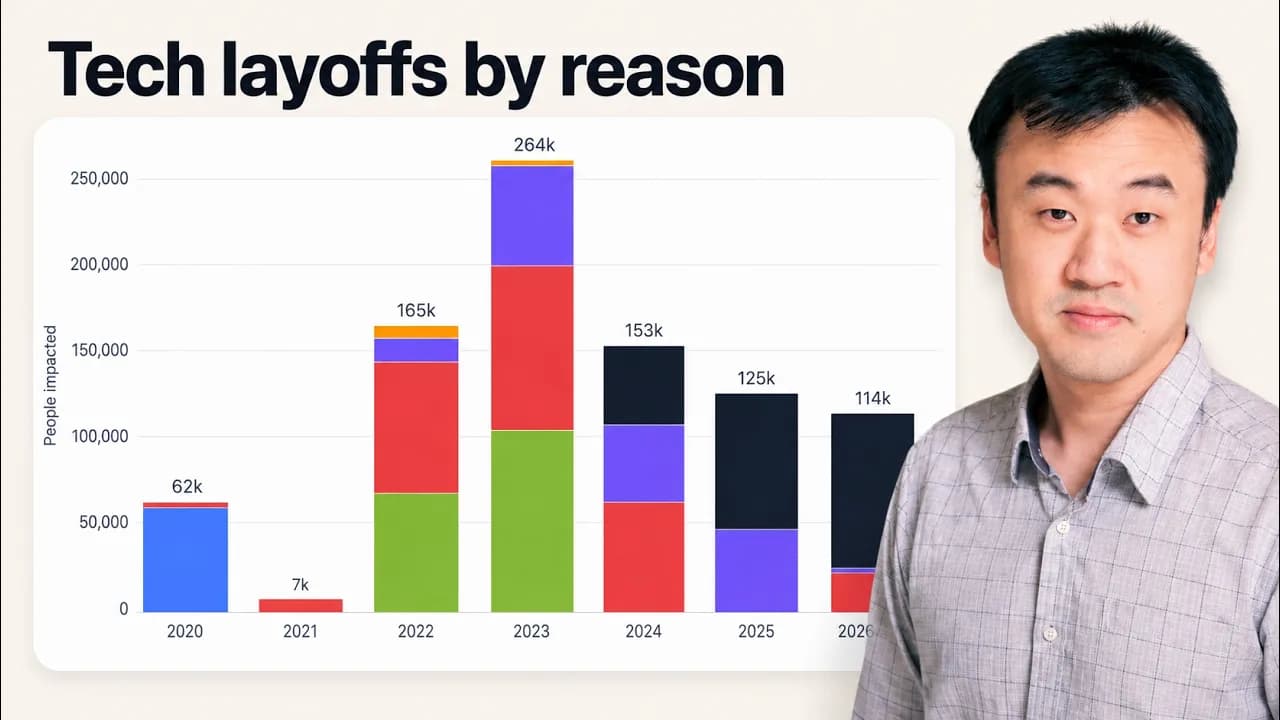
Between November 2022 (ChatGPT release) and September of the current year, information sector employment dropped from 3.12 million to 2.74 million Americans, representing a loss of 376,000 jobs or approximately one job every 5 minutes continuously for nearly 4 years.
Despite the 376,000 job losses in information sector, total employment grew by 3% during the same period. Contributing factors included pandemic overemployment, rising interest rates, and Hollywood strikes.
US call center employment reached 307,200, the lowest level since 1994. Customer service representative positions decreased by approximately 284,000 jobs over three years.
Computer programmer positions decreased by 30% while software developer positions grew by 10%. Freelance platform postings for writing and programming jobs decreased by 21% within 8 months of ChatGPT's launch.
From January to September of the current year, American employers attributed 120,136 job eliminations to artificial intelligence, making AI the leading cause of layoffs and more than doubling the previous year's total.
Sam Altman stated: "There's some over-reliance on AI where people blame it for layoffs they would have made anyway, and there's also real displacement of some types of jobs because of AI."
The automation abyss is real but consists of thousands of individual abysses, one for each value path, breaking at different times. Innovation arrives as single leaps, but economic spread occurs gradually. Each value path creates its own abyss, combining to form a smooth economic curve.
Companies in five of the Federal Reserve's twelve regions have reduced workforce through natural attrition or delayed hiring after AI investments.
Stanford University research found that employment rates for workers aged 22-25 in AI-vulnerable jobs decreased by 11% since late 2022. Employment rates for young workers in less vulnerable jobs grew by approximately 10% during the same period.
A post-labor economy is defined as a model where human labor is not a binding constraint on economic activity or productivity. Each automation abyss represents an additional location where this occurs.
When value chains cross their precipice, work continues but wages previously derived from that work do not return. Ownership becomes critical: if income derives solely from work, each abyss removes income portions. However, ownership stakes in machines ensure each abyss provides returns.
Automation occurs gradually across individual queues, sections, and value chains rather than through a single economy-wide event. The process has already begun.
Keep David Shapiro in your library
Save the videos and channels worth coming back to, and find them again in one place.