The ONLY 2 Exercises You Need to Fix Your Flat Butt
These notes were generated by AI and may contain inaccuracies.
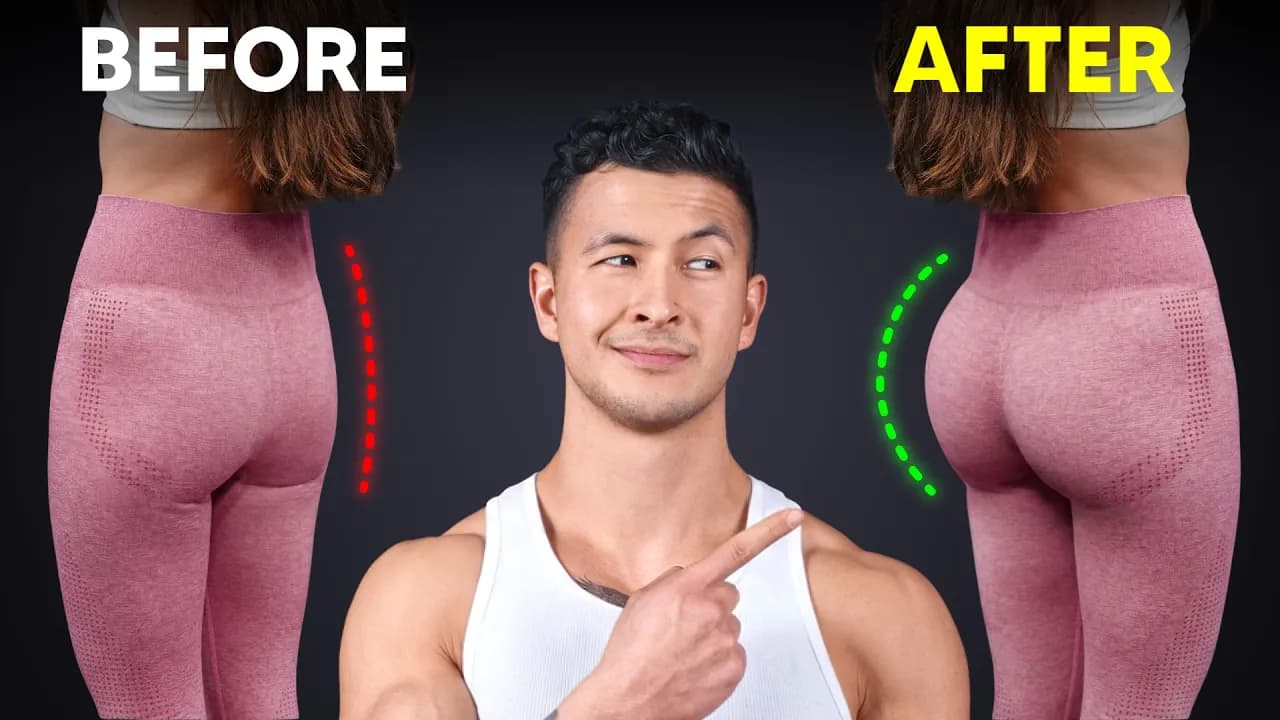
Weak and underdeveloped glutes cause strength stalls, posture breakdown, and nagging back pain. Two exercises fix this, improving movement, jump height, and running speed. These come from glute expert Brett Contreras, inventor of the hip thrust, who has helped thousands build stronger glutes. Can be done at home. First exercise is new to most; second has a bonus technique that transformed results.
Glutes consist of three muscles; largest is gluteus maximus. Weakens from sitting all day without proper training, leading to posture issues and back pain. Main function is hip extension (deadlifts, squats). Surprisingly, Brett didn't choose those for top growth.
I think the reverse lunge is the best, but it's too good. It makes you too sore. If I have you do dumbbell walking lunges to failure... Your glutes get too sore. Your glutes, your adductors, everything gets so sore.
Lunges, squats, deadlifts work glutes but have three problems:
- Taxing compound movements; other muscles (lower back, grip) fail first, leaving 7-8 reps in glutes.
- Weak glutes mean other muscles steal gains.
- Excessive soreness (e.g., Bulgarian split squats brutal, delays recovery).
Personal example: Squats used to hit glutes well, but after neglect, inner thighs and quads dominated despite heavy weights. Strong squats/deadlifts don't guarantee glute growth.
Brett's solution: step-up (actually glute-focused step down), low soreness, allows 2-3x/week training (at least 2x).
The step-up does not get you as sore. And therefore, you can perform it more frequently. And we want to train glutes two to three times a week. At least twice a week. If you can handle three times a week, have at it.
Bodyweight setup: Stand on platform (bench). Step back, keep back leg in line with torso, lean forward, sit way back. Tap ground, come up. Reach back further. At bottom, freeze: 45-degree torso angle for stretch.
Similar to lunge/split squat but one leg in air + form tweaks force glutes to do most work. Highly effective even bodyweight.
Setup alternatives: Use bench next to rack/equipment for balance. No custom platform needed.
- Slowly push hips back, fold torso.
- Reach back leg to lightly touch ground.
- Drive hips forward using planted-leg glute, no momentum.
- Keep knee over foot (not forward over toes) to avoid quads.
- Bench height: front thigh parallel to ground at bottom.
- Too high? Add plate under back foot.
- Home: sturdy chair + counter.
- Progress with weight.
Weighted version: Hold dumbbell in opposite hand. Forces stabilization:
- Standing: mostly glute medius (outer upper glute).
- In stretch: gluteus maximus + counteracts rotational torque.
Now a workout staple; added to Built with Science Plus app with form guide and tracking.
Step down hits glutes in stretched position (builds lower glutes). Pair with squeeze-position exercise for full round shape (upper glutes).
Past bias: stretch-focused grow faster. But study with Brett compared stretch vs. squeeze for glutes: combine both for biggest growth benefit (full study in linked video).
I've seen big strong dudes that squat 315, 405. They didn't have end-range hip extension strength. So, they were prone to getting low back pain because they want to anterior tilt and put everything in the flex position. When you have extended range hip extension strength, you noticed you start noticing good things. Your body starts distributing stress better, squats feel better, deadlifts feel better, you start taking longer strides when you walk.
Hip thrust builds this strength.
Embarrassed? You're okay bending over with barbell but not thrusting? Alternatives: single-leg dumbbell hip thrust (home-friendly).
- Upper back high on bench for stability.
- Feet far enough: knees over feet at top (too close = quads; too far = hamstrings).
- Brace core, squeeze glutes, drive hips up.
Bonus: Scoop method (game-changer):
- Tuck chin, eyes forward.
- Arch back at bottom, move sternum down, tilt pelvis up by squeezing glutes. Feels weird, less weight/height, but maximizes glute activation. Chin tuck key.
What I'll say if he wants to be pure hingy, your gaze will go like this. Come up like that. And you'll push as tall as you can possibly go. That's like pure hinge. Now I'll show you more pure scoop. Look forward. Move the sternum down. Tilt the pelvis this way... Now do a blend. I kind of like the scoop.
Hinge method: Look forward at bottom, up at top, straight line.
60% of Brett's clients prefer scoop; 40% hinge. Experiment to find best.
Scoop benefits: Helps back pain (e.g., wife avoided hip thrusts after slip; now heavy pain-free with chin tuck). 90-day glute growth challenge with wife.
Brett: 3 sets of 8-12 reps, 2-3x/week.
Full leg workout example provided (personalize via Built with Science Plus app): form guides, progress tracking, personalized plans, training/nutrition in one place, AI coaching with your data.
Try free 2 weeks: buildwithscience.com or QR code.
Next video: two exercises that transformed shoulder growth.
Keep Jeremy Ethier in your library
Save the videos and channels worth coming back to, and find them again in one place.