The ONLY 5 ETFs You'll Ever Need (Hold FOREVER)
In a Nutshell
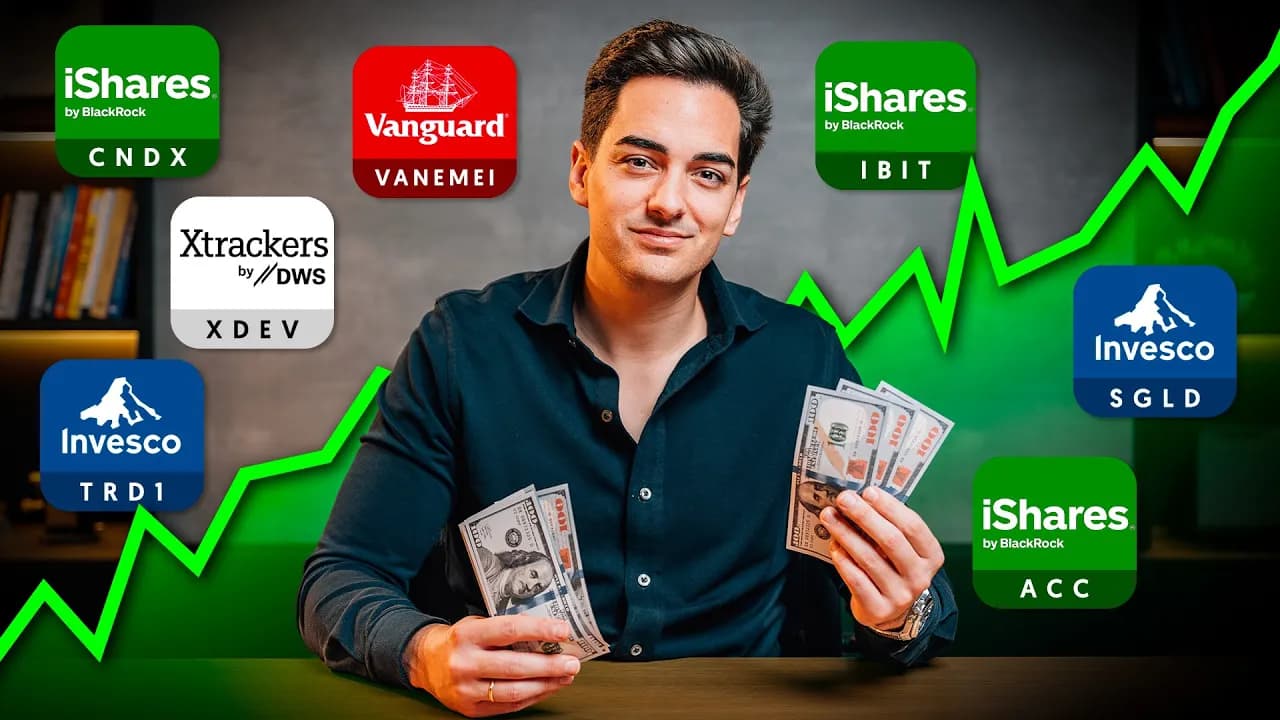
The video recommends a simple four-ETF portfolio for long-term holding: VTI (or an S&P 500 ETF) for broad U.S. equity exposure, VT for global diversification, SCHD for dividend income, and SGOV for near-risk-free cash yield. These funds provide automatic rebalancing, low costs, and coverage across market caps, geographies, and asset types without needing bonds or complex tilts. The fifth element emphasized is investing in personal skills and passion projects to build long-term wealth beyond market returns.
These notes were generated by AI and may contain inaccuracies.
The speaker introduces the concept of five ETFs that form a complete, resilient portfolio suitable for long-term holding through any market conditions. After 20 years of investing experience, the recommendation is to avoid overcomplicating portfolio construction.
The base of any portfolio should be broad US equity exposure. The S&P 500 tracks the 500 largest US companies including Apple, Nvidia, Amazon, Microsoft, and Meta. VTI tracks the entire US stock market, covering approximately 3,500 companies and including mid-cap and small-cap stocks beyond the S&P 500.
Historically, both have delivered returns around 10% annualized over the long run. Since the modern S&P 500 index was established in the late 1950s, short-term periods may see one outperform the other, but returns converge over decades. In classic financial planning, the foundation would typically be insurance, but here the equity foundation is established first with VTI or an S&P 500 ETF.
Most American investors hold only US stocks and consider themselves diversified. VT provides exposure to the entire world stock market, covering approximately 9,000 companies at the time of recording. The allocation is roughly 60% US and 40% international, including developed markets (Europe, Japan, Canada, Australia) and emerging markets (Asia).
International markets have outperformed US markets during certain decades such as the 1970s and 2000s. VT rebalances automatically and carries an expense ratio of 0.06%, or $6 per $10,000 invested. This single fund provides complete global equities exposure.
SCHD is a dividend-focused ETF from Schwab that holds high-quality US companies with long track records of paying and growing dividends. Top holdings at the time of recording include Texas Instruments, Qualcomm, Coca-Cola, and Verizon. These companies have maintained dividend payments through recessions, pandemics, and rate hikes.
The dividend yield is 3.22% at the time of recording. An investment of $50,000 would generate approximately $1,610 annually in dividends. Dividends can be taken as cash or reinvested via DRIP. The expense ratio is 0.06%. The speaker owns a significant position in SCHD.
The video is sponsored by Webull. Recent changes include updated intraday margin rules that now apply uniformly regardless of account size. Webull launched an MCP server allowing direct connection of brokerage accounts to AI tools such as Claude and ChatGPT for analysis of watchlists and positions. The platform offers free institutional-grade charting, real-time data, and paper trading. Vega AI provides real-time chart explanations.
Webull Premium offers 3.35% APY. A promotion provides eligible users $20 worth of Nvidia shares and one month of premium after an initial $500 deposit.
SGOV is presented as the cash component, though the speaker notes cash should ideally form the true foundation due to its liquidity and defensive nature. SGOV is an iShares Treasury bill ETF holding ultra-short-term US government T-bills with maturities of zero to three months. It is considered close to risk-free while generating yield.
At the time of recording, SGOV yields approximately 3.5% on a 30-day basis with a 0.09% expense ratio, maintaining a net yield near 3.5%. Interest from US Treasury securities is exempt from state and local income taxes, making it particularly advantageous in high-tax states such as California, New York, and New Jersey. The speaker uses SGOV to park funds not exposed to equity volatility while protecting purchasing power better than traditional checking accounts.
The fifth and most important component is not an ETF but personal investment in oneself. The speaker shares his story of starting the Whiteboard Finance channel in November 2017 after purchasing a whiteboard from Craigslist. He held a finance degree from December 2010 but worked selling cars after graduation during high unemployment. After roughly 18 months of producing content without income, he transitioned to full-time YouTube in April or May 2019.
The message is to identify a personal passion and take action, especially when unfulfilled in a day job. The speaker remains passionate about personal finance and may eventually pursue becoming a holistic financial planner.
The speaker reflects that his early investing mistakes stemmed from lacking a system rather than selecting poor stocks. The four ETFs plus cash component provide a simple, diversified starting framework without bonds, sector tilts, or value/small-cap tilts.
Resources mentioned include a free 7-day financial roadmap spreadsheet available via QR code and whiteboardfinance.com. Whiteboard Finance University offers live sessions every Thursday at 5:00 p.m., a chat room, and courses at whiteboardfinanceuniversity.com. The video concludes with a call to share with others and subscribe.
Keep Marko - WhiteBoard Finance in your library
Save the videos and channels worth coming back to, and find them again in one place.