The Real Reason Palantir Stock Is Collapsing
In a Nutshell
Palantir stock has fallen 45-50% from its $207 peak and remains overvalued at 118x earnings despite strong Q1 2026 results showing 85% revenue growth. The decline stems from capital rotating toward AI semiconductor stocks, unsustainable growth rates as the revenue base scales, and 51% government contract dependency creating budget risk. The speaker views Palantir as fundamentally overvalued with a fair value of $97, recommending it as a watch rather than buy until price action shows reversal.
These notes were generated by AI and may contain inaccuracies.
Palantir experienced incredible growth from $15 per share to highs of $207, making it one of the top performing growth stocks of 2025. As soon as 2026 began, the stock started showing lower highs and lower lows. Currently the stock is down approximately 45-50% from its peak, representing a sustained downturn over the past six months rather than a minor pullback.
To understand Palantir fundamentally, analysis must go beyond charts to examine what the company produces and its projected growth trajectory. Using Investing Pro software to analyze PLTR, the data shows that even after a 46% selloff, 27 analysts maintain an average price target implying 13.6% additional downside with a fair value of $97 per share. The current price sits at 118 times earnings, down from approximately 250 times earnings at the $200 peak.
Michael Burry opened a short position on Palantir using contracts as a leveraged vehicle when the stock hit highs around $200 per share. While aggressive, this approach aligns with Burry's established style. Reports indicate he has begun covering part of his short position but maintains the view that the stock could decline further into the $50s, with this projection extending into 2027.
During early 2025 amid the Trump tariff war, Palantir experienced sharp retracements while broader markets did not decline by 50%. This extreme volatility indicates the stock was overvalued, overhyped, and speculative. Unlike stable stocks like Apple, Palantir's price action signals speculative characteristics that eventually face correction when market attention shifts elsewhere.
Money previously invested in Palantir has shifted toward AI semiconductor stocks including Micron Technologies, AMD, SanDisk, and Intel. This rotation reflects changing market focus from Palantir's military defense business model to AI-related growth opportunities.
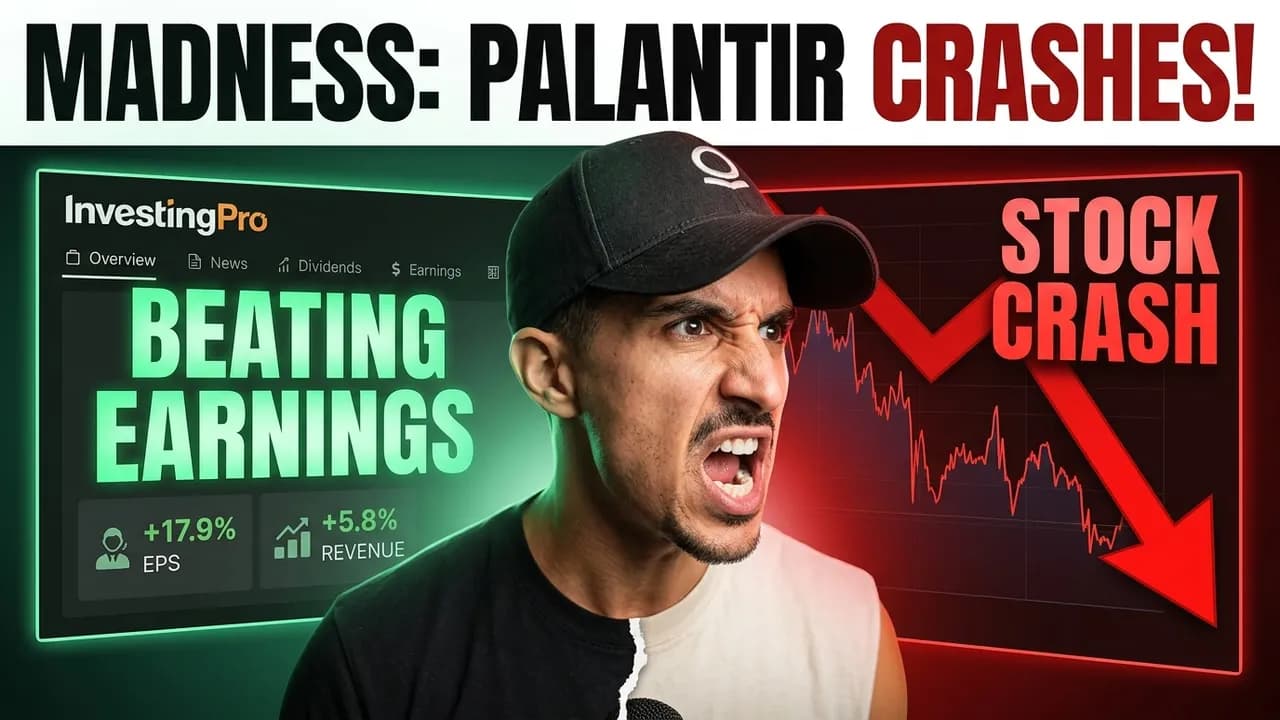
Q1 2026 marked Palantir's strongest quarter as a public company, with revenue surging 85% year-over-year to $1.6 billion and beating estimates. Despite this strong fundamental delivery, the company was not producing results commensurate with its valuation, trading at a significant premium.
Micron Technologies presents a contrasting case where despite 800% price appreciation over the past year, the stock trades at a 25 P/E ratio. Micron generates $90 billion in revenue and $50 billion in net income, demonstrating a company where fundamental growth has kept pace with or exceeded price growth. This differs fundamentally from Palantir's situation where price appreciation outpaced fundamental growth.
Intel is viewed as a hyped-up proxy of a semiconductor company benefiting from Trump administration support despite ongoing losses. SanDisk presents a similar setup, trading at elevated premiums while running on semiconductor sector hype rather than demonstrated fundamental strength.
Palantir's valuation reached 250 times earnings at peak, representing an extreme premium. Even after a 50% discount, the stock still trades at 118 times earnings. This premium pricing leaves no margin for error as investors have already priced in perfection.
When evaluating investments, focus should center on identifying risks rather than confirming bullish narratives. The bare case scenario highlights that despite significantly beating Q1 2026 earnings estimates, the stock fell 5.66% in after-hours trading due to investor concerns that current multiples (EV/EBITDA of 130 times and P/E ratio of 119 times trailing) already priced in perfection with no margin for error.
Fair value is estimated at $97 versus the current price of $112. The stock sits at a 52-week low while losing momentum and hype. Success in 2025-2026 markets often depended more on strong stories and price momentum than robust fundamentals, as evidenced by nuclear fusion energy companies that performed well in 2025 but declined sharply in 2026 despite lacking strong fundamentals.
Sustaining triple-digit US growth rates becomes mathematically more difficult as the revenue base scales toward $7.7 billion. The law of large numbers makes it increasingly challenging to maintain 50-80% year-over-year growth when moving from $1 billion to $7-8 billion in revenue. Intensifying competition from Microsoft, AWS, Google, and specialized AI firms may compress growth rates faster than markets anticipate.
51% of Palantir's revenue comes from government contracts, primarily US government sources. This government contract reliance introduces budget cycle risk. While geopolitical tensions currently serve as a tailwind, extended continuing resolutions or defense budget reallocations could disrupt the 84% year-over-year US government growth trajectory.
Current geopolitical issues including tensions in the Middle East may result in defense budget reallocations away from Palantir's typical funding sources. The expectation that Palantir would benefit from US-Iran conflicts did not materialize because government funds are being redirected to other priorities such as $100 million in humanitarian aid to Lebanon.
Palantir remains fundamentally overvalued at current levels. A price of $100 would warrant consideration, but there is no urgency to purchase. Investment would require price action showing signs of recovery and reversal, specifically higher highs and higher lows on the 4-hour timeframe, before taking a small long-term position.
The NASDAQ and S&P 500 remain near all-time highs while Palantir struggles significantly. If broader markets decline, speculative stocks like Palantir will fall harder and further. Current economic conditions include potentially one rate hike in 2026 that was not previously anticipated, rising inflation, and a weak labor market.
The US Pentagon delayed publicly announcing strikes on Iran until after the stock market closed at 4:00 PM Eastern time, potentially to reduce immediate market impact. Iran has indicated it may fully cancel talks with the US while the US considers sending humanitarian aid to Lebanon.
Palantir is viewed as a watch rather than a buy. The stock remains overvalued at 118 times earnings with significant downside potential. Direction and sentiment are bearish with overall market uncertainty stemming from geopolitical issues, high inflation, weak labor market conditions, and potential rate hikes. Investment consideration would only arise if price momentum and direction begin to change favorably.
Being a successful company does not justify being overvalued. The approach prioritizes finding deals rather than timing the market or overpaying for assets. Palantir represents a successful business generating revenue, but current valuation does not reflect a favorable risk-reward opportunity given bearish direction, bearish sentiment, and uncertain overall market conditions.
Keep Ricky Gutierrez in your library
Save the videos and channels worth coming back to, and find them again in one place.