The Risk Of NOT Investing Into SpaceX Stock At $115
In a Nutshell
Ricky argues that SpaceX at $115 offers asymmetric risk-reward for small position sizes, as a potential 100% recovery to prior highs outweighs the 100% loss risk when exposure is limited to amounts that can be comfortably lost. He warns against leverage or oversized bets, noting the company’s negative P/E, upcoming selling pressure from early investors, and speculative AI data-center dreams, but stresses that complete non-exposure means missing potential gains. The core takeaway: invest small amounts in high-conviction growth names like SpaceX during fear-driven dips, avoid leverage, and accept that some exposure beats none when the downside is capped by prudent sizing.
These notes were generated by AI and may contain inaccuracies.
Ricky from Tech Solutions discusses his personal approach to investing and trading in the stock market. He is a self-described huge Elon Musk fan who owns a Cybertruck, Model X, and has a Tesla Roadster on pre-order. Despite this fandom, he has not been a fan of Tesla recently due to fundamental performance issues rather than political reasons.
Ricky maintains a managed account for his children's investments (daughter aged 4, son aged 9 months) and has been investing for them only during market drawdowns. He began investing for his daughter in 2022 during a significant market downturn and continued during the Trump tariff war in the previous year. He emphasizes that his investment approach focuses on being invested rather than timing the market.
During a meeting with his financial advisor, the advisor brought up SpaceX and mentioned high price targets. Ricky had previously been vocal about not believing in or understanding SpaceX, but the advisor's suggestion planted a seed for further research. He views this encouragement to explore new investment opportunities as an important role of financial advisors.
Ricky stresses the importance of being able to carry informed conversations with financial advisors rather than blindly following their recommendations. He notes that many people have advisors but lack the knowledge to engage meaningfully in discussions about their investments.
Ricky emphasizes that investing is never guaranteed, using Nvidia as an example of a company that appears unstoppable but could potentially decline in 5-15 years. He strongly advises against using leverage, noting that even established companies like Nvidia could face challenges.
He highlights the importance of considering investment timelines, especially for children's accounts where the timeframe spans 14-18 years. This long-term perspective allows for companies that may not appear fully established currently to potentially grow significantly over 10-20 years.
SpaceX currently has a negative 162 P/E ratio, indicating the company is losing money. The company is valued at over a trillion dollars with approximately $19 billion in revenue and $8.6 billion in net income, though net income is expected to grow.
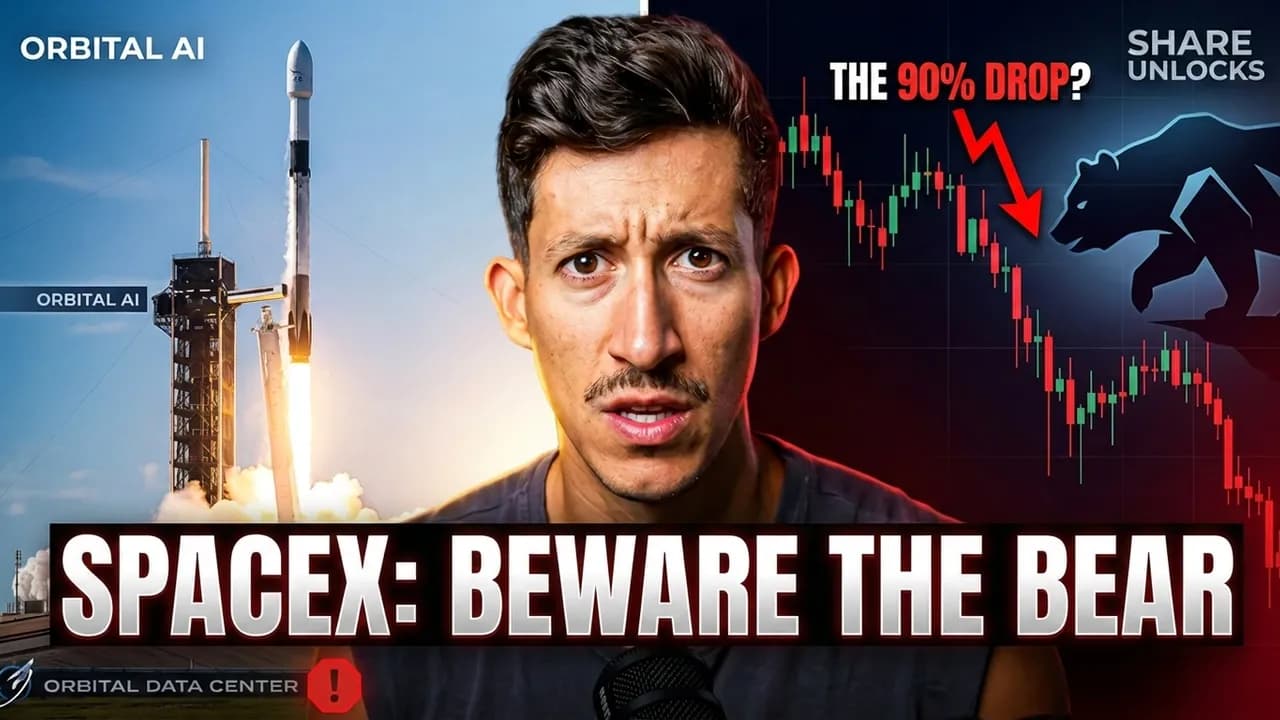
The stock reached all-time highs around 40 days ago at $230 per share but has since dropped nearly 50% to approximately $115 per share. This creates a potential 100% return scenario if it recovers to previous highs, or a 100% loss if it goes to zero.
Ricky draws parallels to United Healthcare's situation following the CEO killing incident and Medicare fraud investigation. The stock dropped to the $200-300 range amid negative sentiment and uncertainty. He notes that if it had gone to zero from those levels, investors would have lost everything, but if it recovered, they could have doubled or tripled their money. The company is now trading around $450 per share.
He references the investment principle of buying when people are fearful and selling when greedy, noting that the best investors often do nothing for long periods of time while holding their investments.
Analyst price targets for SpaceX range from $115 (HSBC) to $300 (Morgan Stanley), with the average around $236. Other targets include JP Morgan at $225, Bank of America at $235, and Goldman Sachs at $205. All targets are significantly above the current $115 trading price.
Current market conditions show overbought technical indicators on larger timeframes, with uncertainty regarding Middle East developments, oil prices, oil reserves, and potential Federal Reserve interest rate increases. Speculative stocks like SpaceX tend to crash harder during market downturns.
Ricky identifies two major investor mistakes: investing too much (including using leverage) and not investing at all. He emphasizes that investing too much can put investors in positions where they cannot tolerate the time needed for recovery, especially when facing margin calls or leverage pressure.
He notes that investing is never a straight upward trend and that the greatest investors often do nothing for long periods because they're not leveraged and can withstand downturns without stress-induced selling.
For his children's accounts, Ricky considers investing only small dollar amounts (a few hundred to a few thousand dollars) so that if SpaceX goes to zero, the loss is easily stomachable given gains in other equities. This approach allows for some exposure without overexposure.
He emphasizes that the risk-to-reward ratio favors having some exposure, as the upside potential multiple is significantly greater than the potential for loss when using appropriate position sizes.
Major SpaceX shareholders include:
- Elon Musk: 42%
- Founders/SEO company: 10.4%
- Fidelity: 10.2%
- Google: 7.4%
Google recently reported significant paper gains from their SpaceX investment, with approximately $98 billion of their $112-118 billion in reported gains coming from SpaceX holdings.
Several concerns exist regarding SpaceX investment:
- The company is currently down 50% from recent highs
- First batch of private investors haven't been able to sell yet, with potential selling pressure expected around August 11-12th when 25% may be allowed to sell
- Many private investors entered at $135-139 and may want to cut losses
- XAI (related to SpaceX) burns through more capital than it generates revenue
- Speculation about 10-30 trillion dollar market caps based on non-existent AI data centers in space
- No clear business plan for profitability visible for either XAI or SpaceX
SpaceX generates significant revenue from US government contracts. The data center concept, particularly working with Jensen Huang and Elon Musk on space-based AI data centers, remains highly speculative and far-fetched to Ricky.
Ricky references Mark Zuckerberg's comments on Meta's AI investments, where Zuckerberg stated that the risk of not investing enough and missing out on being one of the major players is greater than the risk of overinvesting. This philosophy suggests that being underinvested in transformative technologies carries higher long-term risk than potential overinvestment.
Ricky concludes that some exposure is better than no exposure, but overexposure is worse than no exposure. He emphasizes that nothing at all means no potential gain but also no loss, while overexposure carries high chances for loss.
He strongly warns against using leverage, citing examples from crypto markets and South Korea's leveraged semiconductor memory chip investors. The message is that using leverage will likely result in losing capital faster than simply investing without leverage and maintaining positions over time.
Ricky clarifies this video is not a promotion of SpaceX as a buy recommendation, and he remains vocal about the significant downside potential while acknowledging the asymmetric risk-reward opportunity for those with minimal, appropriate position sizing.
Keep Ricky Gutierrez in your library
Save the videos and channels worth coming back to, and find them again in one place.